Ed Schoenfeld, CoastAlaska

Terrifying visages: Native armor inspired fear in foes

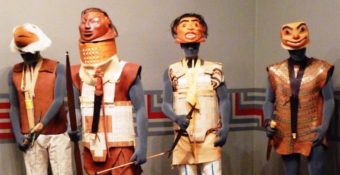
Four armed, armored figures display Tlingit war gear created by Sitka's Tommy Joseph as part of the Alaska State Museum's "Rainforest Warriors" exhibit. It's one of three Alaska shows tourists will see this season.
Four armed, armored figures display Tlingit war gear created by Sitka’s Tommy Joseph as part of the Alaska State Museum’s “Rainforest Warriors” exhibit April 29, 2013. Such helmets and armor were the topic of a Dec. 1, 2016, lecture by the Alaska State Museum’s Steve Hendrickson. (Photo by Ed Schoenfeld/CoastAlaska News)

Tlingit battle helmets were designed to inspire fear. The thick, wooden head armor carried imagery of strong warriors, fierce animals or revered ancestors.

But helmets also played a ceremonial role, representing clans or helping shamans scout behind enemy lines.

The Alaska State Museum's Steve Henrickson discusses Tlingit armor during a Dec. 1, 2016, lecture at the Walter Soboleff Building. To the left, Preston Singletary's house pole depicts an armored warrior. (Photo by Ed Schoenfeld/CoastAlaska News)
Steve Henrickson discusses Tlingit armor during a Dec. 1, 2016, lecture in Juneau. To the left, Preston Singletary’s house pole depicts an armored warrior. (Photo by Ed Schoenfeld/CoastAlaska News)

When Alexander Baranov led Russian fur traders into Southeast in the late 1700s, he met some fierce resistance.

The Alaska State Museum’s Steve Henrikson said Tlingit warriors appeared one night within their camp.

“He has a very vivid description of how terrified this made everybody seem because these big figures just materialized in the middle of their camp. Because of the layers of padding, they were all really big and tall. The helmet might add another 6 to 8 inches,” he said.

But they were exceptions. Henrikson, the museum’s collections curator, said most warriors did battle with little to protect them, beyond animal hides.

The carved, painted helmets, bentwood face shields and wooden body armor was just too bulky.

“The types of battles that they had often required lots of quick movements and if you’re wearing that armor, it’s fairly heavy and bulky and it restricts your movements. So it would only be employed in very strategic ways,” he said.

Henrikson presented images and information at a Dec. 1, 2016, Sealaska Heritage Institute lecture, Terrifying Visages:  Armored Warriors of the Northern Northwest Coast, at the Walter Soboleff Building in Juneau.

He showed examples of helmets adorned with sea lion whiskers and animal skins.

“Some helmets used the headskin of a bear, a brown bear stretched over a plain, wooden form,” he said.

Battle helmets were thick, made out of burls and other off-grain pieces of wood, which were harder to penetrate or crack.

Henrickson said the origins and ages of many are not known. But one whale design points to a possible origin.

“This one has a seal in its mouth and that may point to it being from the Killer Whale Chasing Seal House of Angoon,” he said.

Steve Henrikson gives a presentation Thursday, Dec.1, 2016, on wearable armor worn by northern Northwest Coast Natives at the Sealaska Heritage Institute in downtown Juneau.. Henrikson is Alaska State Museum's curator of collections. (Photo by Tripp J Crouse/KTOO)
Steve Henrikson has found nearly 100 battle helmets made by northern Northwest Coast Natives at the Sealaska Heritage Institute in downtown Juneau. (Photo by Tripp J Crouse/KTOO)

Henrikson and his fellow researchers have tracked down nearly 100 helmets in museums in the U.S. and overseas.

And sometimes they just show up at an auction. That was the case for one recent find, which appears to represent a merganser, a crested duck with a serrated beak found in Alaska waters.

“Again, no documentation. It was just found in a castle in France. But it’s purely Tlingit,” he said.

He said there’s no question Southeast’s Haidas and Tsimshians made armor too. But so far, most examples are Tlingit.

Armor was made of wood, animal hides or both, sometimes held together by sinew or yarn.

Henrickson said they were strengthened by other materials, including outdated Chinese coins brought in by Russian fur traders.

“They were able to get a good deal on them and they brought them out here and Northwest Coast Natives used them for decorating their regalia but also to maybe make the armor more impermeable to bullets and buckshot,” he said.

That only worked for a while. Early firearms were often weak and inaccurate. As guns gained strength, armor became no match.

But it still had ceremonial use, which continues to this day. And, a number of modern artists have created their own versions for display or use in dance groups.

Hear the full lecture Terrifying Visages: Armored Warriors of the Northern Northwest Coast, with Alaska State Museum Curator of Collections Steve Henrikson.

Steve Henrikson gives a presentation Thursday, Dec.1, 2016, on wearable armor worn by northern Northwest Coast Natives at the Sealaska Heritage Institute in downtown Juneau.. Henrikson is Alaska State Museum's curator of collections. (Photo by Tripp J Crouse/KTOO)
Steve Henrikson gives a presentation Dec.1, 2016, on wearable armor worn by northern Northwest Coast Natives at the Sealaska Heritage Institute in downtown Juneau. Henrikson is Alaska State Museum’s curator of collections. (Photo by Tripp J Crouse/KTOO)

Ferry changing payment system for Southeast route

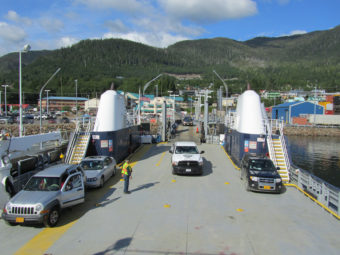
The ferry Lituya loads vehicles onto its car deck at the Ketchikan Ferry Terminal before sailing to Metlakatla. (Photo by Linda Hall/Alaska DOT&PF)

The Alaska Marine Highway System is changing the way passengers pay for sailings on one southern Southeast route.

Spokesman Jeremy Woodrow said the change impacts those riding the small ferry Lituya, which sails between Metlakatla and Ketchikan.

“You pay round trip when you’re going one direction and then it’s a free trip going the other direction,” he said. “This seemed like a good solution because, when you’re driving in the Lower 48 on toll bridges, it’s not uncommon to have a fee going one way and then (it’s) free in the other direction on toll bridges and actually toll roads as well.”

The Annette Island Ferry Terminal, which serves Metlakatla, is unstaffed, so travelers can’t buy tickets there.

Woodrow said the Lituya’s crew is too small to handle sales.

The system tried to find a contract vendor in Metlakatla without success, he said. That left few options.

“While they can still do it online, many of the customers who travel from Metlakatla to Ketchikan use cash primarily as their main way of purchasing tickets,” he said. “So they can’t actually purchase their tickets until they get to Ketchikan where they can go into the terminal.”

The 180-foot-long Lituya is the ferry system’s only one-route ship. It sails five days a week. The annual passenger count is about 30,000 a year, about 15,000 each way.

Woodrow said the new ticket policy will probably go into effect in January.

Metlakatla has about 1,500 residents.

What’s officially called the Metlakatla Indian Community is the region’s largest Tsimshian city.

Ferry officials are still looking for a solution to a similar problem affecting Angoon and some other small port communities.

Those towns also don’t have staffed terminals. And sailings head to multiple ports, so the Metlakatla solution won’t work.

Woodrow said ferries serving those communities have enough staff to take tickets. But problems remain for those without computer access.

“So the purser will meet them at the top of the vehicle ramp, take their names if they don’t have a ticket already, and then make sure to find them on that route,” he said. “Obviously, we would prefer to have people paying in advance.”

He said the ferry system is looking into installing ticket kiosks in some communities.

Modern ‘warriors’ protect language, water, subsistence, families

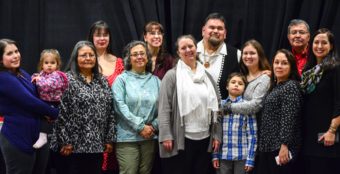
Alfie Price poses with his family and friends after he was honored as a language warrior during a Nov. 22, 2016, awards ceremony. (Photo courtesy Central Council of Tlingit and Haida Indian Tribes of Alaska)
Alfie Price, sixth from the right, poses with family and friends after he was honored as a language warrior during a Nov. 22, 2016, awards ceremony. (Photo courtesy Central Council of Tlingit and Haida Indian Tribes of Alaska)

What makes a modern warrior?

According to Southeast Alaska’s largest tribal organization, it’s someone who fights to preserve subsistence rights or Native languages. And it’s those who work for clean water or care for other people’s children.

Four people or families were named as modern warriors by the Central Council of Tlingit and Haida Indian Tribes of Alaska during a Nov. 22  Native American Heritage Month Celebration in Juneau.

Organizers said those recognized represented many other tribal citizens who also go above and beyond to advocate, protest and protect.

Alfie Price co-leads a Tsimshian language practice group in Juneau. He’s also learning the Tlingit and Haida languages.

But when he accepted an award naming him a Warrior for Protecting our Languages, he spoke in Eyak, a Prince William Sound Native language that’s considered extinct.

“I just wanted this room full of people to hear a few words of Eyak tonight,” he said.

Miciana Hutcherson speaks after being named Warrior for Protecting Our Sacred Lands and Waters at a recent ceremony. (Photo courtesy CCTHITA)

Price, who also is Tlingit, talked about the process of learning the language of his Tsimshian ancestors.

“An unexpected side effect of learning Sm’algyax especially is I feel my own healing,” he said. “The hurts and the things that made me bitter in my life are falling away. They’re becoming light on my shoulders.”

At the ceremony, Miciana Hutcherson was named Warrior for Protecting Our Sacred Lands and Waters.

Hutcherson is an activist who joined the Standing Rock Sioux protesting construction of the Dakota Access Pipeline. She said the campaign’s motto, “Water is Life,” is also important in her Tlingit homeland.

That includes protecting transboundary rivers from industrial development on the Canadian side of the border.

“We’re standing up for our inherent rights in a way that we’ve never seen before,” she said. “We’re giving our kids and future generations something to be proud of and ensuring that we’ll leave something behind tangible for them to hold onto and that’s each other.”

Also honored was Harold Martin, who was named Warrior for Protecting Our Traditional Harvesting Rights.

The longtime central council subsistence director led numerous efforts to continue or preserve traditional harvests of seals, otters and other marine life.

Martin, a former logger, stressed the importance of secondary schooling.

Harold Martin was named Warrior for Protecting Our Traditional Harvesting Rights. (Photo courtesy CCTHITA)

“Education opens all kinds of doors. It’s never too late to go back to school,” he said. “I was 40 years old when we decided to go back to school in 1974. And I was able to go to work and still retire.”

Veronica and Mike Hoyle were named Warriors for Caring for Our Children.

Surrounded by his large family, Mike Hoyle talked about fostering kids and taking responsibility to raise them.

“We never had any thoughts of adopting,” he said. “We just wanted to do the right thing, when people need a place to sleep. You just look out for your family.”


Watch the celebration program, which begins about 48 minutes into the video:

Feds OK selling or scrapping ferry Taku

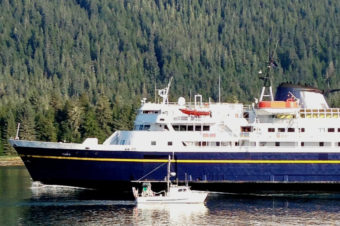
A Petersburg fishing boat passes the ferry Taku near the entrance of Wrangell Narrows in August, 2013. (Ed Schoenfeld/CoastAlaska News)
A Petersburg fishing boat passes the ferry Taku near the entrance of Wrangell Narrows in August, 2013. The ship is tied up and will continue to be until it’s sold or scrapped. (Photo by Ed Schoenfeld/CoastAlaska News)

The Alaska Marine Highway System is moving ahead with plans to sell or scrap the ferry Taku. But it’s keeping its options open for a second sidelined ship, the Chenega. The vessels were discussed at Monday’s Marine Transportation Advisory Board meeting.
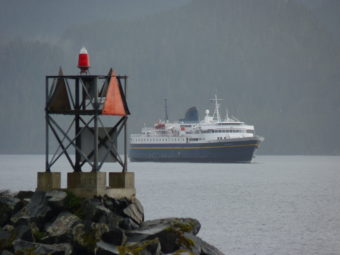
The Taku has been tied up for more than a year, with no plans for its return.

But the state can’t just put the 350-passenger ship on Craigslist or eBay — or run ads in newspapers or trade publications. It has to jump through some administrative hoops.

Ferry chief Mike Neussl said one “hoop” is permission from the Federal Highway Administration, a major funding source.

“We’re received that, just recently, and are now working with the Department of Law on the actual procedures necessary to declare that vessel excess and dispose of it through the proper channels, either by sale or scrapping the vessel,” he said.

The state used the online auction site eBay to sell the 230-passenger ferry Bartlett in 2003.

The price was just under $400,000.

Officials at the time said it would cost $5 million to $6 million to bring it into compliance with new safety regulations.

The Taku has been appraised for sale as a working vessel and for scrap metal. Officials aren’t releasing those figures.

The fast ferry Chenega pulls into the Whittier terminal in September, 2011. It's been sidelined indefinitely. (Photo by Ed Schoenfeld/CoastAlaska News)
The fast ferry Chenega pulls into the Whittier terminal in September, 2011. It’s been sidelined indefinitely. (Photo by Ed Schoenfeld/CoastAlaska News)

The state is taking a different approach to a second sidelined vessel, the fast ferry Chenega, which tied up this fall.

Neussl says its future hasn’t been determined. But it will cost more than $1 million to bring it back to service.

“As every day goes by, additional licenses and certificates expire that will need to be updated as part of the process of bringing it back online,” he said.

He says the ship needs an overhaul and the water jets that power it need work.

Ferry General Manager Capt. John Falvey says top fast-ferry staffers also need special certifications.

“When you get a boat laid up like that, a lot of these officers and the mates and engineers, they’re gravitate to other ships. They’re going to lose those certifications,” he said.

Neussl says the state budget cuts led to a schedule that doesn’t require all of the system’s 11 ferries.

“One of the ways to reduce operating costs and not impact greatly the level of service provided is to reduce the size of the fleet,” he said.

The marine highway is spending about a half-million dollars a year tying up the two ships.

The 11-year-old Chenega is being stored in a Tacoma, Wash., shipyard. It was taken out of service because it requires more fuel, making it more expensive to run than most other ships.

It’s sister ship, the Fairweather, is still in use, but doesn’t operate as often as it used to.

The 53-year-old Taku is docked in Ketchikan’s Ward Cove. It was removed from service because of its age and it doesn’t fit into the highway’s long-term plans.

Ferry study recommends management changes

The ferry Malaspina makes a rare appearance near downtown Sitka in 2010. A new report suggests a public corporation be formed to manage ferry operations. (Photo by Ed Schoenfeld/CoastAlaska News)

The Alaska Marine Highway System should break into two agencies to prepare for the future.

That’s the conclusion of a new ferry governance study released by the Southeast Conference, a regional development organization. The study examined ferry operations in Alaska and elsewhere.

Report author John Waterhouse said scheduling, pricing and similar management areas would be handled by a public corporation owned by the state.

“Give the folks operating the ferries the flexibility and tools to evaluate their routes and revenues and to really do what they need to do in terms of making the system as efficient and provide as much benefit as is financially possible to the core user groups,” he said.

Waterhouse, of Seattle-based Elliott Bay Design Group, produced the draft report with Juneau-based research firm McDowell Group. He presented it at Monday’s Marine Transportation Advisory Committee.

Dennis Watson is general manager of the Inter-Island Ferry Authority, as well as mayor of the city of Craig. (Photo by Ed Schoenfeld/CoastAlaska News)
Dennis Watson chairs the steering committee looking into ferry governance changes. (Photo by Ed Schoenfeld/CoastAlaska News)

Craig Mayor Dennis Watson heads up the committee overseeing the governance study, which began last summer.

He said marine highway assets would remain the property of a state agency.

“The state maintaining ownership and control of the vessels and terminals and what-not allows them to be able to get federal funding to be able to do maintenance and capital improvements on them,” he said.

The study recommends several interim changes.

The changes include include forward-funding the system and giving the marine highway control over labor negotiations.

Those could be difficult to get through the Legislature.

Watson, who manages a small ferry system in southern Southeast, calls the plan a starting point.

“If you create a mechanism that allows you to do a little bit more long-term planning and some of the things … the marine highway has a hard time doing, I think that everybody believes that would be of benefit,” he said.

Marine highway officials said they support the study and any efforts to improve the system.

Report author Waterhouse said the next step will be to develop a business plan.

The ferry governance steering committee meets Tuesday, Nov. 22, to review the report via teleconference.

Ferry system plans more fare hikes

Extra ferry life rings lean against other spare parts at the Ketchikan Marine Engineering Facility at Ward Cove last January. (Photo by Ed Schoenfeld/CoastAlaska News)
Spare life rings lean against other parts at the Alaska Marine Highway System in Ketchikan in 2014. The ferry system just released its summer 2017 schedule, which includes fare hikes. (Photo by Ed Schoenfeld/CoastAlaska News)

The Alaska Marine Highway System plans its next round of fare increases to start May 1. That’s when the new summer schedule begins.

Spokesman Jeremy Woodrow said it’s the second year of a five-year effort to equalize ticket prices.

“What we’re trying to do is bring similar distance fares into a similar price across the entire system. So you’re getting what you pay for no matter where you are in the system,” he said.

Most fares are being raised only a few dollars, as shown on the AMHS reservations website. A few are dropping. Some examples, based on rates for one adult passenger:

  • Juneau-to-Ketchikan will be $4 more (from $122 to $126).
  • Kodiak-Homer is up $2 (from $83 to $85).
  • Bellingham, Washington-to-Skagway, one of the longer routes, will increase $13 (from $451 to $464).
  • Cordova-Whittier will cost $3 less (from $84 to $81).

The new May-to-September schedule was released Wednesday.

Sailings are actually up for the busier months, June through August. But Woodrow said they’re down for the next full budget year, which begins in July.

“Where we’ve been able to reduce the frequency of sailings has been more in the shoulder season. Late April, early May and then late September [is] where we’ve kind of reduced just a week here or there for each ship,” he said.

He said the summer schedule was developed around the governor’s proposed budget. It calls for a 5 percent cut in unrestricted general fund spending.

The Legislature could further reduce the marine highway budget. Woodrow said any such cuts would come out of next fall, winter and spring’s schedules.

Site notifications
Update notification options
Subscribe to notifications