Ed Schoenfeld, CoastAlaska

Coastal lawmakers consider ferry system’s future

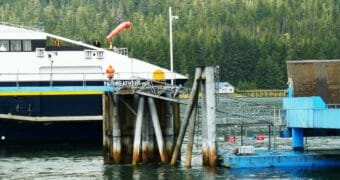
The fast ferry Fairweather docks in Petersburg Aug. 20, 2013, after a trip from Juneau. Budget cuts eliminated that route. (Photo by Ed Schoenfeld/CoastAlaska News)
The fast ferry Fairweather docks in Petersburg Aug. 20, 2013, after a trip from Juneau. Budget cuts eliminated that route and reduced Fairweather sailings. (Photo by Ed Schoenfeld/CoastAlaska News)

The Alaska Marine Highway has seen deep funding and service cuts as the state deals with a massive budget deficit.

With the money running low, what are the system’s prospects during this year’s legislative session?

Coastal lawmakers have heard from lots of constituents about fewer ferry sailings.

One is Ketchikan Rep. Dan Ortiz, an independent whose district’s link to the mainland is a stop or two south.

“We used to be able to have a choice of maybe three trips at least down to Prince Rupert during a week,” he said. “Now it’s been reduced to once a week and even in the worst times of service, once a month. That’s crazy.”

The same is true for Sitka Rep. Jonathan Kreiss-Tomkins, a Democrat whose district includes Petersburg and other island communities.

Once-frequent service has dropped to a trickle, he said.

“That impedes Alaskans trying to live their lives, not mention commerce in a pretty significant way,” he said.

The region’s lawmakers said it’s about more than declining revenue.

Recent House and Senate majorities have largely marginalized the voice of ferry port towns.

A sign along Juneau's Glacier Highway points to the Auke Bay Ferry Terminal (Photo by Ed Schoenfeld/CoastAlaska News)
A sign along Juneau’s Glacier Highway points to the Auke Bay Ferry Terminal (Photo by Ed Schoenfeld/CoastAlaska News)

Sitka Sen. Bert Stedman, a Republican who represents the region south of Juneau, points to disproportionately large cuts to the ferry system, compared with other Department of Transportation programs.

“And I’m hoping with the new legislative makeup that we’ll be able to stabilize that and get some parity amongst the rest of DOT,” he said.

He’s referring to the new bipartisan House majority, which put all of Southeast’s representatives in leadership positions.

Gov. Bill Walker’s budget proposal for the next fiscal year cuts marine highway spending by about 2 percent. That’s far less than in recent years. But it’s still enough to eliminate about 180 jobs, most onboard two now-unstaffed ferries in long-term storage.

“The problem is we can’t cut any more. We just can’t,” said Juneau Sen. Dennis Egan, a Democrat whose district covers northern Southeast.

He’s among lawmakers hoping to block those cuts.

Some hope to add a little funding, though others say increased efficiency is the key.

Beyond the budget, the ferry system faces possible management changes stemming from this year’s session.

They’re tied to a study recommending the marine highway be run by a public corporation overseen by a stakeholders’ board. Ship, terminal and other assets would remain the state transportation department’s property.

Gov. Bill Walker signs a memorandum of understanding with the Southeast Conference as its President, Gary White, Lt. Gov. Byron Mallott and Transportation Commissioner Marc Luiken watch Thursday at the Auke Bay Ferry Terminal. (Photo by Ed Schoenfeld/ CoastAlaska News)
Gov. Bill Walker signs a memorandum of understanding to reconsider ferry management with the Southeast Conference, as its President, Gary White, and others watch May 19, 2016. (Photo by Ed Schoenfeld/ CoastAlaska News)

Juneau Rep. Sam Kito III, a Democrat whose district includes Haines, Skagway and a few smaller communities, said independent management could make the system more flexible and responsive.

“They can tell us this is what the marine highkway system will look like in five years, this is what our goals are for improving cost recovery, for decreasing costs, and I think they can do that very well within the public corporation framework,” he said.

It’s a bad idea, Stedman said, at least for now. He worries lawmakers could use it as an excuse to cut funding.

“Where’s the revenue? If the state’s subsidizing the marine highway $60 million, $70 million, $80 million a year, where’s that revenue stream and how stable is it?” he said. “Once that question’s answered, we can have more dialog on how we’re going to operate it.”

Whether it’s governance or money, the region’s legislators want the result to be a more predictable marine highway.

Justin Parish, a Democrat who represents Juneau’s Mendenhall Valley, puts it this way.

“People are depending on the service for medical transportation, for school transportation and to make trips to buy necessities,” he said. “I don’t think that there’s a sufficient degree of consistency and reliability right now.”

We won’t know whether any of this will happen until lawmakers pass a budget, and possibly other legislation.

Alaska Pioneer Homes escape state budget cuts, for now

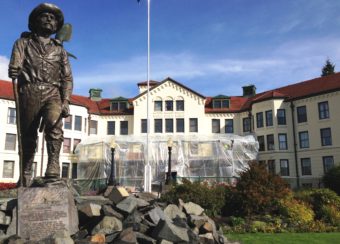
"The Prospector" statue stands in front of the Sitka Pioneers Home entrance, which was under repair Sept. 20, 2016. The homes reduced admissions as budgets were cut. (Photo by Ed Schoenfeld/CoastAlaska News)
“The Prospector” statue stands in front of the Sitka Pioneers Home entrance, which was under repair Sept. 20, 2016. The homes reduced admissions as budgets were cut. (Photo by Ed Schoenfeld/CoastAlaska News)

When the Alaska Legislature convenes later this month, it will consider a budget that makes no further cuts to Alaska’s Pioneer Homes. Final decisions are months away.

But Gov. Bill Walker’s spending plan would help level the senior-care program’s funding after several years of reductions.

Juneau Sen. Dennis Egan’s heard a lot from his constituents about cutbacks at Alaska Pioneer Homes. And he understands their importance, from personal experience.

“My mother was a tenant for over five years. And I know the good that Pioneer Homes do,” he said.

His mom, former Alaska First Lady Neva Egan, was a lot like many in the six homes, in Southeast and the Railbelt.

“She had dementia and she was always very confused. And the folks here at the Juneau Pioneer Home facility were just incredible folks,” he said.

Juneau Sen. Dennis Egan addresses a conference in 2014 in Juneau. (Photo by Ed Schoenfeld/CoastAlaska News)

Egan, a Democrat representing about half of Southeast, is happy to see the governor plans no more cuts.

Walker’s operating plan calls for spending about $51 million in state money during the fiscal year beginning in July. That’s a slight increase over the current budget year, which itself was a small boost from the previous one.

Pioneer Homes Division Director Vickie Wilson said they lost capacity because of  budget reductions.

“No program wanted to be cut, but we all felt that we were doing our share. But it did result in having a lower number of beds available that we could provide care in,” she said.

Learn about assisted living at Alaska Pioneer Homes.

One way to look at it is the total number of residents. That dropped close to 10 percent over most of the past three years, ending in the fall.

Another way is how quickly beds are filled when residents die or move.

In the 2015 fiscal year, about 97 percent had new occupants. But the following year, it was only about 83 percent.

Wilson said that’s because Pioneer Homes spend about 80 percent of their budget on staff who tend to residents’ medical needs and provide them with meals and other essentials.

“Many positions, we had no funding for. So we’ve lost many of our staff through the cuts that we had,” she said.

Staff losses, many through attrition, have slowed admissions at the homes, in Ketchikan, Sitka, Juneau, Anchorage, Palmer and Fairbanks.

The active waiting list, for those ready to enter any of the facilities, is more than 650. An inactive, placeholder list is eight times as long. Wilson estimates about three-quarters of those on the active list need the highest level of care, which requires more staff.

Learn about life at the Sitka Pioneer Home.

She said open positions are being filled, just not as fast as they used to.

“They are being held longer. But that could be a month to six weeks,” she said. “Not turning around and hiring tomorrow. And it allows us to be able to manage.”

There’s no guarantee the governor’s Pioneer Homes budget will remain untouched as it works its way through the Legislature.

Sen. Egan said he’ll be among those pushing for the funding.

“I hope the heck it does. I hope it makes it,” he said.

And has Egan signed up and added his name to the waiting list?

“Oh, absolutely. I signed up on my 65th birthday,” he said, admitting his wife, Linda, took care of the paperwork. He added he hopes he doesn’t need go to into a home.

Bill would cut ferry costs, reinstate discharge rules

Extra ferry life rings lean against other spare parts at the Ketchikan Marine Engineering Facility at Ward Cove. (Photo by Ed Schoenfeld/CoastAlaska News)

A Southeast lawmaker introduced a bill this week to help Alaska Marine Highway ferries meet state pollution-control rules. It would also exempt new ships from a law requiring a percent of construction spending go toward art.
Senate Bill 3 is one of about 50 pieces of legislation prefiled by Alaska lawmakers Jan. 9.

Technically, most ferries and small cruise ships operating in Alaska are out of compliance with state water-discharge rules.

That’s because regulations exempting them from more-stringent rules designed for much-larger cruise ships ran out a little more than a year ago.

Michelle Hale, department of Environmental Conservation Division of Water, said it took the agency a while to figure that out. So it’s not fining ferries or other small ships.

Instead, she said the division is seeking a legislative solution through a bill introduced before the session starts.

“It will reinstate that language that will then provide for ferries and small cruise ships to use a different method of treatment than is required of the large cruise ships,” she said.

Hale said that method, which has been in place for several years, requires far less equipment and staffing.

“So the Best Management Practices Plan requires them to collect samples and run their treatment systems at an optimal level. But they’re not required to meet the more stringent limits of the large cruise ships,” she said.

She said the requirements apply to ships carrying from 50 to 249 passengers. That’s counted by the number of beds, not including upper bunks, cots or fold-outs. So, while some ferries carry more people, the bed counts are within the limits.

Officials said without the pollution-control exemption, costs will increase.

“We’re having trouble with the marine highway as it is, with capital expenditures,” said state Sen. Bert Stedman, R-Sitka, who introduced Senate Bill 3, which would reinstate the small-ship exemption.

“I would imagine it’s going to be lightning-bolt subject matter when we get it in the system,” he said. “I’d like to keep it focused down on trying to keep our smaller fleet going, particularly the marine highway.”

Another provision of Stedman’s bill would exempt three new ferries from the state’s Percent-for-Art Program. That uses part of construction costs to purchase paintings, sculpture and other creative works for display on marine highway vessels.

Ferry spokesman Jeremy Woodrow said that provision would reduce the cost of two new Southeast shuttle ships and a replacement for the Tustumena.

“The department does support SB 3, which would allow the department to use existing artwork that has been taken off the Taku, which is in permanent layup status,” he said. “We have also removed art from the Chenega which is in long-term layup status.”

That concerns state Rep. Sam Kito III, D-Juneau, whose district includes three other ferry port cities.

“The arts community is a very active and economic contributor to our Southeast community,” he said. “I would like to see Southeast artists to be able to provide art for our public facilities, including the marine highway system.”

Stedman said the idea came from discussions with state officials.

He said the bill is a rough draft. Like all legislation, it will undergo changes if it gains traction and advances through the Legislature.

British Columbia will clean up mine near Juneau

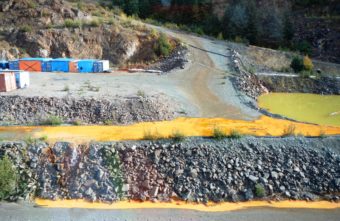
A Tulsequah Chief Mine settling pond overflows at the site about 40 miles northeast of Juneau Sept. 26, 2016. (Photo Courtesy of British Columbia Ministry of Energy and Mines)
A Tulsequah Chief Mine settling pond overflows at the site about 40 miles northeast of Juneau Sept. 26, 2016. (Photo courtesy of British Columbia Ministry of Energy and Mines)

Canadian officials say they’ll stop polluted mine water from entering a salmon-rich river that flows into Southeast Alaska near Juneau. The work could include plugging up tunnels from British Columbia’s decades-old Tulsequah Chief Mine.

The Tulsequah Chief hasn’t operated since 1957. Two companies tried to reopen it during the past 20 years, but both failed.

That’s left a legacy of acidic water carrying pollutants into the Tulsequah River. It’s a tributary of the Taku River, a key source of salmon caught in Southeast Alaska.

Provincial officials had ordered the latest developer, Chieftain Metals, to clean up the site. After the company went bankrupt last fall, British Columbia sent inspectors to see what had been done. But it wasn’t much.

British Columbia Ministry of Energy and Mines Minister Bill Bennett said a government contractor took care of improperly stored chemicals and petroleum products.

“They were not able before freeze-up to do anything about the settling pond that exists beside the river that captures the runoff from the hill that the old mine was built into,” he said.

A Tulsequah Chief Mine settling pond overflows at the site about 40 miles northeast of Juneau Sept. 26, 2016. (Photo Courtesy of British Columbia Ministry of Energy and Mines)

He said experts will look into plugging leaking mine tunnels to stop the discharges into the pond, which leaks into the river.

If that’s not practical, he said they’ll look at other options.

“Even though the water that’s been tested by both Alaska and British Columbia has shown no negative impacts on aquatic organisms, it’s still against our rules for that water to be flowing into the Tulsequah River. So, one way or the other, we have to stop it,” he said.

“I think there is actually some good news here and a change from past practices,” said Chris Zimmer, Alaska campaign director for the group Rivers Without Borders.

He said the studies Bennett mentioned were faulty and inconclusive. And he’s been calling for a cleanup for years.

“In the past, B.C. was simply saying we’re going to let the mining companies come in, develop the mine and clean it up. I think now Minister Bennett realizes that after two bankruptcies that this mine isn’t one that will be developed and B.C.’s now going to have to responsibility for the cleanup,” he said.

B.C. acknowledges a new company could take over the Tulsequah Chief. It’s in the hands of a Canadian firm that would like to recoup some of its investments. It could do that by selling the mine.

But Bennett said such a developer would have to meet tighter standards.

“We would need an ironclad commitment from any new buyer that they were going to do what’s necessary immediately. And if we can’t get that, then the government would act on the closure and remediation plan and just simply close the site down,” he said.

That’s what transboundary mine activists, including Zimmer, want. But he said it’s not as easy as it sounds.

“Plugging up the mine to stop the movement of water is one thing. You could do that relatively cheaply and quickly. But the problem is eventually you’ll have cracks, water will start moving and you’ll be back to the acid-mine drainage situation where you would need a water-treatment plant,” he said.

And that would be costly.

Chieftain did set up such a plant for a while, but determined it was too expensive to run without the mine opening and generating income.

Southeast’s top 2016 stories: Ferries, elections, forests, rivers

The new bipartisan House majority caucus. The leaders, seated left to right, include Majority Leader Chris Tuck, Rules Chairwoman Gabrielle LeDoux, Speaker Bryce Edgmon, and Finance Co-Chairman Paul Seaton. Nov. 9, 2016. (Photo by Andrew Kitchenman/KTOO/APRN)
The new bipartisan House majority caucus holds a press conference after forming in November. Southeast members are Juneau’s Sam Kito III, far left, Juneau’s Justin Parish, third from left, Sitka’s Jonathan Kreiss-Tomkins, center, and Ketchikan’s Dan Ortiz, second from right. (Photo by Andrew Kitchenman/KTOO/APRN)

The legislature, transboundary mining, timber harvest plans and a shrinking ferry system are among Southeast Alaska’s top stories of 2016.

November legislative elections significantly improved the region’s standing in the House.

Democrat Justin Parish narrowly beat incumbent Republican Cathy Muñoz in Juneau’s Mendenhall Valley district. That contributed to a statewide shift that put Democrats and their allies in charge of the House for the next two years.

Parish was among those promising to protect regional interests.

“From my seat there … I’ll able to quash any possible thought of a capital move,” he said.

He and Southeast’s three other representatives will all have majority leadership positions once they’re sworn in in January. Only one Southeast representative was in the majority during the past session.

The Taku loads in Sitka Sunday morning before sailing to Hoonah and Juneau. It was then tied up for repairs. Photo by Ed Schoenfeld.
The ferry Taku loads in Sitka in 2012. Now, it’s tied up and waiting to be sold or scrapped. (Photo by Ed Schoenfeld/CoastAlaska News)

Driving on or off an Alaska Marine Highway ferry became harder in 2016, as budget cuts shrunk the number of sailings and two ships went into long-term storage.

The 11-year-old fast ferry Chenega was tied up in Tacoma with an uncertain future. And the 50-year-old Taku was docked in Ketchikan with the intent of being scrapped or sold.

Exploration companies in 2016 continued drilling to expand ore bodies at potential mine sites near the British Columbia-Alaska border.

And critics in Southeast kept pushing for restrictions on mines in transboundary watersheds that drain into the state.

That led state and provincial officials to sign a statement of cooperation in October promising more openness and increased environmental monitoring.

The Tongass National Forest makes up most of Southeast Alaska (Courtesy U.S. Forest Service)

Critics – and the state — said it was not enough and will continue pushing for a binding federal agreement.

Also in 2016, the U.S. Forest Service finalized long-debated plans to move Tongass timber harvests from old-growth to younger trees.

The industry said the plan, announced in December, would make future timber sales uneconomical. Environmental critics said the transition was too slow and didn’t protect enough fisheries and wildlife habitat.

In other news, Southeast Alaska’s regional Native corporation rejoined the fishing industry in May by investing in Independent Packers Corp., a Seattle processing plant.

Prince of Wales deer season extended, wolf season ended

A Sitka black tailed deer in June 2014.
A proposed delay in the start of “doe season” is meant to protect fawns — but may not make sense biologically. (Creative Commons photo by Kenneth Cole Schneider)

Subsistence hunters seeking deer on Southeast Alaska’s Prince of Wales Island will have an extra month to hunt. But the island’s wolf season has been shortened.

Game Unit 2The Federal Subsistence Board extended the deer season through January in what’s called Game Management Unit 2. The season usually runs through December.

The later date only covers federally qualified subsistence hunters and only applies on federal lands.

U.S. Forest Service subsistence biologist Jeff Reeves said the season ends Dec. 31 for other hunters.

“This extension is new for Unit 2. But there are similar provisions that have existed up in Unit 4, which is the Sitka (and) the Admiralty-Baranof-Chichagof-Island areas,” he said. “The typical norm, though, is most deer seasons don’t run beyond the calendar year.The extended season does not raise the bag limit. Subsistence hunters continue to be allowed to take up to five deer and only one can be a doe.”

The Southeast Alaska Subsistence Regional Advisory Council recommended the extension after hearing from hunters. Reeves said it was later approved by the full subsistence board.

“One of their justifications for going ahead was that at that time the deer population seems to be healthy. The series of mild winters had been really good to the deer and that the deer harvest data is reflecting that deer populations seem to be good,” he said.

He said harvest tickets from this season will carry over into January. But hunters will need a new, 2017 license.

Another change was recently announced for the Prince of Wales Island game unit.

The Alaska Department of Fish and Game closed the area to wolf hunting and trapping starting Dec. 21.

Wildlife Conservation Regional Supervisor Ryan Scott said as of mid-December, Game Management Unit 2’s seasonal limit of 11 had nearly been taken.

“We had 10 wolves submitted for sealing, or check-in, which suggests we’re going to hit our quota very soon and we wanted to get the season closed and hopefully stay within the quota or at least not go over by too much,” he said.

The season usually runs December through March.

Scott said it also ended early last year due to concerns about a declining population. He said it seems to be recovering.

“We wanted to take it easy. We wanted to be careful with the population. However, all indications are right now that we are seeing an uptick in wolf numbers and that’s exactly what was anticipated,” he said.

He said the most recent population estimate for the island was 108.

Wolf hunting on Prince of Wales has been opposed by conservation groups.

A recent Audubon Alaska report said logging, hunting and road-building caused a 75 percent population decline over the past 20 years.

Wolf hunting and trapping has also been closed on Douglas Island, which is part of Juneau. Fish and Game said the allowable three wolves were taken. The closure was announced Dec. 21.

Site notifications
Update notification options
Subscribe to notifications