Ed Schoenfeld, CoastAlaska

Update: More money for the Alaska Marine Highway

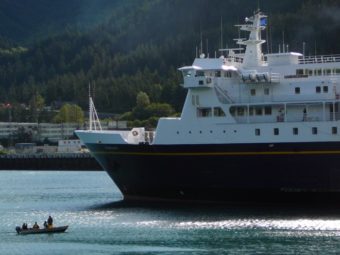
The fast ferry Fairweather docks in Petersburg Aug. 20, 2013, after a trip from Juneau. Budget cuts eliminated that route. (Photo by Ed Schoenfeld/CoastAlaska News)
The fast ferry Fairweather docks in Petersburg on Aug. 20, 2013, after a trip from Juneau. Budget cuts eliminated that route and reduced sailings to and from other communities. (Photo by Ed Schoenfeld/CoastAlaska News)

State House budget writers have restored much of the ferry system cut proposed by the governor for the next fiscal year.

The House Finance Committee on Thursday added about $2.1 million to the Alaska Marine Highway budget. Gov. Bill Walker’s spending plan, released in December, included $2.8 million – or 2 percent – less than this year’s budget.

Marine highway officials did not request the extra money. Spokeswoman Meadow Bailey said if it makes it through the budget process, the system will add a little more than seven weeks of sailings.

“That service would likely be added in May and June of 2018. And that would be to the vessel Fairweather and it would add three port calls per week to Lynn Canal and one additional run per week between Sitka and Juneau,” she said.

The Fairweather is a fast ferry that carries a little more than 200 passengers. It can hold about 30 cars and trucks.

Ketchikan independent Rep. Dan Ortiz proposed the funding increase.

“Mainly it came out of the numerous comments that I received that talked about real issues that have developed because of the overall reduction in service that the marine highway system has had to adapt to due to their reduced funding,” he said.

One hotel owner told him Ortiz cuts cost him $100,000 in business, the lawmaker said. Others told him reduced ferry service makes travel more expensive, including trips for food or medical care.

House District 36 Rep. Dan Ortiz addresses thea Ketchikan Chamber of Commerce in 2014. (Photo by KRBD)
House District 36 Rep. Dan Ortiz addresses the Ketchikan Chamber of Commerce in 2014. (Photo by KRBD)

Ortiz said marine highway reductions have totaled about 13 percent over two years. He said the rest of the Transportation Department has been cut far less and he wants to reduce the difference.

“While it certainly doesn’t equate to complete equity, it puts the whole equity picture a little bit closer to parity between coastal Alaska and the money we spend on roads and airports and things like that,” he said.

Ortiz did not suggest how the extra money would be used.

He proposed the extra money in an amendment to House Bill 57, the chamber’s version of the operating budget for the fiscal year starting in July.

It will have to make it through a House floor vote and the Senate to become official.

The governor could also veto the increase, as he has some other extra money in the Legislature’s budget.

Editor’s note: This report was updated to include details of how the extra money would be used.

Low salmon projections cancel popular Southeast spring king derby

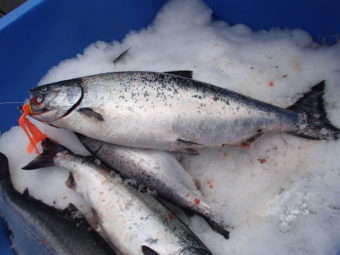
Last year's Spring King Salmon Derby in Juneau ran for all of May. This year's was cancelled due to poor salmon returns. (Image courtesy Spring King Salmon Derby)
Last year’s Spring King Salmon Derby in Juneau ran for all of May. This year’s was canceled because of projected poor salmon returns. (Image courtesy Spring King Salmon Derby)

A popular Southeast spring fishing derby won’t happen this year, because there aren’t enough fish.

David Turner Jr. won 2016's Spring King Salmon Derby with a 29.25-pound salmon. (Image courtesy Central Council of Tlingit and Haida Indian Tribes of Alaska)
David Turner Jr. won 2016’s Spring King Salmon Derby with a 29.25-pound salmon. (Image courtesy Central Council of Tlingit and Haida Indian Tribes of Alaska)

The Central Council of Tlingit and Haida Indian Tribes of Alaska has organized the Spring King Salmon Derby for two decades.

The Juneau-area contest has raised $475,000 for scholarships to more than 1,500 students.

But this year, the state Fish and Game Department announced it was shutting down the king salmon sport fishery in the area, because too few fish were expected to return to the Taku River, near derby grounds.

Central Council Higher Education Manager Laird Jones said it had no other choice.

“They closed the fishery from mid-April to mid-June. And the derby is typically the month of May. So, no hooks in the water for king salmon,” he said.

He said the council, a regional tribal government, considered moving the derby dates back, but decided it wouldn’t work.

Fish and Game officials aren’t sure why Taku River returns are down.

Juneau Area Management Biologist Daniel Teske said the problem is in the ocean, not the rivers where kings spawn and hatch.

“Something’s happening out there, whether it be less prey available or more predators and we are seeing it throughout a bunch of different systems here in Southeast,” he said.

The department on Monday also restricted chinook fishing near the Chilkat, Stikine and Unuk rivers:

  • Haines-Skagway area: The waters of Chilkat Inlet, north of Seduction Point, are closed April 15-July 15. In waters of Lynn Canal north of Sherman Rock the retention of king salmon is prohibited. Those caught must be released immediately and returned to the water unharmed from April 15-Dec. 31.
  • Ketchikan area: Fishing is closed April 1-Aug. 14 in Behm Canal and the contiguous bays enclosed to the north by a line from Point Lees to Elsie Point and a line from Elsie Point to the longitude of the outlet of Long Lake and to the south by a line from the western entrance of Bailey Bay to the northern tip of Hassler Island. In West Behm Canal, the bag and possession limit is one king salmon 28 inches or greater in length for all anglers.
  • Petersburg-Wrangell area: In the waters of District 8, for May 1-July 15, the bag and possession limit is one king salmon, 28 inches or greater in length for all anglers.

Teske said the low runs are part of a trend.

“We’ve been in a period of low productivity for the last several years and our projected return for 2017 is well below our escapement goal,” he said. “Therefore, we’ve had to implement some conservative regulations in order to limit harvest.”

The central council supports the closure in hopes of building back fish populations.

And Jones said Fish and Game provided plenty of notice.

“They called our specialists here … around the end of December … and kind of said, ‘Here’s what we’re thinking, statisticians are still crunching the numbers and it’s looking bad,’” he said.

The Golden North Salmon Derby has three official stations, Douglas, Auke Bay and Amalga Harbor. (Photo by Lisa Phu/KTOO)

Juneau has another large fishing contest, the Golden North Salmon Derby. It’s organized by the group Territorial Sportsmen.

Board member Matt Robus said it happens after Taku kings peak.

“A very large majority of the fish poundage caught in that August derby is coho,” he said. “There are a few king salmon and a few other individuals of other salmon species that are caught. But by and large the whole salmon derby at that time of year is focused and based on the silver salmon run.”

That derby also raises funds for scholarships. It’s brought in more than $1.7 million for more than 300 students since the program began in 1953. Its grants are larger than the central council’s, but go to fewer people.

Robus’ group understands how the council’s cancellation affects anglers and students, he said.

“We are very sympathetic with the spring derby situation and we don’t wish that situation on anybody,” he said. “It’s unfortunate, but obviously, conservation of those fish stocks is the first thing … and I think everybody agrees with that.”

That’s the situation now, but salmon returns change from year to year.

Central council’s Jones said his organization is concerned a closure could happen again in 2018.

“We’re hoping that taking some of these measures might be enough,” he said. “But if it happens again, we’ll have to cross that bridge and see how well our fundraising goes this year.”

The council still plans to help students with college costs, he said, and is considering other methods of raising the money.

Ferry Kennicott’s late return cuts port calls

The state ferry Kennicott will return to service March 30, two weeks later than planned.

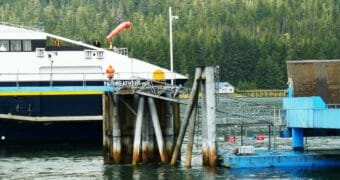
Fishermen in a skiff pass the ferry Kennicott in Whittier’s harbor in 2011. The ship will return from repairs two weeks late. (Photo by Ed Schoenfeld/CoastAlaska News)

It stopped sailing in early January for its annual overhaul at the Ketchikan Shipyard.

Alaska Marine Highway General Manager John Falvey said crews found more wear than expected when they took apart the engines. He said two full container vans of parts were sent south for repair.

“We learned just a few days ago from … the engine manufacturer that because of the unexpected level of maintenance that needed to be done on those parts that they had in Seattle, that we were going to require an extra two weeks,” he said.

The Kennicott carries up to about 500 passengers and 65 to 75 vehicles. It’s almost 20 years old, which makes it one of the younger ships in the marine highway fleet.

It sails a long route, from Bellingham, Washington, through Southeast and the Gulf of Alaska, to Kachemak Bay and on to Kodiak.

The Southwest ferry Tustumena will enter the shipyard for its overhaul March 13.

Falvey said that leaves five ports with no service from March 23 to March 27.

“Basically, what it comes to is Kodiak and Homer lose three port calls, Port Lions loses two port calls, Seldovia loses a port call and Chenega Bay will lose two port calls,” he said.

The Kennicott went into its overhaul later than scheduled so it could cover for other ferries needing repair.

Read the Kennicott’s full April schedule.

Southeast tribal safety expert defends sections of SB 91

Jason Williams, Central Council of Tlingit and Haida Indian Tribes of Alaska public safety managers, discusses criminal justice reform as legislative aide Jordan Shilling listens during a Native Issues Forum Thursday at Juneau's Elizabeth Peratrovich Hall. (Photo courtesy CCTHITA)
Legislative aide Jordan Shilling, left, listens as Jason Wilson, public safety manager for Central Council of Tlingit and Haida Indian Tribes of Alaska, discusses criminal justice reform during a Native Issues Forum Thursday at Juneau’s Elizabeth Peratrovich Hall. (Photo courtesy CCTHITA)

Some of last year’s changes to Alaska’s criminal code have drawn fire from law enforcement officials, politicians and crime victims.

A partial rewrite is underway.

But a Southeast tribal justice leader said sections of Senate Bill 91 are worth keeping.

Jason Wilson is public safety manager for the Central Council of Tlingit and Haida Indian Tribes of Alaska. He manages the tribe’s Village Public Safety Officer program. He’s also a member of the state’s parole board.

At a Thursday forum, he said probation system changes are helping lesser criminals remain functioning members of society.

He referred to a situation where probation terms include no drug or alcohol use. He said breaking that rule used to mean an automatic 15-day lockup.

Sen. John Coghill, left, aide Jordan Shilling, middle and Tlingit-Haida Central Council's Jason Wilson, discuss criminal justice changes during a Native Issues Thursday in Juneau. (Photo by Ed Schoenfeld/CoastAlaska News)
Sen. John Coghill, left, aide Jordan Shilling and Tlingit-Haida Central Council’s Jason Wilson discuss criminal justice changes Thursday in Juneau. (Photo by Ed Schoenfeld/CoastAlaska News)

“So, this person relapses. That’s a violation and they go to jail,” he said. “They now lose their home because they’re sitting in jail. They lose their home and they lose their job. So, when they come back out, we’re starting all over.”

The new rules still punish offenders with jail time, just not as much, Wilson said. Experts understand relapses are part of the recovery process.

“Now with the justice reform, we’re an automatic three days (in jail) and we’re out,” he said. “The offender is reminded these are things that we need to work on, we need to add treatment. They still hopefully have their home and they still hopefully have their job.”

Wilson was one of four panelists addressing criminal justice reform at a Native Issues Forum in Juneau.

Other speakers were Fairbanks and North Pole Sen. John Coghill, who’s working on updates to the justice reform legislation; his aide, Jordan Shilling, and Talia Eames, Central Council Second Chance Reentry program coordinator.

Watch the entire forum.

Bill would change state arts council to a corporation

Lawmakers take their first look Friday at a bill changing the Alaska State Council on the Arts from an agency to a public corporation.

The council distributes funds to artists and art organizations around the state.

Executive Director Andrea Noble-Pelant said it would allow for more partnerships and funding opportunities.

“Our choice is we can stay the same and watch our organization dwindle, or be less effective,” she said. “Or we can take a step to become more efficient.”

Senate Bill 66 and House Bill 137 call for the change.

The switch to a public corporation would result in a number of operational adjustments.

One would remove the council from requirements of the state procurement code.

Juneau’s Ben Brown, who chairs the arts council’s board, said it’s a necessary change.

“The procurement code is something to make sure that state agencies operate in a certain matter,” he said. “We’re a little bit different than some other state agencies in some of the programs and services we are trying to provide.”

“We’re certainly different in having funding available to us from private foundation partners,” Brown said.

The council’s budget for this year is about $2.8 million. About a quarter comes from the state, a quarter from the federal government and the rest from foundations and other private donors.

The legislation was proposed by the council after an extensive operational review, Brown said.

It will have its first hearing at 8 a.m. Friday before the Senate Education Committee. The identical House version is not yet scheduled.

Both versions were authored by their chamber’s Education Committees, which reflects broader support than a measure sponsored by individual legislators.

Another section would exempt artists’ submissions to the council from public records laws.

Noble-Pelant said information about accepted art commissions would remain public. The bill removes those from artists whose proposals are not accepted.

“Artists are business people and they are part of that creative economy,” she said. “They are often sole proprietors and when they apply for a commission, it’s much like someone who’s applying for a job.”

The bills would keep the state arts council within the Department of Education.

The legislation changes board member requirements, from having interest in the arts to having expertise. Brown said that’s important.

“Hopefully, all Alaskans have interest in the arts. That’s one of the reasons the council exists,” Brown said. “But I don’t know that it’s fair to say that as many Alaskans have expertise in the arts. And to be a member of the council, it’s appropriate that people have more than just a passing interest, but have some level of expertise, whatever that may be.”

The change could expand the pool of applicants to administrators and others who are not necessarily artists themselves, Noble-Pelant said.

Under the bills, the board’s 11 members would automatically become trustees for the new corporation. Members would continue to be appointed by the governor.

Feds extend Obamacare deadline for some Alaskans

Some Alaskans have another chance to sign up for health insurance under the Affordable Care Act.

Enrollment for insurance through the Affordable Care Act has been reopened for some Alaskans. (File photo)

A special enrollment period is being offered to those who were in a plan from Moda Health last year.

That company has since dropped out of the program, though it provides other coverage in the state.

Jon Zasada of the Alaska Primary Care Association said some Moda customers didn’t know they could sign up for a plan from Premera, the state’s only ACA provider.

“If they were effectively covered at the end of the year and lost their insurance due to the fact that Moda was no longer in the market, they are eligible for a special enrollment period through March 1st of 2017 for the 2017 coverage year,” he said.

Details are available through the website getcoveredalaska.org.

Enrollment for most other Alaskans had to be completed by the end of January. But those with significant life events, such as marriage or having a child, are allowed to sign up at other times.

The Trump administration and Congress have vowed to repeal or significantly change the Affordable Care Act, also known as Obamacare.

But Zasada said those enrolled will likely have coverage through the end of this year.

“No official action has been taken yet that changes the current law,” he said. “If folks are interested in gaining coverage and learning about their options, given the current set of rules or under any changes that might be coming up, we are available to help.”

Some 27,000 Alaskans have coverage through the Affordable Care Act marketplace.

Site notifications
Update notification options
Subscribe to notifications