Ed Schoenfeld, CoastAlaska

Inter-Island Ferry attracts more passengers

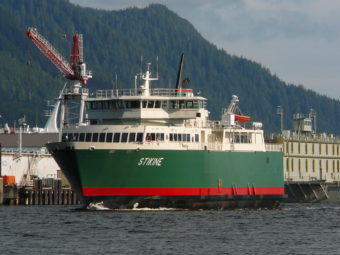
Ferry Stikine in Ketchikan
The Inter-Island Ferry Authority ship Stikine sails to its Ketchikan terminal in 2008. It and its sister ship, the Prince of Wales, are carrying more passengers following a drop in ridership. (Photo by Ed Schoenfeld/ CoastAlaska News)

Southeast Alaska’s independent ferry system is working its way out of a ridership slump.

The Inter-Island Ferry Authority sails a daily round-trip route linking Hollis, on central Prince of Wales Island, and Ketchikan. The authority is separate from the Alaska Marine Highway System.

The service, which began 15 years ago, carried more than 50,000 passengers for its first nine years. Then the numbers started dropping by as much as 20 percent.

Dennis Watson is general manager of the Inter-Island Ferry Authority, as well as mayor of the city of Craig. (Photo by Ed Schoenfeld/CoastAlaska News)
Dennis Watson is general manager of the Inter-Island Ferry Authority. (Photo by Ed Schoenfeld/CoastAlaska News)

General Manager Dennis Watson said they’re coming back up.

“Last year, we actually had a pretty good bump because we’d been kind of going downhill since the economic crisis a couple years ago. And things seem to be turning around,” he said.

He said predictions of good salmon runs make him optimistic for this year. The route is popular with commercial, sport and subsistence fishermen.

The ferry authority is a non-profit organization run by representatives of five Prince of Wales Island communities, plus Wrangell.

The authority’s $3.9 million budget for this fiscal year is funded largely by ticket sales, which provide about 85 percent of revenue. But it also gets money from the state and federal governments. Gov. Bill Walker’s capital budget includes $250,000 for the next fiscal year.

The authority has two nearly identical ferries, the Prince of Wales and the Stikine. They trade off on the route, allowing time for each to undergo maintenance and repairs without interrupting service.

Watson said that doesn’t always work. Earlier this month, a container van struck and damaged a door near water level. It wouldn’t close, which is required.

“We couldn’t go grab the other boat because we had just taken the safety gear off of it and sent it south. So, it didn’t do us any good to have two boats at that point. But we got past it and we’re back in full operation again,” he said.

The ferry authority sailed a second route for about two years linking the island’s Coffman Cove with Wrangell and Petersburg. It ended because it attracted too few riders.

Read a report on the economic impacts of the Inter-Island Ferry Authority.

Longtime leader Rosita Worl to leave Sealaska board

Longtime Sealaska regional Native corporation board member Rosita Worl will step down as a director in June. She will continue to head up the Sealaska Heritage Institute. (Photo by Lakeidra Chavis/KTOO)

One of the Sealaska regional Native corporation’s longest-serving leaders is stepping down.

Rosita Worl has spent 30 years on the Juneau-based corporation’s board of directors. She said she’s been thinking about leaving for a while.

“I probably would have resigned three years ago, but at that point in time, I was chair of the Lands Legislation (Committee) and I felt like I wanted to see that completed before I left the board,” she said.

That controversial bill traded corporate land near shareholder communities for more valuable timber properties within Southeast’s Tongass National Forest.

After several attempts, it passed Congress in 2014.

Worl will complete her final three-year board term, which ends in June. That will leave an open seat on Sealaska’s board of directors, to be filled during spring shareholder elections.

In the past, many departing board members resigned during their terms and were replaced by an appointee, who then ran as an incumbent.

Worl will continue as president of the Sealaska Heritage Institute, the corporation’s cultural arm.

The anthropologist, who’s taught at the University of Alaska Southeast, says she’s looking forward to completing some academic projects.

“I’ve had to spend most of my energies on Sealaska and Sealaska Heritage Institute. And I’d like to finish a couple of manuscripts that I have: Tlingit property law and an ANCSA study, for example,” she said.

Worl, of Juneau, is one of the longest-served members of Sealaska’s 13-person corporate board.

Only Albert Kookesh of Angoon has served longer.

Worl’s leadership roles have extended outside Southeast Alaska.

She’s been on the boards of the Alaska Federation of Natives, the Indigenous Languages Institute and the National Museum of the American Indian.

She’s also chaired the federal Native American Graves Protection and Repatriation Act Review Committee.

Her Tlingít names are Yeidiklats’akw and Kaa háni and she is Eagle of the Shungukeidí (Thunderbird) Clan from the Kaawdliyaayi Hit (House Lowered from the Sun) of Klukwan and a Lukaax.ádi yadi (Child of the Sockeye Clan).

Senate kills Alaska predator protection order

A Denali wolf carries part of its prey. Congress is overturning a predator protection measure put in place by the Obama Administration. (Photo by Ken Conger/National Park Service)

The U.S. Senate voted Tuesday to overturn an Obama Administration rule that banned certain methods of killing predators on national wildlife refuges in Alaska.

The vote was 52 to 47.

The Obama administration wanted to ban killing bear cubs and wolves in their dens, killing bears over bait and other practices that opponents deem inhumane.

The methods aren’t broadly allowed in Alaska anyway, but the state Board of Game said they’re tools that it should be able to deploy, when needed, to restore a balance between predator and prey species.

Alaska’s congressional delegation argued the state has the right to manage hunting throughout Alaska and that the rule violated the statehood compact and other federal laws.

The House has already voted to overturn the regulation. President Trump is expected to sign the repeal.

An identical Park Service regulation remains on the books related to hunting on Alaska’s national preserves.

Eight Southeast cities target metal junk

Old trucks are parked in the bushes in Wrangell. The Southeast city is one of eight working on a group agreement to collect and barge old vehicles and other scrap metal south for recycling. (Photo by Aaron Bolton/KSTK)

Tons of scrap metal are piling up in Southeast Alaska’s smaller cities. Some set up their own recycling or disposal programs. But a new effort aims to make it easier – and less costly – to get rid of the debris.

Heavy equipment loads scrap metal onto a barge in Ketchikan. Eight Southeast cities plan a group recycling effort. (Photo courtesy Ketchikan Gateway Borough)

What do you do with a car not worth fixing? Or a broken range or an outdated wood stove?

If you’re responsible, you take it to the landfill, if there is one. If you’re not, you leave it on the street, or push it into a ditch, or a pit, or in cave country, even a sinkhole.

Wherever it ends up, someone needs to deal with it.

“In Klawock, we actually have about a 10-year stockpile of scrap metal that we haven’t gotten rid of,” said Leslie Isaacs,  city administrator for the southern Southeast community, on Prince of Wales Island. “There’s a classification of white metal, which is your appliances and then there’s junk vehicles and then ferrous and non-ferrous metals …”

The same is true in Thorne Bay, about 30 miles to the northeast.

City Administrator Wayne Brenner told a recent Southeast Conference Mid-Session Summit meeting that sometimes, folks leave more than metal.

“A lot of people when they do move out, they’ll bring a freezer out to the solid waste site, a lot of times still full of frozen fish,” he said.

The Southeast Alaska Regional Solid Waste Authority is taking on the problem. It’s a coalition of regional governments that already set up a group discount for barging garbage south to a Washington state landfill.

Now, the authority, which is affiliated with Southeast Conference, is negotiating with Waste Management, a large trash-hauling company that already operates in Alaska. The plan is to send a barge to collect the scrap metal, then barge it south to be recycled.

An aerial view of the junkyard site four miles south of downtown Wrangell. (Photo courtesy of Alaska Department of Environmental Conservation)
An aerial view of the junkyard site 4 miles south of downtown Wrangell. (Photo courtesy Alaska Department of Environmental Conservation)

The authority thought it had an agreement with another company about two years ago. Petersburg Public Works Director Karl Hagerman said it didn’t work out, because the value of scrap metal dropped by more than half.

“Now that we’re seeing that price rising, the viability, the feasibility of a scrap metal trip for communities is there again,” he said.

It won’t happen immediately. But Hagerman said the communities want to be ready to respond quickly.

“When the price starts to plateau, that’s the time when we seriously look at doing it, to know if there is going to be a cost or even a payment to the communities,” he said.

The solid waste authority and the trash company will set a basic price for the service.

Thorne Bay’s Brenner said each city will then have to negotiate supplemental contracts.

“Every community has a little bit different setup. They have a little bit different process in shipping. And some of us that are closer to the markets hopefully get a little better break than the ones further away,” he said.

Petersburg, Wrangell and the Prince of Wales Island cities of Craig, Klawock, Thorne Bay, Kasaan, Hydaburg and Coffman Cove are involved.

Klawock’s Isaacs said the group effort can make it work.

“If you can take the barge and make a complete circle through Southeast and stop in at every community, is there enough metal there to make it worth your while? And getting to Petersburg, getting to Klawock and sharing some of those fixed costs of running the barge and the equipment, it would make it a much more cost-effective procedure,” he said.

No one’s really sure how much metal needs to be moved. But Hagerman said the best guess so far is around 3,000 tons.

Senate panel cuts public broadcasting

KFSK in Petersburg is among Alaska public radio stations that could end local programming under proposed budget cuts. (Photo by Ed Schoenfeld/CoastAlaska News)

A state Senate panel wants to eliminate funding for most public broadcasting in Alaska. That puts it in conflict with the House and the governor, who want to keep the finances flat.

Gov. Bill Walker’s fiscal year 2018 budget proposes spending about $3.6 million for public broadcasting. It includes radio, TV and ARCS, a rural satellite television channel.

That amount made it through the House budget-writing process. But a Senate Finance Committee panel on Tuesday cut almost all public broadcasting money.

Sitka Republican Sen. Bert Stedman told a Southeast Conference meeting that it’s evidence of the split between Railbelt lawmakers and those representing smaller communities.

“The rural guys? We like it. Southeast, Kodiak, Western Alaska, pick your spot. If there’s a natural disaster, getting some of the local news is very critical. But it’s a target,” he said.

State funding is a significant part of most stations’ budgets, including this one’s. It also leverages federal funds, which most stations would lose if the cut is passed.

The defunding proposal will go before the full Senate Finance Committee before heading to the chamber’s floor.

The cut was made by that panel’s subcommittee considering the Department of Administration’s budget, which includes public broadcasting.

It’s chaired by Wasilla Republican Sen. Mike Dunleavy, who proposed the cuts, saying revenue shortfalls mean some programs must be eliminated. Fellow Southcentral Republicans Anna MacKinnon and Shelley Hughes voted with him.

Juneau Democrat Dennis Egan opposed the cuts through amendments to restore the money. They were voted down.

Update: Tied-up ferry Taku is for sale

The state ferry Taku is for sale. The minimum price for the 54-year-old ship is $1.5 million.

The ferry Taku waits to load passengers in Sitka while it was still sailing. It’s been tied up and now is for sale. (Photo by Ed Schoenfeld/CoastAlaska News)

Alaska Marine Highway officials announced the invitation to bid Saturday. The deadline for proposals is May 9.

The Taku is tied up at Ketchikan’s Ward Cove. It was taken out of service in June of 2015 due to budget cuts and other factors.

Ferry chief Mike Neussl said it doesn’t meet the department’s needs anymore.

“With the state’s budget crisis and budget challenges that we have and the marine highway have, it’s not possible to run an 11-ship fleet. We just don’t have the maintenance funding and the operational funds to do that,” he said.

The Taku was built for long sailings, with room for about 350 passengers and 50 vehicles. It has 40 staterooms, a cafeteria, observation lounges and a covered solarium.

Marine highway spokeswoman Meadow Bailey said it’s not a derelict vessel. She said it can still sail, but needs some certifications and maybe some work.

“It’s being sold as-is, where-is. So whoever wins that bid would have the responsibility of transporting the vessel, paying for the cost to transporting it, or if they decide that they want to store it still, to assume that cost,” she said.

The marine highway had to win federal approval before moving ahead with the sale, because federal funds were used for maintenance. It also had to offer the ship to other state and local government agencies. There were no takers.

Another state vessel, the fast ferry Chenega, is also in long-term storage.

But Neussl said it’s still part of the fleet.

“The decision has not been made that that vessel is excess to the state’s needs, like we have made for the Taku. So that vessel is just in kind of inactive status right now, pending the outcome of the budgetary process and what it looks like we can afford to operate,” he said.

He said about a dozen people or organizations expressed interest in buying the Taku before it went out to bid.

Editor’s note: This report was updated with additional information about the vessels and quotes from officials.

Site notifications
Update notification options
Subscribe to notifications