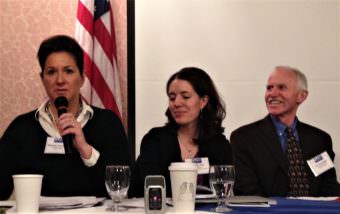
Homeless youth advocate Michelle Overstreet, left, talks about drug abuse during an Alaska Municipal League forum Feb. 22, 2017, in Juneau. Dr. Anne Zink and Dr. Jay Butler also were on the panel. (Photo by Ed Schoenfeld/CoastAlaska News)
Alaska has another tool in the fight against opioids.
Public health officials are distributing thousands of disposal bags that chemically react to and leave no trace of the drugs.
The bags are sealable pouches containing active carbon. You add drugs and water, seal and shake it, and wait for 30 seconds. The carbon neutralizes the drugs, so they have no effect. The biodegradable bags can be thrown out with the trash.
Michelle Overstreet is executive director ofMy House, a Wasilla-based organization that helps homeless teenagers. She told those at an Alaska Municipal League meeting in Juneau that it’s important to dispose of drugs safely at any time, not just official drop-off days.
“We’ve had parents coming in to get those, we’ve had grandparents coming in to get those,” she said. “People are excited about having a way to get rid of those that isn’t throwing them in the garbage or down their septic system, which then can leach into their well.”
A drug-disposal pouch from a painkiller company that’s providing 25,000 such bags to Alaska. (Photo courtesy Mallinckrodt Pharmaceuticals)
Mallinckrodt Pharmaceuticals, which makes opioid pain-killers, is contributing 25,000 disposal bags to the state.
Alaska Chief Medical Officer Dr. Jay Butler said his agency is sending 1,000 bags to its clinics.
“I recognize that some of our public health centers don’t have full-time staffing anymore. But that is one of the ways we want to get these into the communities. Or if we can provide some directly to you, we’d be happy to do that also,” he told municipal leaders at the forum.
Public health official Andy Jones said distribution began a few weeks ago.
They’re going to hospitals, recovery centers, homeless shelters, tribal governments and others who can get them to all parts of Alaska.
“There’s a lot of communities that don’t have public health centers,” Jones said. “So we’ll also be looking at the clinics and community health aides.”
“We do have a lot of itinerant nurses within public health nursing that travel go out to the communities quite often,” he said. “So they’re going to be equipped with these pouches and they can hand these out as they travel across the state.”
Jones said the bags are an easy way to dispose of unused prescription painkillers, which are frequently stolen or sold to addicts.
“The targeted audience may not be the individual who’s using, especially,” he said. “More or less, (it’s) the individual who’s coming into recovery.
“When you go into those recovery centers or those homes, they can’t be carrying pills or prescriptions,” Jones said. “These bags give them that way to dispose of those medications in the right manner.”
Gov. Bill Walker recently declared the opioid epidemic astate emergency. Other efforts include distributing 5,000 naloxone kits, which can stop opioid overdoses.
Alaska’s largest tribal government is revamping its constitution with an eye toward greater efficiency and cultural context.

The Central Council of Tlingit and Haida Indian Tribes of Alaska plans a constitutional convention April 19-21 in Juneau. (Photo by Ed Schoenfeld/CoastAlaska News)
Delegates representing the Central Council’s more than 30,000 tribal members will meet April 19-21 at Elizabeth Peratrovich Hall, Juneau.
Will Micklin, council second vice president, chairs the committee preparing for the convention.
“(We’re) trying to imbue what began as very utilitarian documents that are very brief and speak only to broad authority and try to imbue that with an expression of our culture and our ways of life,” he said.
Like other federally funded organizations, the council expects challenges maintaining its programs. Micklin said inflation also is driving up costs. He hopes constitutional changes can encourage efficiencies.
He said the changes should also help increase involvement.
“We’re looking to put actionable information in the hands of our assembly members for longer periods prior to the opening of our tribal assembly so that they can review, consult with their communities and have a more deliberative period before we actually have to take action,” he said.
The constitutional convention was called at last year’s tribal assembly by Central Council President Richard Peterson.
The council lists 21 registered communities. Most are in Southeast, but they include Anchorage, San Francisco and Seattle.
The ferries Matanuska, right, and Fairweather, left, dock at Juneau’s Auke Bay terminal May 20, 2016. The larger ship is delayed in its return to service after an overhaul. (Photo by Ed Schoenfeld, CoastAlaska News)
The ferry Matanuska will take 10 days longer than expected to return from repairs.
The ship, which sails Southeast waters, was scheduled to resume service Feb. 10. Instead, it will return to its route Feb. 20.
The Matanuska has been out of service since Jan. 4 for its annual overhaul. Officials say engineers found more damaged steel than expected.
The Matanuska sails from Prince Rupert, British Columbia, to Haines, with stops in most Southeast port cities.
The ferry was built in 1963, making it one of the Alaska Marine Highway System’s three oldest ships. It can carry up to 450 passengers and about 80 cars or trucks. It has about 100 staterooms.
The ferry Taku loads up at the Prince Rupert, B.C., ferry terminal July 24, 2014. The Alaska Marine Highway could give it to another government agency. (Photo by Ed Schoenfeld/CoastAlaska News)
The Alaska Marine Highway wants to know whether any other government agencies want the ferry Taku.
It’s another step toward selling or scrapping the 350-foot-long ship, which has been tied up for about a year and a half.
Spokeswoman Meadow Bailey said the new owner would have to keep carrying passengers.
“The great example that I was given is, if you want to take the ferry and use it as a public ferry, that’s fine,” she said. “But if you wanted to use it as a private floating hotel that generated revenue, that would not fit the requirements for this step in the process.”
Municipalities and other government agencies have until Feb. 21 to declare their interest.
The state will put the Taku up for sale if no one responds.
Bailey said officials have not yet decided when or how it would be sold. There’s also no sale price yet.
She said it’s in good shape. But a new owner would need to pay for certificates and inspections to run it as a ferry.
“If somebody wanted to use it for something other than a fare-generating service carrying passengers, those certificates and inspections might not be need to be completed,” she said.
The 54-year-old Taku is in long-term storage at Ketchikan’s Ward Cove.
The marine highway has already taken one necessary step toward its sale: that’s getting permission to sell the ship from the Federal Highway Administration, a funding source.
The Taku used to sail Southeast waters, connecting the region’s communities with Prince Rupert, British Columbia. It carries up to 370 passengers and around 70 vehicles.
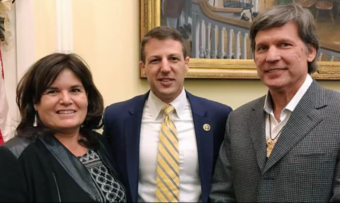
Central Council of Tlingit and Haida Indian Tribes of Alaska Fourth Vice President Jacqueline Pata, left, poses with Trump Native American Coalition Chairman Markwayne Mullin and Tlingit-Haida Central Council Second Vice President Will Micklin during a mid-December listening session. (Photo courtesy Central Council of Tlingit and Haida Indian Tribes of Alaska)
President Donald Trump angered many Native activists by moving to restart Dakota Access Pipeline construction.
Thousands have protested the line, saying a portion of it could poison the Standing Rock Sioux’s water supply. They also see the move as an affront to tribal sovereignty.
But before Trump’s inauguration, his transition team met with Native leaders to ask what they wanted out of the new administration.
The coalition, formed just before November’s election, is chaired by Republican U.S. Rep. Markwayne Mullin, a member of the Cherokee Nation of Oklahoma.
“There are things in this administration’s agenda that we can find common ground on, like infrastructure development, like improving the economies of our communities,” she said. “But tribal leaders made it really clear tribes are governments and should be treated as such and respected as such.”
She said tribal leaders brought up health care, government contracting, education and resource extraction. That included opposition to the Dakota Access Pipeline.
“Tribal leaders said things like, ‘We’re not opposed to development. But we want to be able to make sure that we have a meaningful place and that our consent is part of the process of evaluating the permits that may affect our lands,'” she said.
Some leaders went into the mid-December meetings angered by reports that the coalition’s chairman wanted to take tribal lands out of tribal hands.
Tlingit-Haida Central Council’s Will Micklin, who also attended the meeting, said those reports were refuted.
“He assured me he had no intention of privatizing tribal lands,” he said. “It was a misinterpretation of his desire to make productive the tribal estate, which are tribal lands.”
Micklin said an overriding issue was the future of Obamacare.
“We’re concerned that the repeal of the affordable health care act not also repeal the Indian Health Care (Improvement) Act and not reduce funding for it from our other funding sources,” he said.
Another issue to watch was land into trust, which allows tribal governments to transfer title to the federal government and protects the land from taxation or seizure.
Alaska Native tribes have just begun using the program.
Mark Trahant is an independent journalist, professor and blogger on Native issues. (Photo courtesy Trahant Reports)
Mark Trahant is a former University of Alaska journalism professor and a blogger on Native issues. He’s a member of the Shoshone-Bannock Tribe now teaching at the University of North Dakota.
“That was kind of evolving late in the Obama administration. And now, (if) organizations and tribes want to follow through they’re going to need some sort of mechanical side to make the process work. And whether or not resources are put into that by the administration, I think will be interesting to see,” he said.
Changes in the state’s far north are also being watched by some Alaska Native leaders.
Trahant worries the new administration doesn’t know much about it, beyond the potential for oil and gas production.
That’s especially since Trump and members of his administration question the human role in climate change.
“Even thinking about the United States as an arctic nation and a changing arctic nation and what does that mean and what are the policy implications,” Trahant said. “The Obama administration had pushed very hard on the environmental side of that. But now you may see things like more interest in shipping lanes and resource extraction and that sort of arctic issues.”
Trahant predicts tribes will have fewer problems with Ryan Zinke, Trump’s pick to lead the Interior Department.
He said the Montana congressman understands tribal sovereignty and other key issues.
“The person who’s been nominated for Interior secretary is an avid fisherman,” Trahant said. “He understands the language of that and recognizes the importance of a healthy fishery, both as a food source and subsistence.”
Trump takes over from an administration that expanded relations with tribal governments and other Native groups.
Each department had a Native liaison who reached out and addressed concerns.
Tlingit-Haida Central Council’s Pata is among those hoping that continues in some form. But they say Obama will be a hard act to follow.
“What made a big difference was President Obama went to Indian country and when he saw it, it compelled him,” she said. “I’m hoping that we do get high-level officials from the Trump administration into Indian country and they will fulfill their desire to bring some of their drive for economic opportunity to Indian country as well.”
While most attended the Trump team’s Native coalition meetings were encouraged by the interest, they know many of their concerns don’t mesh with the new administration’s goals.
That’s certainly the case with the Dakota pipeline.
Petersburg resident Jeff Meucci points to a lands map while Ed Wood looks on during a meeting on Alaska Mental Health Trust Land Office timber sales. (Photo by Angela Denning/KFSK)
The Alaska Mental Health Trust Land Office will not pursue timber sales at controversial sites in Petersburg and Ketchikan – at least for now.
The Trust had planned for sales at what’s known as Petersburg P-1, as well as Ketchikan’s Deer Mountain. Both met with community opposition.
Deputy Director Wyn Menefee said the Trust Land Office will focus instead on trading those and other parcels for Tongass National Forest timberlands.
Bills introduced in the U.S. House and Senate call for that exchange — and to speed up the process.
“While we’re pursuing this exchange we’re not pursuing any sort of timber harvest activity on Petersburg P-1 or Deer Mountain,” he said. “We are fully trying to get this exchange through.”
The organization’s board meets Jan. 25-26 at the Elizabeth Peratrovich Hall in Juneau.
The board packet includes a memo from land office Executive Director John Morrison. He said he’s confident the needed legislation will pass Congress this year. Bills authorizing the exchange failed to pass last year.
Menefee said a bill with nearly identical language must also be approved by Alaska’s Legislature.
“The ideal situation is we come out of the Congress efforts and have a federal bill enacted sometime by this summer and then likewise if we can get it through the state Legislature this … spring and get an approval, then those two marry up,” he said. “We can start putting the exchange in place.”
That’s a very tall order.
Federal land legislation usually passes only as part of a larger measure with a dozen or more other bills added in. That makes them more controversial.
But Menefee is optimistic. And he said timber sales won’t automatically be pursued if the legislation fails.
“If anywhere in the future … the whole exchange falls apart, we would come back to the board and we would speak to the board in a board meeting before pursing any timber harvest contracts,” he said.
The Trust Land Office announced last summer that it planned to move forward with timber sales on the two sites if exchange legislation wasn’t approved by this month.
After public outcry and questions about the office’s decision-making process, that plan was delayed.
The Petersburg property is on a steep hillside above Mitkof Highway south of downtown.
Residents say logging would make landslides, which have occurred in the area, more likely to happen.
Landslides are also a concern at the Ketchikan property, which is behind a residential area. It’s above the water supply for the adjoining town of Saxman.
Opponents also say planned clear-cuts would be unsightly and hurt the tourism industry.
The two properties, plus other land trust property in Sitka and Juneau, would be traded for remote parcels of federally owned land on Prince of Wales Island and near Ketchikan.
KRBD’s Leila Kheiry contributed to this report.
Close
Update notification options
Subscribe to notifications
Subscribe
Get notifications about news related to the topics you care about. You can unsubscribe anytime.