Ed Schoenfeld, CoastAlaska

Alaska, British Columbia detail transboundary mine pact

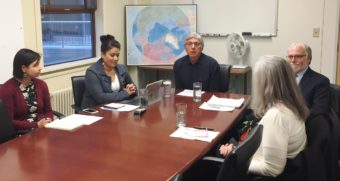
Lt. Gov. Byron Mallott opens the first teleconferenced meeting of a bilateral working group on transboundary mines Dec. 16. Shown are, from the left, Meghan Topkok, First Alaskans Institute; Barbara Blake, senior advisor to Mallott; Mallott; and David Rogers and Jackie Timothy, Department of Fish and Game. (Photo courtesy Governor’s Office.)
Lt. Gov. Byron Mallott opens the first teleconferenced meeting of a bilateral working group on transboundary mines Dec. 16. Shown are, from the left, Meghan Topkok, First Alaskans Institute; Barbara Blake, senior adviser to Mallott; Mallott; and David Rogers and Jackie Timothy, Department of Fish and Game. (Photo courtesy Governor’s Office.)

Alaska and British Columbia are working out details of how they will handle transboundary mine concerns. They’re figuring out how to coordinate the work of monitoring and permitting on both sides of the border.

A statement of cooperation between the state and the province signed in early October promised openness, transparency and increased environmental monitoring.

Now begins the work of meeting those goals.

Lt. Gov. Byron Mallott heads up the state’s effort to address concerns about British Columbia mines near rivers that flow into Southeast Alaska.

He said state and provincial officials met via teleconference meeting Dec. 16.

“We’re trying to create a big tent here, but with a very specific process of engagement and sharing and review and critical examination of all those things that we need to,” he said.

The state’s Department of Environmental Conservation will address water-quality concerns. Terri Lomax is a manager in the agency’s Monitoring and Assessment Program.

“We, of course, can do our testing on the Alaska side and we’re hoping our B.C. counterparts can do testing on the British Columbia side, but that hasn’t been determined yet,” she said.

Testing will create a record of what’s in transboundary river water now — with an eye toward changes that could threaten fisheries, wildlife and people.

“Some of the groups that are already doing monitoring are collecting water and sediment contaminates of concern, specifically like trace metals. That kind of information is going to really help us in deciding how to narrow down our focus and … how to pick the right parameters and methods to be looking at,” she said.

Those other groups include tribal governments in Southeast Alaska and northwest British Columbia. They’ll be asked to help develop the regionwide monitoring program.

8-26-15 B.C. Mines Minister Bill Bennett discusses the week's mine meetings as Lt. Gov. Byron Mallott and other state officials listen during a Wednesday press conference. (Photo by Ed Schoenfeld, CoastAlaska News)
B.C. Mines Minister Bill Bennett discusses transboundary mining as Lt. Gov. Byron Mallott and other state officials listen during a 2015 press conference. (Photo by Ed Schoenfeld, CoastAlaska News)

Other state agencies will work on protocols for input into B.C.’s permitting process.

Mallott said the state will also develop a website to share information about transboundary mines.

“You can never say nothing will drop through the cracks,” he said. “But at least we will have a process and a working relationship that is stronger and more focused and with a value construct that did not exist before.”

The state’s efforts accelerated last year after environmental, fisheries, tribal and community leaders pushed for active engagement with B.C. leaders.

One mine, the Red Chris, began operations in the Stikine River watershed last year. Another, the Tulsequah Chief, is closed and leaking pollutants into the Taku watershed. A half-dozen to a dozen others are being explored or considered for development.

Guy Archibald works with Inside Passage Waterkeeper and the Southeast Alaska Conservation Council.

“I think the process itself is helping make things safe. Any time Alaska and B.C. can communicate on these projects to each other and ask for expertise, I think is constructive,” he said.

But he said the state needs to do more than monitor water quality or put information on a new website. He said it needs to worry about more than mines. For example: new dams.

“Anything that brings the cost down for developing these mines, such as access to hydropower, makes their development that much more likely,” he said.

Other mine critics also say the state’s agreement with B.C. needs to go further.

Salmon Beyond Borders' Heather Hardcastle reacts to the week's mining meetings while Rivers Without Borders' Chris Zimmer, center, and the Douglas Indian Association's John Morris listen. (Photo by Ed Schoenfeld/ CoastAlaska News)
Salmon Beyond Borders’ Heather Hardcastle speaks during a panel including Rivers Without Borders’ Chris Zimmer, center, and the Douglas Indian Association’s John Morris in 2015. (Photo by Ed Schoenfeld/ CoastAlaska News)

Fisheries business owner Heather Hardcastle is with the group Salmon Beyond Borders.

“We would like to see enforceable protections and financial assurances that we will not be negatively impacted by upstream mining in British Columbia. And I still don’t see how the state of Alaska is pushing for those,” she said.

Hardcastle said future meetings following up on the transboundary agreement should be advertised and made open to the public.

State officials say more details will be available in January.

Mallott said a meeting of stakeholders, including mine critics, will happen within the next six months.

Salmon Beyond Borders and other groups continue to pursue federal involvement in the issue.

Hardcastle points to a longtime goal of invoking part of a treaty that governs U.S- Canada water conflicts.

“One way to get closer to such an agreement would be for the International Joint Commission to get involved,” she said. “But at this point we’d like to see any sort of true federal engagement on this issue and we just haven’t yet.”

Mallott said that’s on his agenda when he heads to Washington, D.C. And federal officials have been responsive, to a point.

In a prepared statement, British Columbia officials said the province will share equal responsibilities under the agreement. That includes water-quality monitoring.

They say tribal governments, called First Nations in Canada, will participate, as will the mining industry.

Budget leaves ferry schedule as is, for now

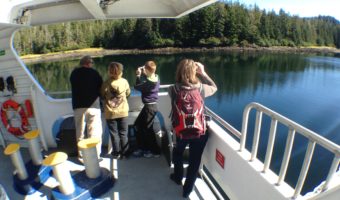
Passengers enjoy the scenery during a Sept. 3 fast ferry Chenega sailing between Sitka and Juneau. Sitka would lose most of its ferry service under a schedule based on a reduced budget proposed by Gov. Bill Walker. (Photo by Ed Schoenfeld/CoastAlaska News)
Passengers enjoy the scenery during a late summer fast ferry sailing between Sitka and Juneau. Budget cuts have reduced such runs. But the cuts may be leveling out. (Photo by Ed Schoenfeld/CoastAlaska News)

Gov. Bill Walker’s newly released operating budget requires no changes to the Alaska Marine Highway’s scheduled sailings.

Walker’s spending plan for the fiscal year beginning in July proposes a $2.8 million, or 2 percent, budget cut.
Spokesman Jeremy Woodrow said that came as no surprise to ferry schedulers.

“The proposed FY18 budget that was released by Gov. Walker reflects the ferry schedule that was proposed and issued and is up for reservations currently. So the passengers and customers can expect to see ferry service unaltered through the summer season,” he said.

When Walker released his spending plan Thursday, he began a months-long process of legislative debate. Final budget numbers won’t be known until the end of the session.

Woodrow said additional cuts would reduce future sailings.

“Those changes would likely be reflected in next winter’s ferry schedule or the following summer’s schedule, which does contain part of fiscal year 2018 in it,” he said.

Budget documents show the proposed cuts will eliminate about 180 marine highway jobs. That’s about a 14 percent reduction, comparing full-time equivalent positions.

The documents also indicate some jobs would be created when new Alaska Class Ferries go into service during the next budget year.

Woodrow said those jobs were assigned to the ferries Taku and Chenega, which are no longer being used.

“Most of those are unfilled. There’s a few of them where there’s actually positions staying. But there’s enough vacancies currently within the fleet for people to move into different positions on other ships,” he said.

The marine highway operates nine ferries serving 35 communities in the Southeast, Southcentral and Southwest parts of the state. That doesn’t include the two ships taken out of service.

Congress boosts plans for new Craig boat harbor

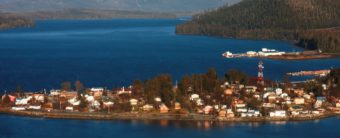
Craig, on Prince of Wales Island, is a large step closer to building a new boat harbor. (Photo courtesy Bob Claus)

A bill on its way to the president’s desk authorizes most of the money needed to build a new boat harbor in Craig. But the funding itself will wait for future congressional action.
The legislation includes about $29 million for the harbor in Prince of Wales Island’s largest city.

Craig City Administrator Jon Bolling said that’s the cost of planning and installing large breakwaters.

One conceptual draft of the design for a new Craig boat harbor. (U.S. Army Corps of Engineers image)

“They’re high-cost items. And they need to be in place first before any floats are constructed because the site is too exposed to add a float system in without the protection of the breakwaters,” he said.

About another $3 million in state and local funds are needed to install floats and related infrastructure.

The authorization comes from the Water Infrastructure Improvements Act, which passed the U.S. Senate on Saturday. It already passed the U.S. House.

It also authorizes federal spending for other Alaska projects, including harbor work at Elfin Cove, Valdez, Little Diomede and St. George.

Bolling said there’s only a preliminary harbor design. But it will include room for commercial and private boats of various sizes.

“It’s a mix of long, open runs of floats and conventional slips for various boat sizes from smaller boat length of 20 feet up to 60 feet long or greater,” he said.

Alaska’s congressional delegation pushed to include the funding authorization in the water bill.

Bolling said it’s a very important step toward construction.

Craig already has about 220 slips, plus transient moorage, in two existing harbors. The new harbor will be built at the old Craig Cannery site.

Engine trouble delays Alaska ferry Matanuska

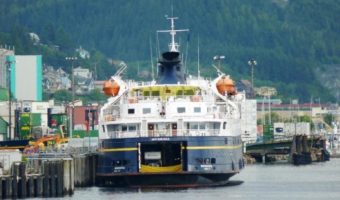
The ferries Matanuska, right, and Fairweather, left, tie up at Juneau's Auke Bay Ferry Terminal May 19. 2016. (Photo by Ed Schoenfeld/CoastAlaska News)
The ferry Matanuska, right, docks at Juneau’s Auke Bay Ferry Terminal  earlier this year. It’s running late for a week after an engine problem caused a delay. (Photo by Ed Schoenfeld/CoastAlaska News)

The ferry Matanuska is sailing an altered schedule for about a week due to mechanical problems.

It will delay Juneau-to-Prince-Rupert sailings, which include stops in Hoonah, Sitka, Kake, Wrangell, Petersburg and Ketchikan. Haines is also affected.

Alaska Marine Highway spokesman Jeremy Woodrow said the problem is with one of the Matanuska’s two main engines.

“It wasn’t major but it was significant enough that the vessel had to only use one engine transiting from Wrangell to Ketchikan. That put the vessel behind schedule,” he said.

The ferry Matanuska docks in Wrangell, giving a passenger a chance to make a cell phone call. (Ed Schoenfeld/ CoastAlaska News)
The ferry Matanuska docks in Wrangell, giving a passenger a chance to make a cell phone call. (Photo by Ed Schoenfeld/CoastAlaska News)

“Then, when they arrived in Ketchikan they were able to repair the part overnight and then continue on their schedule.”

The ferry left Ketchikan on Monday about 12 hours behind schedule. That will delay port calls until Dec. 20. Woodrow said no Matanuska stops are being canceled.

The ferry carries up to 450 passengers and 85 vehicles. The 400-foot-long ship is more than 50 years old.

The Matanuska schedule includes a Saturday, Dec. 17, Christmas break shopping run from Kake to Juneau.

“That was noted in this schedule for Kake customers to see that that service is still planned to be delivered. Just a little bit behind schedule than previously was posted,” Woodrow said.

He said the run is similar to other special sailings for events, such as local festivals and basketball tournaments.

Kids learn folk songs, instruments in elementary school class

Gastineau Elementary School music teacher Patrick Murphy leads his class in song. (Photo by Ed Schoenfeld/CoastAlaska News)

Guitars, mandolins, ukuleles and banjos are common enough at bars, coffee houses and folk festivals. But one Juneau music teacher has made them the standard for his elementary students at Gastineau School in Douglas, which is part of Juneau.

Gastineau Elementary School student Sophia Lundeman sings and plays guitar during a music class led by Patrick Murphy. (Photo by Ed Schoenfeld/ CoastAlaska News)
Gastineau student Derrick Price sings and plays mandolin during Patrick Murphy’s class. (Photo by Ed Schoenfeld/ CoastAlaska News)

Patrick Murphy leads a group of energetic third-graders through a folk standard, pointing out chord changes and strumming styles.

He weaves his way around the classroom, checking that instruments are tuned and the right lyric sheets are out. The kids quickly become focused.

“This is silly, but the most difficult thing as a teacher is to get them to sit down. If I can get them seated with their gear, then in 30 seconds, we’re making music,” he said.

These kids pick up instruments pretty soon after the school year starts. That’s because Murphy wants them to get a feel for the songs before they get to the technical side.

“I do that later. I kind of have this belief that if they can make music first – sing and play – then that reference will help them when they start reading stuff on the staff and on the clef, which we do,” he said.

Students focus on guitar the first year. But the classroom walls are hung with other stringed instruments. By the end of third grade, many are ready for something new.

“In fourth or fifth grade, I kind of just let them grab an instrument. And they turn to the chord chart and they teach it to themselves. And then I teach them their role in a string band. The banjos have the thumb picking and the mandolins and ukuleles kind of chop with the snare drum and that sort of thing,” he said.

All this is very different from Murphy’s own schooling, which was mostly classical.

“I was a trained bass player. I went through the conservatory system. And it just about taught the music out of me. … And I met a bunch of guys who were cowboys. They liked to sit around campfires and play guitar,” he said.

Patrick Murphy works with banjo and guitar players Quinn Andel, Eric Holberg and Andrew William during a class at Gastineau Elementary School. (Photo by Ed Schoenfeld/CoastAlaska News)
Patrick Murphy works with students Quinn Andel, Eric Holberg and Andrew William during a class at Gastineau School. (Photo by Ed Schoenfeld/CoastAlaska News)

“And I asked one of my friends to teach me. And he said, ‘I’ll teach you how to play guitar. Two rules: You can’t write anything down and you can’t ask me any questions.’”

Those rules forced him to figure things out. Pretty soon, he was teaching himself.

Murphy grew up going to a church that had lots of acoustic music. That included songs in the folk tradition, some from decades ago.

So, how does he interest students in old folk songs in 2016?

“Kids like history. They like to hear stories that are bizarre. The story of John Henry, the third-graders love that. Why would he bother to compete with a machine? The absurdness of the human spirit sometimes to a young kid is really entertaining,” he said.

Still, some come to him with more recent songs. It’s not so much Bruno Mars or Lady Gaga, but pop classics, such as “Yellow Submarine” or “Lean on Me.”

Some end up in the class songbook, which he updates every year.

Murphy used to teach middle-school band. This and other schools where he’s worked have had many years of stand-up student choirs. He’s not critical at all.

“That kind of approach is great. That high-art music takes a certain discipline to play and work on that. But I guess, from my perspective, I want them to have fun and I want them to do it on their own,” he said.

And they do. Murphy starts some days with a full musical assembly in the school commons, where everybody gets a chance to play and sing.

It’s a cacophony and it’s not always pretty. But the kids – and teachers — have smiles on their faces.

Ruby Rivas and Mila Hargrove discuss a song as teacher Patrick Murphy leads a music class at Gastineau Elementary School in Douglas. (Photo by Ed Schoenfeld/ CoastAlaska News)

Gulf of Alaska beach sands could be mined

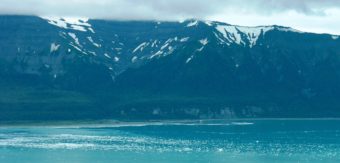
Part of the beach at Icy Cape is seen from the water Aug. 8, 2008. Beach Sands contain gold and garnet, which has industrial uses. (Photo by Sam Beebe/Creative Commons)
Part of the beach at Icy Cape is seen from the water Aug. 8, 2008. The Alaska Mental Health Trust Authority Lands Office says beach sands contain gold and garnet, which has industrial uses. (Photo by Sam Beebe/Creative Commons)

The Alaska Mental Health Trust Authority is advancing plans to mine Gulf of Alaska beach sands about 75 miles northwest of Yakutat.

The trust’s board allocated $2 million last month to create a new entity to begin developing the project on land it owns at Icy Cape.

Preliminary exploration and analysis found promising concentrations of gold, as well as garnet and other heavy minerals.

Trust Land Office Executive Director John Morrison told trustees about the project’s value at a November meeting.

“This has an exceptional potential for the trust to generate revenue from its land base, and in fact has one of the greatest potentials to generate revenue of any of the trust’s assets,” he said.

The trust land office manages its property to support mental health services for Alaskans. It usually does that by leasing property or selling resources, such as timber, for others to harvest or extract.

In this case, the trust plans to take a more direct role.

At the mid-November meeting, Morrison said the new entity would explore and develop the property through joint ventures.

“What we are proposing here is to take what we are calling phase 3, which would be a further definition of the potential resource base and the marketing efforts involved in attracting the attention to bring this resource base to market,” he said.

Garnets found in the beach sands, which stretch inland, have industrial applications. They’re used as abrasives or for filtering water.

If investors are found, then developers would need numerous government permits before moving forward. The property is within the Yakutat Borough. Manager Jon Erickson said he had not yet been consulted about the project.

A somewhat similar proposal was made by an out-of-state company for mining beach sands near Yakutat about six years ago. That effort ended after initial mineral values could not be confirmed.

Conservation and fisheries groups objected to that development, saying it could hurt salmon and other marine life.


Editor’s note: KTOO’s building sits on land leased from the Alaska Mental Health Trust Authority. KTOO has also applied for and received occasional grants for special reporting projects from the authority.

Site notifications
Update notification options
Subscribe to notifications