Ed Schoenfeld, CoastAlaska

Regulations liberalized in the Craig spawn-on-kelp fishery

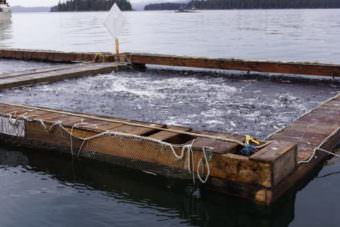
Herring bubble at the surface of a pound in the spawn-on-kelp fishery near Craig in 2014. (Photo by Alaska Department of Fish and Game)

It’s looking like it could be a good year for herring near Craig. About 16 miles of herring spawn was observed in the area this week. But that doesn’t mean it’s a good year for commercial fishermen in the spawn-on-kelp pound fishery.

Sixteen miles of spawn is considered pretty good for the Craig area. The Alaska Department of Fish and Game has been tracking the spawn for decades. And although this year is looking about average for the last 30  years, it’s better than recent years.

Scott Walker is the area management biologist for the Alaska Department of Fish and Game in Ketchikan.

“With 15 miles of spawn, active spawn on one day was probably the biggest day of spawn we had in many, many years,” Walker said. “We’re above average and it looks like it’s going to be, might be the best in 10 years.”

Walker has been helping manage the spawn-on-kelp fishery since it began in 1992.The fishery allows fishermen to catch herring and put them into structures to spawn and then release them later.

Because of the spawn being observed this year, Walker announced liberalized fishing regulations.

“We have opened fishing to evening hours,” Walker said. “And we have expanded the fishing area to include all of the area where spawn has occurred.”

Leading up to the fishery,  things didn’t look so good. All signs pointed to a less-than-great year. Walker says the biomass that was forecast — or the amount of herring predicted to be in the area — is about half of what they are actually seeing.

“And so we went into this fishery with a very conservative approach,” Walker said. “And in fact we had to.”

The commercial quota was set at 349 tons of herring, which is far less than recent years. Fish and Game put restrictions on the pound fishery to limit pressure on the fish. For the first time, fishermen were required to share a pen with at least five other permit holders. The state also limited the fishery to 20 pounds. Last year 46 structures were fished, the year before it was 76.

But filling those pounds with fish is proving to be difficult. Even though there are a lot of herring spawning in the Craig area, they are spawning in unusual areas.

“Most of these pounds are not going to get fish it looks to me like,” Walker said. “The fish spawned in non-traditional areas and so I could tell it was going to be a real struggle for these guys to fill their pounds.”

The pounds are not easy to move around and fishermen can’t travel too far with their live catch. So, Walker opened up fishing at night.

“It’s never over till it’s over and I’m hoping that this expanded area will help a few guys,” Walker said.

Walker says managing the fishery by miles of spawn can be deceptive. Just measuring the area of spawn doesn’t give you the full picture.

“That just tells you that a particular stretch of shoreline has spawn on it,” Walker said. “It doesn’t say how dense it is.”

The spawn can be far reaching but not have as many eggs as a smaller, more concentrated region.

But currently, things are looking good and the state is allowing continuous fishing to provide more opportunity to harvest herring.

The department has been monitoring the spawn activity from airplanes and boat and divers will be doing assessments during the next week to document the spawn activity from under water.

Echoes of past ring loudly at WWII internment anniversary ceremony

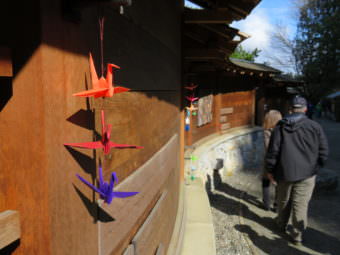
Origami cranes adorn the memorial wall at the Bainbridge Island, Washington, Japanese American Exclusion Memorial. (Photo by Tom Banse/Northwest News Network)

Echoes from Northwest history rang loudly for people in the present at a memorial ceremony last week to mark 75 years since the U.S. government forcibly removed the first Japanese Americans from their West Coast homes and sent them to internment camps. This happened in the wake of the Japanese attack on Pearl Harbor in World War II.

One of the first groups rounded up came from Bainbridge Island, Washington, due to its proximity to the Puget Sound Naval Shipyard. The 75th anniversary commemoration of the internment took place at the Bainbridge Island Japanese American Exclusion Memorial, a relatively new unit of the National Park System at the location of the island’s former ferry landing.

Kay Sakai Nakao was 22 years old at the time the U.S. Army posted notices on the island about a newly signed presidential executive order.

“It was very sad and scary because we were never told where we were going or how long we were going to be gone,” she recalled on Thursday. “They didn’t explain anything; just take what you could carry.”

Nakao, now 97, was one of many speakers who invoked the memory of the Japanese internment to urge people to stand up against targeting of Muslims, Jews or immigrants in the present day.

“We don’t want something like this to happen ever again. The way the country is going you never know,” she said.

A military police officer posts Civilian Exclusion Order No. 1, requiring “evacuation” of Japanese living on Bainbridge Island, Washington. (Photo courtesy Bainbridge Island Japanese American Exclusion Memorial)

The Japanese ambassador to the United States, Washington’s Democratic governor, a tribal chairman and religious leaders also spoke to the crowd of more than 200 people gathered for the anniversary ceremony. Besides Nakao, more than a dozen other Japanese-Americans who spent time confined in inland internment camps attended.

In his remarks, Gov. Jay Inslee drew a line from the World War II internment history, to what he called real “fear” harbored by some in the public today and Washington state’s court challenges to President Donald Trump’s executive orders limiting travel from certain majority-Muslim countries.

“We stand on federal ground as part of the national park system to say that we will never let fear overcome us,” Inslee said. “We will never succumb to fear again and we will always stand up for the rights of everyone who lives in this blessed land.”

“Our motto is a motto of hope and action: ‘Nidoto Nai Yoni – Let it not happen again,'” said Master of Ceremonies Clarence Moriwaki, president of the Bainbridge Island Japanese American Community. “We’re falling down on it because it is happening again.  It makes me feel sad. But it makes me feel empowered because so many people came out. Everybody spoke with such conviction and belief, that hope is there.”

In total, 120,000 thousand people of Japanese descent were confined for about three and a half years in hastily-built internment camps including Minidoka, Idaho, and Manzanar, California. It wasn’t until decades later that the U.S. government apologized for what was by then deemed an unconstitutional mass detention brought on by war hysteria.

Unalaska teen: If you like sushi, take care of the environment

Cade Terada fishes in Unalaska. He is an Arctic Youth Ambassador. (Photo courtesy Cade Terada)
Cade Terada fishes in Unalaska. He is an Arctic Youth Ambassador advocating for protecting fisheries. (Photo courtesy Cade Terada)

Across the state, a cohort of young Alaskans is raising awareness about the rapidly changing Arctic environment.

Cade Terada is one of 22 Arctic Youth Ambassadors. Growing up in Unalaska, America’s largest fishing port, he was immersed in the seafood industry.

Terada looks like a young, hip politician. Hair gelled back, the 18-year-old sports a grey quarter zip and khakis with an earring and a tattoo peeking out from under his sleeve.

He graduated from high school early, back in December.

You might not guess the role fishing has played in his life. Terada’s father grew up in a small town in Northern Japan and the best way to make money was fishing.

“He had to drop out of school in the ninth grade because his family was quite poor at the time,” Terada said. “So, he’s been working in fishing ever since, which is approximately 40-plus years.”

What did he think of fishing as a child?

“I really enjoyed it,” Terada said. “I really enjoyed looking in the tide pools with all the hermit crabs. I thought it was really cool looking at fish. I don’t know what it was about it, but it was an exciting opportunity to see what was out there, what could we catch.”

At what point did he decide Unalaska was pretty unique in its wealth of resources?

From a young age, Cade Terada, left, was exposed to the fishing industry by his father. (Photo courtesy Cade Terada)

“I kind of started realizing it back when I was beginning my high school career,” Terada said. “It didn’t really hit me that maybe 90 percent of my class has someone working in the fishing industry.”

“My history teacher would always talk about how this town would be a ghost town if we didn’t have fisheries and that really got me thinking that everything is dependent on the fisheries where I’m from.”

Becoming an Arctic Youth Ambassador was a stretch for Terada. He didn’t really excel in high school.

“There’s a lot of other kids like me that have the mindset that if they have a low GPA they aren’t going to be able to do much,” Terada said. “I want to let people know if you have a low GPA that doesn’t mean anything. … With this ambassador program I’ve had to opportunity to go to Greenland (and) Canada. I’ve met the prime minister of Canada, Justin Trudeau. I’ve met with countless government officials. That’s not something you’d expect from a kid with a 2.6 GPA.”

Terada has been passionate about protecting the environment for as long as he can remember. He got his start with Alaska Youth for Environmental Action. After a youth organizing summit, he was encouraged to apply to the Arctic Youth Ambassador program.

For Terada, convincing people to care about the environment is simple. He puts it in perspective.

“A lot of people I meet like sushi. And I come from the place that’s the number one fishing port in the nation, so if you like crab, if you like eating fish, you like eating any of this you better take care of the environment,” he said. “People are like ‘Wow, I really like my caviar and if I don’t care about the environment there’s going to be no more caviar or lobster.’”

At only 18, Terada feels like he’s already making a difference.

Next up is college where he’s planning to pursue degrees in political science and environmental studies. Then, he wants to return to Alaska to run for elected office.

After nearly two decades living in America’s largest fishing port, he thinks he’ll be able to bridge the gap between science and politics and continue to advocate for his community and the environment.

Police say Ketchikan doctor’s death ‘suspicious’

The Ketchikan Police Department’s headquarters. (Photo by KRBD)

The death of Ketchikan doctor Eric Garcia earlier this week is now considered suspicious after police learned the friend who reported Garcia missing on March 27 allegedly stole money and valuable items from Garcia’s home.

Garcia was found dead in the upstairs living room area of his home on Summit Avenue on March 27 after his friend, 31-year-old Jordan Joplin of Maple Valley, Wash., called police to say Garcia hadn’t been seen for 10 days. Police initially considered the death to be from natural causes, but as a matter of routine, sent the body to the state Medical Examiner’s Office for an autopsy.

Four days later, the Ketchikan Police Department called local media in for a news conference. Deputy Police Chief Josh Dossett said police heard from family members who live in the Lower 48 that Garcia had some valuable collections of coins, hard liquor, wine and watches that were not found in his home.

Dossett said police searched Garcia’s vehicle, and found evidence of a shipment of items sent by barge on March 17.

“The investigation showed Mr. Joplin shipping the items,” Dossett said. “Ketchikan Police Department contacted the shipping company and had the shipment stopped. Three officers responded to the Seattle area. Officers continued to work the investigation here in Ketchikan. Officers learned that Mr. Joplin was withdrawing money from Dr. Garcia’s account for a total of approximately $37,000.”

When the shipping containers arrived in Washington, they were searched by King County Sheriffs, Port of Seattle police and Ketchikan police.

“Officers recovered a large amount of Dr. Garcia’s property,” Dossett said. “An arrest warrant was issued for Mr. Joplin for theft in the first degree. Officers contacted Mr. Joplin a short time ago as he attempted to pick up the property, and he chose not to speak with officers.”

Joplin was arrested on the warrant and will need to be extradited to Ketchikan to face charges. Dossett said the time frame for that process depends on many factors, so he couldn’t say when Joplin would be arraigned for the alleged theft.

Dossett said the missing money has not yet been recovered. Police are still determining whether they have found all the missing items.

And then there’s the death.

Dossett said Garcia had last been seen at work at around noon on March 16. He had plans to attend a week-long, out-of-town conference, so he wasn’t expected back at his workplace.

Dossett said the shipments and the electronic bank account transfers started on March 17, which is after Garcia is believed to have died.

Dr. Garcia’s autopsy results showed no obvious cause of death. So, Dossett said a toxicology screening has been initiated.

“Due to the nature of the case, they’re speeding it up,” Dossett said. “We should have some results in two to three weeks. Normally it’s a six to eight weeks wait for toxicology. At this point, we would consider the death suspicious.”

Dossett said some Ketchikan officers are still in Washington, searching Joplin’s home in Maple Valley for additional evidence with the continued assistance of King County Sheriffs and Port of Seattle police.

Dr. Garcia was a general surgeon at PeaceHealth Ketchikan Medical Center for about 10 years.

Celebrating Turkish culture in Anchorage

Rabia Duddy belly dances at a Turkish cultural event in Anchorage. (Photo by Zachariah Hughes/Alaska Public Media – Anchorage)

The Republic of Turkey is about as far as you can travel from Alaska on the other side of the globe. The country of nearly 80 million people straddles the edges of Europe and Asia, with a Mediterranean climate, and a rich history as the seat of both the Byzantine and Ottoman Empires. Again, not a lot of parallels with Alaska. But both places have food and dance at the center of their cultural traditions.

At the Wildberry Theater in Anchorage on a recent Saturday night, Engin Kılıç sharpened a long knife next to leg-sized cone of meat rotating near a flame.

“Makes it sharper,” he explained. “Gets dull very easily.”

Kılıç (who’s last name means ‘sword’ in Turkish) was slicing thin strips of meat and heaping it onto pillowy flatbread. It’s a dish called döner, which is was once just an inexpensive street food — almost like the Turkish equivalent of a hot-dog cart– but has spread around the globe and become ubiquitous in world capitals. The meat here is layers of beef and lamb pressed together and marinated for a full day.

“As it cooks, as you can see, its dripping. All that fat is dripping, so it keeps the whole meat very moist,” Kılıç said.

Cooking döner is a bit of a kitchen hobby for Kılıç, who taught himself out of curiosity. He plated the food up as part of a sold-out cultural event called Tables of Istanbul. It’s an evening of food, belly dancing and a documentary by a sociology professor.

“If someone had told me 23 years ago that one day I would live in Alaska, I would never have believed them,” said the film’s narrator, Prof. Zeynep Kılıç, as the screening began.

Kılıç grew up in Ankara, but got her doctorate in the U.S. A few years ago, she moved to Anchorage for a job at UAA, in part to be closer to her brother Engin — the same amateur chef slicing döner. In the film, “Tables of Istanbul,” Professor Kılıç uses her own experience as an immigrant missing Turkish cuisine as doorway into examining the country’s phenomenally complex culinary traditions.

“I just realized that my scholar self was a very critical … like, ‘food imperialism,’ and ‘racialization of ethnic food,’” Kılıç tossed out. “Then my regular self in the kitchen was like, ‘I eat baklava, yay!’”

For years, Kılıç would invite friends over and cook. People would often ask questions about the foods she was making. So she’d give an answer.

“And then there was all this, like, ‘oh my god, I’m telling people all this stuff about Turkish cuisine, but I don’t know anything about it.’ I just know what my mom showed me,” Kılıç laughed. “People treat as if your word is the last word if you’re the only Turkish person they know.”

Her film looks at restaurants and foods around Istanbul, Turkey’s enormous cultural capitol. Kılıç looks at the historical and class dimensions of different foods, and where they fit into the ways people come together to eat. The setting is Turkey, but it’s the kind of curiosity and awareness about food she believes can be applied anywhere.

“It’s not just about Turkish food, if anybody around the table can start thinking about ‘what does my table represent?’ Is this about me being Jewish and eating Kosher food? Or is this about me being Muslim and eating halal food? Or is this about being Alaskan and eating the fish that I fished last summer?” Kılıç posed. “I think these are universal questions.”

After the documentary ended, there was a second round of belly-dancing. In an elaborate costume with colorful, swirling veils, jangling metal talismans, and flashes of bare flesh, the main dancers’ hips ricocheted back-and-forth in time with a rapid drum. It was like watching the choreography to a music video, but with muscle movements one might not even know existed.

The performance was led by Rabia Duddy, who arrived in Anchorage in 2002 after growing up and studying dance in Turkey.

“It’s not a burlesque, it’s not a ballet,” Duddy said of belly-dance. “It’s a truly phenomenal dance form…you become a live instrument on stage.”

Like a lot of immigrants, Duddy acutely missed the things that were common place in her home culture. As a response, she made a little sliver of Anatolia in Anchorage teaching belly-dance, which was a challenge. For example, figuring out how to put highly specific bodily movements into language — a different language, no less.

Omuz atma,” Duddy offered, as an example, “meaning shoulder shimmy. Or shoulder accent. It took a while.”

Duddy estimates there are about 50 Turks in Alaska, mostly in Anchorage, and she knows the majority of them. In 2013, she decided to undertake a personal initiative, and began organizing events to bring Turks together and expose more people in Alaska to Turkish culture.

This particular night is bitter sweet: it’s one of the last gatherings Duddy is putting on before she and family move out of state this summer.

“It’s emotional” Duddy said. She’d like to see the community she’s helped bring together continue convening for celebrations and special occasions. “I’m hoping (they) continue to have gatherings like this.”

For now though, as guests filed out and the last desserts were scraped from their trays, Duddy felt accomplished with how many people came to eat, learn, and watch a little belly-dancing.

Southeast tribal court builds on its experience

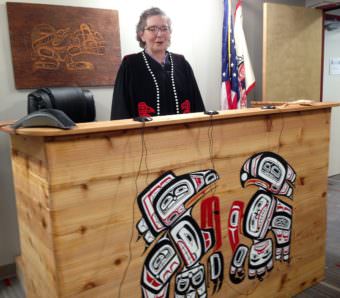
Presiding Judge Debra O'Gara stands in the Juneau courtroom of the Central Council of Tlingit and Haida Indian Tribes of Alaska. (Photo by Ed Schoenfeld/CoastAlaska News)
Presiding Judge Debra O’Gara discusses tribal justice  in the Juneau courtroom of the Central Council of Tlingit and Haida Indian Tribes of Alaska. (Photo by Ed Schoenfeld/CoastAlaska News)

Southeast Alaska’s largest tribal court operation just celebrated its 10th anniversary.

It started with child support and paternity cases and branched out to include domestic violence protection orders, custody disputes and adoptions. Now, it’s planning to further expand the kind of cases it handles.

Presiding Judge Debra O’Gara opens a hearing in the Central Council of Tlingit and Haida Indian Tribes of Alaska’s courtroom.

It follows a set procedure, but is less formal than state or federal courts. O’Gara sits at the bench and wears a black robe. But both are decorated with the council’s Eagle-Raven formline design logo.

She said the Juneau-based court has between 900 and 1,000 open cases. They involve some of the council’s approximately 30,000 members in Southeast, the rest of Alaska, the Pacific Northwest and elsewhere.

“We firmly believe that tribal members are more likely to come into court when the court is their own tribal court. And it’s their own tribal laws that are being implemented,” she said.

The Andrew Hope Building in downtown Juneau is home to the courtroom of the Central Council of Tlingit and Haida Indian Tribes of Alaska. (Photo by Ed Schoenfeld/CoastAlaska News)
The Andrew Hope Building in downtown Juneau is home to the Central Council of Tlingit and Haida Indian Tribes’ courtroom. (Photo by Ed Schoenfeld/CoastAlaska News)

The Central Council’s Tribal Assembly authorized the court in 1989, but it took a while before operations began.

It started out handling a short list of cases and related services. But that’s expanded, with grants, interagency agreements and new ideas.

One major focus is developing systems for young offenders, as well as those at risk of getting into trouble. That includes an early diversion program, which offers counseling and tutoring while encouraging involvement with extended family and cultural activities.

“If we don’t intervene early, the youth are more likely to end up committing crimes or getting into trouble and getting into the justice system,” she said.

About a year ago, the Central Council signed an agreement with the state giving it authority over some foster care and other services for Native children facing abuse or neglect.

Council Director of Family and Youth Services Francine Eddy Jones said only a few cases have been transferred so far. But they have potential.

“They’re coming into tribal court, but they’re also seeing familiar faces in terms of tribal caseworkers working with them to identify what they need to be working on,” she said.

“Our goal is always to support the families and see if we can move toward reunification,” Eddy Jones added.

The National Council of Juvenile and Family Court Judges is supporting the tribal justice program.

It recently chose Tlingit-Haida’s court as one of six nationwide to be studied and given expert advice. O’Gara said the scrutiny will help.

“It’s not any funding. But what we get is we get them to come out. They’re going to look at our system, they’re going to look at our codes, they’re going to meet our staff, they’re going to look at our procedures,” she said.

A team visited in February and its report is expected soon.

About 85 percent of the tribal court’s cases involve child support. But it has plans for further expansion. If funding becomes available, O’Gara said it will begin taking some criminal cases.

Central Council President Richard Peterson said those found at fault will be held accountable.

“We’re not trying to get some free pass for people. But we’re trying to make it so they are dealt with compassionately enough that they’re given a chance to right their wrongs,” he said.

O’Gara said there’s already an agreement with the state court system to make sentencing recommendations in some cases involving tribal members.

She said she hopes to begin what’s called “circle sentencing” soon. But cultural programs and other support services need to be put in place first.

The Central Council’s tribal court is one of several in Southeast Alaska. Others operate throughout the state.

Editor’s note: Debra O’Gara is a member of KTOO’s board of directors.

Site notifications
Update notification options
Subscribe to notifications