Ed Schoenfeld, CoastAlaska

Winter ferry schedule better than last year

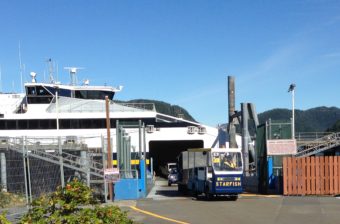
A baggage cart, nicknamed Starfish, leaves the Chenega in Sitka Sept. 3, 2015. The fast ferry is tied up for most of this fiscal year. (Photo by Ed Schoenfeld/CoastAlaska News)
A baggage cart, nicknamed Starfish, leaves the Chenega in Sitka on Sept. 3, 2015. The fast ferry is tied up for the rest of this fiscal year. (Photo by Ed Schoenfeld/CoastAlaska News)

This winter’s Alaska Marine Highway schedule offers more sailings than the previous season’s. It also eliminates five-week service gaps for some communities.

The schedule, released Aug. 17, shows a 6 percent increase in sailings. That’s the difference between last season’s 166 weeks and this season’s 176.

Ferry system spokesman Jeremy Woodrow says one fewer ship will be down for major repairs at a key time of year.

“Last year, the Columbia went in for a major capital improvement project where it was out for the entire winter schedule,” he said. And this year the Columbia will be providing service through October and the first half of November, as well as the second half of April this year.”

Drivers move their cars and trucks off the ferry Fairweather at the Angoon terminal in 2010. (Photo by Ed Schoenfeld/CoastAlaska News)
Drivers leave the ferry LeConte at the Angoon terminal in 2010. Angoon will have more service this winter. (Photo by Ed Schoenfeld/CoastAlaska News)

A draft schedule released in May called for more cuts. Overhauls of several ships would have eliminated service to Tenakee Springs, Gustavus and Angoon for more than a month.

Woodrow says marine highway staff found a fix.

“They were able to reschedule those overhaul periods and still provide service to Prince William Sound and those communities of northern Southeast Alaska without having a service gap this winter,” he said. “By doing so, we moved around the overhaul periods for the LeConte, Aurora and Fairweather and each one of those vessels will kind of be filling in for the other when they going to their overhauls this year.”

The schedule also shows no shutdown of Skagway service for part of the winter. That’s because planned repairs to the northern Southeast community’s ferry dock have been pushed back.

It’s not all good.

Work on the ferry Matanuska will cancel some southern Southeast sailings, Woodrow said.

“That is going into its overhaul in January to the beginning of February this next year,” he said. “And that will create a service gap to Prince Rupert during that time.”

Overall, service for the fiscal year is less than in the previous year, with more ships laid up.

That’s due to an approximately 10 percent budget cut tied to declining state revenues.

Correction: In an earlier version of this story, the caption to the second photo misidentified the vessel pictured. It’s the LeConte, not the fast ferry Fairweather.

Pioneer homes won’t take new residents, at least for now

The Sitka Pioneer Home was the first such facility. Five others operate in Ketchikan, Juneau, Anchorage, Wasilla and Fairbanks. (Photo by Emily Kwong/KCAW)
The Sitka Pioneer Home was the first such facility. It and others in Ketchikan, Juneau, Anchorage, Palmer and Fairbanks have lost staff due to budget cuts. (Photo by Emily Kwong/KCAW)

Alaska’s Pioneer Homes have stopped accepting new residents, at least for a while. It’s one more impact of state budget cuts.

The state’s six homes usually serve about 440-450 Alaskans at any given time.

State Pioneer Homes Division Director Vickie Wilson said reduced funding is dropping that number by about 30, or 7 percent.

“They are beds that we are not filling because we don’t have adequate staff to be able to ensure good, safe care,” she said.

Wilson’s agency has lost 30 positions, mostly because of attrition. And since senior care is labor-intensive, fewer people can be housed.

Jacque Farnsworth and Jack Brandt lead a music activity at the Juneau Pioneers’ Home. Farnsworth says she’s been singing and playing piano there since 2003. (Photo by Lisa Phu/KTOO)
Jacque Farnsworth and Jack Brandt play for Juneau
Pioneer Home residents earlier this year. (Photo by Lisa Phu/KTOO)

That means the homes, three in Southeast and three in the Railbelt, can no longer accept new residents in the highest category of care. It’s called Level 3, and it’s pretty much like a nursing home, with 24-hour, hands-on assistance.

“Right at the moment, it’s all six of them. No one’s taking any of the level 3s right at this point,” she said.

More than half of all residents, and a large number of applicants, are in that category. Two lower levels, different types of assisted-living care, require less staffing.

Wilson said seniors seeking such care might have a chance to get a bed. But, probably not right away.

“We would look carefully at their level of care and see if we could manage them with the staff that we have,” she said.

“This is devastating,” said Ann Secrest, communications director for the Alaska branch of AARP, a nationwide senior advocacy group.

She said Alaskans are living longer and staying at home as late as they can. But there comes a time when more care is required. So pioneer home cuts remove a much-needed option.

“The majority of individuals are cared for at home. There are approximately 120,000 and 128,000 Alaskans who serve as unpaid family caregivers. So there’s going to be more of a burden put on those unpaid family caregivers throughout the state,” she said.

Alaska, overall, falls far short of providing the care its seniors desire.

The Ketchikan Pioneer Home is one of six in Alaska caring for older residents. (Photo by KRBD)

Alaska Commission on Aging member Mary Shields said that’s in part because of demographics.

“We have the fastest growing senior population in the nation, by percentage. There’s nothing much we can do about that,” she said.

She said it’s no surprise pioneer homes are facing cutbacks. But she objects to those who say reductions don’t have to affect services.

“Some people call it the low-hanging fruit. I don’t. We’ve already cut all of that off. We’re now into the mid-level branches,” she said.

Residents, or their families, do pay for part of their care. Charges run from about $2,500 to $7,000 per month.

The state considered turning the homes over to the private sector to save money. But it’s dropped that idea, though services such as pharmacies could still be privatized.

Of course, beds open up as residents die. Pioneer Homes Director Wilson said 20 to 25 percent of beds become available each year.

That could allow more new residents in. But Wilson said that’s only if funding remains the same.

“Being a realist, as we take cuts, we will continue to have to consider that more beds will have to be cut,” she said.

Even in better times, it’s hard to get into a pioneer home. As of mid-summer, close to 600 people were on the active waiting list.

The inactive list, those waiting until they’re in greater need, is much larger.

Note: Finding residential care is just one of the challenges facing older Alaskans and their families. CoastAlaska’s Aging Southeast series, produced earlier this year, describes other concerns. 

Most incumbents do well in Southeast primaries

I voted sticker
Secrecy folders for ballots and “I Voted” stickers at a polling place in the State Office Building for early and absentee voting, Aug. 15, 2016. (Photo by Jeremy Hsieh/KTOO)

Tuesday’s primary election was pretty low-key in Southeast Alaska. The real battle for state House and Senate candidates will come during the general election. But a few trends emerged.

The region had no primary match-ups. So, ballots showed only one candidate per race, or in some cases, none.

Primaries up north had more action. And some say they show a more conservative, anti-incumbent drift.

But political analyst Christopher Clark, who previously worked as a journalist and a legislative aid, said it’s not that simple.

“You can draw some speculation from each of the races. But each one has its own little explanation or cause for what happened,” he said.

Southeast results show incumbents polled stronger than their challengers in two of the region’s competitive races.

One is Juneau’s House District 34, which includes the Mendenhall Valley and neighborhoods to the north.

Incumbent Republican Cathy Muñoz got about 54 percent of the total vote, while Democratic challenger Justin Parish won about 46 percent. That’s based on a bit more than 1,550 votes cast on both parties’ ballots.

Southeast Alaska's House districts are 33, 34, 35 and 36. The Senate districts, which each include two House districts, are Q and R. (Map courtesy Alaska Redistricting Board)
Southeast Alaska’s House districts are 33, 34, 35 and 36. Senate districts are Q and R. (Map courtesy Alaska Redistricting Board)

The margin was much smaller in House District 35, which includes Sitka, Petersburg, Craig, Hoonah, Pelican, Angoon and Kake.

Incumbent Democrat Jonathan Kreiss-Tomkins got just short of 51 percent of the votes. Republican challenger Sheila Finkenbinder won a little more than 49 percent. In all, just below 1,300 ballots were cast.

Clark said those and other competitive races will hang on candidates’ positions on the state budget crisis.

“This is the first step toward a fiscal plan. The primary was the first step. Because how you vote will shape what can get passed in the Legislature,” he said.

The third competitive race is House District 36, which includes Ketchikan, Wrangell and southern Prince of Wales Island. But the primary election gives no indication of how the candidates stand up against each other.

Incumbent Dan Ortiz wasn’t on the ballot, because he’s an independent, with no party primary. Constitution Party candidate Kenneth Shaw wasn’t on a primary ballot either.

Republican challenger Bob Sivertsen won all 860 primary votes. All three candidates live in Ketchikan.

Clark said the three-way race could help Ortiz, who caucuses with Democrats.

“And it can be argued that Ken Shaw, the ultraconservative, arguably, from the Alaska Constitution party, very well could take votes away from the Republican,” he said.

Two other incumbents ran unopposed in the primary and face no competition in the general election.

One is Sitka Republican Bert Stedman, who represents Senate District R. It includes his hometown, Ketchikan, Petersburg, Wrangell, Prince of Wales island and most Southeast villages. His primary vote count was just below 1,650.

The other is Capital City Democrat Sam Kito III, who represents House District 33. It includes downtown Juneau, Haines, Skagway and Douglas. His primary vote count was a bit over 1,300.

The candidates have just short of three months before the general election. Clark said they have a lot of work to do.

“It’s an old bromide, but it works. All politics is local and those who knock on doors tend to win. So the fundamentals still apply today, as they did yesterday and will tomorrow,” he said.

Five Southeast legislative seats are on the general election ballot. The sixth, Senate District Q, is not. The incumbent, Juneau Democrat Dennis Egan, is in the midst of a four-year term.

Who is on Tuesday’s Southeast primary ballots?

Southeast Alaska's House districts are 33, 34, 35 and 36. The Senate districts, which each include two House districts, are Q and R. (Map courtesy Alaska Redistricting Board)
Southeast Alaska’s House districts are 33, 34, 35 and 36. The Senate districts, which each include two House districts, are Q and R. (Map courtesy Alaska Redistricting Board)

Southeast Alaskans heading to the polls Tuesday will find few legislative candidates on their ballots. That’s because the region’s four House and two Senate districts have no primary contests. Two retired lawmakers provide some perspective on the situation.

While Southeast has six legislative districts, only three are in contention this year.

“I think that’s because people talk to each other a lot more in our communities in Southeast,” said Beth Kerttula, a former Juneau representative.

Beth Kerttula resigned her seat yesterday for a fellowship at Stanford. (Photo by Skip Grey/Gavel Alaska)
Juneau Rep. Beth Kerttula addresses the state House during her final term. (Photo by Skip Gray/360 North)

“Candidates will talk to each other. And a lot of times, people will support each other instead of fighting with each other or running against each other,” she said.

Kerttula’s old seat is one of the quiet races this year. The only candidate is the incumbent, Democrat Sam Kito III, who was appointed to the job after she stepped down.

Another quiet race is the Senate seat for central and southern Southeast. Incumbent Bert Stedman, a Sitka Republican, is unopposed.

There are a number of reasons for the small number of challengers.

Former Wrangell Rep. Peggy Wilson said some would-be primary candidates can’t make the commitment.

“You campaign hard for three months in the primary and as soon as the primary’s over, then you’re campaigning hard again for the general. So it’s six months of intense work,” she said.

Wilson didn’t seek re-election two years ago. Voters chose Ketchikan’s Dan Ortiz, an independent, to fill the seat.

Ortiz isn’t on the primary ballot because he’s not a member of any party.

Ketchikan’s Bob Sivertsen is on the district’s Republican ballot with no in-party opposition. He, Ortiz and Constitution Party member Kenneth Shaw will face off in the Nov. 8 general election.

Former legislator Kerttula said in her experience, a quiet primary doesn’t stop campaigning.

Rep. Peggy Wilson speaks during a House Resources Committee meeting during the 28th Alaska Legislature, March 17, 2014. (Photo by Skip Gray/Gavel Alaska)
Wrangell Rep. Peggy Wilson speaks during a committee meeting in 2014. (Photo by Skip Gray/360 North)

“I know the candidates right now who don’t have primaries are still out going door to door. Because it gives you maybe an opportunity to have a more in-depth and less stressful conversation with people. And that’s just hugely beneficial for everyone,” she said.

Two Southeast House races are more traditional, with an incumbent challenged by a member of the opposing party.

In Sitka, incumbent Democrat Jonathan Kreiss-Tomkins is being challenged by Republican Sheila Finkenbinder. The district also includes Petersburg, Hoonah, Pelican, Angoon and Kake.

And in Juneau, incumbent Mendenhall Valley Republican Cathy Muñoz faces Democrat Justin Parish.

That’s five of Southeast’s legislative districts. The sixth is held by Juneau Sen. Dennis Egan, a Democrat in the middle of a four-year term.

Former lawmaker Wilson said despite the lack of contests, people should still go to the polls.

“I tell everybody, ‘It’s so important to vote. It’s such a privilege to vote.’ A lot of people say, ‘Oh, my vote doesn’t count anyway.’ But our votes do count,” she said.

There is some action on this year’s primary ballot. Both the U.S. House and Senate races have interparty contests.

State Department to hear transboundary mine concerns

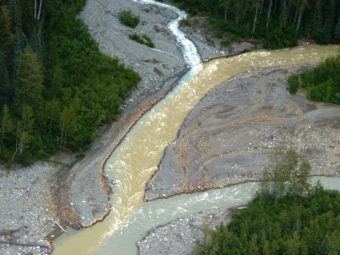
Sulphurets Creek, which drains naturally occurring rusty water from the KSM prospect, enters the Unuk River. (Photo by Ed Schoenfeld/CoastAlaska News)
Sulphurets Creek, which drains naturally occurring rusty water from the KSM mine prospect, enters Mitchell Creek upstream from Southeast Alaska. Tribal officials worry mining will send polluted water into British Columbia rivers that flow into Alaska. KSM officials say their pollution-control designs will keep that from happening. (Photo by Ed Schoenfeld/CoastAlaska News)

U.S. State Department officials are in Southeast Alaska this week to talk about transboundary mines. The Environmental Protection Agency also has sent representatives.

They’ll visit Ketchikan and Juneau at the invitation of the Central Council of Tlingit and Haida Indian Tribes of Alaska.

Council President Richard Peterson said the officials will meet with tribal governments, Native corporations and state officials.

A map of the Tulsequah and Taku Rivers watershed from Rivers Without Borders.
This map shows watersheds of major rivers in Southeast Alaska and northwest British Columbia. (Courtesy Rivers Without Borders)

“They’re basically here to hear and see our concerns with mining activities in the transboundary area of the British Columbia and Yukon … that threaten our boundary waters ecosystem and its four great rivers, which are the Alsek, Taku, Stikine and Unuk,” Peterson said.

The council is among regional and statewide groups worried about the impacts of mines and exploration projects in British Columbia.

They say polluted water could end up in B.C. rivers that flow through Southeast Alaska. That could damage salmon and other fisheries.

The State Department has declined requests to refer the issue to an international commission handling boundary-waters conflicts. The agency instead said it’s a local issue that can be worked out by Alaska and B.C. governments.

Central Council Executive Committee member Rob Sanderson Jr. said he hopes that attitude will change after the meetings. Officials will also fly over the Unuk River, a transboundary waterway north of Ketchikan.

“The biggest thing that I’m hoping for is to bring awareness to the national level and to the international level,” Sanderson said.

In addition to tribal organizations, visiting officials are scheduled to meet with Gov. Bill Walker and Lt. Gov. Byron Mallott. Mallott oversees the state’s transboundary mining efforts.

B.C. mine owners and environmental officials say they are already protecting transboundary rivers.

Note: Mitchell Creek was misidentified as the Unuk River in the description of the top photo in this article. It has been corrected. Also, the description of State Department involvement has been expanded.

Anchorage summit kicks off ferry management study

The fast ferry Fairweather docks at Juneau's Auke Bay Ferry Terminal in 2013. (Photo by Ed Schoenfeld/CoastAlaska News)
The fast ferry Fairweather docks at Juneau’s Auke Bay Ferry Terminal in 2013. It’s one of several ships with an uncertain future as the marine highway system’s budget shrinks. (Photo by Ed Schoenfeld/CoastAlaska News)

An effort to restructure the Alaska Marine Highway System begins this month with a summit in Anchorage.

The Aug. 20 event will be the first for a 12-member steering committee established to oversee the effort.

Robert Venables will coordinate the summit for the Southeast Conference, a Juneau-based regional development organization.

“Really, it’s intended to be a listening session for hearing what Alaska’s vision is for the marine highway system,” Venables said.

The restructuring effort began in May, when Gov. Bill Walker signed an agreement with Southeast Conference officials. It calls for the steering committee to work with a contractor to come up with a new operating plan.

Seattle-based Elliott Bay Design Group was awarded the $39,000 contract. It’s already produced a governance study for Washington State Ferries.

The first phase will focus on management changes, Venables said.

“Whether it takes administrative orders from the governor or it whether it’s statutory changes that the Legislature would consider and adopt into law, those are the type of things that Phase 1 will bring out in time for the next (legislative) session,” he said.

Further work will consider route and vessel changes, partnerships and new revenue sources.

Venables also chairs the state’s Marine Transportation Advisory Committee, which has examined similar issues, but has no power to change policy. Several of its members are on the restructuring steering committee.

Most state ferries operate in Southeast Alaska, though some sail Prince William Sound and Southwest Alaska.

Extra ferry life rings lean against other spare parts at the Ketchikan Marine Engineering Facility at Ward Cove last January. (Photo by Ed Schoenfeld/CoastAlaska News)
Extra ferry life rings lean against other spare parts at the Ketchikan Marine Engineering Facility at Ward Cove in 2014. (Photo by Ed Schoenfeld/CoastAlaska News)

Anchorage was chosen for the summit because of its central location, Venables said.

It will make it easier for Railbelt lawmakers, tour businesses and trucking companies that use ferries to be involved, he said.

“The marine highway system is really important to all of the state and it’s important that this effort is not just a Southeast effort, it’s not just a Southeast Conference project,” he said. “It’s a statewide project, so we want to make sure that we give everyone an opportunity to participate.”

The statewide ferry summit will be from 9 a.m. to 3 p.m. Saturday, Aug. 20, at the Atwood Building.

The Marine Transportation Advisory Committee will meet at 1:30 the previous afternoon. Both events will be teleconferenced.

Steering committee members are:

  • Dennis Watson, Craig Mayor and CEO of the Inter-Island Ferry Authority, committee chairman.
  • Elizabeth Bolling, staff to Rep. Dan Ortiz.
  • Dan Kelly, general manager of Alaska Marine Trucking (Lynden Inc.).
  • Dave Kensinger, owns a regional produce business based in Petersburg.
  • Greg Wakefield, owner of AAA Moving and Storage in Anchorage.
  • Shannon Adamson, representative, International Organization of Masters, Mates & Pilots.
  • Josh Howes, president of Premier Alaska Tours.
  • Will Ware, transportation manager, Central Council Tlingit and Haida Indian Tribes of Alaska.
  • Sharon Hildebrand, Assistant to the Director of Development and Alumni Relations for UAF.
  • John Whiddon, Kodiak City Council, owner e-commerce fish market.
  • Michael Anderson, Cordova artist.
  • Denny Bousson, 30-year employee of AMHS, Skagway.
Site notifications
Update notification options
Subscribe to notifications