Jacob Resneck, CoastAlaska

Jacob Resneck is CoastAlaska's regional news director based in Juneau. CoastAlaska is our partner in Southeast Alaska. KTOO collaborates with partners across the state to cover important news and to share stories with our audiences.

State seeks public input on future of Alaska’s ferry system

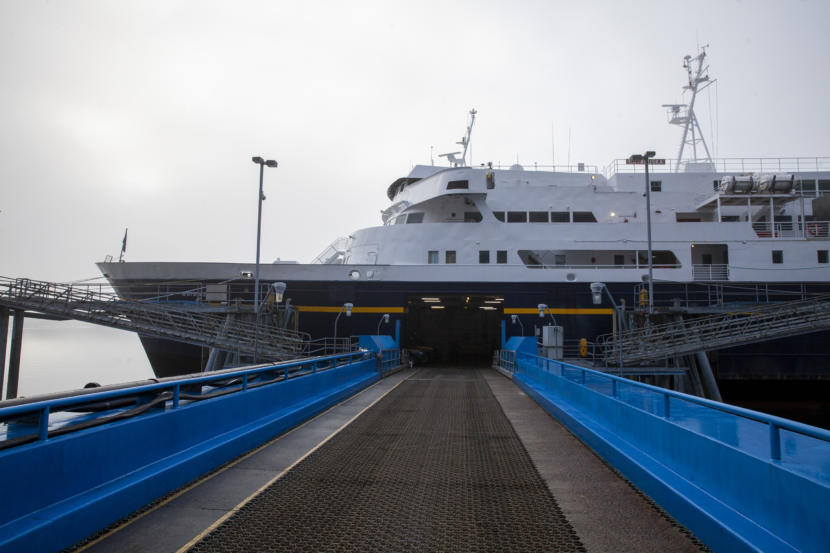
Vehicles load onto the Alaska Marine Highway System ferry Malaspina on a 2019 run to Prince Rupert, British Columbia. (Photo by Eric Stone/KRBD)

The group tasked by Gov. Mike Dunleavy to plot the course of Alaska’s ferry system is holding two rounds of public comments on the future of the fleet.

The Alaska Marine Highway Reshaping Work Group has been meeting since February. Its first task was to work from the $250,000 ferry study commissioned by the Dunleavy administration. It concluded privatization of the system would not pencil out.

Now, the nine-member group is working against a September 30 deadline to make recommendations to the administration.

“The AMHS Reshaping Work Group welcomes and appreciates public input,” Chairman Tom Barrett, a retired Coast Guard admiral and pipeline executive, said in a statement. “Our goal is to deliver a more reliable marine highway system, operating at less cost and providing coastal communities transportation that helps support their fundamental economic, educational, social, health, and mobility goals.”

Residents of coastal communities have been vocal over concerns of cutbacks to service, with more than 200 comments sent to the Department of Transportation over a five-day period earlier this month. They decried long service gaps projected this winter that the agency has blamed on declining revenues due to the COVID-19 pandemic.

The first round of public comment will be from 3 to 6 p.m. Wednesday. A second session will be held from 4 to 6 p.m. September 2.

The Department of Transportation streams the meetings on its website and on social media. People can testify by calling toll-free 1-844-586-9085. Or email DOT.AMH-Reshaping@alaska.gov.
Alaska Supreme Court halts ‘No Name Bay’ land transfer to mental health trust

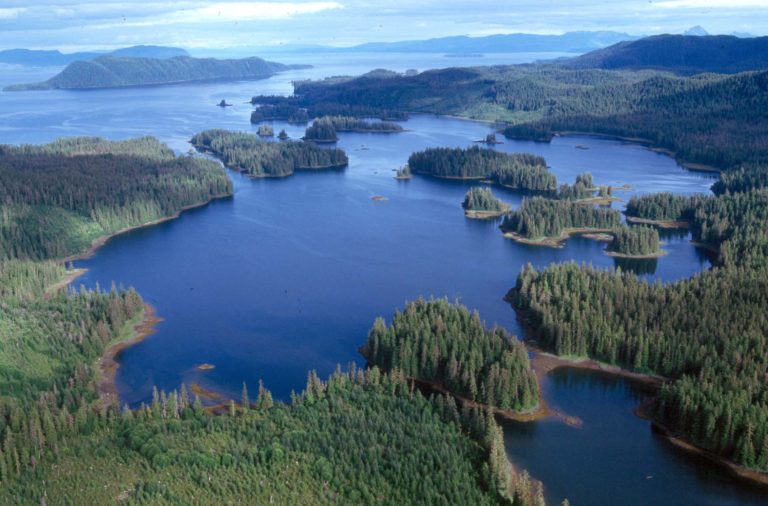
No Name Bay on Kuiu Island in Southeast Alaska in 1992. (Photo by Skip Gray/Lighthawk)

Alaska’s highest court has sided with environmentalists: The state should not have turned over a swath of Southeast forestland to the Alaska Mental Health Trust for potential logging.

The case goes back to the 1990s, when a settlement directed the state to manage an approximately 3,400-acre tract on Kuiu Island for wilderness conservation and habitat.

But the Southeast Alaska Conservation Council says that in 2009, the state Department of Natural Resources began to quietly engineer a way to turn over the No Name Bay parcel to the mental health trust, which commercially logs in the region.

“And that’s when SEACC is like, ‘Whoa, that’s against the agreement that we have,’” said SEACC Executive Director Meredith Trainor.

The group filed a lawsuit in 2013 after it learned of the state’s intentions.

On Friday, the Alaska Supreme Court released a 51-page opinion. A majority of justices rejected a number of arguments by SEACC, but all agreed with a central charge: that the state violated public notice requirements when it tried to transfer the land without telling anybody.

It’s kicked the case back to the lower court to work out the details of what exactly happens next with the land.

But the bottom line, Trainor says, is the forestland around No Name Bay won’t be ceded to the mental health trust for potential clear cutting.

“Those lands provide important access to Kuiu Island for Southeast Alaskans who hunt, fish and recreate there,” she added. “It also includes key habitat for wildlife from deer to marten, otter, wolf, black bear, migratory waterfowl and of course, salmon.”

A spokesman for the state Department of Natural Resources says the agency is still considering the decision.

“Until we’ve completed a careful review we cannot comment,” DNR spokesman Dan Saddler said in a statement.

Canadian mining company ramps up exploration near Juneau’s Herbert Glacier

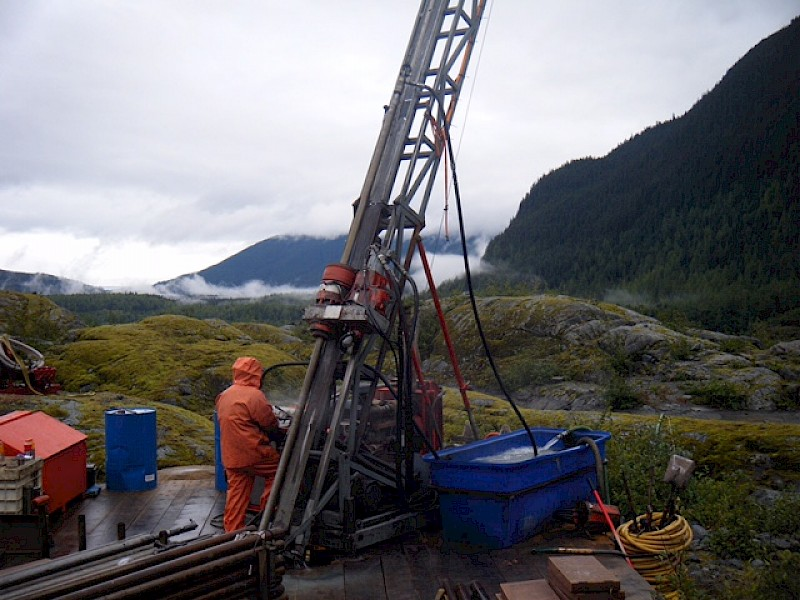
A Grande Portage drill rig near Herbert Glacier in 2019 (courtesy Grande Portage Resources)

A Canadian mining company has expanded its efforts to explore a potential hard rock gold deposit near Juneau’s Herbert Glacier. The area has been laid bare in recent decades by retreating ice.

Grande Portage Resources has been drilling on federal mining claims in the Tongass National Forest off and on since 2010. The company’s CEO, Ian Klassen, says shares sold to investors have allowed the company to ramp up drilling core samples from several gold-quartz veins this summer.

“This season is looking a little different than previous years because we have two drill rigs operating on the Herbert gold project we started drilling in the first week of July, and both rigs will now be running probably until mid to the end of September,” Klassen said.

It’s not the only difference this year. COVID-19 has meant extra precautions for bringing drilling crews to the area. The mining sector is classified as essential in Alaska, provided companies file their COVID-19 protocols with the state. Klassen says his team’s footprint has been minimal.

“We do operate in a very small bubble,” he said. “Our team works very cohesively. They traveled together, they eat together, the actual drill crews operate on a two times 12 hour schedule. So, you know, they get flown out to the site where the drill pad is, don’t interact with anybody other than the helicopter pilot and come back and, you know, at the end of a 12 hour shift, you’re pretty exhausted. So you go right to bed.”

In a statement, the company said it has drilled eight holes so far and has 15 more planned. Each of the holes contained multiple veins.

Grande Portage of Vancouver, B.C. is what’s known as a junior mining firm that explores for gold. It’s courting a larger partner that will have the resources to develop a gold mine.

Matanuska crew cleared after passengers test positive for COVID-19

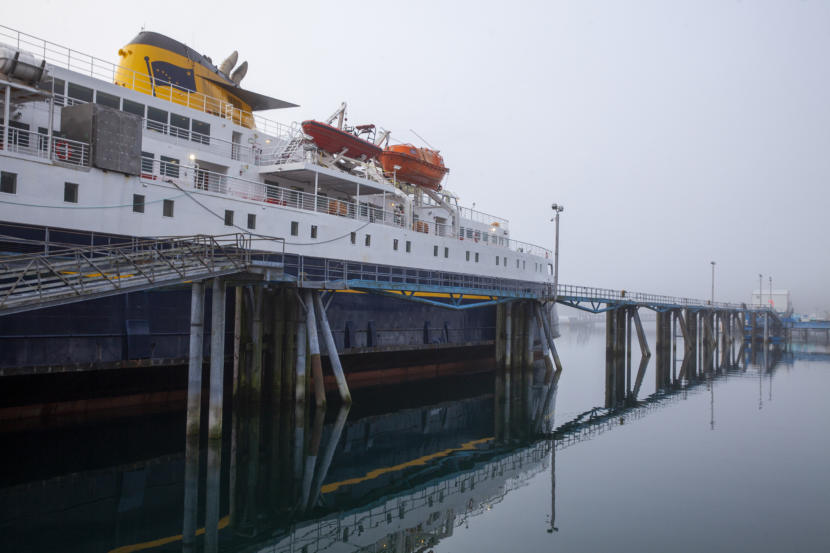
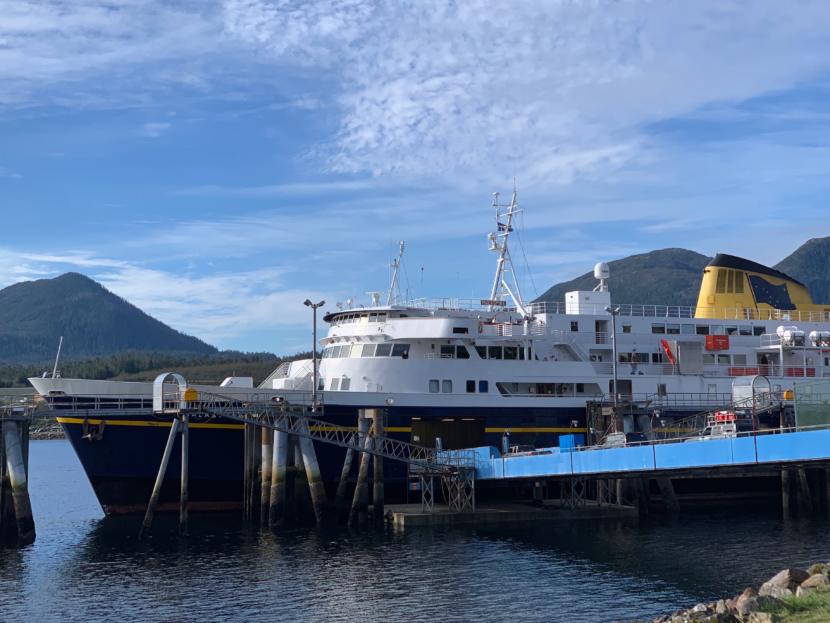
The Matanuska docked on Friday, February 7, 2020 at the Auke Bay ferry terminal in Juneau, Alaska. (Photo by Rashah McChesney/KTOO)

The crew of the state ferry Matanuska has been cleared after everyone was tested for COVID-19, Alaska Marine Highway System officials said Monday.

State officials say all 47 swabs came back negative on Sunday. That’s following a report that at least five passengers tested positive after riding the ferry from Kake to Juneau on August 10.

The mainline ferry remains in Bellingham, Washington after last Friday’s sailing was canceled. Service will resume on Aug. 21 when the ferry returns north to Ketchikan.

COVID-19 testing at Kensington Mine finds ‘approximately 25’ positive cases

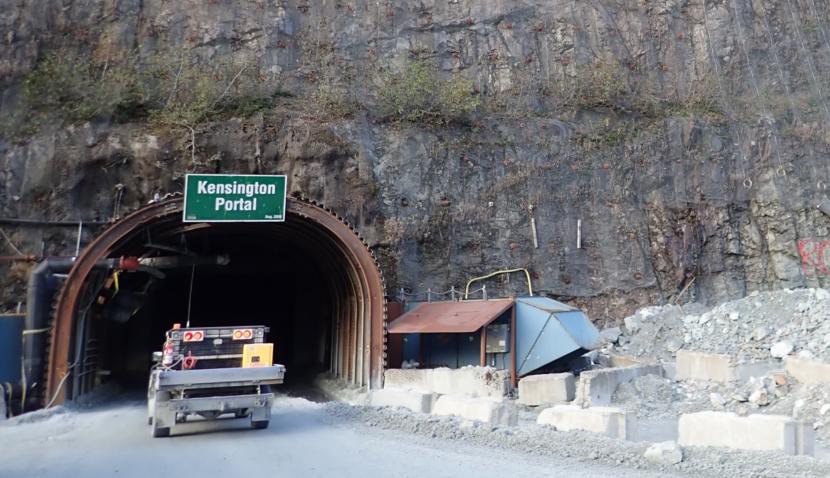
A mine vehicle enters the Kensington Portal on Oct. 15, 2019.
A mine vehicle enters the Kensington Portal on Oct. 15, 2019. It’s one of two accesses for a network of about 28 miles of underground tunnels. (Photo by Jacob Resneck/CoastAlaska)

More than two dozen people have tested positive for COVID-19 at Juneau’s Kensington Mine, representatives of the remote mine said Sunday.

Testing of about 250 people at the mine site yielded “approximately 25 cases,” according to the company.

“Approximately half of the positive cases are exhibiting mild symptoms and the remainder are asymptomatic,” Coeur Alaska spokeswoman Jan Trigg said in a statement. “The health and safety of our people, families, communities, and contractors remains our top priority, and we are committed to help stop the spread of COVID-19.”

The workers who tested positive and their close contacts have been moved off the mine site. They are now isolating at a Juneau hotel until cleared by medical providers, the company said.

Coeur Alaska quarantines its workers for one week before testing them for COVID-19. After receiving a negative test, employees work on site for four weeks.

Kensington Mine is only accessible by air and water. It is one of the largest private sector employers in Southeast Alaska, with nearly 400 people on its payroll.

5 ferry passengers with COVID-19 disembarked in Juneau Aug. 10

The Matanuska at the Auke Bay ferry terminal in Juneau, Alaska on Feb. 7, 2020. (Photo by Rashah McChesney/KTOO)

Some 49 crew members on the state ferry Matanuska are being tested for COVID-19 after a group of infected passengers rode the ferry on Monday, August 10. That’s according to state transportation officials, who announced Friday that anyone traveling on the mainliner in recent days should monitor themselves for any coronavirus symptoms.

Transportation officials say a group of five infected passengers boarded in Kake. They were traveling together and reportedly had no close contact with other passengers or crew.

The ferry made a stop in Sitka before the five infected passengers disembarked in Juneau later that day. There were nearly 150 people on the ship that day.

The ferry’s COVID-19 protocols require masks and social distancing on board, and none of the Juneau-bound passengers disembarked in Sitka’s port.

“We have in place a ‘gangway-up’ policy which does not allow passengers or crew to go ashore when the ship comes into port,” state transportation spokesperson Sam Dapcevich said in an email. “Passengers are only allowed to disembark at their destination port.”

The Matanuska arrived in Bellingham, Wash. on the morning of Friday, Aug. 14. Its entire crew is being tested for the coronavirus, state officials said Friday afternoon.

The small Southeast island community of Kake reported its first COVID-19 case on Monday, after a local woman in her 60s was medevaced. She’s recovering in a regional hospital.

The community has since gone into lockdown, banning all but essential travel to and from the village. Tribal health providers tested 371 people, which is the majority of the village’s population. Nearly all tests have returned negative. Some 12 tests are still pending, medical providers said Friday.

State transportation officials say the Matanuska’s crew will need to be cleared of the coronavirus before the ferry returns north to Alaska.

Site notifications
Update notification options
Subscribe to notifications