Jacob Resneck is CoastAlaska's regional news director based in Juneau. CoastAlaska is our partner in Southeast Alaska. KTOO collaborates with partners across the state to cover important news and to share stories with our audiences.
The Douglas Bridge as seen from the 1600 block of Evergreen Avenue, Juneau. (Photo by Tripp Crouse / KTOO)
A construction barge carrying a crane on Wednesday evening failed to clear the underside of Juneau’s Douglas Bridge. A bystander recorded the incident from shore.
The Marine Exchange logged the tug Columbia Layne at 7:41 p.m. transiting the narrows of Gastineau Channel. The tide was going out, about two hours before it would reach its low mark for the evening.
A bystander with a cell phone caught the sights and sounds of a steel crane jutting up in the air as the barge failed to clear the underside of the steel and concrete span. The crane whip-sawed upward after it dragged along the underside of the bridge. The tug and barge continued on its southeastern track.
The video was shared widely on social media Wednesday night.
Coast Guard Petty Officer Ali Blackburn says state transportation engineers did a visual inspection.
“The impact was confirmed and there was no damage reported to the vessel or the bridge” she said.
Alaska Department of Transportation’s regional spokesman Sam Dapcevich released a short statement saying bridge engineers were on scene within an hour of the apparent accident.
“Limited access and diminishing daylight kept them from completing a full inspection, but they were able to determine that the damage was not severe and that a closure was unnecessary,” he wrote Thursday morning.
State transportation engineers conducted a follow up inspection on Thursday. According to the agency, the crane caused what appears to be superficial damage that should not hinder the Douglas Bridge’s structural integrity.
The state Douglas Bridge is a 620-foot span that connects downtown Juneau with Douglas Island. The Columbia Layne is a 189-ton tug owned by Channel Construction of Juneau. Vessel tracking showed the tug setting a course to return to port.
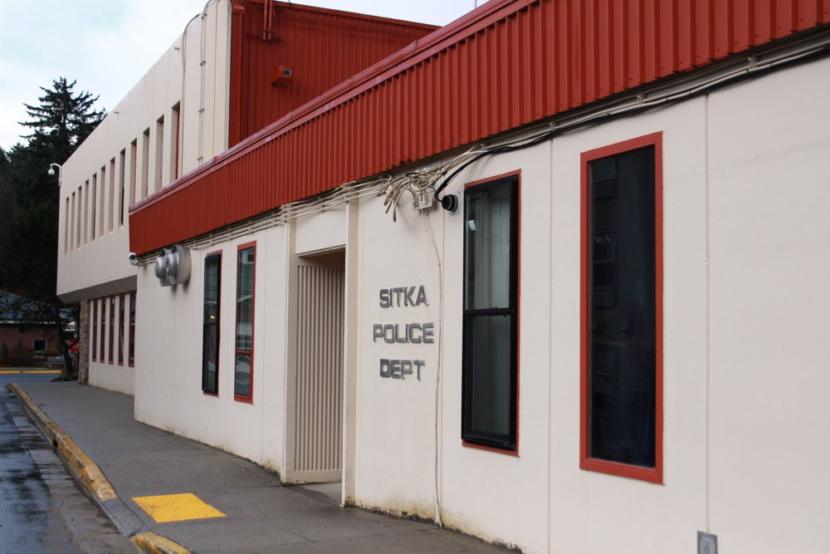
Sitka Police Department. (Photo by Karla James/KCAW)
The head of the Alaska Police Standards Council is questioning a decision by the Sitka Police Department to rehire a decertified police officer to work in its local jail. Although the hiring is now more than 10 years old, it has relevance today: The police officer initially lost his job and his certification over allegations of excessive force against prisoners, but a legal loophole prevents the state from taking action.
Dale Hanson has worked for the Sitka Police Department twice. The first time didn’t end well. He was originally hired in 1976, three years later, he shot and killed 28-year-old Peter S. James who had been reported flashing a gun at passersby near Sawmill Creek. An inquest ruled it justified as Hanson told a jury he had been fired upon.
The Sitka Sentinel reported the city paid $100,000 (about $280,000 in today’s dollars) to settle a lawsuit brought by the man’s family.
But it wasn’t the large payout that cost him his job.
“In the very early 1980s there were allegations against him that he had allegedly assaulted an inmate in the jail,” said Bob Griffiths, executive director of the Alaska Police Standards Council which oversees licensing the state’s law enforcement officers. There were actually two allegations of assault — separate incidents in 1981.
Old newspaper clippings from the Sitka Sentinel detail one of them: Hanson struck a young man he’d picked up the night before for underage drinking. He was charged with assault though it’s unclear if he was ever prosecuted.
“But the city terminated him,” Griffiths said. “And this council at that time revoked his police certification.”
Now when that happens it’s meant to be the end of the line for a person’s law enforcement career in Alaska. But not necessarily in Sitka.
The Alaska Police Standards Council was created to keep troubled officers from bouncing around the state.
“Part of the mission was to try to close the loopholes,” said former Sitka police chief Sheldon Schmitt, who chaired the commission for five years. “Because, Alaska had a bad reputation for years of bad police officers … rotated around the state.”
It was actually Schmitt who rehired Dale Hanson in 2009. It had been 28 years since Hanson was fired, and Schmitt says he doesn’t recall any red flags during the routine background check.
“I don’t think that we would have hired anybody if we had uncovered a decertification unless there was some sort of mitigating after action,” Schmitt said. “You know, things that happen later that somehow mitigated it. I just don’t think that that would have happened.”
But apparently it did. So how? Here’s what’s known: Aside from the excessive force complaints in the jail, Hanson had reportedly asked a fellow officer to falsify evidence against another man. This is all documented in his 1983 decertification letter, which literally sat in a box of paper records and wasn’t checked when he was hired a second time, this time as a jailer.
Griffiths says poor record keeping at the time may be partly to blame. Until files were digitized, records were separated by category — probation officers, jailers, police officers were separated.
“And until about six years ago when the police Standards Council purchased and put in place a computerized system those records were not integrated,” he said.
Hanson’s old police file probably would’ve remained forgotten, but a series of records requests by USA Today journalists led to the creation of one of the nation’s first databases of decertified police officers posted online last year. Dale Hanson’s name is among more than 33,000 listed across 44 states.
Earlier this month CoastAlaska asked the police standards council if this former police officer — fired and stripped of his certificate for assaulting people — had been cleared to work in Sitka’s jail?
Griffiths looked into it and notified the Sitka Police Department of possible concerns. He put the city on notice that Hanson’s continued employment as a jail guard could be referred to the standards council for possible action.
Then on July 28, 2020, after receiving some updated legal advice, Griffiths reversed himself: the legislature had carved out an exemption for municipal jailers.
“Sitka has not chosen to adopt or subject themselves to state regulation governing the municipal corrections officers in their facility — that’s the bottom line,” he said.
That means the standards council — meant to regulate police department personnel in the state — lacks any authority over Sitka’s municipal corrections officers.
“And they may just conclude that after this lengthy period of time that it’s not something they need to be concerned about,” Griffiths said, “but I don’t know that it’ll be up to them.”
The exemption for municipal corrections officers was carved out by the legislature in 1998, noted Robert Henderson, a former deputy attorney general under Gov. Bill Walker overseeing the Department of Law’s criminal division. He’s now an associate professor at the University of Alaska Anchorage’s Justice Center.
“I don’t know why the legislature carved out this exception,” Henderson said in a phone interview. “If it is a loophole and it was a mere oversight by the legislature then it needs to be addressed,” he said. “But I hesitate to answer that precise question because I think it calls for some speculation.”
Police personnel records — including allegations of abuse — are sealed. So it’s nearly impossible to check Hanson’s work history since he was re-hired in 2009.
One high-profile case is known. Hanson was the jailer on duty in 2014 when two Sitka police officers stripped and repeatedly tased a Mt. Edgecumbe student inside his jail cell.
Video was leaked online leading to community outcry over the teen’s treatment. A lawsuit was filed. Eventually $350,000 was paid to the man’s family.
Schmitt notes that the nearly six-minute video shows Hanson on the periphery throughout the Taser incident.
“The lawsuit wasn’t really directed at him,” Schmitt said. “It was directed at the officers with the Taser. But I don’t recall any complaints against him or excessive use of force complaints or really any type of complaints against Dale Hanson.”
Sitka city officials declined to be interviewed. In a statement, City Administrator John Leach says Hanson is on personal leave until August 5.
“Chief [Robert] Baty will be providing a quarterly update to the Assembly concerning his department at the August 11th Assembly meeting,” Leach wrote in an email.
Messages left for Hanson seeking comment weren’t returned.
“Regardless of Alaska Police Standard Council’s determination, we are still looking in to the matter,” Leach added in a follow up email.
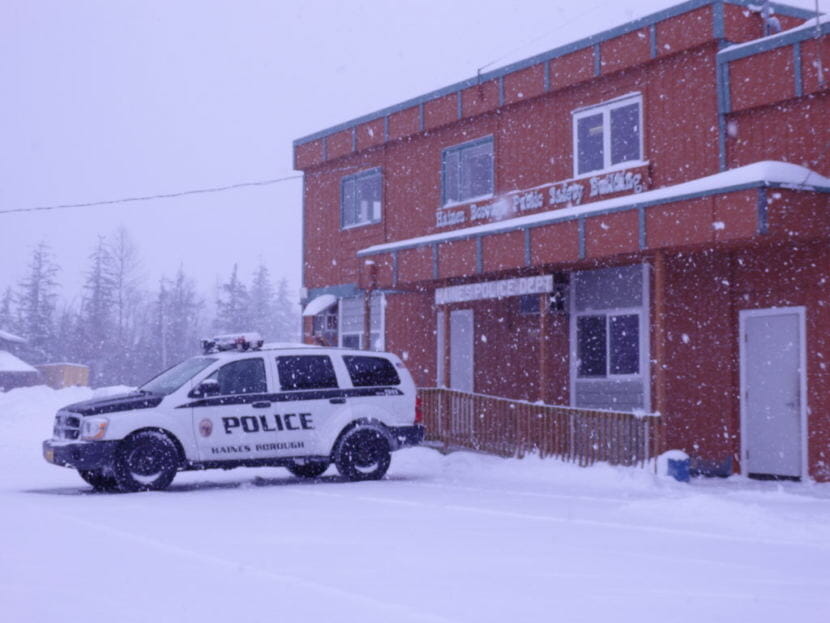
Haines Borough Public Safety Building, where the Haines Borough Police Department is headquartered. (Photo by KHNS)
Calling “the police” in Southeast Alaska could mean summoning an officer from one of more than a dozen different law enforcement agencies depending where you are.
That’s the reality in the United States where most police are local.
“There are between 17,000 and 19,000 law enforcement agencies in the United States,” said Alaska Justice Information Center Director Troy Payne. “And many of them are quite small. Many of them are, you know, a few dozen officers or less.”
That’s certainly the case in coastal Alaska which has about 14 police agencies — again, depending on how you count.
“So if you really want to know how policing is done in the United States, you’ve got to get down to the lowest unit of government that provides law enforcement services, and you know, in your neighborhood where you live,” he said.
A series of records requests filed by CoastAlaska this summer has produced nearly every policy manual or use of force policy used by police departments across the region.
A review found stark differences.
Take the use of deadly force, for example.
Ketchikan, Wrangell and Sitka instruct officers to exhaust all alternatives before firing their weapons, others don’t.
Former Juneau Police Chief Bryce Johnson demonstrates how officers saw Jeremie Tinney hold an object that appeared to be a rifle during an officer-involved shooting on Dec. 3, 2016. (Photo by Matt Miller/KTOO)
Most departments only authorize the deadly use of force on someone threatening to kill or seriously injure somebody. Or is armed and fleeing a felony arrest. But in Hoonah and Yakutat, officers can use deadly force against a rape suspect caught in the act. Or a robbery suspect whether they’re armed or not.
Payne said departments have historically resisted sharing these kinds of guidelines given to officers.
“In part, that’s because there’s a fear that the bad guys will, will learn how they do things and adapt their methods and response. And some of that’s a legitimate. There’s this growing movement for a lot more transparency than has been present historically,” he said.
Nearly every city and borough provided police department policy manuals in full. There were exceptions: In Klawock, city officials discovered they didn’t have one. The city administrator said they’re working on one now given the added scrutiny on police and how they do their jobs.
“I think right now, most chiefs around the Southeast most departments are erring on the side of transparency as a means to re-engage trust in communities based on the national discussion that’s going on,” said Haines Police Chief Heath Scott.
Scott previously worked as deputy chief in the District of Columbia overseeing hundreds of officers. In Haines, he has five.
He said when he was hired in 2016 the department’s policies file was thin.
“They had just started looking at their policies,” he said. “They had about 14, I believe.”
Over the next two years he said he worked to overhaul and set out what he felt were modern standards for his officers in how they handle evidence, use force and deal with allegations of misconduct.
A policy manual guides administrative codes of conduct. More serious offenses can end up being prosecuted. And that usually gains the attention of a state panel that’s empowered to pull a police officer’s certificate. Sworn officers need to be certified to work in Alaska.
The board is called the Alaska Police Standards Council and it’s made up of a mix of police chiefs and civilians. That board’s current executive director, Bob Griffith is a veteran of small town police departments. In fact, Heath Scott in Haines took over for him when he retired.
“Heath (Scott) ended up inheriting some of the rather lax policy — I shouldn’t say lax — but some of the policies that needed modernization from my administration,” Griffith said.
Griffith said he’s been in agencies before that had no policy and procedure manuals and had to start from scratch to develop them.
“Quite frankly, we stole from the best, and used those policies as templates, and adapted our own policy based on the agency in the community,” he said.
Another place where Southeast Alaska police departments differ is howthey use potentially deadly force, such as chokeholds.
The infamous carotid hold was used by a Minneapolis police officer on George Floyd whose death caused a nationwide uproar.
That move is completely banned by Craig’s police department on Prince of Wales Island. But in Wrangell it’s authorized as a “non-lethal” measure. In other jurisdictions it’s considered lethal force.
A police vehicle leads the 2019 Fourth of July parade. (Joe Viechnicki/KFSK)
“Out of out of an abundance of caution, I think most departments are going the way that that we are in Haines,” said Police Chief Scott. “And that’s to use it in association with deadly force if it was an option that you needed to save yourself or another than it would be afforded to you, but we do not want our officers using it outside of the deadly force circumstance.”
How force is reported also varies by department. Some require a police officer to report the threat of force — such as if they unholster their gun and point it at someone. Others only consider actual physical force used.
“There’s this growing movement for a lot more transparency than has been present historically,” Payne said. “So that’s a start, right, is that we can do things like putting policy manuals, online or otherwise making easily available so that people can look at the use of force policy in particular, but other policies that the agency has, and really start asking, okay, well, what why does this policy exist, and how is it enforced? And is this really what our community wants?”
These policy manuals are administrative guidelines and won’t automatically shield a police officer from prosecution.
But they do provide a framework of how they’re expected to conduct themselves. And they’re open to scrutiny at the community level.
Police operations manuals and use of force policies:
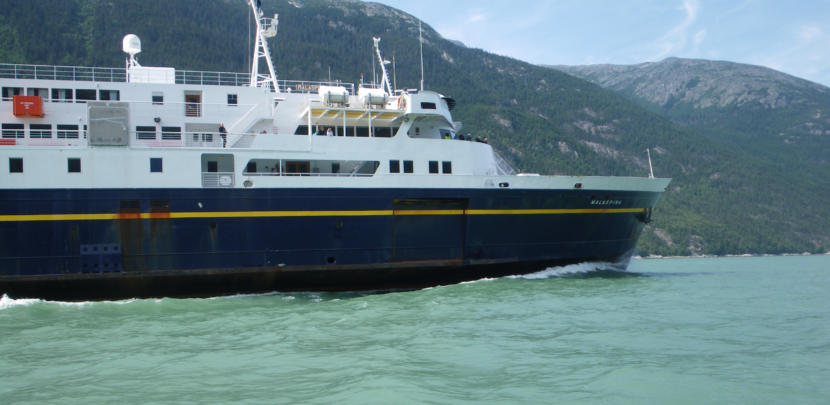
The Alaska Marine Highway System ferry Malaspina plies the waters of upper Lynn Canal in route from Haines to Skagway in Southeast Alaska, August 15, 2012. (Photo by Kelli Berkinshaw/KTOO)
A consensus is emerging among the group tasked with reforming the Alaska Marine Highway System: The $24 million subsidy proposed Gov. Mike Dunleavy is insufficient, regardless of whether the ferries are a public or private entity. The nine-member task force appointed by the governor in February is facing a deadline later this fall.
The Alaska Marine Highway Reshaping Work Group as it’s called is chaired by Tom Barrett, a former Coast Guard admiral with logistical experience working for Alyeska Pipeline Service Company.
“None of the dozens of studies have come up with the idea that any private operator could run the system and make a profit,” Barrett said at the group’s July 16 meeting.
Wanetta Ayers’ day job is to run a public policy think tank in Anchorage. She says that low target was counterproductive.
“If we drive the system down to a $24 million subsidy, not only are we critically injuring the system, but we’re probably just stepping over dollars to pick up dimes because it’s going to cost us so much more as a state to try and sustain these communities that we’re crippling,” she said.
Sen. Bert Stedman, R-Sitka, said the question of food security isn’t limited to just coastal villages in Alaska. The ferries are part of the state’s emergency supply chain in case of a catastrophe were to hit Rail Belt communities.
“We’ve been told by the finance committee that it’s probably unlikely that they’re going to be able to fly in enough food to take care of the population base,” Stedman said. “The marine highway becomes an essential corridor for keeping those Alaska citizens fed and watered.”
Sitka Republican Sen. Bert Stedman. (Photo by Skip Gray, Gavel Alaska)
There’s at least one vocal ferry skeptic in the group. Tony Johansen, a Fairbanks-based highways contractor appointed to represent road-connected communities, has been critical of the Alaska Marine Highway System’s expense. He urged the working group to take a look at the size of populations served in relation to the amount of money required to provide ferry service.
“And consequently, I think there are some people that should not be served by the system,” Johansen said. “But I would think one of those groups of people is, where we’re spending a quarter billion dollars to build a boat to service Southwest Alaska.”
He’s referring to the long-stalled project to replace the aging ferry Tustumena which runs from Homer to Unalaska in the Aleutians. His remark opened up a classic dispute between Rail Belt vs. coastal Alaska communities.
“It’s frustrating to me to hear well, ‘We can’t do that just to serve 14,000 people,’” said Rep. Louise Stutes, R-Kodiak, an outspoken critic of the governor’s cost-cutting. “Well, I’m going to tell you something, though. The road from Anchorage to Fairbanks wasn’t cheap. And it sure as hell isn’t cheap to maintain it and do all the work that DOT does on it.”
Members agreed that money alone wouldn’t fix the ferry system’s woes. Many of its problems stem from waste, mismanagement and poor planning.
Politicians on the call took aim at past political meddling in key decisions over design of the fleet’s ships.
“Every governor has a different idea,” Stedman said. “And sometimes back to back governors are, you know, 180 degrees out.”
“I think the way you you get consistency among governors is if you take that decision away from the governor’s office,” Venables said. “And you put that decision for the design of these vessels into the hands of naval architects and marine engineers.”
He says the two Alaska Class Ferries – built at a cost of around $120 million – have yet to deliver. The only one that’s been launched — the Tazlina — is tied up and won’t be returned to service until it has new side doors installed.
Its range limitations are because it’s configured as a day boat. Without quarters for crew the ship can’t run for more than 14 hours in a stretch, limiting its abilities to serve many routes in the system. Its sister ship Hubbard has yet to ferry a single passenger and likely won’t be until new side doors are installed, DOT officials said.
“It’s mind boggling to me that the Hubbard took three, four years to build and then the state’s owned it for two years,” Venables continued. “There’s no plans for revenue service and it’s a brand new boat.”
The working group is tasked with defining what essential levels of service are for coastal communities without road access, how to make the fleet more efficient, and perhaps recommendations to change the way the ferry system is run. Its report is due by September 30.
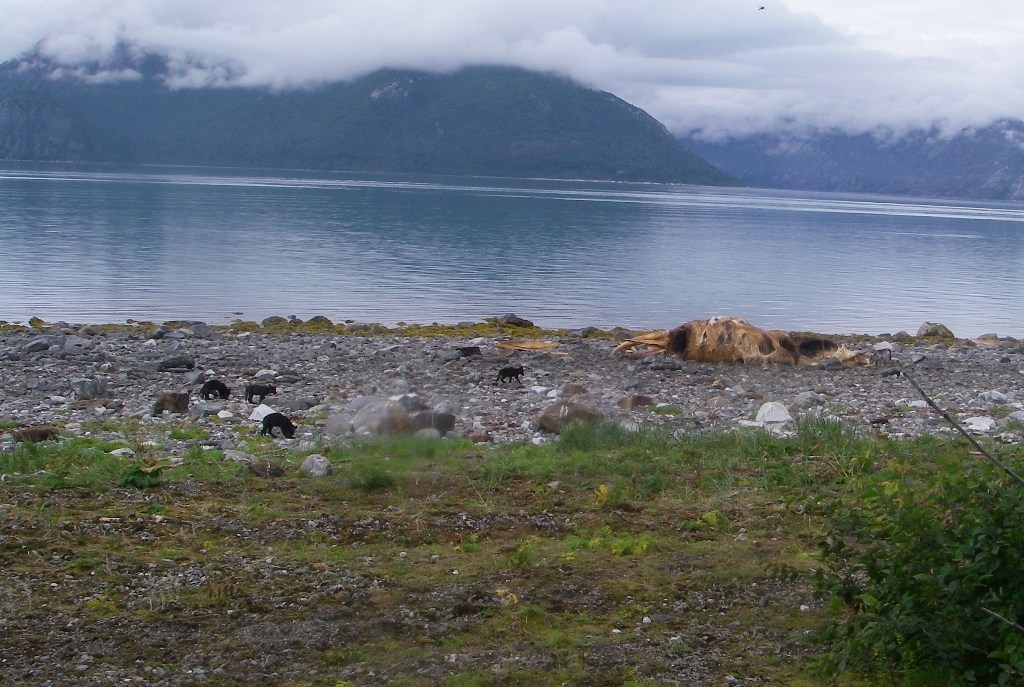
Wolf pups checking out the carcass in 2010 in Glacier Bay National Park and Preserve. (Photo courtesy U.S. National Park Service)
Conservationists filed a petition Wednesday seeking federal protections for Southeast Alaska’s wolves.
The Center for Biological Diversity’s Shaye Wolf said Alexander Archipelago wolves are being targeted by hunters and their habitat is under threat.
“These wolves are being devastated by trapping and by clear cut logging of their forest home,” the California-based staff scientist said Wednesday. “And they need some stronger protections if they’re going to survive.”
Alaska Department of Fish and Game’s regional wildlife conservation supervisor Tom Schumacher in Juneau says the agency hasn’t completed its estimate for last fall’s population. But even so, the state doesn’t believe Southeast Alaska’s wolves are endangered.
“Not having read the current petition I can’t really comment specifically — but we don’t see it as necessary,” Schumacher said. “We think we can manage the wolves sustainably.”
The 111-page petition asks wildlife managers to declare Alexander Archipelago wolves as a distinct population. It identifies threats from legal and illegal trapping, deforestation from logging, inbreeding, and climate change. It blames the decline in Prince of Wales Island’s deer habitat on the legacy of clear cuts which peaked in the 1980s and 90s.
“We will review the petition and supporting documentation as a part of our petition review process,” U.S. Fish and Wildlife Service spokeswoman Andrea Medeiros said in a statement. The agency has 90 days to respond.
The filing of a formal petition triggers what is often a lengthy and complex process.
Previous failed petitions to list the region’s wolves under the Endangered Species Act were filed in 1993 and 2011.
The cover design of Goldbelt Inc.’s 2016 annual report was inspired by the late Clarissa Rizal, a Goldbelt shareholder and weaver. (Photo by Jeremy Hsieh/KTOO)
State regulators have fined a Goldbelt Native corporation board member over a social media post that implied shareholders would be paid if they’d vote a certain way.
Screenshot of a Facebook post by Richard Beasley. State financial regulators accused Beasley of “materially misrepresenting that shareholders were required to vote in favor of the proposed settlement trust to receive $100.00 from Goldbelt.”
Everyone that participated in the election received the same incentive designed to boost participation for the Native corporation to reach quorum at its annual meeting.
In an enforcement order dated June 30, the state’s Division of Banking & Securities says: “Shareholders were not required to vote in favor of the proposed settlement trust to be eligible to receive $100.00 from Goldbelt.” It ordered him to pay a $1,000 fine.
Goldbelt shareholder Ray Austin says he’d filed a formal complaint over Beasley’s Facebook post because it was misleading.
He’s a longtime critic of the Native corporation’s management and recently was on the receiving side of sanctions over an unrelated dispute with Beasley.
“I didn’t like that statement when I saw it because I didn’t think it was truthful,” he said in a phone interview. “You didn’t have to vote ‘yes’ to get your hundred dollars.”
The state regulator fined Austin earlier in June over a Facebook post last year that accused Beasley of failing to disclose his paid contract work for Goldbelt. He says he’s requested a hearing to defend himself.