Jacob Resneck is CoastAlaska's regional news director based in Juneau. CoastAlaska is our partner in Southeast Alaska. KTOO collaborates with partners across the state to cover important news and to share stories with our audiences.
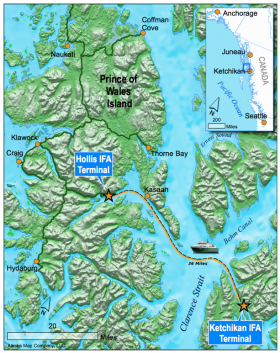
A map of southern Southeast shows the route taken by the Inter-Island Ferry Authority ferry. (Photo courtesy Inter-Island Ferry Authority)
Prince of Wales Island’s ferry link with Ketchikan has been severed after the only serviceable ship in the Inter-Island Ferry Authority’s fleet broke down last Friday.
A statement Monday describes a “catastrophic propulsion system failure” on the port side of the M/V Prince of Wales.
“We realize that this is a major inconvenience to our customers and supply chain partners,” ferry authority’s General Manager Ronald Curtis wrote in a statement. “We are working diligently on trying to identify solutions for our customers in this difficult time.”
Repairs to its sister ship M/V Stikine have been delayed “due to the inability of technicians to travel from the Lower 48,” Curtis said. “We are working to get technicians scheduled and M/V Stikine back into service.”
In the meantime, both ferries are unable to make the 72-mile round trip journey between Ketchikan and Hollis.
The IFA carries passengers, vehicles and freight and is key to supplying Southeast Alaska communities on Prince of Wales Island.
The M/V Stikine is projected to be back in service on June 11 and will sail five-days-a-week, Curtis said. Her sister ship Prince of Wales will be repaired once parts and technicians are available, he added.
“The funds are distributed to provide relief as soon as possible,” she told CoastAlaska on Tuesday. “But we also need to balance that with the fact that some of the eligible fisheries included in the assistance are either ongoing or have not started yet.”
The state’s plan will likely be overseen by the Pacific States Marine Fisheries Commission. But Alaska officials and lawmakers have been pushing for the state to cut the checks directly.
Baker says the state’s negotiations are ongoing with federal fisheries officials to avoid delays.
“We have heard those concerns,” she said. “And so we are examining mechanisms to get the funds directly in the most expeditious manner either from NOAA Fisheries or the Pacific States Marine Fisheries Commission for the state to take the lead on.”
Those eligible for funding include commercial fishermen, charter guides, tribes, employees of seafood processors and subsistence users in Alaska’s state and federal fisheries.
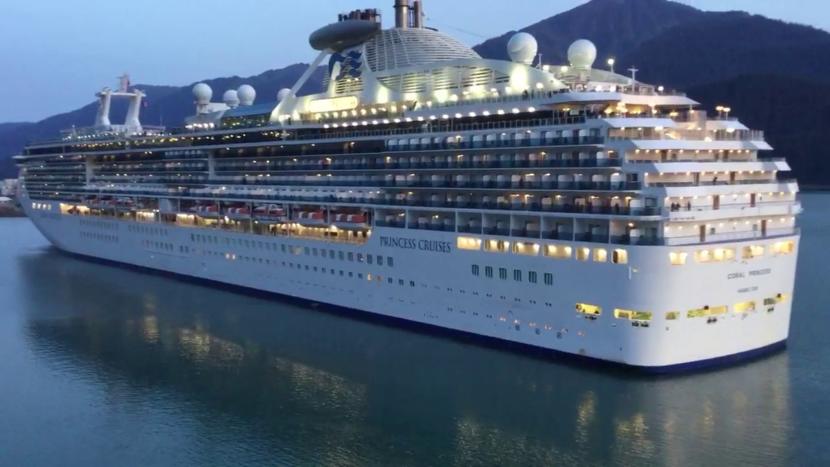
This still from a video shot by an Ocean Ranger aboard the Seven Seas Mariner shows the Coral Princess adrift after it lost power on the evening of Aug. 10, 2019. (Photo courtesy Mark Farley/Ocean Rangers)
A Princess Cruises ship lost all power to its engines as it was maneuvering away from Juneau’s docks last summer. The Coast Guard fined the cruise line for not immediately reporting the close call, and the agency recently discussed the case for the first time.
A state cruise ship monitor shot a series of short videos from the deck of a nearby cruise ship. The Ocean Ranger’s video and subsequent written report offer details on how the 19,600-ton Coral Princess drifted without power in Juneau’s Gastineau Channel.
The Coast Guard’s investigation found contaminated lube oil in one of the ship’s diesel generators caused it to break down as the Coral Princess was getting underway.
Coast Guard Lt. Nicholas Capuzzi was the lead investigator for the Aug. 10, 2019, incident. He says when a generator fails, the ship’s power management system is supposed to keep the remaining generators from being overtaxed.
“One of the watch officers had neglected to properly configure the generator ahead of time,” Capuzzi told CoastAlaska on Monday.
That meant the surge in demand knocked out the ship’s second diesel generator as well.
“So both generators were offline and as an electric propulsion-driven vessel there was no longer any power to the propulsion motors,” he explained.
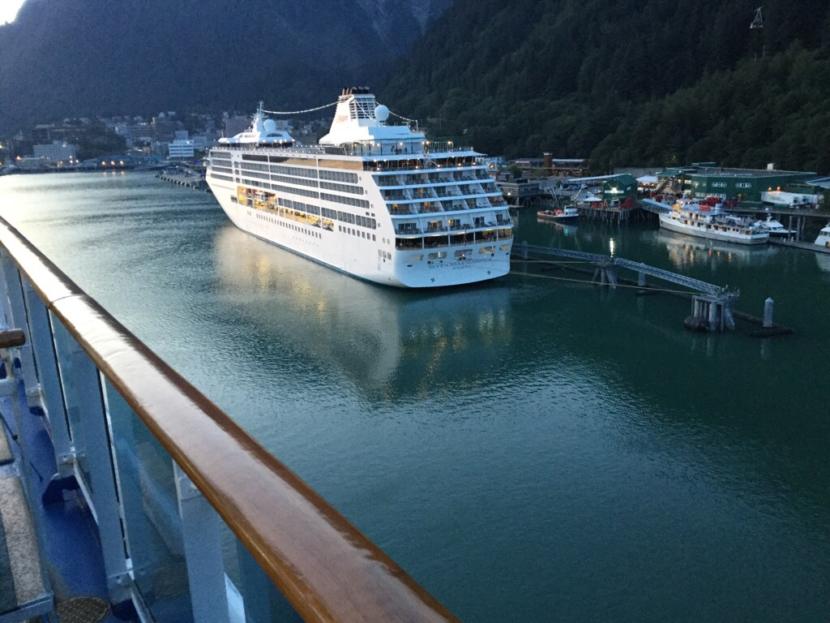
Steven Chouinard – an Ocean Ranger cruise ship monitor – shot this photo from the Coral Princess’ deck after it lost power and began to drift toward the Seven Seas Mariner (pictured) moored at Juneau’s AJ Dock. (Photo courtesy Steven Chouinard/Ocean Rangers)
It was about a quarter to nine — an hour before high tide — with light winds and calm seas. Even so, without propulsion, the Coral Princess began drifting toward a smaller cruise ship, the Seven Seas Mariner, moored to an adjacent dock.
As the crew prepared to drop emergency anchor, Capuzzi says a gas-turbine generator was brought online nearly 10 minutes after the blackout took out the engines.
“And that provided enough power for them to regain propulsion,” he said. “And then they eventually brought the non damaged generator back online as well.”
The ship’s crew was required to tell the Coast Guard about the failure immediately. But that didn’t happen until 10 p.m. — more than an hour after the 8:47 p.m. blackout. By then, the ship had already departed for Skagway.
Capuzzi says the delay in reporting the mishap was a violation of regulations. Princess Cruises — a subsidiary of Carnival Corp. — paid a $5,000 fine on February 14.
CoastAlaska first inquired about the incident last October. And followed up with a Freedom of Information Act request in January. But it was only this month that the federal agency agreed to speak about the findings of its investigation which it completed in January.
The records request remains unfilled by the agency’s Washington, D.C., headquarters, without explanation.
Princess Cruises representatives did not respond to phone or email messages seeking comment.
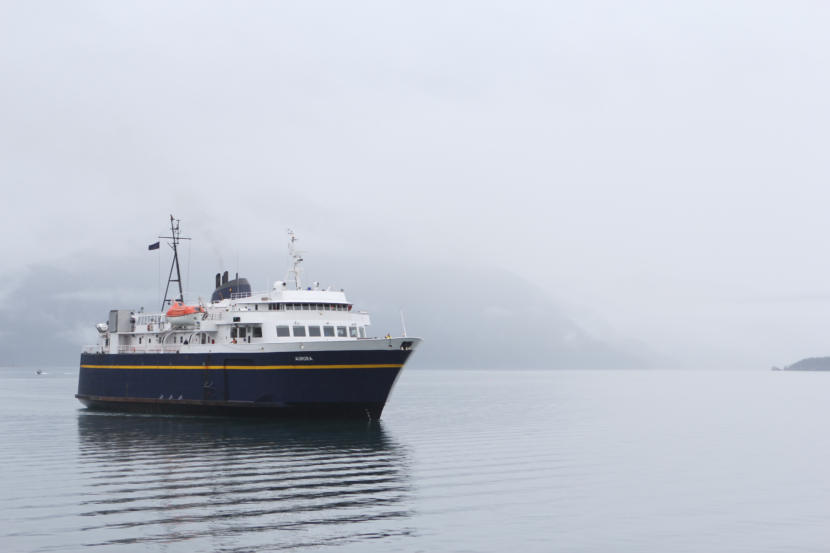
The Aurora, a 235-foot Alaska state ferry, approaches the dock in Whittier, its departure point for its trip across Prince William Sound to Cordova. (Photo by Nat Herz/Alaska’s Energy Desk)
Gov. Mike Dunleavy’s administration has filed a four-year request for federal support for the state’s transportation needs. But critics say it prioritizes highways and bridges over fixing the state’s aging ferry fleet.
“We are doing everything we can to work on fixing this issue — and like I said — coming together to come up with a sustainable solution that’s gonna go forward for many years,” he told reporters on Feb. 19.
Asked about using federal highway dollars available for maintenance and repairs, the governor deferred to Department of Transportation Commissioner John MacKinnon, who pointed to the agency’s Statewide Transportation Improvement Program, or STIP.
“Look at the STIP and that will show you where we’re putting federal funds into ports and ship repairs,” MacKinnon said.
It’s a four-year plan to leverage nearly $500 million in federal funding to pay for state transportation needs; a wish list of sorts that the state draws up to spend federal money. And under the program, the federal government pays about 90% of each project whether it’s a road, bridge or ferry boat.
As part of the deal, the state gets a pot of federal money that has to be spent on ferries. It works out to about $16.8 million a year for the entire fleet. But the state can also spend other federal funds on the ships too.
Only according to the STIP approved on April 28 — it doesn’t plan to. Critics say that’s a red flag.
“By not asking for enough money to maintain the fleet, it’s an indicator of what their intentions are,” David Kensinger, a Petersburg businessman and member of the steering committee of the Alaska Marine Highway Reform Project.
He told CoastAlaska that the state’s use of federal dollars doesn’t prioritize the aging vessels.
“When you have a fleet where the majority of the vessels are between 45 and 58 years old, if you want to keep them running, you have to have an active maintenance program,” Kensinger said. “You actually have to spend real money on them.”
To be clear, this isn’t a huge change from the way federal funds were spent on the marine highway in previous years.
Data provided by state transportation planners show the ferry system has received — on average — about $21.2 million annually in total federal funding between 2010-19.
But the latest STIP projects the state putting less than that into ferry repair for the next four years at a time when breakdowns and mishaps are becoming more common.
DOT’s Program Development Director Ben White says the drop is due to other critical highway projects across the state.
“We have more needs in the state for infrastructure than we have available federal funding so we’re having to stretch the federal dollar further and further,” he said. “But there isn’t a policy that’s roads first.”
He says the STIP is often amended — meaning the state can redirect federal funds to specific needs. His agency is working on an amendment now, he said, but details won’t be out until summer.
Some of the long-range planning decision hinge on the recommendations of the governor’s Alaska Marine Highway Reshaping Work Group, state officials say, which is meeting through the end of summer to advise the administration on the future of the fleet.
“And so that’s part of the other issue that we’ve tried to program a STIP for the next four years worth of funding and we’re also waiting for the reshaping working group to come out with with their initial findings and their priorities,” White added.
Transportation Commissioner John MacKinnon has cited another key reason why more federal dollars aren’t being leveraged for ferries. It has strings attached: federally funded projects have to be put out to a nationwide competitive bid.
“Annual overhauls are done at the Ketchikan shipyard, they’re done with state funds,” he told reporters in February. “If they were to be done with federal funds, we’d have to write up a much bigger design and contract put it out to bid and the work very possibly would go to Seattle or Portland — so probably not in our best interests.”
There’s strong support in the legislature for keeping money in-state and employing Alaska workers.
“But when you have a ship that needs massive amounts of work, there comes a time when you need to take a look at the fiscal efficiency and using the federal highway funds,” Sen. Jesse Kiehl (D-Juneau) said in an interview. “And sometimes that means opening up that competitive bid without an Alaska bidders preference.”
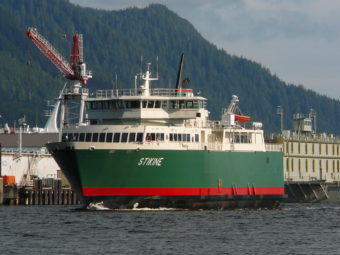
The Inter-Island Ferry Authority ship Stikine sails to its Ketchikan terminal in 2008. (Photo by Ed Schoenfeld/CoastAlaska)
And there’s another wrinkle: Alaska has two public ferry systems: the marine highway and the Inter-Island Ferry (IFA) that runs between Ketchikan and Prince of Wales Island.
This year, the IFA was left out of the four-year STIP. That’s led to warnings it’ll need a commitment of about $6.2 million to keep its two ships running.
“It makes me a little uneasy that we’re not in the STIP, of course,” IFA chief Ronald Curtis said.
But he says he’s received assurance that the IFA will get the money it needs.
It may be from the pot of ferry boat money. And that could mean even less for repairs and upkeep for the Alaska Marine Highway System’s fleet.
Or it might not. It all depends on how the agency amends its transportation plan later this summer.
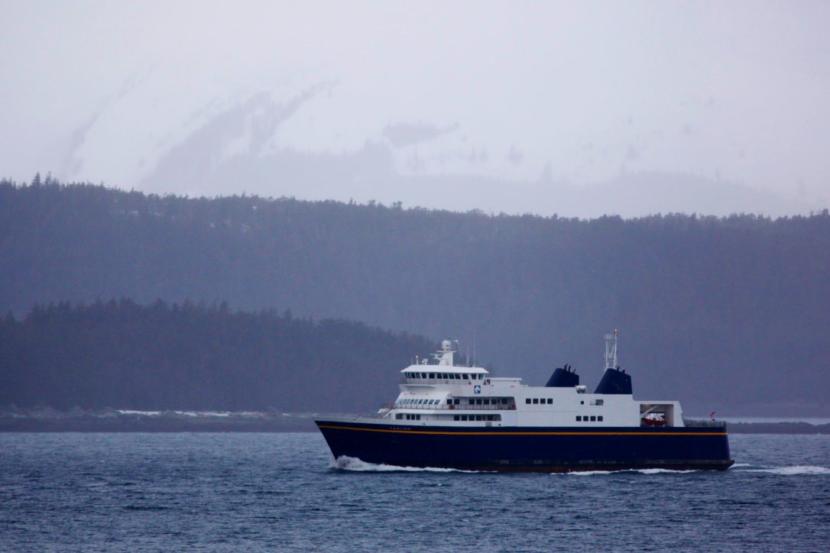
The M/V Tazlina rounds Point Retreat on its way to Juneau on Saturday, Jan. 29, 2020. (Photo courtesy of Jay Beedle)
Masks and other face coverings won’t be made mandatory for passengers and crew aboard state ferries.
In a statement, the Alaska Marine Highway System says it puts the health and safety of employees and passengers first and will continue to work to prevent the spread of COVID-19. It says cloth masks are available for crew but not currently required.
“Right now passenger numbers on AMHS vessels are very low, and social distancing is easily attainable for employees and passengers,” state transportation spokeswoman Meadow Bailey said in a statement.
Alaska Airlines recently announced that masks are now required for any crew members coming within six feet of passengers. The mask requirement will be extended to passengers on May 11.
Since March, the state ferry system says it’s been turning away passengers with flu-like systems. The measure is designed to prevent the spread of COVID-19 between communities.
There are currently two vessels running: the Tazlina connecting the northern panhandle and the Lituya that shuttles between Metlakatla and Ketchikan.
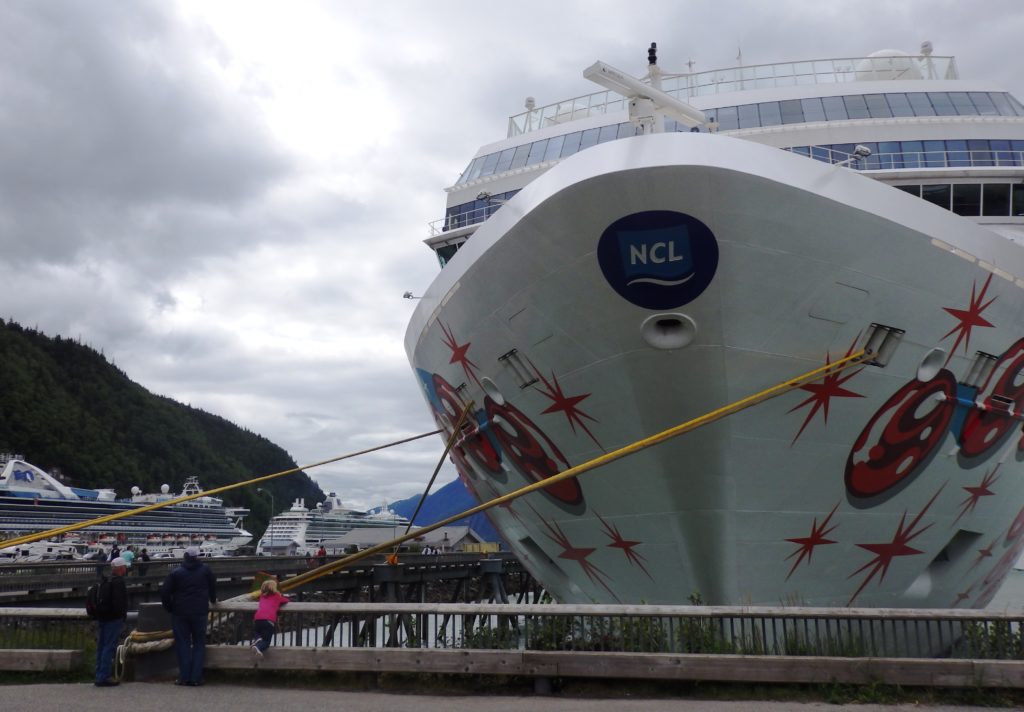
The Norwegian Pearl tied up at Skagway’s Broadway Dock in July 2017. Two more cruise ships are moored at the railroad dock in the background. (Photo by Emily Files/KHNS)
Update (May 6, 11:54 a.m.) — Jacob Resneck, CoastAlaska
Norwegian Cruise Line Holdings Ltd. now says it’s successfully raised $2.225 billion.
“Contingent on completion of the transactions, the company expects to have approximately $3.5 billion of liquidity,” the company said in a statement released on Wednesday. “This significantly strengthens the company’s financial position and liquidity runway and it now expects to be positioned to withstand well over 12 months of voyage suspensions in a potential downside scenario.”
Norwegian Cruise Line Executive Vice President Howard Sherman told CoastAlaska in an email early Wednesday that the cruise line’s “commitment to Alaska is stronger than ever.”
“I can confirm for you that all of our investments in Alaska have been proceeding on schedule,” Sherman wrote. “The payments for the Juneau property have been made, and will continue to be made, on schedule. And both funding, and construction, of the projects at Ward Cove and Icy Strait Point have proceeded on schedule.”
Original story
Stock in Norwegian Cruise Line’s parent company took a dive on Tuesday, erasing more than 22% of its worth.
That’s following news that the cruise line is seeking to raise $2 billion in capital to stay afloat.
Norwegian is the smallest of the world’s big three cruise lines. But it’s heavily invested in Southeast Alaska. It deployed two megaships last year — the Norwegian Bliss and Norwegian Joy — and had planned their return this year until the COVID-19 pandemic.
“To date, Norwegian Cruise Lines has paid $15 million on schedule,” Alaska Mental Health Trust Authority spokesperson Allison Biastock wrote Tuesday in a statement to CoastAlaska. “NCL has been communicating that they expect to close the deal with complete payment later this calendar year.”
The Miami-based company told investors Tuesday it’s raising $2 billion through a combination of stock offerings and private bonds that would be paid back first in the event of the cruise giant going belly up. The cash infusion includes $400 million from L Catterton, a private equity group that gets a seat on Norwegian’s board of directors.
The company’s stock sale announcement included a cautionary note cataloging a laundry list of risks facing the cruise industry.
The risks and uncertainties facing Norwegian Cruise Line, the statement said, “are amplified by and will continue to be amplified by, or in the future may be amplified by, the COVID-19 outbreak.”
The company is putting up — among other things — two cruise ships and two islands it owns as collateral.