Jacob Resneck, CoastAlaska

Jacob Resneck is CoastAlaska's regional news director based in Juneau. CoastAlaska is our partner in Southeast Alaska. KTOO collaborates with partners across the state to cover important news and to share stories with our audiences.

Colorado mining company agrees to multi-million dollar clean up plan for Tongass uranium mine

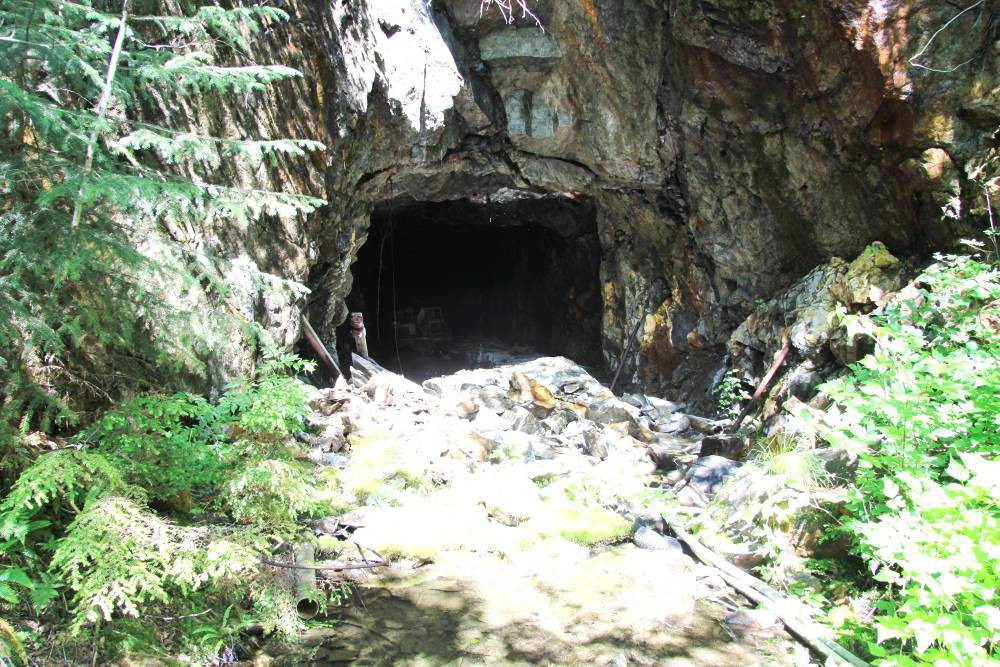
A portal into the former Ross-Adams Mine on Prince of Wales Island
This portal to the former Ross-Adams Mine is one of three openings to be sealed to prevent radioactive waste from leaching into the environment. (Photo from U.S. Forest Service)

Alaska’s only producing uranium mine has been idle for nearly a half century leaving a legacy of radioactive waste in the Tongass National Forest. Now, a Colorado mining company has agreed to a $7 million clean up plan for the Prince of Wales Island area that’s been in the works for decades.

The former Ross-Adams Mine lies on the slopes of Bokan Mountain at the head of Kendrick Bay. It’s relatively remote — about 40 miles by air to Ketchikan. But its location doesn’t mean people don’t treasure the area.

“Local residents here will use that area for halibut, as an example, coming up here in the next couple of weeks,” said Eric Rhodes of the Organized Village of Kasaan. He’s the tribe’s point-man overseeing efforts to clean up pollution in the region.

“It is a highly used area and precious and protected for a reason,” he added.

But this area has long been used for other purposes, too. The federal government commissioned aerial surveys in the 1950s to find uranium deposits throughout Alaska to fuel the nation’s atomic reactors and build nuclear weapons.

An open pit mine was developed in 1957. It would change hands, opening and closing several times before shuttering for good in 1971.

And it’s that same open pit that the most recent operator, Newmont Corporation of Colorado, has agreed to fill in with radioactive mine debris.

Some of the old equipment and structures will need to be torn down and hauled off the island, says Linda Riddle, the U.S. Forest Service official overseeing the project.

“There’s a lot of associated debris from the mining operation,” she told CoastAlaska. “They had some trailers and buildings and lodging that, you know, they’re really falling down and they can’t really be used for anything. So all that stuff will be cleaned up and removed.”

But most of the radioactive debris will be buried and covered with a geo-membrane — essentially a heavy plastic covering to seal up the site.

This is all detailed in a 114-page consent agreement tentatively reached between Newmont Corporation — one of the world’s largest mining companies — and the U.S. Forest Service in the past year. It lays out the mine company’s final responsibilities with the site by completing the estimated $7 million clean up. It also waives more than $530,000 in costs the Forest Service says it’s incurred reaching the deal.

Cleaning up the area isn’t the only reason there’s interest in getting this job done. The state of Alaska first identified it as a contaminated site more than 20 years ago. But now there’s another mining company with interest in Bokan Mountain lending new urgency to cleaning up the radioactive waste.

Canada’s Ucore has been investing in a rare earths operation at Bokan Mountain. These are rare metals and minerals used in high tech products like smartphones and flat-screen TVs.

In 2014, Alaska’s legislature approved $145 million in low-interest bonds to help underwrite its efforts to develop a rare metals industry in Southeast Alaska.

Ucore’s New Hampshire-based Chief Operating Officer Mike Schrider says the former open pit uranium mine is about a mile away from where the Canadian mining company is prospecting.

“But because there is a haul road that goes out there and everything originates in Kendrick Bay,” Schrider said, “this is certainly going to going to help the area overall and we’re very excited about this.”

State and federal environmental regulators won’t help oversee the cleanup plan. That’s because the Forest Service has asserted itself as the lead agency responsible with making sure all relevant laws are followed.

EPA’s regional office has in the past raised concerns about this arrangement, most recently in 2018. But in a statement to CoastAlaska spokesman Bill Dunbar says EPA is pleased work is moving forward to cleanup the site.

“While the Forest Service has the authority to direct cleanups on its lands under the Superfund Law, EPA retains its authorities to compel further action if we have reason to believe additional actions must be taken to protect human health and the environment,” Dunbar wrote. “At this time, we have no reason to believe such actions are warranted.”

After the work is completed Newmont has agreed to monitor the site for three years. And state regulators say effective monitoring will be key.

Anne Marie Palmieri is a project manager for contaminated sites for the Alaska Department of Environmental Conservation. She’s been tracking this site for about 18 years and says state regulators want assurances that of the long-term success of the plan.

“There are no stipulations about how monitoring will continue,” she said. “So that’s something that we will want to know — how the Forest Service will ensure that the remedy remains protective.”

The Forest Service is taking responsibility for the site after Newmont fulfills its commitments under the plan.

And Riddle says there shouldn’t be any issues as long as the work is well-engineered and executed. A third-party engineering analysis in 2015 laid out different scenarios for the site.

“And the Forest Service selected the most robust alternative for cleaning up the material and closing the mine site,” Riddle said.

The Forest Service is accepting written comments on its proposed agreement with Newmont Corporation through August 7.

Preliminary work is expected to begin later this year.

Goldbelt shareholder fined $1,000 over Facebook post accusing state regulator of inaction

The cover design of Goldbelt Inc.'s 2016 annual report was inspired by the late Clarissa Rizal, a Goldbelt shareholder and weaver. (Photo by Jeremy Hsieh/KTOO)
The cover design of Goldbelt Inc.’s 2016 annual report was inspired by the late Clarissa Rizal, a Goldbelt shareholder and weaver. (Photo by Jeremy Hsieh/KTOO)

State financial regulators have fined a Goldbelt, Inc. shareholder over a Facebook post complaining of inaction by the state agency responsible for financial oversight of the corporate board. This comes as the state’s broad powers over shareholder speech is under review by the Alaska Supreme Court.

Goldbelt shareholder Ray Austin complained to regulators in 2018 that board members were breaking the rules by not filing financial disclosures.

“It’s important that board members disclose any conflict of interest that they may have,” he said in a recent phone interview from his home in New Mexico.

But he says that the Alaska Division of Banking & Securities, which has oversight of the board of Juneau’s urban Native corporation, did nothing.

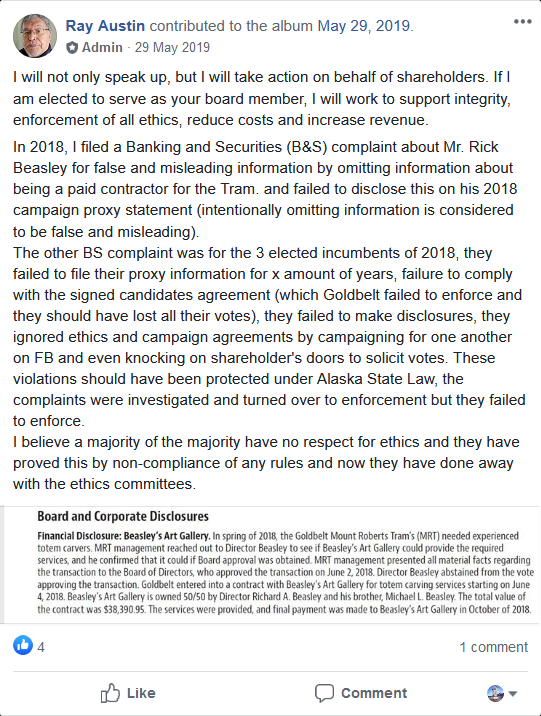
Then, in a Facebook forum in May of 2019, while running for a seat on the board he went public with that and another complaint he’d filed:  Goldbelt board member Richard Beasley, an accomplished Tlingit master carver, had signed a contract for work at the corporation’s Mount Roberts Tramway a month before the corporation’s annual meeting and board elections. But this wasn’t disclosed to shareholders.

Alaska’s Banking & Securities Division says “Facebook posts are ‘proxy statements’ as defined in 3 AAC 08.365(14) because they are communications that were made available to shareholders under circumstances reasonably calculated to result in the procurement, withholding or revocation of a proxy. In other words, they could help sway a shareholder with voting power in a Native corporation election. (Screenshot by Jacob Resneck/CoastAlaska)

Normally board members aren’t allowed to work for corporations they’re overseeing. But the board had made an exception for one of their own. Austin’s post also revealed the details of past complaints, none of which he believes were acted upon by regulators.

But it’s that public, online complaint that’s landed Austin in hot water. State financial regulators are empowered to regulate any public statement that could sway a board election in a Native corporation — which his post seeking support from shareholders arguably was.

The rules are designed to block misleading information that could affect projects and defraud investors. But critics like Austin say it’s more often used to silence dissent of shareholders of regional, urban and village Native corporations.

Freedom of speech is important. I think, shareholders or anyone should have the right for freedom of speech,” Austin said, “and it appears that we don’t.”

Regulators charged with enforcement say that’s not the case.

Every complaint is treated equally,” said Leif Haugen, chief of enforcement for the state’s Banking & Securities Division.  He wouldn’t comment on allegations against Goldbelt’s board of directors, as investigative files are confidential.

Most, though not necessarily all, enforcement actions are generated by complaints brought to the seven-member enforcement team. He says most orders and fines are against individual shareholders probably because they often don’t have the same access to professional legal advice.

“We see more complaints against shareholders maybe because they aren’t quite as knowledgeable about the regulations.”

Goldbelt’s CEO McHugh Pierre says the corporation didn’t try to silence Austin, a perennial candidate for the board and outspoken critic of the corporation’s management. And he denies that  board members band together to campaign for each other.

“We don’t have a board slate like Sealaska or other corporations do,” he told CoastAlaska News. “It’s a totally independent campaign cycle. And so the corporation doesn’t take a position one way or another and doesn’t take actions against candidates regarding Banking & Securities investigations.”

So why did regulators issue a June 16 enforcement action against Ray Austin?

  • He didn’t file disclosures of his own with the agency before publicly seeking support for his election campaign.
  • The Facebook post got a date wrong in his narrative about Richard Beasley’s disclosure requirement for working as a contractor at the corporation’s Mount Roberts Tramway.

“So, (Austin) was saying that it should have been disclosed in the 2018 proxy,” Pierre explained, “which, that was impossible because the work wasn’t for the previous year. The work was beginning in 2018. And in fact, began after the proxy was already printed (in April).”

And it’s on this basis that regulators say a “material misrepresentation” was made, and fined him $1,000.

There are differing views on whether Goldbelt should’ve disclosed one of its board incumbents had a paid side-gig with the corporation. But to date, regulators are silent on that point.

“I won’t speak about other matters that have been under investigation that didn’t result in an order or anything that may be currently being investigated,” Haugen said.

But back to the larger question: Are regulators overreaching by fining dissident shareholders? The Alaska Supreme Court has already heard arguments from the ACLU, challenging the state’s power to regulate any speech in print or online that could influence the governance of Native corporations.

Haugen says the courts have traditionally sided with the regulator. In fact, its broad powers aren’t limited to just shareholders of Native corporations created out of the Alaska Native Claims Settlement Act or ANCSA.

“Any person, theoretically, who gets involved in soliciting proxies could become a respondent in an ANCSA complaint,” Haugen said. “I can tell you that I haven’t seen that in my time here. But I guess it’s theoretically possible.”

That remains untested. Even so, the state’s authority over Native corporation elections violating free speech is a question now being weighed by Alaska’s Supreme Court justices.

Austin has the right to defend himself in an administrative hearing. But to do that, he’ll need to have forms notarized — in person — and he says that’s too risky in a pandemic. He lives in New Mexico, where as of early July 2, more than 500 people have died from COVID-19; there have been more than 12,000 confirmed cases in the state.

“We’re close to the Navajo reservation and my wife’s Navajo and we know people that have the virus right now,” Austin said. “My brother-in-law’s brother died from it and so I just didn’t want to jeopardize myself and my family.”

He’s now in touch with state regulators on the potential workarounds so he can defend himself in a hearing without coming into contact with people outside his household.

Effort to have term limits for Sealaska board fails, and other news from the 2020 annual meeting

A Sealaska corporate logo adorns the roof of the Southeast Alaska Native corportation's headquarters in Juenau on May 2, 2018.
A Sealaska corporate logo adorns the roof of the Southeast Alaska Native corportation’s headquarters in Juenau on May 2, 2018. The logo has representations of the Eagle and Raven moieties of the Tlingit, Haida and Tsimshian cultures. (Photo by Jeremy Hsieh/KTOO)

An effort to institute term limits for Sealaska’s 13-member board of directors has failed despite receiving a majority of ‘yes’ votes from shareholders.

Similar term-limit measures also failed to advance in 2016 and 2012.

The longest serving member is former state Sen. Albert Kookesh of Angoon, who’s been on Sealaska’s Board of Directors since 1976.

This year’s measure faced a steep hill to climb. It needed more than 1 million shares directed by shareholders to succeed. But it still fell short with nearly 820,000 shares in favor compared to less than 520,000 against. And more than 600,000 shares weren’t counted either way.

Shareholders hold various amounts of shares. The more shares they own the more weight their vote carries.

Sealaska held its annual meeting on Saturday, June 27.

In the race for Sealaska’s board of directors, three of the four seats up for election went to board-endorsed candidates running on a joint platform. They were newcomers Lisa Lang of Hydaburg and Angela Michaud of Anchorage.

Morgan Howard of Kirkland, Washington was re-elected for a second term.

“Our path forward looks promising as we continue to protect our land, preserve our heritage, revitalize our languages, increase shareholder opportunities and improve communication to shareholders,” Howard said in a statement.

Independent candidate Karen Taug filled the fourth open seat. The Juneau resident touted her experience working in finance as an asset. Following her election, Taug told CoastAlaska she’d like to see the regional Native corporation partner with urban and village corporations, as well as tribal governments, to create job opportunities across Southeast Alaska.

“Because I believe that if we have a good economy, then we can help provide jobs for shareholders so that they can provide for their own families. I think that’s a bigger benefit than a once- or twice-a-year dividend,” she said in a phone interview. “The dividends are nice, don’t get me wrong. I think dividends are important. But I believe having a job is more important, because then you can provide year-round.”

Because shares, rather than shareholders, are counted as votes it’s nearly impossible to say which candidates received more support from individual shareholders.

Board Endorsed

  • Lisa Lang – 796,125
  • Morgan Howard – 793,141
  • Angela Michaud – 791,926
  • Michael Roberts – 239,056

Independents

  • Karen Taug – 788,133
  • Vicki Soboleff – 612,323
  • Richard Beasley – 482,692
  • Sidney Edenshaw – 396,273
  • Kimberly Strong – 207,412
  • Myrna Gardner – 188,947
  • Monico Ortiz – 101,225

The average shareholder has 400 shares.

Sealaska is based in Juneau and has more than 22,000 shareholders making it the largest of Alaska’s dozen regional native corporations. It reported more than $700 million in revenue last year.

At its annual meeting, the Sealaska board of directors reappointed its management team including CEO Anthony Mallott, COO Terry Downes, CFO Doug Morris and VP of Legal Affairs Jaeleen Kookesh.

According to a 2020 filing, Downes was the highest paid employee, making around $2.1 million in 2019; Mallott and Morris reported compensation totaling $1.14 million and $1.17 million respectively.

Board Chair Joe Nelson was paid nearly $250,000 in 2019. The other dozen board of directors’ compensation starts at $2,000 a month.

Note: This article has been corrected to reflect that Lisa Lang lives in Hydaburg, not Juneau.

Court deals potentially fatal blow to logging plan for tens of thousands of acres of Tongass National Forest

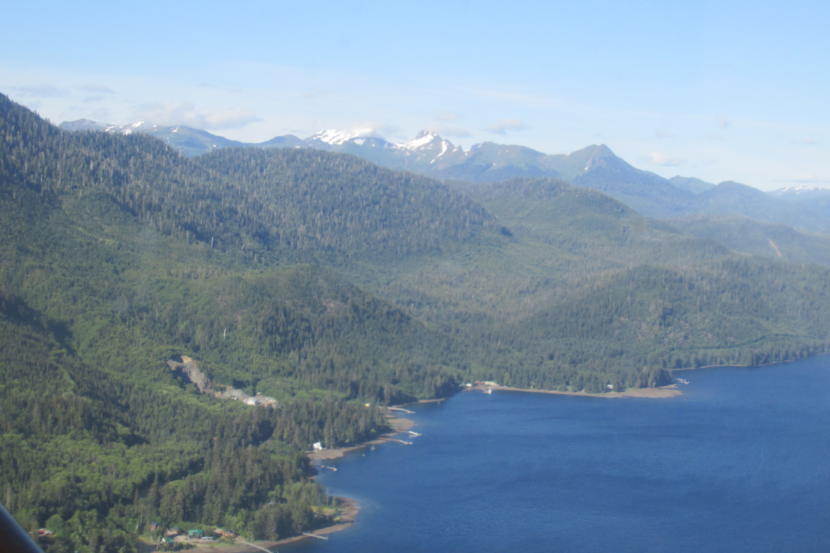
An aerial shot of Prince of Wales Island. (Photo by KRBD)

A federal judge has dealt a potentially fatal blow to what would’ve been the largest timber sales in Tongass National Forest in decades.

The court challenge ends the U.S. Forest Service’s plan to open up 24,000 acres of old growth forest on Prince of Wales Island to commercial logging. It also halts road building for the 15-year project.

Conservationists had successfully blocked the federal government’s attempt at pre-clearing large amounts of timber for sale without identifying the specific areas where the logging would actually occur.

But after the Forest Service argued throwing out the entire project would harm what’s left of Southeast Alaska’s timber industry, Judge Sharon L. Gleason gave both sides a final chance to make a case for and against allowing the agency to correct deficiencies in its review and move forward.

Her final ruling came down squarely against the Forest Service’s plan. In a 14-page order signed on Wednesday, Judge Gleason ruled the “the economic harm” of invalidating the timber sales “does not outweigh the seriousness of the errors” in the agency’s handling of the project.

“It’s exactly what we asked for and we couldn’t be more pleased,” said Meredith Trainor, executive director of the Southeast Alaska Conservation Council which brought the lawsuit.

The ruling, she says, effectively sends the feds back to square one, triggering a fresh environmental review under the landmark National Environmental Policy Act — “which includes requesting public input on the specific areas that they want to log, which is what was a big sticking point in the basis of this case,” Trainor said.

Alaska’s timber industry reacted with disappointment to the ruling.

“The Southeast timber industry is primarily reliant on timber sales from the (Tongass National Forest),” Tessa Axelson, executive director of the Alaska Forest Association wrote in a statement. “This decision further threatens the viability of Southeast Alaska’s timber industry.”

The Prince of Wales Landscape Level Analysis was the first time the agency used this approach for environmental review on an Alaska timber sale. The ruling affects these projects including the Central Tongass Project near Petersburg and Wrangell as well.

But the judge’s decision does not affect other aspects of the Prince of Wales project. That includes habitat and stream restoration and investment in recreational trails and cabins that had been supported by a resident advisory group. It’s unclear what progress will be made in those areas as most non-timber sale related projects remain unfunded by the Forest Service.

The federal agency can appeal the decision. It did not return calls for comment.

Editor’s note: A previous headline for this story said “Court deals potentially fatal blow to logging plan for 24,000 acres of Tongass National Forest.” 24,000 acres is the area in the plan for harvesting old-growth trees. The authorization also includes nearly 20,000 additional acres of young-growth trees. The reference to the specific number of acres has been removed. 

New COVID-19 rules in place for Alaska’s ferries, including testing, mask wearing and social distancing

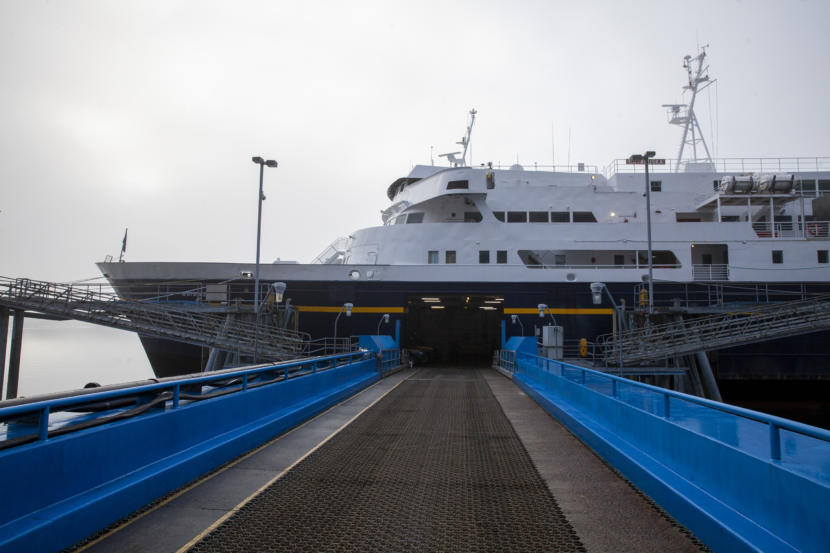
The Matanuska docked on Friday, February 7, 2020 at the Auke Bay ferry terminal in Juneau, Alaska. (Photo by Rashah McChesney/KTOO)

The Alaska Marine Highway System announced a set of new protocols over the weekend that it says will protect against the spread of coronavirus on its vessels.

Passengers on Alaska’s mainline ferries are now being required to get a COVID-19 test before traveling. While passengers on shorter haul voyages aboard the LeConte and Lituya will be asked to sign a screening form instead, attesting they’ve had no symptoms nor have traveled to an infected area without social distancing.

But the testing requirement, which mirrors rules for visitors arriving from outside Alaska, will be in force on the fleet’s mainliner ships (Kennicott, Matanuska and Tustumena) even for short trips. Passengers will have to show evidence of a negative test from within 72 hours before being allowed to travel.

Passengers and crew will also not be allowed on shore during port calls and will only disembark at their final destination. And with some exceptions, passengers 2 years and older will be required to cover their faces on all vessels unless they are in a stateroom, a smoking area or eating.

Alaska’s ferry link with the Lower 48 is scheduled to resume June 25 with a return voyage from Ketchikan to Bellingham. Passengers are being notified of the new testing rule, though it can take several days for COVID-19 results to be processed.

“We understand that testing can be a challenge, but for the safety of crew and passengers it is really important that we do everything possible to mitigate the spread of COVID-19,” Department of Transportation spokeswoman Meadow Bailey wrote in a statement. “If we have one positive person on board, vessels and crews have to be pulled out of service. In addition to mitigating the spread of COVID-19, we also need to have a dependable system.”

The marine highway began running ferries at reduced capacity at the end of May to allow social distancing on board. The policy wasn’t announced in advance and some passengers reported being turned away and denied tickets. Earlier this month seven crew members tested positive for COVID-19 aboard the Tustumena during a trip to the Aleutians. All sailings of that ship are canceled until July 2.

The announcement reverses an earlier policy that didn’t require masks of its passenger and crew on state ferries.

Two of Alaska’s largest seafood processors, merge salmon operations

The Petersburg Fisheries seafood plant, owned by Icicle Seafoods is and where the company got its start in 1965. (Photo courtesy KFSK)

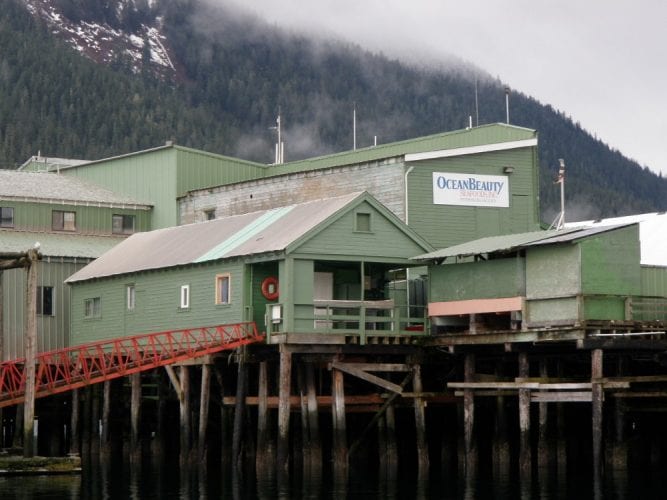
Two of Alaska’s largest seafood companies are merging their Alaska salmon and Gulf of Alaska groundfish processing businesses. Icicle Seafoods and Ocean Beauty Seafoods will be combining forces to create OBI Seafoods.

Talks of a potential merger have been circulating for months. There’s been speculation in the seafood industry press that the two Seattle-based companies are seeking to remain competitive against the other major industry players in Alaska.

To meet the strength of Trident Seafoods and Silver Bay Seafoods, Icicle and Ocean Beauty really needed to do this,” Drew Cherry, editor of IntraFish, said on Friday.

He first reported on a possible deal exactly a year ago. He said it’s driven by a big-picture trend: More processing plants than fish to fill them.

There’s a lot of overcapacity in the Alaska salmon processing sector. It’s not exactly a sector that’s doing that well right now,” he said.

The Icicle and Ocean Beauty collective venture will own 10 shoreside processing plants across coastal Alaska. Several are on Bristol Bay but there are also plants in Cordova, on Kodiak Island and in Southeast including Petersburg.

There have been upgrades to some of the plants in Bristol Bay, said Cherry, who grew up in the region.

But beyond that a lot of these Alaska salmon facilities — they’re not in great shape,” Cherry said.

Ocean Beauty CEO Mark Palmer will lead the new venture — OBI Seafoods. He said since 2016 the two companies have invested $50 million into their plants. He bristles at the suggestion that those operations have fallen behind.

“When you drive by a plant and look at it from the outside, it may not look that much different,” Palmer said. “When you go inside; they’re significantly different.”

He said the companies are particularly proud of upgrades to their Wood River plant in Dillingham and are reopening a cannery in Naknek. Overall, he said, the company will redouble its commitment to modernizing its Alaska operations. And this merger will cut costs and allow it to do this.

The ownership group is not going to take dividends out of the Alaska operation,” Palmer said by phone. “They’re going to plow those back into investments in the plant. So we have a long term commitment … to build up the plants and modernize them.”

The two companies have very different ownership. Half of Ocean Beauty is owned by the Bristol Bay Economic Development Corporation. The other is a small group of Outside investors.

Icicle on the other hand was bought by privately-held Canadian giant Cooke Seafoods in 2016.

“Cooke is one of the world’s largest salmon farming companies,” Cherry noted.

And he said that creates some natural tension with Alaska’s wild salmon industry.

The majority of — I don’t want to say majority — but a big chunk of the Alaska salmon processing sector is now partly owned or partly controlled by a major salmon farming company,” Cherry said.

CEO Mark Palmer said about half of Cooke’s more than $2 billion sales volume is wild harvest. He said its partners in Bristol Bay raised some concerns but came to see the mutual benefits of a deal.

“It’s certainly some consternation, you know, in the initial conversations with BBEDC,” Palmer said, “But they got past that very quickly, and they recognize that they’re partners with a global seafood giant.”

It’s too early to speculate what the merger will mean for Alaska fishermen and the market price of their catch.  Second generation Southeast Alaska fisherman Justin Peeler is the skipper of the 58-foot fishing vessel Defiant out of Sitka. He’s been selling to Icicle for more than 15 years.

And as an Icicle fisherman, this will be my third merger, if you will, Icicle has bounced around a little bit in that timeframe,” Peeler said by phone.

He said he’s cautiously optimistic the combined company will grow its North American market share. He said Icicle has been a strong company, but has sold much of its fish outside the United States.

“We haven’t had a large domestic presence and I’m excited to see that grow,” Peeler said, “and I think with the merger of the two companies, I think it puts both companies in a position to have that happen.”

Not included in the merger are Icicle’s two floating processing vessels: the Gordon Jensen and the Northern Victor which is permanently moored in Dutch Harbor. Those two vessels will continue to operate under Icicle Seafoods.

Ocean Beauty will maintain its smoked salmon and distribution network under the name OBS Smoked & Distribution.

Terms of the deal weren’t disclosed. A company statement said the combined operations are set to take effect June 1 — in time for Alaska’s summer fishing season.

Site notifications
Update notification options
Subscribe to notifications