Jacob Resneck is CoastAlaska's regional news director based in Juneau. CoastAlaska is our partner in Southeast Alaska. KTOO collaborates with partners across the state to cover important news and to share stories with our audiences.
Much of Prince of Wales is part of Tongass National Forest. As such, hunting and trapping are managed by both the state and federal governments.
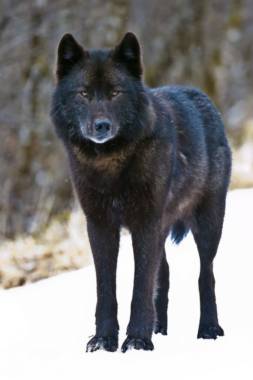
The U.S. Forest Service postponed the federal subsistence wolf season until at least Oct. 31. The state’s hunting season is slated to open two weeks later. Now, wildlife advocates are calling for both hunting and trapping seasons to be canceled altogether.
State and federal managers eliminated the harvest cap last year. And that allowed a record 165 wolves to be hunted and trapped, says Patrick Lavin of Defenders of Wildlife in Anchorage.
“That level of trapping — direct mortality — is on top of other challenges for these wolves, especially from extensive habitat loss from clear cutting and road building in the past,” Lavin told CoastAlaska. “So, it’s a population kind of struggling to survive that got especially hard hit last year because of that change in policy.”
A 2018 estimate by the Alaska Department of Fish and Game put the Alexander Archipelago wolf population at around 170. But biologists say wolves breed quickly and a 2019 population estimate — minus the 165 reported killed — is due in the next few weeks.
That report will be a key factor in determining whether the state’s hunting and trapping season will go forward, state Fish and Game Commissioner Doug Vincent-Lang wrote in a Sept. 18 letter to the Alaska Wildlife Alliance. He added that under the current management plan, the season will be closed if the population estimate falls below 100 wolves.
Hunters on the island have disputed that the wolf population is threatened. The animals are largely targeted due to their predation on deer. Venison is a prime subsistence food for the island’s residents.
But there’s been little consensus about the health of Southeast Alaska’s wolf population, a controversy that’s run for decades.
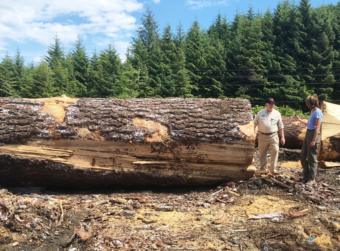
U.S. Secretary of Agriculture Sonny Perdue and Sen. Lisa Murkowski look at some old-growth logs in the yard at Viking Lumber in Klawock. The two toured Prince of Wales Island on July 5, 2018. (Photo by Leila Kheiry/KRBD)
The Trump administration announced last week that it’s planning a full rollback of the Clinton-era “Roadless Rule” for the Tongass National Forest. The administration described the goal of the rollback as “maximum additional timber harvest.”
The Roadless Rule, simply stated, forbids road building and industrial activity — with some exceptions — in areas that don’t already have them. It covers nearly 9.4 million acres, or just over half, of Southeast Alaska’s Tongass National Forest.
Addressing civic and business leaders at Southeast Conference on Friday, Sen. Lisa Murkowski praised the federal government’s decision.
“The Roadless Rule is not just about timber,” Murkowski said via videoconference link. “It is about reasonable access for a wide variety of users, whether it is for renewable energy that we work so hard to build, whether for recreation, whether for mineral — it is for all pieces of the Southeast economy.”
Alaska’s congressional delegation has long opposed the 2001 rule. So has the state of Alaska, which sued and settled with the feds to win an exemption that lasted about seven years.
So those applauding the decision say don’t expect boom times right away. Especially not with logging
“I don’t think it’s going to be any more intensive than it was when we had total exemption in the period from 2004 to 2011,”Jim Clark, former chief of staff to Gov. Frank Murkowski told CoastAlaska.
The Juneau attorney has been helping fight the Roadless Rule from the beginning. He predicts it’ll help the mining and energy sectors — especially hydropower — by making it cheaper and easier to build roads on federal forest lands. But it won’t happen overnight.
“It would be a mistake to oversell either the problems that are going to occur for the environmental community as a consequence of this, or to oversell how much economic development is going to occur,” Clark said.
Industry groups signal support
The Alaska Forest Association — a timber industry group — applauded the federal government’s decision.
“Application of the Roadless Rule to the Tongass was never appropriate and has stifled the timber industry, and the larger Southeast economy,” AFA Board President Bert Burkhart said in a statement.
The Roadless Rule has been popular in Alaska. The Forest Service says it received about 411,000 comments, most of those in favor of keeping the status quo.
And during two years of public hearings, Southeast Alaskans came out in person to defend it. The reasons varied: concern about deer and salmon habitat, preserving wild places for guides to bring tourists.
Tribes were particularly vocal about keeping the national forest intact.
“We want to keep what’s here because we know the effects of logging in our area,” Joel Jackson, tribal president of the Organized Village of Kake said by telephone on Friday. “Old growth timber areas provide for us … berries and our medicines and also to hunt the deer and moose in our area.”
The federal government is required by law to consult with federally recognized tribes that live around the Tongass. Jackson says he feels like the agency was just going through the motions.
“I felt like they didn’t really listen,” he said. “And it turned out they didn’t.”
A November 4, 2019 U.S. Forest Service listening session was well-attended by Roadless Rule supporters. (Photo by Rashah McChesney/Alaska’s Energy Desk)
D.C. timber lobbyist linked Gov. Dunleavy with U.S. Ag Secretary Perdue
Agency emails obtained in a records request by Southeast Alaska Conservation Council show a D.C. lobbyist working for the Alaska Forest Association set up a telephone call between U.S. Secretary of Agriculture Sonny Perdue and Gov. Mike Dunleavy last year.
The governor’s office confirmed the May 7, 2019 call took place but would say nothing about what was discussed. The AFA, whose members were in Washington and in the room during the call, also declined comment.
The revelation of the joint timber industry/Alaska governor telephone call with Perdue has angered tribal leaders. Tribes had offered to travel to D.C. to meet with Secretary Perdue but were reportedly told only an undersecretary would be available to receive them.
Joel Jackson says it’s unfair that Trump administration cabinet officials will meet with industry but not tribal governments.
“They’re just the timber association and the tribes are sovereign nations,” Jackson said. “So that really upset me that we were brushed aside.”
Arguments against exemption range economic to ecological
Taxpayers have lost money on virtually every Tongass timber sale since the 1980s, says a D.C. budget watchdog group.
“We are concerned that opening up areas where they’re not currently roads to timber sales would increase taxpayer losses,” said Autumn Hanna, vice president of Taxpayers for Common Sense, a nonpartisan D.C. group.
“We’ve seen plenty of evidence already the taxpayers would lose significantly more by logging in these old growth areas that are harder to access and have been protected by the Roadless Rule,” Hanna said earlier this month.
The losses happen because the Forest Service actually pays for building new roads used by the timber industry to log public lands. In relatively remote areas with old growth stands of trees, she says, the costs to the public are even higher.
“So, taxpayers are upside down and underwater on the timber sales,” she added.
The Forest Service’s final environmental impact statement runs to nearly 700 pages. And critics have already seized upon one passage that downplays any impact to climate change. It says more logging would have only “a temporary influence on atmospheric carbon concentrations” that would get better as the forest grew back.
“Yeah, I don’t buy it,” said Dominick DellaSalla, an Oregon-based researcher with Wild Heritage, an advocacy group. “And I think they’re kicking the can down the road, there’s a lot more impacts that are going to happen.”
“We’ve got to recognize that every action has a reaction in terms of the atmosphere,” DellaSalla told CoastAlaska. “And to deny that, the Forest Service is really denying climate change.”
Under the federal government’s rule-making process, the Secretary of Agriculture has to wait 30 days from releasing its formal “record of decision.” That’s what makes the rule binding. A future presidential administration could work to change that, but it would have to go through this multi-year rule-making process from scratch.
Agency’s 2016 Tongass forest plan limits old growth logging
But there’s another piece to the Tongass logging debate. The amount of old growth timber that can be cut is restricted by the Tongass forest plan that sets out a transition to young growth over 15 years.
Gov. Bill Walker’s administration petitioned for the Roadless Rule to be rolled back in 2018. But the state didn’t stop there: it also called on the federal government to revise the 2016 forest plan that limits old growth timber harvests.
“There was a request for revision of the 2016 plan,” said Clark, the natural resources attorney in Juneau. “There’s been absolutely no movement on that by the Forest Service or anybody else”
That would be an entirely different fight.
“Rulemaking takes a long time,” Clark said. “And this one would be, I think, more difficult than what we did on the Roadless exemption.”
In other words, the fight over old growth logging in Tongass National Forest is a conflict that moves about as swiftly as the trees grow.
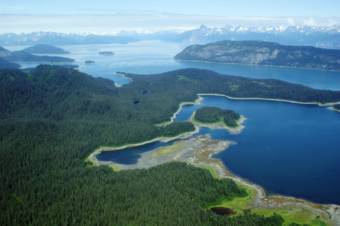
Berg Bay lies on the western shores of Glacier Bay about 20 miles northwest of Gustavus. (Photo courtesy of National Park Service)
A tribe in Southeast Alaska has won permanent protection for the site of a historic Tlingit village whose descendants claim centuries-old ties to Glacier Bay. Complex negotiation secured 150 acres that had been eyed by commercial developers.
But centuries earlier it had been a major Tlingit population center. Then, huge ice sheets forced its inhabitants to relocate south to Chichagof Island to what’s now modern-day Hoonah.
“It has a tremendous cultural significance to the Hoonah Tlingit and most specifically to the to Chookaneidí Clan,” said Bob Starbard, tribal administrator of the Hoonah Indian Association, the 1,200-member federally recognized tribe.
Much of the Chookanhéeni site is encompassed on a 150-acre parcel that was an original Native allotment belonging to the St. Clair family. In 1980, most of the land around it became a national park.
Two years ago the family put the acreage up for sale. The asking price: $1.7 million. Starbard says the tribe had to act.
“We knew that there were some development interests, on the part of lodge owners running a particular commercial venture,” Starbard said. “And that was a use that we felt was incompatible with both the tribe’s interests, the clan’s interest and in the park’s interests.”
But financing such an expensive purchase proved difficult for the tribe. The National Park Service was also interested. But park officials say the federal agency found that the asking price exceeded what the government considered “fair market value.”
That’s when The Conservation Fund got involved. It’s a Virginia-based nonprofit that buys land and deeds it over to agencies for conservation.
“There was quite a bit of head scratching early on about how we were going to accomplish this,” said Brad Meiklejohn, the fund’s Anchorage-based senior Alaska representative. “But we heard clearly from the park that they wanted to find a creative way to make this happen because of the history of the use of the park by the folks from Hoonah. So there was a pretty concerted effort to be accommodating.”
The fund partnered with the National Park Foundation — another nonprofit with a similar mission — to buy the property outright for an undisclosed sum. It’s since deeded the 150 acres to the federal government to be added to Glacier Bay National Park and Preserve.
But that’s not the end of the story.
“The tribe will get special access,” said Philip Hooge, superintendent of Glacier Bay National Park and Preserve. A formal agreement codifies special rights for the tribe to gather plants, fish and build a smokehouse and other cultural structures for ceremonies.
“Glacier Bay was the homeland of the Tlingit and who were driven out by the ice moving out of the bay,” Hooge said. “And it’s been a long road to return that sense of homeland and have the Park Service recognize that.”
Formal plans will be worked out between the tribe and park service each spring. But it’s unlikely anything will be built soon.
The grassy valley and 2,200-feet of beach along Berg Bay will be for both tribal members and park visitors to enjoy. The agreement makes clear the tribe will respect public access for all park visitors.
Bob Starbard, the tribal administrator, says the area known as Chookanhéeni — of which the Chookaneidí Clan takes its name — has a bond that predates modern civilization, and it’s something to celebrate and share.
“We’re not necessarily offended by visitors,” he said. “As long as they respect our rights in history there.”
No hunting will be allowed, or commercial activity. But according to the terms of the conservation easement, the Hoonah’s tribe’s special rights are — in the document’s legalese — “forever.”
A voter enters an election both at Northern Light United Church during municipal elections on Oct. 1, 2019, in Juneau. (Photo by Rashah McChesney/KTOO)
A November ballot measure could radically change the way Alaskans pick their elected leaders. Only one person called in on Monday during an open hearing for Southeast Alaskans.
If passed, Measure 2’s changes would be threefold: first, it would replace separate party primary ballots with one that’s open to all candidates.
Scott Kendall, spokesman for Alaskans for Better Elections, says that would end some of the most competitive races being decided by a limited group of partisan voters.
“Every candidate gets on the same ballot regardless of party and every voter receives the same ballot regardless of party,” Kendall said during a state hearing for Southeast Alaskans on Monday. “You simply vote for your favorite in every race, and the top four vote getters regardless of their party when advanced to the general election.”
Then in November, voters would rank their choices in order of preference. If nobody won more than 50% of first-choice votes, the candidate with the fewest votes would be eliminated and voters who chose that candidate first would have their second choice counted. That process would continue until one candidate received majority support.
Kendall, who served as independent former Gov. Bill Walker’s chief of staff, says the third part of the initiative would increase disclosure requirements for hard-to-trace dark money supporting political candidates.
“That’s money that goes into our election system,” he said. “And because of the way it’s transferred through several nonprofit groups … the voting public has no way of knowing where the money actually came from.”
The Yes on 2 camp is well-funded, with more than $1 million coming from a centrist political group funded by Kathryn Murdoch, a daughter-in-law of media mogul Rupert Murdoch.
“Former Gov. Sean Parnell and former Sen. Mark Begich have called rank choice voting political trickery,” said Brett Huber, a former campaign manager for Gov. Mike Dunleavy.
He’s a spokesman for Defend Alaska Elections, which opposes the measure. Its largest donors include state and national Republican party groups as well as conservative organizations like the Club for Growth and the Koch brothers-funded group Americans for Prosperity.
Huber argues that the current party primary system works, with ranked choice relatively unproven.
“The net effect of this system is to take something that’s known, understood, transparent and fair in Alaskans’ mind and turn it into an experiment that’s failed in other areas — and let us deal with the aftermath,” Huber said.
Under the current system, voters registered nonpartisan or undeclared can request any party’s ballot. That was an issue raised by cartoonist Pat Race, the only member of the public to testify in the hearing.
Race says his House district in Juneau often has competitive Democratic primaries, whereas statewide races for governor or Congress have competitive contests between Republicans. And as a nonpartisan, he can’t vote in both primaries at once.
“It puts me in the position of having to choose which ballot I want to vote on, and which races I want to influence,” said Race, who serves on a steering committee for the ballot measure’s proponents. “Which is really hard, because a lot of these races are decided in the primary elections.”
The initiative would change that by allowing all primary voters to choose their top choices in each race regardless of party affiliation. Measure 2 will appear on the November 3 ballot.
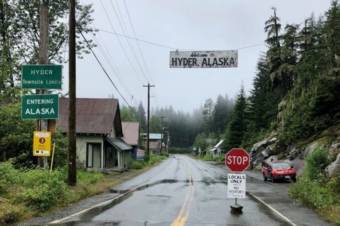
There is no U.S. customs presence at the entrance to Hyder, Alaska as seen in this Aug. 4, 2020 photo. (Photo by Jennifer Bunn/Hyder AK & Stewart BC COVID-19 Action Committee).
At the southeastern tip of Alaska’s panhandle lies the curious town of Hyder. It’s grown naturally alongside its Canadian neighbor of Stewart, B.C.
It has a 250 area code, electricity from B.C. Hydro and its only road access is through Canada’s highway system. It’s separated by 7,000-foot snow-capped peaks from the rest of the state. So its connection with the rest of Alaska is limited.
“There’s about 65 of us. The only way we get supplies is through a mail plane that comes in from Ketchikan twice a week, Mondays and Thursdays, weather permitting,” said Wes Loe, president of the Hyder Community Association.
Most residents buy groceries and fuel and other supplies in Stewart, B.C. which is just over the border. For more than a century that was a mere formality, as Canadian border guards would often wave people through.
“Since March, we can only go to Stewart once every seven days for three hours — to get whatever we need,” Loe said by telephone.
About 400 people live in Stewart, B.C., and they largely consider Hyder’s Alaskans a part of their greater community. A cross-border committee has been working to ease travel restrictions. It’s written letters to Canadian officials asking to relax the rules because of Hyder’s unique situation.
Jennifer Jean is Hyder’s co-chair of the Hyder, Alaska and Stewart B.C. COVID-19 Action Committee.
“We have no amenities in Hyder,” she said. “We have no gas stations, no grocery stores. There’s no medical facilities.”
There’s no school, either. Enrollment dropped below 10 students this year, leading the Southeast Island School District to shutter Hyder’s one-building schoolhouse.
But there was a workaround: Hyder’s five school kids would be enrolled in Bear Valley School in Stewart.
Hyder resident Nick Korpela works across the border on a Canadian work permit. But he says his daughters haven’t been able to cross to see their friends since March.
“We promised them that they’re going to get to go to school and see their friends,” he said. “And two days before school started we got a call from the CBSA — Canadian customs — and they said that they were not going to allow the children through the border.”
Hyder’s five school-aged children sit at desks at the Hyder/Stewart border on Sept. 10, 2020 — the day school starts in Stewart, B.C. They can’t attend because of current border restrictions. Their banner appeals to Bill Blair, Canada’s minister for public safety, who oversees the Canada Border Services Agency. (Photo by Carly Ackerman/Hyder AK & Stewart BC COVID-19 Action Committee).
His daughters haven’t left Hyder since spring — except for a single afternoon on a float plane to Ketchikan. They’d been looking forward to a change in scenery.
“I was kind of sad,” 10-year-old Hilma Korpela said. “I was like, ‘Oh great, one more thing to not be able to do.’”
She’s starting the fifth grade. Now, her mother is preparing homeschool with her 8-year-old sister. But she says it’s not the same.
“I like hanging out with my friends … Hyder gets a bit lonely,” she said.
Jennifer Jean also has two school-aged children.
“It’s really, really hard on them,” she says, fighting back the emotion in her voice. “That was the light at the end of the tunnel for them was to be able to see their friends again. Have a little bit of normalcy in their lives.”
The committee has redoubled its efforts to reopen the border with a recent rally on remote international frontier.
“They were at desks at the border the morning that school should have started, and our Stewart friends and family came to their support the following day,” she recalled.
B.C.’s provincial officials are sympathetic but say their hands are tied because the federal government in Ottawa controls the border.
Dr. Bonnie Henry — the top official leading the province’s pandemic response — told reporters last month she thinks it’d be reasonable to loosen border restrictions for Alaskans living in Hyder.
“My only concern, of course, is that we’ve started to see dramatic increases in cases in the last month in Alaska,” she said Aug. 5. “And I know that that’s been a challenge for my counterpart, who I talk to regularly from Alaska.”
U.S. and Canada COVID-19 numbers are starkly different. Canada has had almost 9,200 reported deaths. Compare that to the U.S. nearing the 200,000 mark.
B.C. has about 1,000 more COVID-19 cases than Alaska. But the province has more than seven times Alaska’s population.
There have been no reported cases of COVID-19 in either town. But with no medical clinic in Hyder, there hasn’t been any testing, either.
“The larger border situation remains very worrisome for many Canadians,” said MP Taylor Bachrach, Stewart’s elected representative in the Canadian parliament, “and there’s strong support for keeping the Canada-U.S. border closed as long as we need to, given the the stark difference in the situation on either side of the border.”
He’s thrown his weight behind his constituents who want the border opened to their neighbors in Hyder.
“I spoke with Bill Blair, the public safety minister for Canada, on the phone and communicated to him the urgency of the situation,” Bachrach said in an interview.
Alaska Gov. Mike Dunleavy has penned an Aug. 27 letter appealing to Canada’s federal government in Ottawa.
“Winter is coming and we know this pandemic will continue for a while,” Dunleavy wrote. “Allowing these communities to integrate will ease feelings of isolation among Hyder residents.”
Dunleavy’s office declined to comment for this story.
Bachrach says there’s been broad consensus from from elected officials in both Alaska and B.C. to work something out.
“At this point, it feels like there’s pretty strong support for some sort of solution,” Bachrach said. “So I’m curious why it’s taking so long to put something in place.”
But so far federal officials in Ottawa show no sign they’re willing to make exceptions.
A spokesperson for Canada’s Ministry of Public Safety and Emergency Preparedness told CoastAlaska that as of Aug. 7, school kids living in the U.S. are prohibited from attending school in Canada because they are subject to a mandatory 14-day quarantine.
“We brought forward significant restrictions at our borders to flatten the curve and prevent the spread of COVID-19 in Canada,” the ministry spokesperson wrote on Thursday. “These decisions have not been taken lightly, but we know that they are necessary to keep Canadians safe.”
It says the restrictions on school children crossing daily is in order to “prevent the importation of cases of COVID-19 to Canada and increased community transmission.”
Residents in Hyder and Stewart haven’t given up. They’re advocating for what they’re calling the Bear Bubble, which would create a shared space for residents in both communities and exempt them from the quarantine rules.
Residents from both communities rally at the Stewart/Hyder border on Sept. 11, 2020 in support of the Hyder children crossing the border to attend school in Stewart. (Photo by Carly Ackerman/Hyder AK & Stewart BC COVID-19 Action Committee).
“We’re doing everything we can to kind of create our bubble community,” said Wes Loe, Hyder’s unofficial mayor.
He says winter is coming, and people are getting worried about the impending darkness, deep snow and isolation that the border restrictions will make much worse.
“You can see the depression, the anxiety, especially the anxiety that’s building up in people,” he said. “And you see things that are taking place that normally don’t take place.”
There have been bright spots. Hyder’s residents haven’t been able to access a Stewart wood yard where they typically get firewood to heat their homes. So Stewart’s citizens recently donated truckloads of logs to Hyder, as a goodwill gesture for their Alaska neighbors.
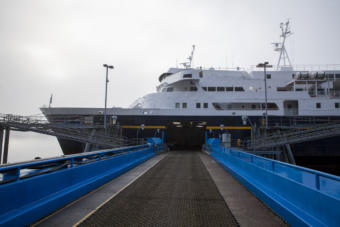
The Matanuska docked on Friday, February 7, 2020 at the Auke Bay ferry terminal in Juneau, Alaska. (Photo by Rashah McChesney/KTOO)
Selling or giving away Alaska’s state-run ferry fleet is not a viable option. That was the conclusion the governor’s marine highway working group reached on Wednesday as it deliberated on recommendations.
The Alaska Marine Highway Reshaping Work Group’s chairman, Tom Barrett, reviewed one scenario from the Dunleavy administration’s $250,000 Northern Economics report that looked at privatization but concluded none of the routes would be profitable. He said if the state divests from the fleet, that would be the end for the marine highway.
“Because that means end the system fundamentally as we know it,” Barrett, a former Coast Guard admiral and pipelines services executive, said at Wednesday’s meeting.
The work group, which was appointed earlier this year by Gov. Mike Dunleavy, is tasked with charting the fleet’s future by finding efficiencies. It has until Sept. 30 to bring its findings forward.
That process is still underway. But on Wednesday, the nine-member group reached consensus that the ferry system is too important for the state to just walk away.
“It’s not ever going to be able to be the fleet of ‘Blue Canoes’ that existed you know 25 years ago,” Barrett said.
Earlier this month, the group held two days of public hearings when Alaskans testified about how they would right-size the fleet. It also heard from coastal communities who said ferry services are literally a lifeline.
“I don’t think I could listen to some of the people and say, ‘Yeah, well, let’s just trash it,’” Barrett said. “We’ve got some hard decisions, but that’s not one of them.”
The group is considering recommendations to reduce the fleet or routes served. It’s also looking at changes in governance and management structure that would give the marine highway more autonomy from the executive branch.
Close
Update notification options
Subscribe to notifications
Subscribe
Get notifications about news related to the topics you care about. You can unsubscribe anytime.