Jacob Resneck, CoastAlaska

Jacob Resneck is CoastAlaska's regional news director based in Juneau. CoastAlaska is our partner in Southeast Alaska. KTOO collaborates with partners across the state to cover important news and to share stories with our audiences.

Board of Fish nominees get chilly reception from commercial, subsistence groups

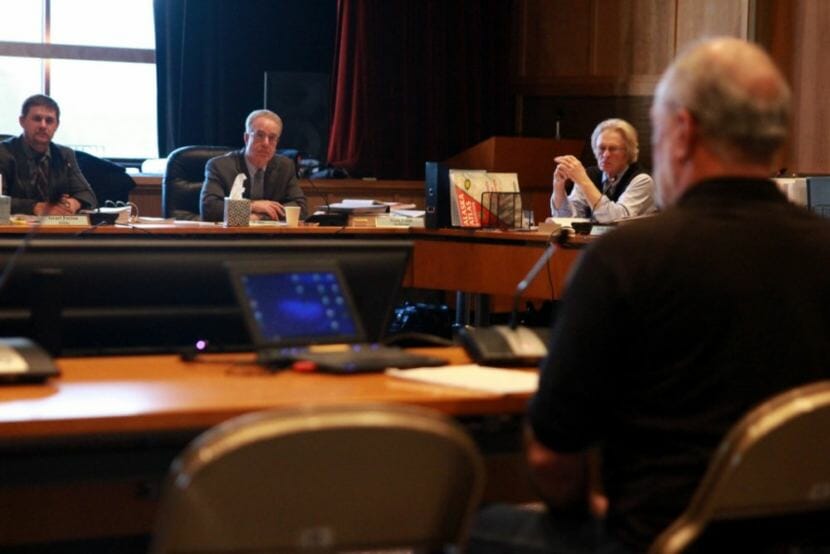
Board of Fisheries members Israel Payton (Wasilla), Alan Cain (Anchorage), and Fritz Johnson (Dillingham) hear testimony on shellfish proposals on the first day of the Southeast Shellfish/Finfish meeting in Sitka. (Photo by Robert Woolsey/KCAW)
Board of Fisheries members hear testimony on shellfish proposals at the Southeast Shellfish/Finfish meeting in Sitka in 2017. The board sets key allocations and is the final arbiter between gear groups and interests competing over a shared public resource. (Robert Woolsey/KCAW)

Gov. Mike Dunleavy’s nominees to the board that regulates state fisheries drew a lot of heat at a Sept. 3 confirmation hearing.

The timing of two of the appointments — along with the COVID-19 emergency — makes it possible that the appointees could set policy for Alaska’s commercial, sport and subsistence fisheries without first being confirmed by lawmakers.

This month’s House confirmation hearing began with a relative unknown in Alaska’s world of fish politics.

McKenzie Mitchell is an adjunct professor at UAF’s School of Management. She called in from a boat on the Yukon River, where she’s working as a moose hunting guide.

“It almost seemed like you’re a natural fit for the Board of Game,” House Speaker Bryce Edgmon (I-Dillingham) asked. “Why would you put your name for the Board of Fisheries when your experience is on the game side primarily?”

Mitchell replied that she’d be open to serving on that board too.

“My experience, I guess, in both fisheries and hunting in the state of Alaska has been, you know, pretty well balanced,” she said.

As experience, Mitchell has touted her graduate thesis on the region’s halibut sport fishery, which is regulated by an international commission rather than the state of Alaska.

Her appointment was also endorsed by the Fairbanks Fish and Game Advisory Committee.

Rep. Louise Stutes of Kodiak quizzed a different nominee, John Wood, on his close ties to the governor. Wood had worked as an aide to Dunleavy when he was a state senator. He now describes himself as a retired attorney residing in the Susitna Valley.

“Mr. Wood, are you currently in any capacity employed by the state presently?” Stutes asked.

He replied that he has a contract advising the Department of Administration on labor negotiations and reports directly to the governor. But he said he didn’t think there’d be any issues with him serving on the board.

“No fish issues whatsoever are covered by the contract,” Wood said. “So no, I don’t believe there to be any kind of conflict.”

That didn’t satisfy the Kodiak Republican.

“Personally, that’s very alarming to me,” she said. “I just believe that morally, not ethically, it is a conflict. But I will move on.”

The most controversial nominee has been Abe Williams. He’s employed by the Pebble Partnership, which seeks to develop an open-pit gold and copper mine on the headwaters of Bristol Bay, where Williams grew up.

“I’ve fished in Bristol Bay for 30 years,” Williams said. “I have subsistence fished with my grandmother, I’ve sports fished with my family, my kids. And, you know, I cherish this resource just as any other. But I also am very, very, very connected to the people in the region.”

Williams was also a plaintiff in a Pebble-backed lawsuit that sought to block Bristol Bay’s regional seafood development association from using dues from commercial fishermen to oppose the Pebble Mine.

“My challenge to them was largely in recognition to large sums of monies that we pay into the organization being directed to organizations like United Tribes of Bristol Bay and SalmonState.”

A judge dismissed the case last year.

Bristol Bay’s sockeye fishery is limited to 32-foot gill net boats — relatively small compared to much of Alaska’s fishing fleet.

Successive proposals before the Board of Fish to open the fishery to larger vessels have been voted down. Williams denied being behind past efforts to change the rule but said he can understand why the limit has critics among some fishermen.

“As a fisherman, I can see where the limit of 32 foot really creates a strain on your ability to do so adequately and be safe when you do it,” he said.

One of the nominees was  not controversial: longtime chairman John Jensen.

The Petersburg resident is now the sole board member from a coastal fishing community for the rulemaking body that makes critical decisions of allocation that can affect livelihoods and impact food security.

It’s also the arbiter in long running disputes between subsistence groups and commercial fishermen or the charter fleet.

The committee opened the line to public testimony. All of the governor’s nominees received support from the sportfishing sector, including Abe Williams.

“Mr. Williams is taking flak today for his connection with the Pebble project, but I personally find it hard to believe that he would knowingly jeopardize the fishery that supported him for decades,” said Forrest Braden, executive director of the Southeast Alaska Guides Organization.

But commercial fishermen took a dimmer view.

“It doesn’t matter that Mr. Williams has fished Bristol Bay for 30 years. It matters that he works for the Pebble Limited Partnership,” said Georgie Heaverley, a Cook Inlet gill netter and member of the Anchorage Fish and Game Advisory Committee.

“And the lawsuit he was involved in against the BBRDSA was widely opposed by commercial fishermen,” she said. “So to appoint him as a commercial fishing representative but does not even have the support of the sector is an insult to this process and an insult to Alaska’s fishermen.”

Others questioned the qualifications of the governor’s nominees, all of whom live in the railbelt, and their grasp on subsistence fisheries.

“Appoint someone who’s actually qualified, not someone who has simply floated by or flown into our communities,” said Stephanie Quinn-Davidson is director of the Yukon River Inter-Tribal Fish Commission for Tanana Chiefs Conference.

She says the Board of Fish makes crucial allocation decisions that can impact food security in rural Alaska.

“These decisions need to be taken seriously,” she said, “and I have concerns with some of the responses you receive from these appointees today that showed woeful inexperience with and knowledge of Arctic Yukon Kuskokwim river fisheries.”

Two of the nominees, Mitchell and Williams, were appointed in April. The legislature adjourned early due to the COVID-19 pandemic, and neither they nor Wood were confirmed. Legislative legal counsel says state law allows them to serve 30 days after the COVID19 emergency declaration expires — currently mid-December.

But if the state’s disaster declaration is extended, the governor’s Board of Fish nominees could serve until January 18 without being confirmed.

That means nominees could vote on fisheries issues affecting Prince William Sound and Southeast without being confirmed by a majority vote of lawmakers.

Susan Doherty, executive director, Southeast Alaska Seiners Association, says that isn’t right.

“Unless being considered for reappointment,” Doherty said, “we believe no candidate should be able to sit and make judgment decisions that affect the lives and livelihoods or cultural opportunities of the people of Alaska without first being confirmed.”

Yet the Board of Fish’s schedule remains up in the air. Its support staff has pointed to risks of holding in-person meetings in Cordova and Ketchikan this fall and winter.

South Revilla old growth logging proposal moves forward in Tongass

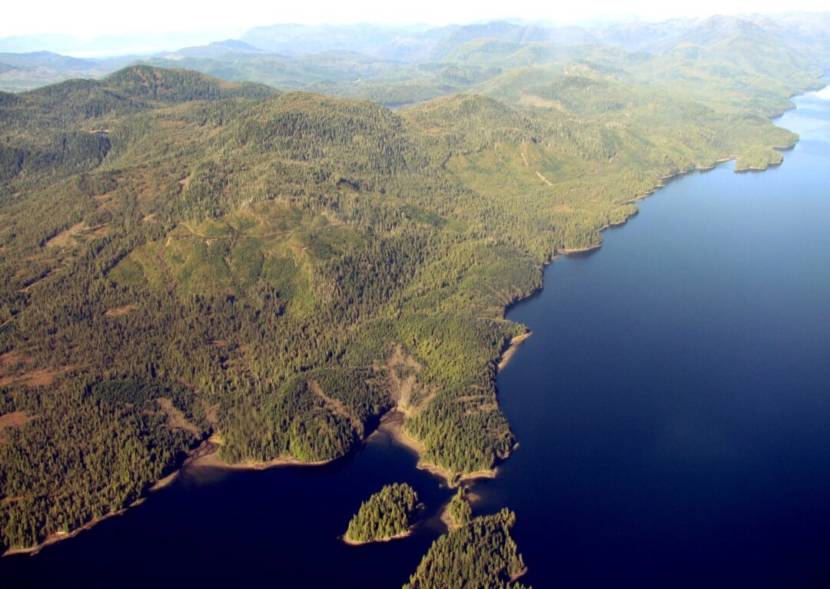
The western shores of Carroll Inlet in 2015. This region about 10 miles northeast of Ketchikan is part of the South Revilla project area, where the U.S. Forest Service proposes to offer more than 5,000 acres of old growth Tongass National Forest to commercial loggers. (Photo by Larry Edwards/Alaska Rainforest Defenders)

The federal government proposes to offer more than 5,000 acres of old growth forest in Tongass National Forest for commercial logging. While conservationists are sounding the alarm over the project near Ketchikan, the timber industry has raised questions over whether it would be viable.

The U.S. Forest Service says the South Revilla project is intended to support around 300 jobs regionally. The timber sales would be over the next 15 years and would be a mix of cutting old and young stands of trees.

The sales would be largely in the Carroll Inlet area, a patchwork of federal and state lands mixed with swaths already clear-cut by the Alaska Mental Health Trust Authority.

“We can’t do much about what’s happening with the mental health trust,” said Larry Edwards of Alaska Rainforest Defenders in Sitka. “But on the public lands that either the state or the federal government own, we shouldn’t be doing any more logging in this area at all.”

The Forest Service’s draft environmental review says removing old-growth habitat may further fragment the forest, eliminating connectivity important to deer, wolf, mountain goat, marten and bear in an area used by subsistence hunters. According to the review, the timber sales would decrease deer habitat, the primary prey for Alexander archipelago wolves, for 150 years or longer. A petition was recently filed to have Southeast Alaska’s wolves listed under the Endangered Species Act.

But the Forest Service justifies the work, saying a steady supply of economic timber is needed to support Southeast Alaska’s forest products industry.

“The Forest Service is going back in, and they’re just picking out isolated areas of old growth that are left over,” Edwards said.

Law prevents the agency from offering timber sales that appraise negative — that is, they would cost more to prep for sale than the agency would get in return.

The agency says it’s already spent about $5.1 million in planning and preparation for this project. Offering a timber sale would cost another $8 million or so. But using its own numbers, all of the proposed timber sales would put the agency in the red — which it can’t do by law.

It’s also unclear whether there would be any takers under current market conditions.

The Alaska Forest Association commented last year that the South Revilla project overlaps with a previous 2,200-acre Saddle Lakes project that was aborted over lack of interest.

“Why waste time analyzing and marking harvest units that have no hope of being financially viable?” the timber industry group wrote last summer.

Eric Nichols of Alcan Forest Products is skeptical the South Revilla project will find a buyer.

“You can’t buy it just to lose money on it,” he said.

Nichols’ company exports raw logs to Asia. The U.S. trade war with China has led to a lot of uncertainty, as tariffs are scheduled to be reimposed next year for his Ketchikan-based firm.

So timber operators may not be willing to incur the risk right now.

“That’s going to make the decision to buy anything very difficult,” Nichols said, “trying to understand what’s going to happen between the U.S. and China.”

Notice of a draft environmental impact statement was published in the federal register on Friday, Sept. 4. That triggers a 45-day comment period to weigh in on the project.

‘I cannot move this building’: Owner of historic boatworks digs in against Forest Service deadline

Wolf Creek Boatworks owner Sam Romey says the belt driven shop machinery, shown in the 1940s, has not changed much in the last 80 years. (Photo courtesy of Sam Romey)

The U.S. Forest Service has given the owner of a boat shop on Prince of Wales Island until mid-December to tear down the historic complex and leave.

That’s in anticipation that the seven-acre parcel occupied by Wolf Creek Boatworks will be transferred to the Alaska Mental Health Trust.

“I am now directing you to remove the boathouse and shop building, in addition to the (sic) those on the list of other structures and improvements shown in the removal plan,” Tongass Forest Supervisor Earl Stewart wrote on August 14. “I find that removal of the boathouse and shop building does not appreciably add to the removal work and restoration that you must complete by December 15, 2020.”

Business owner Sam Romey says the agency’s demands are unrealistic.

“I cannot move this building,” he said in a phone interview. “That’s the whole thing, and they know it. So I either destroy it and then they can say, ‘Oh, you destroyed it.’ Or I leave it and then they’ll half-ass it and let it fall in.”

Wolf Creek Boatworks has been operating for about 80 years using power from a hydro turbine that’s a century old.

Historians say it’s a key piece of the region’s maritime heritage, a holdover from the days of hand-built wooden fishing boats. The buildings were considered eligible to be included in the National Register of Historic Places in the 1980s but never listed.

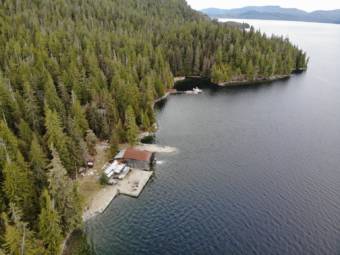
An aerial drone photo of Wolf Creek Boatworks on Prince of Wales Island in September 2019. (Photo courtesy of Sam Romey)

But supporters say it’s no museum relic. The shop remains open for business, servicing boat owners on eastern Prince of Wales communities that would otherwise have to go to Ketchikan.

The business’s Tongass National Forest lease expired in 2015. Romey says while he was working on his renewal, it was included as part of a massive transfer to the state’s mental health trust mandated by Congress.

The Forest Service is supposed to be cataloging sites of historic value lost or destroyed in the transfer. The Forest Service also clarified that if the mental health trust inherits the boatworks buildings, it must manage them in accordance with state preservation laws.

This summer, the Forest Service and trust authority agreed to a one-year extension on efforts to record and document historic sites, because of the COVID-19 pandemic.

But Tongass Forest Supervisor Earl Stewart has not extended the time for Romey to vacate the property he’s managed for 25 years. The agency sent a letter on August 14 expanding the order to tear down the historic shop and boatworks by mid-December — or the owner can just walk away and let the mental health trust take possession of the historic site.

Romey says he’s hired an attorney and plans to see the federal government in court.

“They haven’t given me any choice in the matter,” Romey said. “It’s either I’m in a forced eviction with no compensation. Or I fight it. Well, I got 25 years into it. What’s another five years of fighting them?”

The U.S. Forest Service declined an interview request but sent a short statement saying the agency had completed its federally-mandated review of the historic structures before ordering their removal.

“We sent a letter to Mr. Romey after completing the process, amending the signed 2019 removal plan for his property, which has been in trespass since the expiration of his permit in 2015,” reads the statement sent by Tongass spokesman Paul Robbins Jr.

The Forest Service solicited public comment this spring on what to do about the historic boatworks.

It received more than two dozen letters of support for the longstanding business, one of the last of its kind in the region.

Native rights group backs Kake in lawsuit over emergency subsistence hunt

Kake residents and Elders process moose meat to be distributed to the community
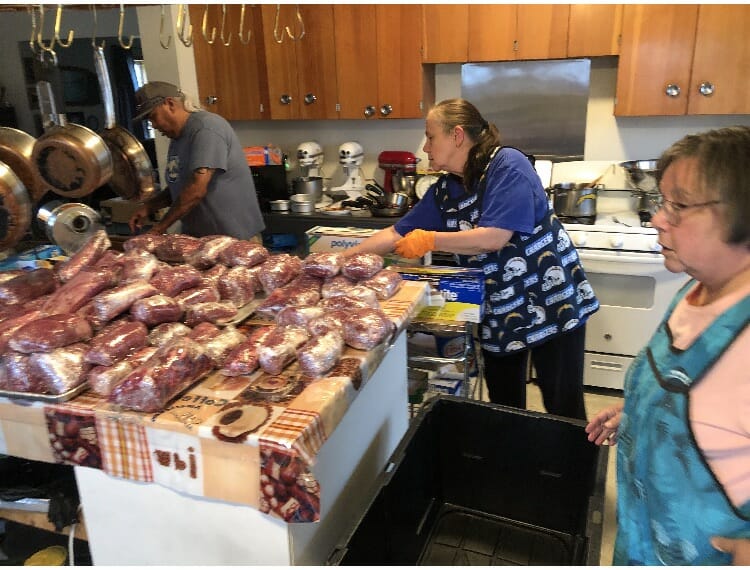
Kake residents and Elders process moose meat to be distributed to the community (Photo courtesy of the Organized Village of Kake)

An Alaska Native rights group is backing the federal subsistence board’s decision to allow a village in Southeast Alaska to hunt out of season during the pandemic. The Dunleavy administration has challenged that move, which will soon get its day in court.

The Native American Rights Fund (NARF) is asking the court to intervene on behalf of the Organized Village of Kake which took advantage of the emergency hunt to take two moose and five deer. The meat was distributed in the community during the early days of the COVID-19 pandemic.

NARF attorney Erin Dougherty Lynch in Anchorage says the state’s legal challenge to special subsistence hunts like Kake’s is part of a larger tug of war between the state and federal managers.

“Really, the state is seeking to disrupt the federal regulatory scheme that has governed subsistence hunting for decades. And, you know, in general, I would say that the state’s actions are extremely disappointing, and part of a long pattern of fighting Alaska Native subsistence rights in the courts and the press,” she said.

The Federal Subsistence Board also cited public safety concerns to restrict an area north of the Glenn Highway to local subsistence hunters. The state Department of Fish and Game filed a lawsuit against the feds last month alleging both actions violated federal law.

It’s asking a federal judge for an injunction that would immediately reopen caribou and moose hunting to non-subsistence users.

In filings, it says the subsistence board’s action has hamstrung its responsibility to manage fish and wildlife in the state.

Assistant Attorney General Cheryl Brooking says the state isn’t going after tribal sovereignty but sees discrimination against non-Natives.

“We’ve got a situation where they’ve shown that they’re going to disregard their own guidelines that they don’t have to have any facts that indicate that there’s actually a food security issue,” she said. “And that they’re going to discriminate between whether you’re native or non native.”

Tribal members have testified that it wasn’t just about scarcity — elders needed access to traditional foods including wild game, not just store-bought meat that wasn’t fresh and relatively expensive. Brooking says the state doesn’t see that as reason enough to allow hunting out of season.

“The meat wasn’t wild game and they prefer the wild game, but there wasn’t any shortage,” she said. “The only shortage that they had was paper products and cleaning supplies.”

A federal judge will hear oral arguments from both sides on Sept. 8th whether to grant a preliminary injunction. Attorneys for Sealaska, the region’s Native corporation have also joined the case in support of the federal government and tribes.

Canadian developer asks for more time before starting open-pit mine upstream of Wrangell

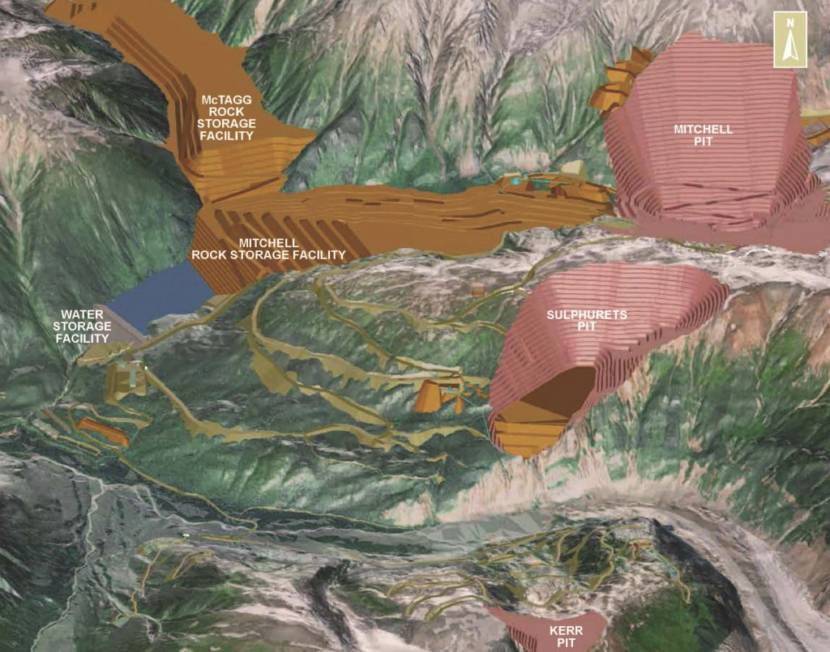
The KSM project’s operational phase mine site layout includes pits to access ore, rock storage, a dam and a water treatment plant provided in 2014. (Courtesy KSM environmental assessment certificate application)

The developer of what could be one of the largest open pit projects on the continent wants more time from Canadian regulators while it seeks partners to develop its B.C. metals mine, about 30 miles from the border.

The Kerr-Sulphurets-Mitchell mine received regulatory approval in 2014 on the condition that it break ground within five years. It’s already received a five-year extension, but now the company says it may need until 2026 to find a development partner.

The gold, silver, copper and molybdenum mine has been compared to Bristol Bay’s Pebble Mine in its scale, wealth and potential environmental risk to Alaska’s communities and fisheries downstream.

Its mine waste would be held about 80 miles from Wrangell in a massive tailings pond created by a dam more than 780 feet high — taller than the Hoover Dam.

But Frederick Olsen, Jr. of the Southeast Alaska Indigenous Transboundary Commission says another extension would mean the mine’s environmental assessment would be 12 years old by the time the developer actually got started.

“Their (environmental assessment) was already outdated because as everybody on earth knows, they were approved before Mount Polley happened,” Olsen said. “You know, when people got a wake up call on that design flaw, a catastrophic, devastating flaw in that type of design.”

He’s referring to the Mount Polley Mine disaster in 2014. That mine’s tailings dam failed, allowing millions of tons of mine waste to spill into B.C. rivers and streams.

Officials in Alaska have been keeping tabs on B.C.’s booming mining sector in transboundary watersheds.

“I meet at least monthly with B.C. officials, but sometimes more frequently depending on specific effort we are collaborating on at the moment,” said Kyle Moselle of the Alaska Department of Natural Resources in a brief statement. He says his office was notified of the proposed extension by B.C. officials and Seabridge Gold, the Toronto-based developer.

Representatives of Seabridge Gold did not return messages left for comment.

Residents to state work group: ferries are essential, not ‘discretionary’

More than 200 people rallied in support of the ferry system in front of the state capitol on Tuesday, Feb. 11, 2020, in Juneau, Alaska. (Photo by Rashah McChesney/KTOO)

More than a dozen people from across coastal Alaska testified Wednesday in support of the state’s ferry system or offered suggestions for improving it. They also lamented cost-cutting that many blame for higher fares, more frequent mechanical breakdowns and long gaps in service.

“Ferries were once the most reliable way to travel around Southeast, but now many of us opt for small planes because of so many ferry cancellations,” said Shannon Donahue in Haines. “Ferry ridership also dropped when it became prohibitively expensive to put a car on the ferry.”

The Alaska Marine Highway Reshaping Work Group held an open line for three hours on Wednesday afternoon. It’s working against a September 30 deadline to make formal recommendations to the governor on the future of the ferry fleet.

Many of the callers expressed well-worn sentiments: that the marine highway is critical infrastructure for communities off the road system.

“We are not using the ferries for frivolous, discretionary travel any more than the residents of Wasilla who drive to Anchorage,” said Carl Becker from Cordova, which has seen deep cuts to service.

David Berg of Viking Travel in Petersburg says his travel agency does a lot of business with out-of-state visitors. But with a summer schedule not posted until March 1, he says most tourists have already made their plans and opt to fly or travel on a cruise ship.

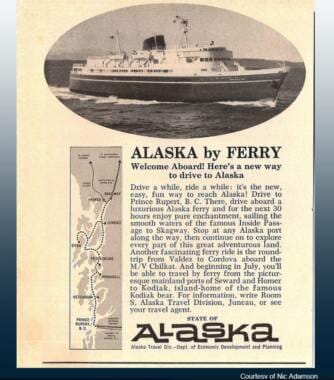
Ferry system brochure. One of many historic documents posted at the Alaska Marine Highway System’s website in commemoration of its 50th anniversary.

He also says the recent introduction of dynamic pricing — which raises fares as space on the boat dwindles — fails to take into account the fleet’s COVID-19 mitigation policy, which reduced passenger and vehicle capacity on the vessels. That, he says, “artificially raises the rates.”

“You take a ship that can carry, say, 400 people, and reduce the load by blocking seats to 100, and suddenly the program thinks a ship is three quarters full,” he explained. “And up go the dynamic rates.”

There were also voices from the villages. Christina Dick says the state is losing potential revenue from Medicaid because unreliable schedules are forcing patients to fly to Juneau on small planes for medical appointments.

But she says that’s not always an option in Hoonah where she lives and works.

“We have a lot of patients that don’t like to fly or have a fear of flying or medical conditions that prevent them from flying,” she said.

Callers from the edge of the system in the Aleutians spoke of the importance of a ferry connection to Dutch Harbor. Travis Swangel phoned in to retell his last experience trying to fly home from Anchorage.

“They basically kind of laughed us out a line when they saw our three large dog crates and all her luggage and everything,” he recalled. But then he saw that the Tustumena ferry was scheduled to depart from Kodiak that evening. Its route terminates in Dutch Harbor. “So we quick jumped on a flight to Kodiak and was able to make the sailing and get home a few days later and actually beat people that were stuck in Anchorage still standing by — by the hundreds — trying to get on an airplane.”

Others expressed support for breaking the marine highway off from the Department of Transportation. Proponents of reform say that would allow more long-term planning and insulate its management from political appointees.

Some questioned whether that could lead to less transparency or would further harm its funding support from the legislature.

The work group is holding a second round of testimony from 4 to 6 p.m. Wednesday, September 2. It’s also accepting written comments via email at DOT.AMH-Reshaping@alaska.gov.

Site notifications
Update notification options
Subscribe to notifications