Jacob Resneck, CoastAlaska

Jacob Resneck is CoastAlaska's regional news director based in Juneau. CoastAlaska is our partner in Southeast Alaska. KTOO collaborates with partners across the state to cover important news and to share stories with our audiences.
Hecla Greens Creek Mine plans to expand Admiralty Island tailings storage

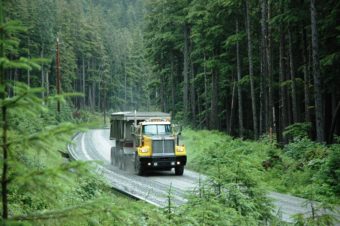
A “max haul” truck drives the Greens Creek road. (Photo by Mike Satre/Hecla Greens Creek Mine)

Hecla Greens Creek Mine plans to expand its waste storage capacity on Admiralty Island. That’s to keep the silver, gold and zinc mine open past 2031, according to filings with the U.S. Forest Service.

The company hopes to expand the mine’s tailings and waste rock storage by about 5 million cubic yards, or about 1,500 Olympic-sized swimming pools. A 45-day period for the public to examine and comment on the plan began Oct. 9.

A pair of virtual meetings on the proposal, with opportunities to ask question, are scheduled later this month.

The company reports producing nearly 9.9 million ounces of silver last year, making it the largest silver producer in the country. The mine will need federal, state and local permits to expand on public land leased in Tongass National Forest.

Tongass National Forest Supervisor Earl Stewart released a statement on Friday underscoring the mine’s economic importance to the region while giving assurances the proposal would be vetted by the agency.

“The Forest Service recognizes the importance of mineral resources to the well-being of the nation and encourage bona-fide mineral exploration and development as part of our multiple-use mandate,” Stewart wrote. “At the same time, our experts work toward minimizing the impacts of mining activities on other forest resources by working closely with the state and other federal agencies to ensure that measures are in place to protect water quality and nearby aquatic habitats.”

Hecla Greens Creek is one of the largest private-sector employers in Southeast Alaska, with around 400 employees and a payroll in excess of $50 million. Its last tailings facility expansion was approved in 2014.

Cruise industry association says passengers are ‘anxious to get back on board’

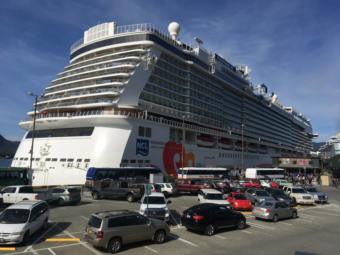
The Norwegian Joy visits Ketchikan on May 13, 2019.
The Norwegian Joy visits Ketchikan on May 13, 2019. (Photo by Leila Kheiry/KRBD)

The head of Alaska’s cruise industry association says people want to get back on cruise ships and visit the state next year. Mike Tibbles briefed the Alaska Board of Marine Pilots on Oct. 9.

“We still are hearing that Alaska remains in high demand, we’re still hearing that there’s a lot of pent-up demand for cruising,” Tibbles said. “Cruisers that have cruised in the past and really are anxious to get back on board.”

The marine pilots board asked Tibbles, the Alaska rep for the Cruise Lines International Association, how many cruise ships and passengers to expect in 2021. He says there’s still too much uncertainty to make projections.

“I just think there’s just too many unknowns at this point to be able to put a specific number out,” Tibbles said.

This year’s cruise season was canceled following a no-sail order by the Centers for Disease Control and the closing of Canada’s ports to cruise traffic. Foreign-flagged vessels require a stop in Canada in order to carry U.S. passengers from Seattle to Alaska ports.

Since the COVID-19 pandemic began, Carnival Corporation-owned lines Princess and Holland America have each sold a ship that had been deployed to Alaska in the summer. A third franchise, Cunard, has also confirmed it’s canceled all Alaska sailings in 2021.

It’s not clear when U.S. and Canadian authorities will allow cruises to resume and visit Alaska ports.

Special FCC licenses could help Southeast tribes close digital divide

Will Micklin of the Tlingit-Haida Central Council discusses environmental monitoring March 9, 2016, at the Elizabeth Peratovich Hall in Juneau. (Photo by Ed Schoenfeld)
Will Micklin of the Tlingit-Haida Central Council at the Elizabeth Peratovich Hall in Juneau on March 9, 2016. (Photo by Ed Schoenfeld)

Southeast Alaska tribes have few communities connected by roads. And while the internet has helped bridge gaps from physical distances, it’s often far from fast or reliable.

That was on display this month when Central Council of Tlingit & Haida Indian Tribes of Alaska held its 85th tribal assembly entirely online. Tribal Vice President Will Micklin says the COVID-19 pandemic made that necessary, but the digital divide was apparent.

“It was a difficult connection for most of the villages outside of Sitka, Ketchikan and Juneau,” he said.

Tlingit & Haida is among hundreds of tribal entities nationwide to apply for a special wireless spectrum license to fill gaps in communities underserved by commercial carriers.

“We don’t have a profit motive,” Micklin said. “Our motive is delivery of service. I really view broadband as an inherent right for our tribal citizens, and that is made ever clearer to me by the impacts of the COVID-19 pandemic, where deficiencies and infrastructures became ever more apparent.”

This year the FCC made that possible by offering a spectrum for wireless broadband — including 3G and 4G and perhaps even 5G data when it’s available— to Native communities. Any unclaimed bandwidth will be auctioned off later to private carriers.

Other tribes in Southeast are taking the same initiative. Hoonah Indian Association has a pending application with the FCC. Tribal administrator Bob Starbard says it covers the tribe’s traditional territory and even some neighbors.

“Our plan is to use it to create a broadband network for all of the community residents of Hoonah and any of the other population centers that’s happened to fall within our territory,” Starbard said.

That territory includes Gustavus, at present time, and because radio waves don’t generally respect municipal boundaries, the service would likely reach Elfin Cove and Tenakee, too.

That overlaps with Tlingit & Haida’s application. But both tribes say they’d cooperate, not compete. The regional tribe has pledged not to overlap its services with local tribes.

If a tie-in with a commercial carrier doesn’t make sense for Hoonah, there’s talk of tribes joining forces because they’ll be on the same 2.5 GHz spectrum. Starbard says the Tlingit & Haida Central Council is discussing “some form of inter-tribal network” with other tribes.

But first, he says, the FCC will need to issue the licenses. And when it does, hundreds of tribes across the United States are expected to have a unique opportunity to fill gaps in connectivity in underserved areas — which describes most of rural Alaska.

Editor’s Note: This article has been updated to clarify that the 2.5 GHz spectrum data will likely be 3G and 4G data services as 5G is not yet available outside of a few limited test markets.

State offers extension for mine lease payments until September 2021

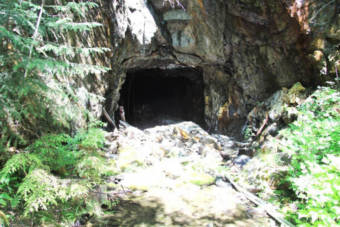
A portal to the former Ross-Adams Mine is one of three openings to be sealed to prevent radioactive waste from leaching into the environment. (Photo courtesy of U.S. Forest Service)


Miners unable to travel to their leases and claims because of COVID-19 can apply for a one-year extension to pay the state.
An announcement by the Department of Natural Resources last month said, in part, that COVID-19 “places an inequitable burden on Alaska’s miners to comply with state statutes through no fault of their own, but rather through an act of God.”

A DNR spokesman says the state on average collects about $4.5 million annually in these fees and lease payments. But since the money would still be due in 2021 it’s considered to be revenue neutral.

“The commissioner’s action makes it possible for holders of all mining claim holders to delay payments of claim and lease rentals, and cash-in-lieu of annual labor, regardless of the size of their operations,” agency spokesman Dan Saddler wrote in a statement.

The Alaska Miners Association welcomed the extension but says the industry group didn’t ask for it.

“We certainly appreciate the state coming up with ways to help the industries impacted by COVID-19, particularly when it can result in longer-term growth,” AMA Executive Director Deantha Skibinski wrote in an email.

Mine employees are considered essential workforce and allowed to apply for exemptions from COVID-19 travel restrictions. The order does not apply to royalty payments from active mining operations this year, the agency said.

State releases plan for $50m in fishing sector COVID-19 relief

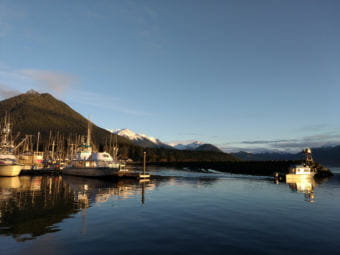
A fishing boat in Sitka’s harbor on Jan. 18, 2018. (Photo by Jacob Resneck/KTOO)

The state has released its plan to divvy up $50 million in federal pandemic payments to Alaska’s fishing industry workers hard hit by COVID-19.

Federal guidance suggested that the state should set aside more than half of the CARES Act funding for processors, about a third for commercial fishermen and 5 percent for sportfishing guides and lodges.

But in a draft released on Oct. 5, the Department of Fish and Game proposes an even split between charter guides, the commercial fleet and seafood processors at 32%.

The state also proposes to set aside small pots of cash for subsistence and aquaculture — at 3% and 1% respectively — for two groups that weren’t included in the federal guidance at all.

The boosts for charter guides, subsistence fishermen and aquaculture have come largely at the expense of seafood processors. Processors command greater revenue but have largely remained operating due to exemptions to travel restrictions for essential workforce. Plants have reported spending millions of dollars trying to keep their facilities free of the coronavirus.

In a statement, Fish and Game said all sectors have been impacted by the pandemic “whether it be reduced wholesale prices and reduction in demand due to economic shut down or sharp declines in tourism due to travel restrictions.”

Applicants for relief would need to document significant losses over the course of the pandemic compared to previous years.

Four coastal lawmakers — including Reps. Dan Ortiz (I-Ketchikan) and Jonathan Kreiss-Tomkins (D-Sitka) — wrote to Gov. Mike Dunleavy two weeks ago urging the state “reimburse processors for COVID-19 expenses to the fullest possible extent through available CARES funding.”

Industry groups representing processors and sportfishing guides said they were still studying the plan and would reserve comment until a later date.

The agency is accepting written comments on its plan until Oct. 19.

Alaska marine highway task force recommends shrinking fleet, forward funding the ferry system

The Alaska Marine Highway System ferry Columbia passes through Wrangell Narrows headed south from Petersburg in Southeast Alaska, June 15. 2012. (Photo by Skip Gray/KTOO)

The group tasked with reshaping the future of the state-run ferry system is recommending the creation of an executive board, fewer vessels, and at least two years of forward funding for the cash-strapped ferries. The Alaska Marine Highway Reshaping Work Group wrapped up eight months of work this month and has forwarded its ideas to the governor’s office. 

The report has not yet been released to the public.

Tom Barrett, a retired Coast Guard admiral and pipelines services executive, chaired the group’s 30-odd videoconference meetings.  At its final one on September 30, he said that the group’s recommendations should be taken as independent advice.

I’ve got no direction steering or limits suggested by anybody in the administration,” Barrett told members of the nine-person panel. “So it’s our report. People can like it or dislike it. Adopt recommendations or not, some of the changes we’re recommending are hard, and will require a fair amount of work to actually make happen.” 

Gov. Mike Dunleavy created the task force to evaluate the $250,000 ferry study prepared by Northern Economics last year. It did that and more, including endorsing the creation of a Marine Highway executive board to steer operations and long-term planning. 

That would replace the existing Marine Transportation Advisory Board which had originally been created for that role. It was downgraded to an advisory body by Gov. Sarah Palin in 2008.

Fewer vessels running and in layup

The work group also recommends reducing the size of the fleet. Barrett pointed to laid up vessels including the two fast ferries and the Malaspina, which are moored at the private Ward Cove at public expense.

They cost $170,000 a month to keep at the dock,” he said of the idle ships, “and they’re never coming back in the system. And literally, you may have to give them away.”

The group didn’t reach consensus on every issue. Some wanted language endorsing progress on replacing the Tustumena, a federally funded project on hold until 2023.

The Alaska Marine Highway System ferry Tustumena sits at the dock in Akutan on the Alaska Peninsula, on July 28, 2012. (Photo by David Waters/KTOO)

Tony Johansen, a road contractor from Fairbanks, maintains that it’s too expensive. He recommended scrapping service to Southwestern Alaska where airplanes can take people and barges can carry freight.

But surely don’t build a huge vessel,” Johansen said, “that’s going to cost a fortune to run with for a system that’s on its deathbed — unless it gets more money out of out of the state system.”

That raised the hackles of Kodiak Republican Rep. Louise Stutes.

Rep. Louise Stutes, R-Kodiak, participates in a House Majority press availability in the Alaska State Capitol on April 3, 2018. The conversation centered on House Bill 286, the state operating budget passed by the House or Representatives the day before. (Photo by Skip Gray/360 North)
Rep. Louise Stutes, R-Kodiak,  in the Alaska State Capitol on April 3, 2018. (Photo by Skip Gray/360 North)

“My blood is boiling here,” she interjected. “Because to just arbitrarily tell a good portion of coastal Alaska: ‘Well, sorry, folks, you’re done.’ It just rubs me the wrong way. It is treating Alaskans poorly.”

It’s unclear whether the Tustumena replacement project was addressed in the work group’s final draft.

More roads, reduced labor costs

Drafts circulated also recommend fewer sailings across the system, fewer communities served, ways to increase road access to coastal communities and to find ways to reduce personnel costs. 

Representing the marine highway’s ferry workers was Ben Goldrich of the marine engineers union. He pushed back on wages being a target for cuts. He suggested more effort to cut waste in procurement, repairs and maintenance from outsourcing by letting ferry crews do more routine maintenance and service work. 

“Ten or 15 years ago, there seemed to be a concerted effort to move away from the crews and move towards vendors and the shipyard,” Goldrich said. “Every time a part is ordered, somebody is trying to get a piece of the action. And that is a place where they can reduce costs by involving the crews more.”

Other recommendations included asking the Legislature to provide forward funding for at least two years, allowing the marine highway to plan and create schedules 12 to 18 months in advance. 

Transportation agency to craft ‘implementation plan’

Department of Transportation spokesperson Andy Mills confirmed that the document has arrived in the governor’s office, but said it won’t be publicly released until agency staff has a chance to digest it and prepare its own implementation plans in the next two weeks.

It’s our plan to have those discussions, and to have at least the initial outline of what recommendations we can act upon in the near and then maybe the long term, have that sketched out as well,” Mills told CoastAlaska on Friday.

A majority of the work group looked favorably on a controversial new ferry terminal at Juneau’s Cascade Point. Proponents say it would shave two hours of travel time on runs up Lynn Canal, allowing dayboats to complete the round trip voyage between Juneau, Haines and Skagway within a 12-hour window.

The work group also recommends the agency adopt a long term plan for the ferry system. And to create a three-member transition team to work within the agency to implement changes in the near future.

Site notifications
Update notification options
Subscribe to notifications