Jacob Resneck, CoastAlaska

Jacob Resneck is CoastAlaska's regional news director based in Juneau. CoastAlaska is our partner in Southeast Alaska. KTOO collaborates with partners across the state to cover important news and to share stories with our audiences.
Judge orders FDA to study dangers of wild release of genetically engineered salmon

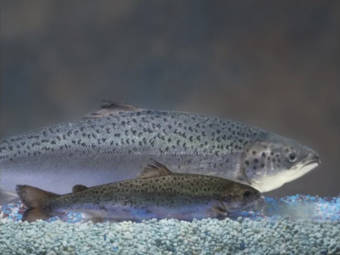
A genetically modified salmon dwarfs a non-modified salmon of the same age in an undated handout photo distributed in 2010. (Photo via AquaBounty Technologies)

A federal judge in San Francisco has ordered federal regulators to re-evaluate the safety of genetically modified salmon. But the court is still allowing thousands of engineered fish raised in tanks in the Midwest to reach American consumers by the end of the year.

The Food and Drug Administration in 2019 approved the farming and growing in land-based pens of an engineered fish that splices genes from Atlantic salmon, Pacific Chinook and an eel-like species called ocean pout.

Marketed as AquAdvantage Salmon, it’s designed to grow about twice as fast as regular farmed salmon.

Environmental lawyers say scientists have urged the FDA to fully consider the ecological risks that could occur if a man-made salmon species became established in the wild.

That is not what the FDA did,” Earthjustice attorney Steve Mashuda told CoastAlaska. “The FDA decided that it would stop its analysis at the assumption that the fish would never get out.”

And that’s where the federal agency erred, U.S. District Court of Northern California Judge Vince Chhabria ruled Thursday in his 16-page decision.

“Obviously, as the company’s operations grow, so too does the risk of engineered salmon escaping,” the judge wrote.

He ordered the FDA to study the issue further and consult with other federal resource agencies over potential risks to wild salmon.

Sending FDA back to the drawing board to take a look at all of the effects of genetically engineered salmon is step one,” Mashuda said by phone from Seattle. “We think when FDA does that, and if they do that in consultation with the expert biologists and listen to outside scientists, they’re going to have to do far more to ensure that these fish are environmentally safe, before they can be continued to be approved.”

AquaBounty Technologies recently announced plans for a Kentucky facility it says would be eight times larger than its existing plant in Indiana.

But Judge Chhabria’s decision effectively blocks AquAdvantage fish from being grown or harvested anywhere but existing facilities until the FDA complies with the court’s ruling.

AquaBounty Technologies President and CEO Sylvia Wulf released a statement on Thursday saying the company is “disappointed” by the ruling. But she says it won’t impact operations at its Canadian egg-growing facility on Prince Edward Island or its Indiana fish farm.

Wild salmon is one of Alaska’s top exports. The engineered Atlantic salmon product has been viewed as a threat, to both the worldwide salmon market and the environment.

The Alaska Seafood Marketing Institute isn’t sounding the alarm over any competitive threat from genetically modified fish. ASMI Executive Director Jeremy Woodrow said by email that consumers are more savvy about the origin of their food.

“Clear labeling and transparency in our food systems is becoming more important every day,” Woodrow’s statement said. “This is just one reason why customers worldwide trust wild, sustainable and natural Alaska seafood.”

The company confirmed the first AquaAdvantage fish grown in Indiana is still slated to hit the U.S. market by the end of the year.

“AquaBounty is excited about the future, and takes seriously the unwavering leadership that is required to offer a safe, secure and sustainable source of Atlantic Salmon that is raised right here in the U.S. heartland for U.S consumers,” Wulf’s statement added.


After 7-month wait, Hyder residents are no longer cut off from Canadian neighbors

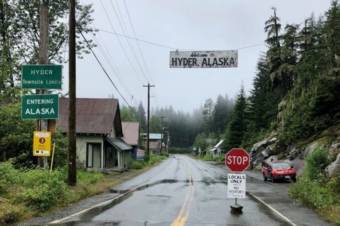
There is no U.S. customs presence at the entrance to Hyder, Alaska. (Photo by Jennifer Bunn/Hyder AK & Stewart BC COVID-19 Action Committee).

Canada has relaxed border restrictions for residents in Hyder. The Southeast Alaska town’s only road out runs through British Columbia.

Since March, the tiny town’s 60-odd residents have been chafing under COVID-19 travel restrictions that left them largely cut off from their Canadian neighbors

But on Oct. 30, the Canadian government announced a number of exceptions to strict 14-day quarantine rules for some border towns. Those towns include Hyder, which is separated from the rest of Alaska by mountain peaks and open water.

There is a lot more freedom of movement across the border, but it is not completely open for locals to go back and forth,” said Jennifer Jean, a Hyder resident and co-chair of the Hyder, Alaska and Stewart, B.C. COVID-19 Action Committee, which spearheaded the effort to reopen the border and attracted support from elected officials on both sides.

Jean says crossings will be limited for “necessities” like groceries, fuel, firewood or helping out family members in need. Recreation and socializing don’t qualify.

We were really looking forward to just the freedom of movement back and forth and open border like we used to enjoy before COVID,” Jean said. “But the reality is, we are living in a pandemic, and the concessions that have been put in place have allowed the freedom of movement that is necessary.”

But Hyder’s handful of school-aged children should be able to attend classes in Canada. Their Alaska school closed this year due to low enrollment, and they’d planned to enroll in neighboring Stewart, BC. The quarantine rule blocked that just days before the fall semester started.  

The new rules give permission to Hyder’s students to cross the border to attend class in Canada, provided they obtain permission from local authorities.

Southeast Alaska reacts to the end of no-sail order for cruise ships

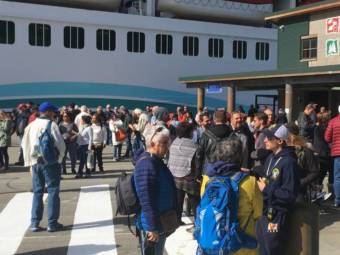
Passengers from the mega ship Norwegian Joy disembark in May 2019 at Ketchikan’s Berth 3 downtown. (Photo by Leila Kheiry/KRBD)

Across Southeast Alaska, industry representatives and local officials are cautiously optimistic about the Centers for Disease Control and Prevention’s lifting of the no-sail order on cruise ships.

Friday’s 40-page order replaces the mid-March ban with a path to resuming week-long cruises in U.S. waters. It requires comprehensive testing at the beginning and end of each voyage.

“It takes a pretty conservative approach, but it gives them the means to get started,” said Patti Mackey, CEO of Ketchikan Visitors Bureau. “And I think that’s all anybody was looking for at this point.”

Alaska was on track to receive more than 1.2 million cruise passengers this year. But that was zeroed out by the COVID-19 pandemic.

Sarah Leonard, President and CEO of the Alaska Travel Industry Association, said in a statement that Friday’s announcement is “a positive step toward Alaska’s summer visitor season in 2021.”

“Alaska’s tourism businesses — working with our cruise partners — are committed to the health and safety of our teams, our communities and our visitors,” Leonard said. “Alaska’s wide-open spaces are a safe travel destination, and we look forward to resuming cruising while adapting to public health measures.”

Some of those measures include CDC language requiring cruise lines to get permission from the communities they visit. That’s key, said Juneau City Manager Rorie Watt, because it allows health authorities to weigh risks.

“Obviously, we’re going to be interested in risk to our population and ability to provide medical services,” Watt said. “So I think there’s a lot to digest. And we don’t really have that much time to plan.”

For elected officials in Skagway, there’s excitement in the town where more than 90% of the local economy is tied to the cruise industry.

“Skagway’s ready to rock,” said Mayor Andrew Cremata. “Some of the obstacles that lie in our path are the fact that Canada still has to open up its borders or at least its ports.”

He’s referring to the current ban on cruise ships in Canadian ports, which was recently extended until late February. Additional extensions to the Canadian port ban could block Alaska’s 2021 cruise season. That’s because U.S. law prevents foreign-flagged vessels from carrying American citizens between domestic ports.

Alaska-bound cruise ships always make a stop in Victoria or Vancouver.

As coronavirus cases rise in Alaska and the rest of the U.S., there’s still skepticism locally that cruises will be able to return in the midst of a pandemic. The CDC’s current travel warnings still advise against cruise travel.
Ketchikan City Council member Sam Bergeron said it’s hard to imagine cruises resuming at the current rate of transmission of COVID-19.

“I think if we want to resume cruising, I think the public safety has to come first,” Bergeron said, “including for the people that are taking the cruises.”

He said more effective treatment — like a COVID vaccine — before next season could make all the difference.

The CDC’s original no-sail order was influenced by outbreaks earlier this year on the Diamond Princess and Grand Princess which infected hundreds of passengers and crew and led to at least 10 deaths.

Fishing industry weighs in on state’s $50M COVID-19 relief plan

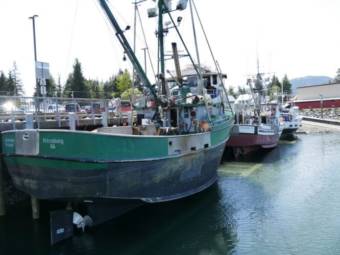
Three fishing boats in Petersburg’s South Harbor. (Joe Viechnicki/KFSK)

A statewide commercial fishing industry group is asking the Dunleavy administration to justify its proposal for distributing $50 million dollars in federal pandemic relief for Alaska’s fishing industry.

Federal guidance recommends allocating more than half of the CARES Act funds to seafood processors and just 5% to the charter fleet and lodges.

But a draft released this month by the Alaska Department of Fish and Game recommends dividing the allocation evenly among sectors, which would increase the pot of money for fishing guides and lodges by more than $13 million.

United Fishermen of Alaska, which represents the commercial fleet and processors, asked the agency to explain its rationale for boosting the charter fleet’s allocation at the expense of other sectors.

UFA’s president Matt Alward signed a three-page letter to the commissioner’s office.

We were asking the department if they could just provide any data, economic data or economic harm to the different sectors that justifies the split,” Alward told CoastAlaska on Thursday.

UFA also pointed out that while commercial fishermen are required to be Alaska residents, no such requirement is proposed for charter guides to qualify for relief.

The formula requires applicants to prove they lost at least 35% in revenue during a certain period. That could be difficult for some charter guides given that bookings were strong during the early days of the pandemic, only to be refunded at a much later date, says Jim Martin of the Alaska Charter Association.

There are some issues, but in general, I think it’s a good plan,” Martin said Thursday.

The Homer-based charter association and the Southeast Alaska Guides Organization wrote letters generally praising the state’s methodology.

“It was really devastating not to have people come in and try to go fishing in Alaska,” Martin added.

Some $1.5 million would be set aside for subsistence users.

Other letters recommended tweaking eligibility requirements to conform to federal subsistence criteria to ensure relief flows to rural households that rely more heavily on subsistence fishing as a food source.

Otherwise relief could be spread too thinly to help those in need, the letters said.

The processing sector says the federal requirement to document steep losses doesn’t conform to facts on the ground. That’s because companies only operated this season by spending tens of millions of dollars on special housing, coronavirus testing, charter flights for workers and other safeguards, says Nicole Kimball, a vice president of the Pacific Seafood Processors Association based in Anchorage.

“What I’ve heard from processing businesses,” she said, is they seek “reimbursement for some of those direct COVID-19 mitigation costs.”

She cited a recent study that found seafood processors spent upwards of $50 million in COVID-19 mitigation alone.

Seafood companies paid for this out of pocket, she said, “to ensure that we could continue to have commercial fisheries. We could protect the processing workforce, and we could protect the communities, primarily remote communities in which we operate.”

The state will submit its final plan to federal authorities after reviewing comments. The Pacific States Marine Fisheries Commission will review the applications and ultimately cut the checks.

Plan approved to sink the Lumberman, Juneau’s troublesome tug

The tugboat Lumberman sitting in Gastineau Channel at low tide on June 15, 2018. It’s since been moved to a city-owned vacant cruise ship dock. (Photo by David Purdy/KTOO)

Juneau’s harbor officials have received the all-clear to scuttle the Lumberman, a derelict tugboat, offshore and in deep water.

The World War II-vintage tugboat has been a fixture on Gastineau Channel.  And it became a jurisdictional tug-of-war between city, state and Coast Guard officials after it broke its anchor line on state tidelands more than two years ago.

It’s now moored to a city-owned cruise dock.  Juneau Port Director Carl Uchytil says permit from the U.S. Environmental Protection Agency gives the city permission to flood the 192-ton steel hulled boat and sink it in 8,400 feet of water.
“If we open this six inch valve, the vessel should sink in 22 minutes,” Uchytil said.

But first, port officials will need to find a way to tow the tug about 50 miles west of Icy Point. How that works, what it would cost and whether it’ll happen this year or next spring is still being worked out.

“It’ll be a very good day when we can put the Lumberman in our in our wake and move on to something else,” he said.

The EPA gave the green light to sink the vessel after it was thoroughly cleaned, first by the Coast Guard in 2018 and more recently by contractors who removed garbage and oily waste from the ship.

The 107-foot tugboat was last used as a makeshift live-aboard anchored outside of Juneau’s Aurora Harbor. Tragedy struck in 2017 when a skiff with five people heading to the tug overturned. Two men on the skiff were never found.

Derelict vessels are a problem across coastal Alaska and Gastineau Channel in particular. As recently as 2015, another derelict tug — the Challenger — sank near Juneau.

It was ultimately refloated, cleaned and dismantled. That cost the public upwards of $2 million.  The state Legislature has since tightened up vessel registration rules in an effort to strengthen the law over the liability of derelict vessels.

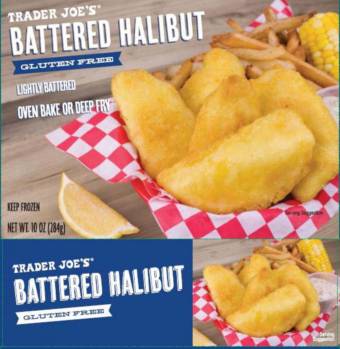
Halibut fillets sourced from Sealaska company pulled from Trader Joe’s

The 10-ounce frozen breaded frozen filets retail for around $8.99 and are supplied by Orca Bay Foods, a subsidiary of Sealaska Corporation. (Photo courtesy of U.S. Food and Drug Administration)

A labeling mistake has led the Food and Drug Administration to order the recall of more than two tons of packaged halibut fillets produced by a subsidiary of Sealaska, the Juneau-based Alaska Native regional corporation.

The agency initiated the recall Friday after it was discovered that the breaded filets, advertised as gluten-free, contain wheat and milk but did not reveal the presence of the potential allergens. No illnesses have been reported.

The 10-ounce frozen filets were sold in Trader Joe’s stores in 19 states but not in Alaska. Some 356 cases have been recalled, with an estimated retail value of around $64,000.

The fish was supplied and packaged by Orca Bay Foods. Since 2017 the Seattle area-based processor has been wholly owned by Sealaska, whose Alaska Native shareholders live in Southeast Alaska and the greater Pacific Northwest.

A Sealaska corporate spokesperson says Orca Bay is reviewing the root cause of the incident.

The breaded halibut was branded Trader Joe’s and is part of a seafood line supplied by Orca Bay and stocked by the grocery giant in the Midwest and Northeast.

Messages left with Trader Joe’s weren’t returned on Tuesday.


Site notifications
Update notification options
Subscribe to notifications