Jacob Resneck, CoastAlaska

Jacob Resneck is CoastAlaska's regional news director based in Juneau. CoastAlaska is our partner in Southeast Alaska. KTOO collaborates with partners across the state to cover important news and to share stories with our audiences.

Lawsuit aims to block wolf trapping on Prince of Wales Island

A wolf on Prince of Wales Island, as captured by a trail camera. (Photo courtesy of the Alaska Department of Fish & Game)

Last year’s record hunting and trapping season eliminated more than half of Prince of Wales Island’s wolf population. That’s according to the 2019 population estimate released on Monday that proposes a 16-day trapping season next month.

The Alaska Department of Fish and Game’s estimate of the wolf population last year is 316. But that number doesn’t factor in the 165 wolves reported taken last winter — more than half the island’s population estimate.

The agency says it considers a 30% harvest to be sustainable. But over half is not. Southeast Regional Wildlife Supervisor Tom Schumacher said as much to the Southeast Alaska Subsistence Regional Advisory Council which met last week.

“There’s no reason that the population couldn’t stand the harvest that it did in 2019,” Schumacher said on Oct. 20. “Is that harvest sustainable through time? I don’t think so.”

Under Monday’s proposal, rural residents eligible for federal subsistence will be able to hunt wolves from Oct. 31 until the end of November. The state’s hunt for non-rural residents wouldn’t open. Trappers will be limited from Nov. 15 to Nov. 30 under both state and federal seasons. There wouldn’t be a limit.

Schumacher told CoastAlaska on Monday that the 16-day trapping season was based on a number of factors.

“We took into account population level information that we had this year — it’s anecdotal — fall 2019 estimate, fall 2019 harvest,” he said. “And they want to ensure given all the controversy surrounding the population, that we had a relatively conservative harvest this year.”

Wolves are targeted because they prey on the island’s deer. But critics say commercial logging on Prince of Wales Island destroyed deer habitat impacting the herds.

lawsuit filed early Monday asks a state judge to intervene. It was filed on behalf of the Anchorage-based Alaska Wildlife Alliance and Joel Bennett, a former member of the Board of Game who lives in Juneau.

“Let’s be clear here, what this is, I think, is a wolf control program for Prince of Wales,” Bennett said.

The lawsuit lays the groundwork for the court to block the state season from reopening in mid-November.

Bennett’s lawsuit calls out the Alaska Department of Fish and Game’s Commissioner by name.

“I don’t think Doug Vincent-Lang would shed a tear if the wolves on Prince of Wales went the way of the passenger pigeon,” he said.

But none of this is a done deal. Fish and Game and the U.S. Forest Service will answer questions and take public testimony by telephone on Thursday. The public meeting begins at 6 p.m. The hour-long public hearing follows at 7 p.m.

A petition by conservationists to add federal protections for Alexander Archipelago wolves in Southeast Alaska is also pending with the U.S. Fish and Wildlife Service. It’s the third such effort since the 1990s.

Anyone interesting in listening in on or participating in Thursday’s 6 p.m. telephonic meeting can call toll free 1-888-566-1030 and enter passcode 3344290 when prompted.

State withholds Prince of Wales wolf population estimate from subsistence council

An undated photo of an Alexander Archipelago wolf in Southeast Alaska. (Photo courtesy of Robin Silver/Center for Biological Diversity)

An estimate of Prince of Wales Island’s wolf population is complete and in the hands of state and federal wildlife managers. But officials refused this week to share their numbers with a regional council tasked with making key decisions on hunting and trapping on federal land. This comes as a petition is pending to list Southeast’s wolves as a threatened species.

State officials told the Southeast Alaska Subsistence Regional Advisory Council — which has a record of supporting the state’s wolf management — that there will be an open season for wolves on Prince of Wales Island.

But hard limits on harvesting wolves were eliminated last year. And that allowed hunters and trappers to redouble their efforts and take a record 165 wolves on and around Prince of Wales Island — nearly as many as the state’s 2018 estimate of the island’s total wolf population.

That’s led conservationists to cry foul and ask that this winter’s wolf season be cancelled. Hunters say the wolf population is healthy and blame the predator for keeping down the deer herds. Another view is that deer habitat has been lost to commercial clear cuts, especially on Prince of Wales.

But before any decision on the wolf hunt is announced, the state and feds need to release their 2019 population estimate to justify their strategy. That was supposed to happen last month. But state officials have blamed COVID-19 for delays in completing laboratory and field work.

Fast forward to Tuesday’s subsistence regional advisory council meeting, where members expected to digest the latest 2019 wolf data.

“I’m not going to release a population estimate and we don’t have a specific plan for the trapping season,” Regional Wildlife Supervisor Tom Schumacher of the Alaska Department of Fish and Game told the council on Tuesday. He says that data wouldn’t be released until the details of the upcoming wolf season were finalized by his agency and the U.S. Forest Service.

What I can tell you is that the 2019 fall estimate is higher than 2018,” Schumacher continued. “And there will be a trapping season. And that trapping season will be shorter than it was last year.”

That withholding of data didn’t sit well with members of the council.

I’m a little unclear on the population estimate, because if that’s a piece of data and it’s final, we want to hear it,” said Bob Schroeder, a member of the council from Juneau. “I can understand how releasing a management plan depends on negotiations and agreement with Forest Service, but a piece of data — we need to see it.”

The state has provided that information in the past. But that hasn’t happened this year. And won’t happen until the length of the wolf season is announced, Schumacher said.

“Given the controversy surrounding this population — the population estimate, the management strategy and the context in which those fall; it’s all part of the same thing,” Schumacher said. “At this point, the department is not comfortable releasing that number. So I’m not going to do that today.”

A public records request for last year’s wolf estimate filed by CoastAlaska early Thursday is pending.

All this comes in the context of a recent petition by conservationists to protect Southeast Alaska’s Alexander Archipelago wolves under the Endangered Species Act

It’s the third such petition since the 1990s. But Schumacher told the council on Tuesday that the U.S. Fish and Wildlife Service is considering it, with a decision expected early next year.

“Our people at headquarters who deal with Endangered Species Act matters on a regular basis tell me that the bar for accepting a petition is relatively low,” Schumacher said. “And they think that Fish and Wildlife Service will accept that petition.”

He says the federal government could list the grey wolf subspecies as threatened.

“If they make that determination, that has some pretty serious implications,” Schumacher said.

In other words, no state or federal hunting or trapping season for Southeast’s wolves. And subsistence would be regulated by a different division of the Fish and Wildlife Service that manages hunting and trapping more conservatively. 

Reached during a break in the council’s meeting on Thursday, regional advisory council chair Don Hernandez says the state agency still hasn’t shared its wolf population estimate with the council. 

“We want to see a well-managed wolf population that, you know, allows for hunting and trapping, if the population numbers justify it,” he told CoastAlaska.

The Point Baker resident of Prince of Wales Island says the subsistence council had supported the state’s wolf strategy. But they’re supposed to take input from regional councils, which are in close contact with residents affected by these decisions. Withholding information doesn’t make that possible.

“All these decisions are going to be made in the next few weeks,” Hernandez said. “And we’re meeting now — and we don’t have the information — and they do.”

The advisory council only meets twice a year, with its next meeting tentatively scheduled for March. 

Alaska Supreme Court hears challenge to fish landing tax

The Alaska Supreme Court heard oral arguments in State of Alaska, Dept of Revenue v. North Pacific Fishing , et al. on October 21, 2020. At stake is a raw fish tax that’s shared with coastal fishing towns across Alaska. (Screenshot by Jacob Resneck/CoastAlaska)

Alaska’s Supreme Court is weighing the legality of a raw fish tax that has pumped at least $25 million into coastal communities over the past five years. But a lawsuit filed by a Washington-based seafood company could change that.

Since the 1990s, Alaska has taxed seafood caught by factory trawlers and floating processors through the fisheries resource landing tax. Even though the fish is caught outside the 3-mile line in what’s considered federal waters, it’s often brought to Alaska fishing ports before being loaded on cargo vessels and shipped overseas.

But the Washington state company, Fisherman’s Finest, is now challenging the state’s tax in court, arguing it violates a pair of provisions of the U.S. Constitution that restrict coastal states from imposing tariffs or duties on goods brought into and out of a state.

Attorney Jim Torgerson told the Alaska Supreme Court on Wednesday that the U.S. Supreme Court wrote in 1996 that it “has never upheld a state tax assessed directly on goods in import or export transit.”

Yet the state is here today, asking this court to uphold a state tax assessed directly on goods in export transit,” he said.

Fisherman’s Finest won a lower court decision last year saying the fish tax is unconstitutional. But the State of Alaska has appealed.

Assistant Attorney General Laura Fox told the justices that the framers of the U.S. Constitution weren’t interested in giving some taxpayers preferential treatment.

Catcher/processor operations take advantage of Alaska to further their business and Alaska’s landing tax merely requires them to pay their fair share for doing business in Alaska like other businesses do,” she said.

This fish tax brought in nearly $42 million over the past four years. More than half of that was shared with Alaska fishing ports.

But nowhere is the revenue more significant than Unalaska, where Dutch Harbor is homeport of the lucrative pollock fishery.

“I think they should pay,” Unalaska’s vice mayor Dennis Robinson told CoastAlaska on Wednesday. “They use our services to be able to get their product to market.”

The port city in the Aleutians collected about $4.6 million from the raw fish tax in 2019. Adak was a distant second, receiving about $150,000 during that same period. Robinson said if the tax is struck down, Unalaska could establish its own excise tax. But that wouldn’t do much for the rest of the state.

As a city, we’d like to see that tax remain in effect,” he said. “And not only for our own interest, but for the interests of the state of Alaska.”

The Supreme Court justices asked only a few questions on Wednesday. It’s not clear when they’ll rule whether Alaska’s fisheries resource landing tax is legal under the U.S. Constitution.

Alaska Marine Highway accepting bids for fleet’s fast ferries

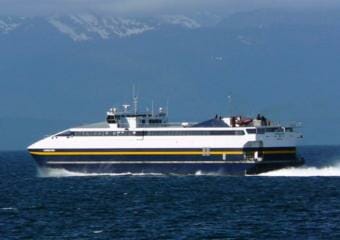
The fast ferry M/V Fairweather steams through Chatham Strait in 2011.
The fast ferry M/V Fairweather steams through Chatham Strait in 2011. (Photo by Ed Schoenfeld/CoastAlaska)

Reducing the size of the state’s ferry fleet was among the cost-saving recommendations from a work group looking to make the Alaska Marine Highway System more efficient. Now, the state is redoubling its efforts to sell its two fast ferries. The sleek blue and gold catamarans were brought into service about 15 years ago with great fanfare but had a rocky start.

A defect with their innovative, lightweight engines caused them to crack, leading to headaches right out of the gate. The state sued the manufacturer in 2010, and both ferries were eventually re-powered with conventional engines.

When they did work, the ferries were popular with passengers. That’s because the 235-foot vessels could cover distances twice as fast as the rest of the fleet — Juneau to Sitka only took about four hours

But the catamarans burned far more fuel than the conventional fleet and struggled in the notoriously rough wintertime conditions in Lynn Canal. So the Chenega was taken out of service in 2015.

The Fairweather went into lay-up last year, says DOT’s regional spokesman Sam Dapcevich.

Each catamaran is powered by four MTU 20V 4000 M73 engines that were installed about five years ago. (Photo by Alaska Department of Transportation)

“We determined that they were too expensive to operate with the high fuel usage complicated machinery and, you know, associated high maintenance costs,” Dapcevich told CoastAlaska.

But that cost-cutting had a price. The agency told lawmakers earlier this year that it’s paying $566,016 a year to moor both fast ferries in Ketchikan’s private Ward Cove facility.
The state tried last year to hire a broker to find buyers, but that didn’t go anywhere.

So DOT is trying something new. It’s accepting sealed bids for each ferry or for both as a package deal. According to filings, the agency has set a minimum reserve price for each ship, but it’s not saying how much that is until the bids are unsealed. Prospective buyers are required to post a refundable $25,000 deposit with each bid.

The public notice went out on Thursday, Oct. 15. And within 24 hours, Dapcevich says the phones started ringing.

“We’ve had some interest, and we are pursuing those leads,” he said on Friday.

The bids will be unsealed on Dec. 15 in a conference room at DOT’s Juneau headquarters. Until then, the agency is inviting prospective buyers to visit Ward Cove to inspect the two ferries.

‘Another broken promise’: Tribes say feds ignored their input on Roadless Rule exemption for Tongass

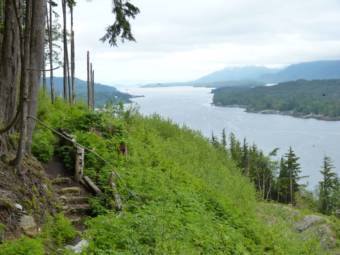
Portions of the Tongass National Forest can be seen from Ketchikan’s Rainbird Trail.
Portions of the Tongass National Forest, seen from Ketchikan’s Rainbird Trail. (KRBD file photo)

Changing a federal rule isn’t simple, but the Trump administration is on the verge of doing it. Last month it started a 30-day clock to completely exempt Tongass National Forest from the 2001 Roadless Rule.
The rule restricts — but does not prohibit — road building and resource development on some national forestlands. Critics say it locks up natural resources. To change it, the federal government is required to consult with tribal governments. And it did — nine Southeast Alaska tribes in all, whose traditional homelands are now part of the country’s largest national forest.

Bob Starbard is administrator of Hoonah Indian Association. When the federal government started its consultation, the tribe was the first to sign on as a cooperating agency. And he says at first it seemed like U.S. Forest Service officials were listening.

“The Tongass, which we sit in the middle of, is part and parcel of being Tlingit. We are people of the land,” Starbard said. “It became clear at the very end, however, that the game had already been fixed.

By that he means the meetings, hearings and public comment periods — which were dominated by Alaskans who favor of keeping the rule intact — didn’t move the Forest Service. It recommended lifting the rule completely and is expected to make it official before the end of October.

“It’s just another broken promise to tribes as far as we’re concerned,” Starbard said.

The nine tribes said as much in an Oct. 13 letter to Agriculture Secretary Sonny Perdue and Forest Service chief Vicki Christiansen.

The three-page letter is unequivocal, with one sentence in boldface: “We refuse to endow legitimacy upon a process that has disregarded our input at every turn.” 

The letter demands an updated environmental impact statement reflecting that the tribes have withdrawn their cooperation.

Marina Anderson, administrator of the Organized Village of Kasaan on Prince of Wales Island, says is was clear that for the federal government, tribal consultation was not taken seriously.

“It was apparent that our participation — requested by the federal government in the throes of this rulemaking process — was a form of box checking, a form of the government saying that they had consulted with us properly and they met with the Indigenous people properly,” Anderson said. “And all of the information that was really relayed to the Forest Service from the tribes, in my perspective, that information was disregarded completely. And really, it distracted us from a lot of other things that we needed to focus on with our time as well.”

In a statement, USDA spokesman Larry Moore wrote that the tribes’ input “was integral to the agency’s analysis during the rulemaking process.”

Alaska’s congressional delegation has long chafed against the Clinton administration-era Roadless Rule.

Republican Sen. Lisa Murkowski has been one of its most vocal critics. She addressed the Alaska Federation of Natives but didn’t mention this milestone during her 18 minutes of remarks. 

“We’ve ensured access to the Tongass by enacting legislation like the Sealaska lands bill and the mental health trust land exchange. We’ve got more on the way,” Murkowski said.

Republican Rep. Don Young applauded the rule change at a recent forum hosted by the Resources Development Council.

“I’m happy to say for those in the area, you know my position I’ve been there I’ve worked there. We’ve got it done. So let’s open up Southeast to the communities for their economic well being,” Young said.

It’s not just Alaska’s congressional delegation that wants to see the Roadless Rule repealed. Elected officials from across the spectrum have spoken out against it. 

Gov. Mike Dunleavy has applauded the Trump administration’s rollback. But it was his predecessor and political opponent — Gov. Bill Walker — who got the ball rolling

But Anderson says elected officials in Alaska have not listened to the majority of residents who oppose the rollback of the Roadless Rule.

“Alaska’s delegation, this entire time, has had industry’s best interest, and they’ve been in full support of the exemption,” she said.

Feds will invest $46.5M to boost high-speed internet in coastal Alaska

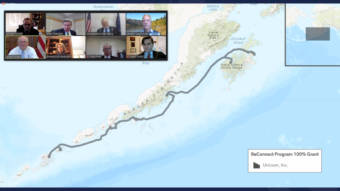
The 814-mile undersea link will connect an existing broadband hub on Kodiak Island with communities along the Alaska Peninsula to Unalaska. (Source: Zoom via Eric Stone / KRBD)

The federal government announced it’s investing $46.5 million to bring high-speed internet to communities across coastal Alaska. That’s expected to improve internet speeds in Southeast Alaska and out as far as the Aleutians.

U.S. Secretary of Agriculture Sonny Perdue made the announcement Tuesday. He said he understands Alaskans are isolated by geography.

“But when we get this high speed, broadband gigabit-speed there, you’re going to be as connected as anyone on the mainland here in that regard,” Perdue said.

More than half of the federal money — $25 million — is going to a subsidiary of GCI to build about 800 miles of undersea fiber cable stretching from Kodiak Island, along the Alaska Peninsula and the Aleutian Chain.

GCI is also spending $33 million of its own capital to complete the connection in 2022.

The U.S. Department of Agriculture’s rural utilities administrator Chad Rupe said the Trump administration recognizes the strategic importance of Dutch Harbor, one of the nation’s largest fishing ports.

“This port is one of our nation’s western, most northernmost natural deepwater ports,” Rupe said. “So this connectivity along the Aleutian chain is especially important not just for our rural economies, but just by sheer geography to support our national defense.”

GCI Chief Operating Officer Greg Chapados said once the fiber optic line is completed, speeds for those living in remote communities should be comparable to Alaska’s urban areas.

“The digital divide between Unalaska and Anchorage will be eliminated,” Chapados said.

GCI said the affected communities in the first phase will be Unalaska, King Cove, Sand Point, Akutan, Chignik Bay and Larsen Bay.

Separately, Alaska Power & Telephone has been awarded $21.5 million to build an undersea fiber optic cable in Southeast Alaska. It would run from Juneau’s Lena Point down the Wrangell Narrows and link communities on Prince of Wales Island.

AP&T is committing just over $7 million to the project. CEO Mike Garrett said it will take about five years to build the 214-mile undersea cable the company is calling SEALink.

“It’s easy to compare this to a superhighway,” Garrett said.

The submerged cable will run from Lena Point near Juneau to Prince of Wales Island. (Graphic by Alaska Power & Telephone)

 After 2025 service will be extended from Kasaan and Coffman Cove to other communities on Prince of Wales, the company said.

The $46.5 million in Alaska grants are part of $600 million approved by Congress in 2018 for the federal ReConnect Program to improve internet connectivity across rural America.

Alaska’s Congressional delegation was also on the Tuesday call.

Nobody from the federal government or telecom companies fielded any questions from reporters invited to cover the announcement.

Site notifications
Update notification options
Subscribe to notifications