Jennifer Pemberton

Managing Editor, KTOO

I bring stories from the community into the KTOO newsroom so that all of our reporting matters. I want to hear my community’s struggles and its wins reflected in our coverage. Does our reporting reflect your experience in Juneau?

What to expect from the instant runoff part of Alaska’s first ranked choice election

Voters cast their ballots at the Anchorage Division of Elections Office on Election Day, November 8, 2022. The polling place served as a an early voting location for districts 1 to 40. (Elyssa Loughlin/Alaska Public Media)

The Alaska Division of Elections has been busy counting votes since even before election day, as early, absentee and mail-in ballots arrive. By Wednesday, Nov. 23, they’ll be done counting the first choice votes on everyone’s ballot. In previous elections, that’s when the races would be called and everything would be sent off to be certified. 

This year, there’s an additional step – called tabulation or sorting. That’s because under Alaska’s new election system, voters rank up to four candidates on the ballot for each race instead of just choosing one. If, after first choice votes are counted, a candidate has more than 50% of the votes, they win outright without a second round. That part hasn’t changed. Races where no candidate wins a majority of votes will go to tabulation.

During the tabulation, the fourth place finisher for each race is eliminated and the second choice candidates from those ballots get added to the results from the first choice vote count. This keeps happening in rounds until there are only two candidates left, and the one with the most votes wins.

We’ve done this once before. In August, the Division of Elections did the tabulation live on Facebook for the special election to replace Rep. Don Young. That was with a cell phone camera held up to a computer screen — a couple of mouse clicks, and it was over. 

This time around will be more of a production. The process will be live on KTOO 360TV and streaming on multiple websites. Division of Elections staff will go down the ballot, race by race, reallocating second choice votes until each one has an unofficial winner. Some races might require reallocation of third choice votes, too.

The U.S. Senate and House races will be first, then the governor (if necessary – he’s on track to get more than 50% of the votes after first choices are counted) and then the state legislative races that don’t have a winner yet, which is the case for roughly a quarter of them.

A photo of a sample ballot for Alaska's 2022 special election
A sample ranked choice ballot for the Division of Elections. (Photo by Liz Ruskin/Alaska Public Media)

Ranked choice voting is also known as instant runoff voting. In some states, there’s a second round of voting when there’s not a majority vote winner in a two-candidate race. For instance, in Georgia, voters will go to the polls again this year in December to determine the outcome of the senate race between Sen. Raphael Warnock and Herschel Walker, among others. Under Alaska’s new voting laws, we’ve already voted in that second round by ranking our choices on one ballot.

The live coverage of the ranked choice vote count will begin at 4:00 p.m. on Wednesday, Nov. 23. At 6:00 p.m. Alaska Public Media will offer an hour-long Alaska News Nightly special with election results and analysis. 

After the tabulation, election results will be unofficial until they are certified. The Division of Elections’ target date for that is Nov. 29.

This story is part of KTOO’s participation in the America Amplified initiative to use community engagement to inform and strengthen our journalism. America Amplified is a public media initiative funded by the Corporation for Public Broadcasting.

City green lights Glory Hall’s affordable housing project in downtown Juneau

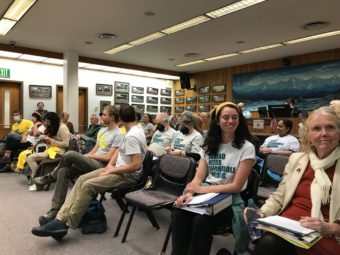
People sitting in rows of folding chairs in a city meeting hall.
At least 40 people came to the meeting, most of them wearing shirts that said “Juneau Needs Affordable Housing.” (Photo by Jennifer Pemberton/KTOO)

Juneau’s Glory Hall has been granted a conditional use permit to convert the space that used to house its emergency shelter into a seven-unit affordable housing complex.

Nearly a full year after they first applied for the permit, Glory Hall staff and their lawyer went before the city’s planning commission for the last time on Tuesday night.

And their supporters showed up in full force. At least 40 people came to the meeting, most of them wearing shirts that said “Juneau Needs Affordable Housing” in plain block letters.

More than two dozen people testified in favor of the commission’s approval of the permit. They spoke passionately for three minutes each, for more than an hour. No one who testified expressed opposition to the project. There was testimony from people who had experienced homelessness and from people who work with Juneau residents who don’t have stable housing.

Rev. Karen Perkins’s church hosts Juneau’s cold weather shelter.

“I see every day — actually every night — how dangerous it is for people not to have places to live,” she said. “I don’t adequately understand what the concern is about creating these units … help me understand it, if there’s someone who can.”

City officials have denied earlier permit requests from the Glory Hall, citing the part of Juneau’s city code that says construction projects in avalanche and landslide hazard zones can’t “increase density.”

The Glory Hall’s project would increase the number of units in the building, but it would decrease the number of people in the building.

A woman sits in a folding chair facing commission members
Mary Alice McKeen, who is representing the Glory Hall, at the Planning Commission meeting on Oct. 25 in Juneau. (Photo by Jennifer Pemberton/KTOO)

Mary Alice McKeen has been representing the Glory Hall during the permitting process. She said at the meeting that the city’s definition of density “goes against such common sense and such logic that it leads people to have distrust and frankly scorn of government institutions.”

Four physicians testified. Emergency room doctor Jodie Totten said that homelessness isn’t good for people’s health or the health of the community.

“I think this is an opportunity where our community can provide for some people to be stably housed,” she said. “I don’t understand why we would not take this opportunity.”

Commissioner Travis Arndt made the motion to approve.

“I believe it’s a net increase in public health and safety, as the intention will be reducing the number of people located at that site,” he said. “We’re working with the assembly all the time to get more housing downtown. That is exactly what that does.”

The vote was unanimous. The motion to grant the permit passed, and everyone in the audience applauded.

“I feel like a billion pounds has been lifted off my shoulders,” said Glory Hall Deputy Director Luke Vroman. “Some faith is restored that our leaders understand that we have people who don’t have homes, and they need homes.”

A man smiling and wearing a yellow shirt that says "Juneau needs affordable housing"
Glory Hall deputy director Luke Vroman smiles after the Planning Commission voted to approve the Glory Hall’s affordable housing project on Oct. 25 in Juneau. (Photo by Jennifer Pemberton/KTOO)

The city will issue the decision in writing by the end of this week or early next week, and the Glory Hall can then collect any permits they need for the project.

According to Jill McLean, who heads the city’s community development department, the city or anyone from the public could appeal, but she said “it’s highly unlikely that the city would.”

The Glory Hall still wants a permit for its affordable housing project in Juneau

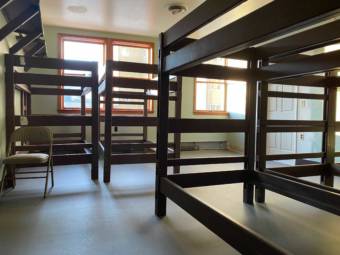
The room that was once the women’s dorm at The Glory Hall in Juneau. December 2021. (Stremple/KTOO)

For almost a year, the Glory Hall has been trying to get a permit to convert the space that used to be a 50-bed shelter to a 7-unit affordable housing complex. The project’s fate could be decided at a Planning Commission meeting Tuesday night.

The nonprofit moved its shelter to the Mendenhall Valley last summer. It still owns the building on S. Franklin Street in downtown Juneau where it used to be housed. And that building is in a known hazard zone for avalanches and landslides, per the city’s maps adopted in the late 1980s.

City code says existing properties in those zones cannot “increase density” through new construction. That’s in conflict with the city’s priority of addressing a shortage of affordable housing. And the Glory Hall has argued that even though the number of housing units will increase with the renovation, far fewer people would be staying at the property on any given night.

The Glory Hall applied for a construction permit almost a year ago. The city initially denied that permit, but the Glory Hall successfully appealed the decision back in May.  That gave the city 30 days to reconsider – after which, it denied the permit again

The Glory Hall did not give up — it submitted an application for a conditional use permit this summer. Earlier this month, the city’s development department recommended that the Planning Commission reject that permit, too.

The Planning Commission will take up the issue of the permit at its meeting Tuesday night. It can grant, deny or impose conditions on the permit. If the permit is denied, the Glory Hall can appeal the decision to the Juneau Assembly.

But the Glory Hall is not going down without a fight. It has invited supporters to testify at the meeting and encourage the Planning Commission to grant a conditional use permit for the project. Glory Hall staff had 40 shirts made with the message, “Juneau Needs Affordable Housing.” 

Staff expect up to 40 people will show up at the meeting.

“We need as many people in attendance at this meeting as possible! Please come! As we all know, Juneau is in the midst of a housing crisis and we believe that every unit counts,” the Glory Hall wrote in a recent newsletter.

The Planning Commission meets in Assembly Chambers at 7:00 p.m. The meeting will also be on Zoom.

A celebration of Filipino food in Juneau

Tasha Elizarde, KTOO’s community reporting fellow, with interview guests Rachel Barril, Lionel Udippa, and Aims Villanueva-Alf on Juneau Afternoon Friday, Oct. 21, 2022, at the KTOO studio in Juneau. (Photo by Sheli DeLaney/KTOO)

October is Filipino American History Month. An event over the weekend in Juneau will celebrate Filipino food with several local chefs.

“So all of my memories, there’s always food associated with them,” said chef Rachel Barril. “Filipino food is the cornerstone of Filipino culture. It’s how we gather for family celebrations, funerals, that kind of thing.”

Barril works at In Bocca Al Lupo in Juneau, which is known for its wood fired pizza. But Barril makes sure there’s always a Filipino take.

“I take the traditional dishes and apply more modern techniques that I’ve learned. I like fermentation. Recently I learned to make miso out of peanuts and I used it in a kare kare dish. It’s like a peanut curry, usually served over oxtail,” she said.

October is the time to consider the contributions of Filipinos to U.S. history because the first Filipinos landed in what is now the United States in October of 1587.

“So, Filipinos have been in America for 435 years. And that’s 33 years before the pilgrims landed,” said chef Aims Villanueva-Alf, who owns Black Moon Coven in Juneau. “I never knew that.”

Villanueva-Alf is from Juneau, but the rich and long history of Filipinos in Alaska specifically is something she’s only recently started to embrace since moving back from the Lower 48.

“I don’t feel like fully let myself really nourish myself in my culture and my heritage until I was out of Juneau,” she said.

Lionel Udippa from Red Spruce and Abby Laforce Barnett from Zerelda’s Bistro will also be bringing food for the event hosted at the Filipino Community, Inc. hall downtown. And they’ll join in a panel discussion, followed by a screening of Ulam, a documentary about Filipino food, sponsored by Friends of the Juneau Public Libraries.

Listen to the full interview on Juneau Afternoon.

This story is part of KTOO’s participation in the America Amplified initiative to use community engagement to inform and strengthen our journalism. America Amplified is a public media initiative funded by the Corporation for Public Broadcasting.


America Amplified

KTOO is amplifying the voices of Filipinos in Alaska. We want to hear from you. What stories would you like to share or learn more about?

Name(Required)

Juneau election results are final, with real estate disclosure repeal effective immediately

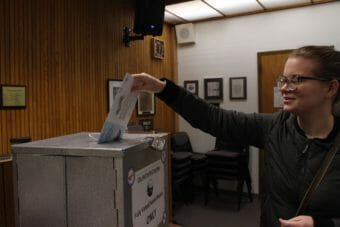
A voter casts a ballot in the 2022 municipal election on Oct. 4 in Juneau, Alaska. (Photo by Tasha Elizarde/KTOO)

Juneau’s 2022 municipal election has been certified. The final results were posted Wednesday evening.

More than 9,000 people cast ballots in this year’s election, representing about a third of Juneau’s registered voters.

There were four propositions on the ballot, and two of them were too close to call on election night. The gaps widened for both as more ballots came in. In the end, Juneau voters decided not to borrow money for a new City Hall, but they did vote to repeal the city’s mandatory real estate disclosure.

Proposition 1, which asked voters to authorize the city to borrow up to $35 million to help pay for a new City Hall, failed by 246 votes.

Proposition 2, which asked voters to approve funding measures for city parks and infrastructure improvements, passed by a wide margin — as did Proposition 3, which authorized the extension of a 1% additional sales tax. 

Proposition 4, a citizen initiative to repeal the mandatory disclosure of real estate sales prices, passed by more than 360 votes. The Juneau Assembly passed the measure in 2020 with the hopes that the information would improve the accuracy of property assessments. The referendum supporters who wanted it repealed called the requirement an invasion of privacy and claimed that requiring disclosures could lead to higher taxes. 

The repeal became effective on Wednesday when the election was certified. 

The Juneau Assembly will learn more about the election results at its next regular meeting on Monday. There are no new assembly members to swear in. Carole Triem, Greg Smith and Wade Bryson all ran unopposed to keep their seats.

Juneau School Board members Emil Mackey and Deedie Sorensen were also re-elected to their positions without facing challengers.

Site notifications
Update notification options
Subscribe to notifications