Jennifer Pemberton

Managing Editor, KTOO

I bring stories from the community into the KTOO newsroom so that all of our reporting matters. I want to hear my community’s struggles and its wins reflected in our coverage. Does our reporting reflect your experience in Juneau?
Alaskans plan to honor victims and survivors of Indian boarding schools

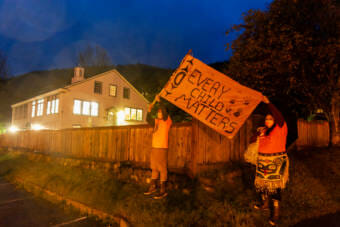
A mother and son hold up a sign for Orange Shirt Day in front of a former Bureau of Indian Affairs school on Douglas Island, on Thursday, Sept. 30, 2021, in Juneau, Alaska. (Photo by Rashah McChesney/KTOO)

Friday is a day of remembrance for Indian Boarding Schools in the U.S. and Canada, also known as Orange Shirt Day. The day of reconciliation was created by Phyllis Webstad, a boarding school survivor in British Columbia who had her favorite orange shirt taken away on the first day of school.

There were dozens of residential schools across Alaska. Generations of Alaska Native children were also taken from their homelands to attend boarding schools in other parts of the country. 

There are a number of events happening around the state to bring attention to the damage these schools did to Indigenous children, and to offer a way to honor victims and begin healing.

“Many people live here on Lingít Aani and don’t know the history of cultural genocide that has happened on this land, as well as the ways in which racism continues to impact families today,” Ati Nasiah said on Juneau Afternoon Tuesday. Nasiah works at AWARE – Juneau’s domestic violence and survivor support organization.

In Anchorage and Juneau, people will wear orange shirts and gather during morning commute times on Friday to wave at drivers and hold signs.

Nasiah said it’s a history that many Alaskans are completely unaware of. 

“Understanding what’s happened here and understanding that history allows for us to strive to tend well to the landscape that we live in,” she said. “And to each other in a way that encourages us to support things like native language revitalization.”

In the evening, there will be a formal apology prepared by the Alaska Quakers at Sayéik Gastineau School in Juneau – the site of the former Douglas Island Friends Mission School, which forcibly assimilated Lingít children.

In May of this year, Interior Secretary Deb Haaland released the first report from an investigation into the problematic legacy of federal Indian boarding schools. 

The government of Canada released a similar report in 2015 after several years of investigation by its Truth and Reconciliation Commission.

Remembering Jeremy Hsieh’s 13 years with KTOO

Jeremy Hsieh portrait
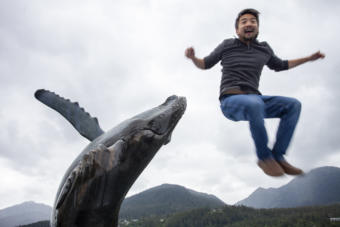
KTOO’s Jeremy Hsieh jumps for a portrait in Overstreet Park in Juneau in 2019. (Photo by Rashah McChesney/KTOO)

Tuesday, Sept. 27, is Jeremy Hsieh’s last day with KTOO.

The first time Juneau heard Jeremy on the radio was Christmas Eve in 2009, with a story about how you couldn’t get Chinese food in Juneau on Christmas. He even called the Japanese and Thai restaurants in town. 

In 2013, he covered professional jump roper Peter Nestler…extensively

He coined the phrase “fecal cliff”or thought he did

City and Borough of Juneau wastewater engineer Lori Sowa discusses wastewater treatment with KTOO reporter Jeremy Hsieh during a tour of the Juneau-Douglas Wastewater Treatment Plant on March 18, 2021. (Photo by Andrés Camacho/KTOO)

Then there’s a simple story from 2013 called “A bear walks into a bar.”

And who can forget the world’s smallest Costco?

Jeremy wore a lot of hats at KTOO. He was a reporter, an editor, a producer. He started freelancing for KTOO in 2009 after getting laid off from the Juneau Empire. In 2011, he started producing Gavel Alaska. He joined the news team in 2013.

His interest in government is a thread that runs through his career here.

Over the last 10 years he reported nearly 1,000 stories for KTOO. That’s 10 years of referendums, of assembly meetings, of gubernatorial candidates. Stories about sewage, about infrastructure spending and property taxes, about Mendenhall River floods, about garbage bears and drug busts. 
Jeremy is moving to Anchorage next month and will report for Alaska Public Media, so you’ll still hear him on the radio. We can all expect to get to know the sewage situation in Alaska’s largest city soon.

Two weeks before Juneau’s election, Will Muldoon says it’s not too late to run

Juneau resident Will Muldoon serves on six boards and commissions for the city of Juneau and the state of Alaska. In 2021, he won as a write-in candidate for school board after entering the race less than two weeks before the election. (Photo by Paige Sparks/KTOO)

In the fall of 2021, Juneau schools still had a district-wide mask mandate in place when seven candidates for school board participated in a forum ahead of the local election.

Watching at home, Will Muldoon realized that at least two candidates were running just to overturn the mask mandate. He knew he had to do something.

He said 25 people called him — some he didn’t even know — encouraging him to run.

“So that kind of felt like critical mass for me,” he said.

He launched a write-in campaign less than two weeks before the election. And he won. It was the first time someone in Juneau had won any election as a write-in in almost 30 years.
Muldoon works as a data analyst for the state of Alaska. He doesn’t have kids. But he is passionate about civic engagement. He serves on six boards and commissions for the city and the state. The school board takes the most time and energy, though.

“The one thing I really didn’t fully consider was just how much of your life it takes over,” he said.

There are the meetings, of course, but there’s also homework between the meetings. And hours and hours of reading emails each week from constituents. People don’t usually write in to tell board members they are doing a good job. The tone is often less than civil.

In his first year, the board has taken public feedback on COVID-19 policies, bathroom use for trans students and reaction to the school district’s food vendor serving floor sealant to students instead of milk.

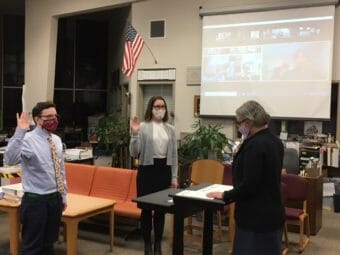
New Juneau Board of Education Members, Will Muldoon (left) and Elizabeth Siddon (center) in person and Amber Frommherz online, took the oath of office on Tuesday, October 19, 2021. (Juneau Board of Education photo)

“It’s tough, because I think with schools in particular, I feel personally that it’s not my job to tell people how to raise their kids, or even really have an opinion on that item,” he said.

But it is his job to make policies informed by the public on the schools’ role in their kids’ lives.

Muldoon says people often ask him if he enjoys serving on the school board.

“‘Enjoy’ is never the word I’m going to use in my top five adjectives,” he said. “I think the work is valid. I think it’s important. It’s also impactful to me on an individual level — like, it’s tough.”

But he’s still enthusiastic about recommending people run for local office.

There are no contested seats on the school board this year. But Muldoon says it’s not too late to “pull a Will Muldoon” and enter the race as a write-in candidate.

“It’s tough to win a write-in campaign,” he said. “I’m aware of that, obviously, and the chances aren’t always the best.”

He ran for school board twice before last year — the first time, when he was only 18 years old.

“I tend to just be a born loser,” he said. “But I don’t mind losing. It’s okay to lose. It’s okay to make mistakes, because that is what really helps us get better.”

He recognizes that the last few years have been hard on everyone. The pandemic has left us burned out on work and on life, which includes our volunteer work and our civic engagement. But he also recognizes that we can’t make life easier for each other if people don’t step up.

“Do I want to be on six boards next year? Probably not,” he said. “Do I want a couple of more folks in our community to be on at least one or two? Yeah, I think so.”

Juneau’s election is by mail again this year and ballots have already hit most people’s mailboxes. But voters have until 8:00 p.m. on Oct. 4 to cast their votes.

There are also dozens of vacancies on Juneau’s boards and commissions.

Muldoon’s advice is always going to be to go for it.

“I wish that people would run and not be afraid to lose with that in mind,” he said. “And if your end goal is to be engaging, and advocating for the things that you believe in, losing is a real good door opener for that.”

This story is part of KTOO’s participation in the America Amplified initiative to use community engagement to inform and strengthen our journalism. America Amplified is a public media initiative funded by the Corporation for Public Broadcasting.

Alaska health officials report Juneau’s 23rd death from COVID-19

The state reported a total of 25 new deaths among Alaska residents, which occurred from January through August of this year. (Photo by Rashah McChesney/KTOO)

Alaska health officials say that a Juneau woman in her 70s has died of COVID-19. It’s not clear when she died. 

The state reported a total of 25 new deaths among Alaska residents, which occurred from January through August of this year. 

Over the course of the pandemic, 23 Juneau residents have died from COVID-19.

The state reported 67 cases of COVID-19 in Juneau from the last week among residents and visitors to town, an increase over the previous week’s 51 cases. That doesn’t include positive results from home tests. 

There were 1,494 cases reported across the state. That includes 544 non-resident cases — more than half of those were identified on vessels at sea related to tourism.

Statewide, 66 people with COVID-19 are in the hospital. None are on ventilators. 

COVID-19 vaccinations are available for anyone 6 months old or older. Updated boosters designed to protect against omicron variants and the original strain of COVID-19 are now available. Anyone 12 and older is eligible if they haven’t received a dose of any COVID vaccine in the past 2 months. 

In Juneau, call 907-586-6000 or make an appointment online

With a little help, Juneau voters are getting the hang of ranked choice voting

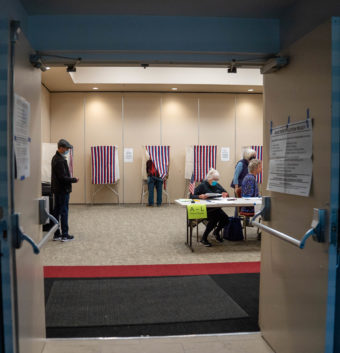
Jo Schoeppe helps voters verify their ballots through the Ballot Cyon Machine at Mendenhall Library on Aug. 16, 2022 in Juneau. (Photo By Paige Sparks/KTOO)

Two years after Alaskans voted on a new way to do elections, ranked choice voting made its debut in the special election to fill the vacancy left in Congress when Don Young died.

Poll workers across the City and Borough of Juneau said they felt prepared to help voters navigate both ranked choice voting and the open primary on the other side of the ballot. 

At the Mendenhall Valley Library, volunteer Vivian Bearden said it wasn’t the ranked choice side of the ballot that was giving people trouble. It was the pick-one primary.

“The Don Young vacancy is really confusing,” she said. “I’ve never seen a ballot with that many candidates.”

There are 22 candidates for U.S. Representative.

At Elizabeth Peratrovich Hall, Juneau voter Portland Highbaugh said she had no problem with the ballot.

“I don’t understand why people think it’s so complicated, honestly,” she said.

She works for the Alaska Municipal League, which supports local governments around the state, so she said she was really informed about both sides of the ballot.

“It’s a pick one primary. So you pick one,” she said. “It’s the same thing we’ve been doing as long as we’ve been voting.”

Portland Highbaugh stands outside Elizabeth Peratrovich Hall after casting her vote on Aug. 16, 2022 in Juneau. (Photo By Paige Sparks/KTOO)

Volunteer Jo Schoeppe was helping people at the library feed their ballots into the voting machine. She asked voters for permission before helping to feed their ballots in, without looking at who they voted for.

“The machine is a little touchy sometimes,” she said. “I feel like I’m being controlling.”

The voting machines are programmed to read both sides of the ballot. When a ballot got rejected, the machine would say which side of the ballot had the problem.

Schoeppe said the most common rejection was for people who only voted for one candidate on the ranked choice ballot. It’s a valid way to vote, but she’d ask if people were sure they didn’t want to rank the rest. 

People did make mistakes, though. Like picking a first choice but skipping second and third, then filling in a fourth. 

“That’s improper,” she said. “And so we return it. They rip it and bring it back.”

Those voters would get a new, questioned ballot and re-do their ballot, which would go in a special locked tote to be tallied by hand.

Preliminary results from this election will be available after polls close, but it will be at least two more weeks until all the ballots are counted and official results come out.

Site notifications
Update notification options
Subscribe to notifications