
Jennifer Pemberton

Managing Editor, KTOO

I bring stories from the community into the KTOO newsroom so that all of our reporting matters. I want to hear my community’s struggles and its wins reflected in our coverage. Does our reporting reflect your experience in Juneau?
As Filipinos head to the polls, some voters in Alaska bet on a political dynasty

Bongbong Marcos’ 2022 presidential campaign in Makati, Philippines. (Creative Commons photo via Patrickroque01)

Hundreds of voters in the Philippine national elections will be waiting for the results in Alaska. And some hope the outcome makes way for a return to the past.

Leo Evangelista got two mailed ballots recently. This week he voted in Alaska’s special primary for the state’s sole seat in Congress. Last week, he voted for the president of the Philippines.

Evangelista is a dual citizen. He’s lived in Anchorage since the early 1990s and has worked as a mail carrier for more than 25 years.

“My family always said, ‘You want to be a nurse or you want to be a mailman?’” he said with a laugh.

He loves his life in Alaska, but he has siblings back in the Philippines and owns a home there still. He’s stayed really involved in politics, and he takes voting seriously.

Workers with the Special Ballot Reception and Custody Group receive ballots at the Philippine Consulate General office in San Francisco. (Photo from the Republic of the Philippines, Philippine Consulate General, San Francisco)

There was some confusion about whether the overseas ballots had enough pre-paid postage. His wife works at the post office too — at the counter. She made sure to weigh their ballot envelopes and add sufficient postage. And then she sent them priority mail to the consulate in San Francisco, because Evangelista is not taking any chances.

He’s not too worried, though. His candidate — Ferdinand “Bongbong” Marcos Jr. — is expected to win.

Even if you’re not following Philippines politics closely, that name is probably familiar to you. Bongbong is the son of Ferdinand and Imelda Marcos. Ferdinand ruled the Philippines from the mid-1960s to the mid-1980s, part of that time under martial law.

Evangelista is like so many Filipinos who left the country toward the end of the Marcos presidency when the family was deposed and fled in exile to Hawaii. It was a very tumultuous time in the Philippines.

Evangelista worked for the government under the Marcos presidency but says he left for opportunity. He says life is better in the U.S. because there are jobs.

But life is better in the Philippines, too, he says. It’s cheap. And warm. And besides, it’s home. He hopes that under the leadership of another Marcos, the country will continue to become more like how he remembers it. He plans to move there as soon as he retires.

Rochelle Solanoy also has plans to return to the Philippines when she retires from her state job in Juneau in six and a half years.

“Because when you go home to the Philippines, you feel like a queen,” she said. “You know, your money stretches.”

Solanoy is also a dual citizen. And she’s more than just a supporter of Bongbong Marcos. She’s a fan. On the Friday before the election, she was driving around Juneau after work, picking up her girlfriends for a celebratory dinner at the Gold Digger, a Filipino restaurant in a strip mall.

“We’re celebrating because it’s Annie’s birthday,” she said. “And we’re celebrating because Bongbong’s gonna win.”

She’s excited about Marcos’ promises to keep cleaning up the cities, to keep building infrastructure and to build a new economy. Her dream is of a big reunion in the Philippines — a homecoming for all the overseas workers. The older people will retire on the beautiful beaches. The younger people will finally have jobs there and be reunited with families some of them have never met.

Solanoy wasn’t always a Marcos supporter. She left the Philippines in 1981 when she was still a kid. But she went back to visit in 1986. She was a teenager and she says she got caught up in the People Power Revolution.

“I mean, they portrayed Marcos to be a dictator. Of course, I believed all of that,” she said.

But Solanoy says she has since relearned the political history of her country. She says she’s still learning, through YouTube videos, about what the older Marcos accomplished during his leadership. In these videos, the years of martial law in the Philippines are now remembered as the golden years, and Marcos is remembered as a philanthropist. She thinks she was lied to for 30 years.

“That’s why I was like, ‘oh my God, I was so stupid!’” she said thinking back on her teenage flirtation with the revolution. “A lot of people are thinking that way. So we want Marcos back.”

Like Leo Evangelista, she’s confident that Marcos will win – unless there is election fraud. In 2016, Bongbong Marcos lost his vice presidential bid against Leni Robredo. His supporters believe the vote was rigged, but Marcos’ official protests of the result failed.

Robredo is now also vying for the presidency. Solanoy and her friends say they’re scared of cheating – that somehow Robredo will win again. But they also say they trust the current president, Rodrigo Duterte, to ensure a clean election. After all, his daughter is running for vice president.

“Of course he’s going to protect his daughter,” Solanoy said.

Election day is Monday, May 9. It’s a holiday in the Philippines. When the polls close, it’ll be 3 a.m. in Alaska. Leo Evangelista is planning on staying up late to watch the results if they come in right away. He’s planning to take Monday off.

Rochelle Solanoy is already celebrating a Bongbong Marcos win. She says when it happens, she’s going to go to the Philippines and visit him at Malacañang Palace. She wants to talk to him in person about her plans for herself and all her friends to retire from their state jobs and go back home.


This story is part of KTOO’s participation in the America Amplified initiative to use community engagement to inform and strengthen our journalism. America Amplified is a public media initiative funded by the Corporation for Public Broadcasting.


Filipinos in Alaska

KTOO is amplifying the voices of Filipinos in Alaska. We want to hear from you. What stories would you like to share or learn more about?

Name(Required)

Slow start to cruise season is even slower for Juneau Filipino businesses

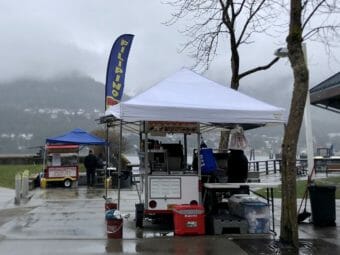
A food stand in Juneau's Marine Park is a collection of tables, grills and coolers under a white tent. A vertical banner says "Filipino BBQ" in blue, yellow and red -- the colors of the Philippines flag.
Carrillo’s and Bernadette’s food stands in Juneau’s Marine Park on April 25, 2022 — the first day of the year with a large cruise ship in port. Both businesses cater to Filipino and Indonesian cruise ship workers. (Photo by Jennifer Pemberton / KTOO)

A megaship called the Norwegian Bliss was the first large cruise ship to come to Juneau this year. It tied up at the dock farthest from downtown, but at Bernadette’s barbecue stand, Dannie Lazaro was grilling a pile of chicken skewers in the hopes that people would start heading his way.

He wasn’t waiting for tourists, though. Most of his business is with the workers on the ship who largely hail from the Philippines or Indonesia and are often hankering for a taste of home.

Last year, COVID-19 restrictions meant that the crew more often than not couldn’t get off the ships in port at all, so that means Bernadette’s and other businesses in town that cater to crewmembers, did practically zero business. Bernadette’s offered delivery. Local longshoremen would pick up the food and take it to the crew stuck on the boats, but that hardly made up for the hundreds or thousands of workers that used to pass by his stand every day before the pandemic.
More than an hour after the ship docked, it was still unclear if the crew would get off the Norwegian Bliss. Lazaro was waiting for all the passengers to get off and then for the crew to board a van that would bring them closer to town.

Lazaro also owns a gift shop on touristy South Franklin Street in Juneau. It’s closer to the ship and people who looked like passengers were starting to trickle in. But no crew. Lazaro’s son Dan was working at the store.

“We have money remittance service, so we rely on them to come down,” he said.

The shop is one of several downtown that offers overseas workers a way to wire money back home. It doesn’t make its money from T-shirts and mugs.

Frontier Gifts on South Franklin Street in Juneau on April 25, the first day of the 2022 cruise season. The store relies on revenue from cruise ship workers wiring money to their home countries. (Photo by Jennifer Pemberton / KTOO)

Eventually, the street started to fill up with tourists. And finally the van that usually shuttles the crew around town pulled up in front of Bernadette’s barbecue stand. But it was empty. The crew wouldn’t be getting off the ship after all. But a local office worker on his lunch break walked up and ordered some chicken skewers.

“How many you want? A thousand?” Lazaro joked.

The slow start to the cruise season was expected. This ship was about half full, but city officials in Juneau have budgeted for a million passengers to come through town this year, knowing that the steady stream of ships will become more and more full as the season progresses.

Each cruise line has its own rules about who gets off the boat and where. Norwegian is notoriously strict. But there are two more ships coming this week and more than a dozen coming every week after that, so Dannie Lazaro will keep the grill hot and keep the chicken skewers coming in the hopes that those hungry crew members will eventually stop by.


This story is part of KTOO’s participation in the America Amplified initiative to use community engagement to inform and strengthen our journalism. America Amplified is a public media initiative funded by the Corporation for Public Broadcasting.


Filipinos in Alaska

KTOO is amplifying the voices of Filipinos in Alaska. We want to hear from you. What stories would you like to share or learn more about?

Name(Required)

Watch: U.S. Sen. Dan Sullivan’s annual address to the Alaska Legislature

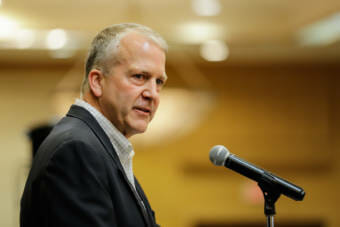
U.S. Sen. Dan Sullivan is set to deliver his annual address to the Alaska Legislature at 11 a.m. Tuesday, April 19.
Watch a live stream here, on KTOO 360TV, or tune into KTOO-FM.

Sen. Sullivan has had a mixed voting record in the Biden years. He voted for the bipartisan infrastructure bill, but against Ketanji Brown Jackson’s confirmation to the U.S. Supreme Court.

Recently, he’s criticized Pres. Joe Biden’s defense budget, saying the military is dangerously underfunded. And, along with Sen. Lisa Murkowski, he’s called on the Biden administration to address the high number of suicides among Alaska’s military service members.

Sullivan has been in office since 2015. Unlike Alaska’s other two seats in Congress, Sullivan’s is not up for re-election this year.

The Alaska Legislature has a tradition of inviting the congressional delegation in to deliver an address while they’re in session. They heard from Alaska’s senior senator, Lisa Murkowski, in February.

KTOO says goodbye to Rashah McChesney

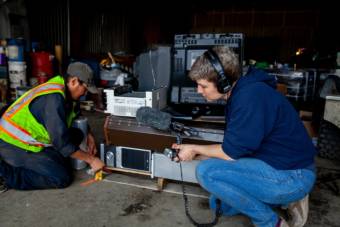
Reporter Rashah McChesney in Unalakleet in 2019, where she was reporting on contaminated sites in rural Alaska. (Photo courtesy of Rashah McChesney)

Friday, March 11, is Rashah McChesney’s last day with KTOO. She’s brought so much memorable reporting to our airwaves over the past six years. More recently, she’s shaped almost everything you hear out of the newsroom as our daily news editor.

Rashah started at KTOO working for Alaska’s Energy Desk in 2016. Her focus was on energy policy. She was intimidating in how much she knew about the ins and outs of Alaska’s oil industry. She was also deeply sourced and seemed to have every lawmaker and commissioner on speed dial.

For the “Midnight Oil” podcast, she drove the haul road with one of the first female truck drivers to work on the Trans-Alaska pipeline.

She joined former Gov. Bill Walker’s trade mission to China.

She went on a reporting trip to the Yukon-Kuskokwim Delta for an investigation into contaminated sites — mostly schools — that no one was responsible for cleaning up. And in addition to award-winning stories on that, she came back with this unforgettable profile of a teacher in the village of Tuntutuliak.

Alice Fitka in her classroom on Wednesday, April 3, in Tuntutuliak, Alaska. (Photo by Rashah McChesney/Alaska’s Energy Desk)

In late 2019, Rashah became the daily news editor for the local newsroom at KTOO. Shortly after taking on this new role — on a Sunday in December — Juneau police shot and killed a man on Cinema Drive in the valley. Rashah went to the scene immediately and started talking to neighbors and friends who had witnessed what happened.

“Many stood on their porches quietly talking, watching their children run along a nearby ditch where bits of bright yellow crime scene tape fluttered in the wind,” she narrates in the story. “Some shook and cried when they talked about what had happened. Many didn’t want to talk on-the-record about Kelly Michael Stephens, better known as Rabbit. But, a handful of people — including Georgianna Joseph — did. They rolled up their sleeves, pulled up their shirts and showed off tattoos that Stephens had done.”

We have a picture of one of those tattoos hanging in the hallway at the KTOO studio. Because people inherently trust Rashah, they warm up to her immediately. Enough to speak into her microphone about their trauma. Enough to roll up their sleeves and pull up their shirts to show themselves to her.

Residents and visitors at the Chinook apartment complex in the Mendenhall Valley show tattoos they were given by Kelly "Rabbit" Stephens on Sunday, Dec. 29, 2019 in Juneau, Alaska. Many said they didn't want their identities known for fear of reprisal. Stephens was killed during an early-morning altercation with Juneau Police. (Photo by Rashah McChesney/KTOO)
Residents and visitors at the Chinook apartment complex in the Mendenhall Valley show tattoos they were given by Kelly “Rabbit” Stephens on Sunday, Dec. 29, 2019 in Juneau, Alaska. Many said they didn’t want their identities known for fear of reprisal. Stephens was killed during an early-morning altercation with Juneau Police. (Photo by Rashah McChesney/KTOO)

Also, she can sing. Which led to this story about a choir that formed during lockdown in Juneau — a choir that practiced entirely from their cars parked around downtown.

Join us in thanking Rashah for her years of service to Juneau and Alaska. She’s taking those same skills and sensibilities to Alabama to serve as an editor for the Gulf States newsroom.

We’ll miss you, Rashah.

Newscast – Tuesday, Mar. 1, 2022

In this newscast:

  • Riverbend Elementary students move back into their flooded school
  • Will Judge Ketanji Brown Jackson still speak at the Alaska Bar Association convention if she’s a Supreme Court Justice?
  • Ravn Alaska’s loyalty program goes crypto
  • Alaska’s U.S. senators renew calls to advance home-state priorities in response to Russia’s aggression toward Ukraine
Site notifications
Update notification options
Subscribe to notifications