In this newscast:
- Riverbend Elementary School closed indefinitely after flood
- A new COVID-19 tracking app comes online in Alaska
- Alaska lawmakers might get per diems after all
- A Fairbanks storytelling program makes it to NPR
I bring stories from the community into the KTOO newsroom so that all of our reporting matters. I want to hear my community’s struggles and its wins reflected in our coverage. Does our reporting reflect your experience in Juneau?
In this newscast:

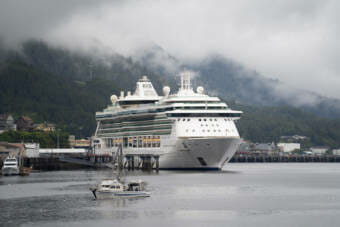
The Centers for Disease Control and Prevention is once again asking Americans to avoid cruise ship travel. With the emergence of the omicron variant, federal health officials say that even fully vaccinated passengers can catch and spread COVID-19.
On Thursday, the CDC raised the risk level for cruise ship travel to Level 4: its highest level, which means even vaccinated travelers should avoid cruise ships. At the previous level, the CDC was only warning unvaccinated people against cruise ship travel.
There are almost 100 ships with COVID-19 on board that the CDC is currently investigating.
All cruise ships are sailing in U.S. waters under a conditional sailing order, which means the cruise ship companies have to comply with certain safety regulations and have agreements with the U.S. ports where they dock. That order has been extended until January 15th.
There is a full slate of cruise ships scheduled to visit Alaska in 2022. The first large ship will arrive in Juneau at the end of April.

The year 2021 was a great one for public art in Juneau. In February, signs went up around town that tell people much more than just where they are physically located. Each one tells an oral history about the place as part of a project called Juneau Voices. Ten stories are narrated by people from Dzantik’i Héeni, whose family histories go back generations.
Over the summer, a Juneau coffee shop got a makeover from Lingít artists, including a mural of a misty seascape by Michaela Sheit.een Goade, who is well-known for her work illustrating a Google Doodle and winning the Caldecott Medal for illustrating the book “We Are Water Protectors.” At the counter there’s an aluminum carving by Robert Mills that tells the story of the Fog Woman. Mills is also responsible for the 20-foot-long formline canoe called Yaadachóon installed this year along the seawalk at Overstreet Park.

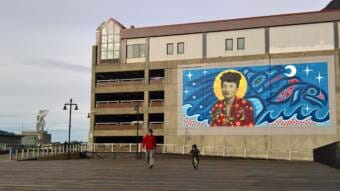
A mural of civil rights icon Elizabeth Peratrovich now adorns the side of the downtown library and parking garage. It’s the work of Crystal Worl. The city is considering changing the name of the whole area around the mural to Peratrovich Plaza.
Crystal Worl’s mural is several stories tall. One of her brother’s works is miniscule by comparison, but also made a huge splash this year. Rico Lanáat’ Worl’s designs caught the eye of an art director at the U.S. Postal Service, who encouraged Worl to submit artwork for a postage stamp. Eighteen million stamps featuring Worl’s depiction of the raven and the box of daylight story were released to the public in July. A ceremony in Juneau celebrated the first stamp ever designed by a Lingít artist and the importance of the design and its story to the people who live in Lingít Aaní today.

In September, a local artist’s beadwork was featured on the hit Native comedy show Reservation Dogs. Kaasteen Jill Meserve was commissioned by the show to make two phallic medallions for an episode. One’s a pickle and the other is a microphone. Meserve is a huge fan of the show and said everyone should watch it. “In not just, like you know, in our Native communities but like for Hollywood and what it means to be really truly represented in media and on screens. It’s very monumental,” she said.
One of Juneau’s newest restaurants, Black Moon Koven, opened up this spring very elusively and mostly through word of mouth. Its dark, moody ambiance has drawn a cult following. It’s a big risk to open a restaurant during the pandemic, but owner Aims Villanueva-Alf’s gut told her to just do it. Last year Villanueva-Alf had closed her wildly popular Auke Bay space GonZo after she was assaulted there.
“I feel like Black Moon was my way of healing through my trauma and continually is a place where it could be, and seems super dark to people, but it actually brought a lot of life and light into my own darkness,” she said.

KTOO is looking back at 2021 through the stories that had the widest and strongest impact on the community. Read stories about justice in Juneau, the cruise industry’s return to Juneau, or the year in state government.

Lawmakers spent a record amount of time at the capitol this year trying to agree on a budget.
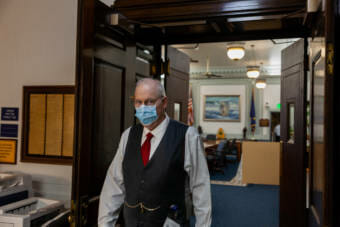
The Alaska Legislature convened in January, during Alaska’s first wave of COVID-19. Plexiglass barriers were installed between lawmakers’ desks, and there were no visitors in the galleries.
Lawmakers had to get tested for COVID-19 a few days a week and had to wear masks in the chambers. Sen. Lora Reinbold, a Republican from Eagle River, refused to comply with any of the safety requirements and was eventually banned from the Capitol. She was later prohibited from flying on Alaska Airlines for refusing to observe the company’s mask mandate and had to find another way to get to work in Juneau after going home to Eagle River. She ended up driving 700 miles and catching the ferry in Haines.

The House of Representatives took almost a month to get organized. And the regular session ended in May with no budget or agreement on an amount for the permanent fund dividend, so lawmakers were called back to a special session.
The budget did not progress even after a second special session, and by then state workers received pink slips because the government couldn’t function without a budget. The shutdown was averted in the final hour and a budget was signed on June 30, but the next day Gov. Mike Dunleavy vetoed the amount for the PFD that lawmakers had settled on: $525. He called that amount “a joke” and called the Legislature back for a third special session to find more PFD funding.
After a lot of stalled-out negotiations, the final amount for the PFD was announced at the end of September: $1,114. But Gov. Dunleavy called them right back into a fourth special session, asking them to pass funding for an additional permanent fund dividend for the year.
And during that fourth special session, the Legislature set a record for the number of days that it’s been in session in a year — 212. And they were still at an impasse on how to balance the state’s budget in the long term. That session ended with no decisions made. Dunleavy said it would be pointless to call them in for a fifth special session.
All year Dunleavy has been advocating for enshrining the PFD in the state constitution and to lower the state limit on spending. Since those proposals did advance through five legislative sessions, supporters of the amendments started to talk about supporting a constitutional convention. But Vic Fisher, the last surviving delegate of the original convention when Alaska’s constitution was written, said Alaska politics currently lacks something the delegates had back then: unity.

“This is about as bad a time to have a new convention as there ever could be or could have been because we are so divided as a people,” he said.
Earlier this month, the Alaska Permanent Fund Corp. board of trustees voted to remove Executive Director Angela Rodell from her position. There was no public discussion of why the board removed her, prompting lawmakers to ask for more information. Rodell had led the corporation since 2015. Under her leadership, the Permanent Fund has grown from $51 billion to $81 billion. Also, the fund began paying for most of the state budget.
Back in September, Rodell and some of the trustees differed over the corporation’s proposed budget, and Rodell asked them whether they were committed to the permanent fund’s independence. Rodell has also publicly advocated for following the rules that limit the state’s annual draw from the fund’s earnings, but Dunleavy has said that the state can afford to draw more than that limit, and wants to pay larger permanent fund dividends.
The Legislature meets again on January 18, 2022, and will pick up the budget debate again.
KTOO is looking back at 2021 through the stories that had the widest and strongest impact on the community. Read about the pandemic’s second year in Juneau, stories about justice in Juneau, the cruise industry’s return to Juneau, or about the city’s avalanche risk.

There were two giant hurdles preventing cruise ships from coming back to Alaska in April when they usually start showing up. The Canadian border was closed. And even though the Centers for Disease Control and Prevention lifted its ban on cruises in late 2020, it was replaced with a “conditional sailing order” — a long list of hoops that cruise companies and ports had to jump through before ships could operate in the U.S. again.
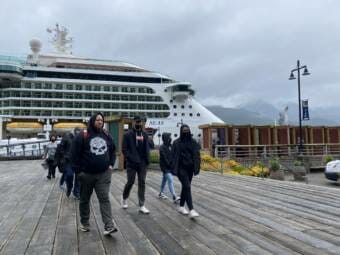
But by July, both of those obstacles were overcome and the first in a short parade of large cruise ships docked in Juneau. Three days later, a city official confirmed that a vaccinated cruise ship passenger was infected with COVID-19. The individual did not circulate in Juneau as a tourist and was not treated at the local hospital; they were medevaced out of town.
When the short cruise season was over and done with, a total of 125,000 passengers came to town, which is less than 10% of the passengers from 2019. That means the city also only received 10% of the revenue it usually gets from head taxes.
To help with the economic impact to cruise ports in Alaska during the reduced season, Norwegian Cruise Line offered $10 million in no-strings-attached relief money. The Juneau Assembly voted to reject the portion of the money that was flagged for Juneau. Some Assembly members were concerned about what the public would think of the city taking the money. The money was instead given to the Juneau Community Foundation, which distributed the donation among several nonprofits in the area.

Activists in Juneau used the light cruise season as an opportunity to gauge public interest in taking measures to limit cruise ship traffic in the future when the industry inevitably returns in full force. The group calls itself “Juneau Cruise Control,” and in April they started gathering signatures for a ballot measure that would put restrictions on the number of cruise ships that could visit Juneau and the amount of time they could be in port. A group called “Protect Juneau’s Future” quickly mobilized to oppose the proposal. Ultimately, there weren’t enough signatures on the petition to get any of the cruise ship limiting measures on the ballot.
KTOO is looking back at 2021 through the stories that had the widest and strongest impact on the community. Read about the pandemic’s second year in Juneau, the search for Juneau’s missing, or stories about justice in Juneau.
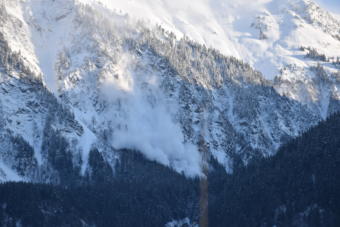
In February, the Behrends neighborhood behind Juneau-Douglas High School: Yadaa.at Kalé was evacuated due to unprecedented avalanche danger. It was the first time the city’s urban avalanche forecaster, Tom Mattice, warned residents of “extreme” avalanche danger and he knocked on 39 doors and told people to get out.
There wasn’t an avalanche that night. The city set up an emergency shelter at Centennial Hall, but only one family spent the night there. Most people stayed with friends or relatives in town and one couple got in their motorhome and moved it to another part of town.
Our newsroom decided to look into the history of avalanches in Juneau. We dug into archives and learned about the massive avalanche 60 years ago in the Behrends path that damaged 30 homes, destroying 7 of them. The snow itself managed to stop short of the houses, but the so-called powder blast that came with it — the wind that follows a massive slide — was responsible for most of the destruction.

There are not great records of avalanches in the area — especially when we’re looking back hundreds of years. But scientists are looking at trees in the area because by looking at tree rings they can reconstruct a timeline of when there have been big avalanches in the Behrends path and other slide zones around town.
We also talked to people who live in the Behrends neighborhood now to get a sense of how they calculate their risk of living there and how that’s different from how experts or the city calculates risk.

We’ll definitely have more reporting on this topic in the new year. The city is currently considering adopting new hazard maps. The maps haven’t been updated since the 70s and based on recent reports, the new maps have roughly 50% of the buildings in downtown Juneau in a moderate or severe risk area for avalanche or landslide. The Juneau Assembly has yet to adopt those maps, and they’ve rejected updates to the maps in the past. The situation with the outdated hazard maps and city code are currently stalling an affordable housing project in downtown Juneau.