KBBI is our partner station in Homer. KTOO collaborates with partners across the state to cover important news and to share stories with our audiences.
An Aug. 23, 2016, protest of the Kenai Peninsula Borough Assembly’s invocation policies. (Photo by Daysha Eaton/KBBI)
After a roughly two-year court battle, a superior court judge ruled Tuesday that the Kenai Peninsula Borough’s invocation policy is unconstitutional.
The court case dates back to 2016 when the Kenai Peninsula Borough Assembly responded to an invocation led by Iris Fontana, one of three plaintiffs in the case. The assembly responded to Fontana’s prayer ending in the words “Hail Satan” by implementing a policy that restricted the invocation to individuals and religious organizations on a pre-approved list.
However, the court only considered whether the policy violated the Alaska Constitution’s Establishment Clause, which states that no law should establish an official religion in the state and that no law should “act as a step towards” an official religion.
The court found that the borough’s policy excluded “minority faiths,” and therefore is unconstitutional. KBBI reached out to the Kenai Peninsula Borough for comment, but did not hear back in time for this story. The station has not reached out to the ACLU or the plaintiffs in the case, but plans to do so.
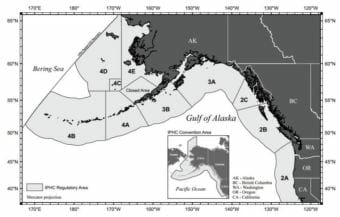
International Pacific Halibut Commission regulatory areas. (Map courtesy of the International Pacific Halibut Commission)
The North Pacific Fishery Management Council, or NPFMC, took a step during its meeting Monday toward regulating unguided boats that anglers pay to use for halibut fishing. The council may require those boats to be registered and may also impose more restrictive charter bag limits on the customers that utilize them.

In recent years, the council has heard testimony about a perceived increase of unguided rental boats in the Gulf of Alaska and in Southeast Alaska. Many have argued that fishing lodges and charters have been using those boats to skirt more restrictive charter bag limits.
“We have seen the guided sector to be very resourceful in creating business entities that are not guided in order to avoid restrictions built into the halibut catch sharing plan,” said Andy Mezirow, who represents the charter sector on the council.
The council estimates that there are roughly 250 rental boats available in International Pacific Halibut Commission regulatory areas 2C, which embodies Southeast, and area 3A, which covers the central Gulf.
Without a specific registration requirement for these boats, it’s hard to know just how many there are, but catch data suggests there is a problem in Southeast.
“The non-charter harvest has been declining and then moved up to equal to the charter harvest in about 2011 to almost doubling by 2016,” Mezirow explained. “This growth combined with public testimony about the influx of new for-hire vessels coming into communities has given the council enough evidence of correlation that a problem exists.”
The sport sector’s harvest is subtracted from the total allowable catch before it’s divvied between the charter and commercial sectors. Mezirow said an increase in sport harvest could reduce the available catch for those fisheries. Halibut stocks are on the decline, and Mezirow also raised conservation concerns in relation to the issue.
The council asked its staff to analyze two potential tools that may help it better understand the potentially growing fleet of for-hire boats.
“Defining these entities as one for-hire sector, creating a registration and aligning the bag limits with the guided sector is a necessary action to understand and then manage this fleet,” Mezirow said as he read Monday’s motion.
The proposed regulations could require businesses that receive any kind of compensation for boats used for recreational halibut fishing to be registered in regulatory areas 2C and 3A. Another alternative could impose charter bag limits on anglers paying to use those vessels.
Council member and Alaska Department of Fish and Game Commissioner Sam Cotten expressed concern about the measures potentially reducing Alaskans’ access to the halibut resource, particularly those who can’t afford a boat.
“We know we can’t distinguish between residents of Alaska and residents of another state in an action like this,” Cotten said. “But sometimes these regulations, any of the regulations we impost have differential impacts on residents and non-residents.”
Council member John Jenson, who owns a boat rental business in Petersburg, echoed Cotten. However, he said he supported the measure for now.
“Hearing that there’s conservation needs in the background here, I’m going to be supporting this for now and see where it goes,” he explained.
The council also asked staff to look into tracking how many halibut sport fishermen utilizing for-hire unguided boats reel in each year.
However, it’s unclear when the council will receive a final report and when it may take final action on the issue.
Wednesday was the very first national test of the Wireless Emergency Alert System, and there are reports that some phones in Alaska and across the country did not receive the test message. State and federal officials are now working to sort out the kinks.
Millions of Americans’ phones made a strange noise Wednesday as the Federal Emergency Management Agency, or FEMA, tested the Wireless Emergency Alert System. But some phones did not go off, including here at KBBI.
The Wireless Emergency Alert System sent out this message to phones nationwide on Wednesday. (Screenshot by Renee Gross/KBBI)
IPAWS is designed to alert Americans about national threats such as a terrorist attack, but the system also works with the Emergency Alert System broadcasters use to alert the public about regional emergencies such as floods.
Savannah Brehmer is the Region 10 spokesperson for FEMA, which includes Alaska, Idaho, Washington and Oregon. She said responses to Wednesday’s test of the Wireless Emergency Alert system have varied.
“Some people didn’t receive it at all. Some people received it multiple times. Some people had their phone on silent and only heard a vibration. Other people didn’t hear anything at all,” Brehmer explained. “Really the thing for listeners to know is the purpose of this test is to find those problems and errors so we can fix them for when we need to use an alert like this.”
There were issues here in Alaska as well. Alaska-based wireless carrier GCI recently integrated with the Wireless Emergency Alert system. Customers previously needed an app to receive emergency alerts on their phones.
This GCI graphic explains the steps of how emergency alerts make it to cellphones. (Courtesy GCI)
Spokesperson Heather Handyside said 90 percent of GCI’s towers received Wednesday’s alert, but she said the wireless carrier is still trying to determine if there were any internal issues.
“We are also getting reports that some of our customers did not get the alert,” Handyside said. “So, right now we are trying to assess the situation to figure out exactly how widespread the message was and if there are any patterns in the customers who did not receive the alert.”
GCI was not the only carrier to experience problems.
Several AT&T phones, including mine, did not receive the message while others on the network did. An AT&T spokesperson said that the company’s internal system worked just fine during the test. However, a software issue unrelated to the test did cause some AT&T customers to lose data services.
Verizon also reported a successful test, but a spokesperson did say that some phones might have not received the message due to loss of signal, out-of-date software and other technical issues, something FEMA also noted in its response.
Brehmer said FEMA is also working to sort out possible issues.
“What we’re looking to do is compile the feedback and in about a month’s time be able to report out on how the test went,” she added.
Feedback can be sent to FEMA at fema-national-test@fema.dhs.gov. FEMA is asking for details on whether phones were on or off and the location of phones during the test among other technical details.
The Alaska Division of Homeland Security and Emergency Management is also soliciting feedback through a survey.
Correction: An earlier version of this story misstated the email address to send FEMA feedback to and has been corrected.
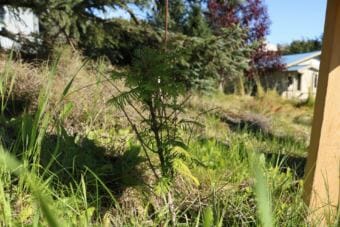
Geoff Cobal’s metasequoia grows off Bartlett Street. (Photo by Aaron Bolton/KBBI)
Could climate change take forests back in time? Kenai Peninsula residents and scientists see evidence that warmer weather is bringing back at least one tree that hasn’t populated Alaska for millions of years.
Across the street from Homer’s Pratt Museum, there’s a small tree growing on the side of the road. You’d probably miss it if it wasn’t for the wooden placard proclaiming it a “metasequoia.”
“Just for your listeners, right now it looks 11 inches high,” Geoff Cobal said as he stood next to the tree off Bartlett street.
A dawn redwood or metasequioa grows in the Hoyt Arboretum in Portland, Oregon. (Photo by Aaron Bolton/KBBI)
He planted the sapling about three years ago. It’s also known as a dawn redwood and can grow to be 100 feet tall.
“But it looks like it might be 1 inch higher then when I planted it. Well, it looks like it’s about the same height as when I planted it. So, it’s not like doing great,” Cobal said as he laughed.
The metasequoia looks like what it is: a relative of the California redwood. More than 50 million years ago, they were a common sight here and across North America. Then they vanished.
In fact, they were believed extinct. We only knew about them from 150-million-year-old fossils. Then in the 1940s, a small population was discovered in a remote valley in China.
They were planted across the United States, including Alaska, in the decades that followed. Cobal wanted to see if they could hack it in Homer, just like they did millions of years ago.
“Our bluffs were certainly warmer than they are now. Although, this metasequoia is now living here,” he noted.
Are climate conditions becoming more like they were millions of years ago? Cobal wanted to find out and ordered 30 trees.
He gave them to friends, but only a few have survived. So Homer isn’t quite like it was when dinosaurs roamed.
But it is moving in that direction. In recent years, the U.S. Department of Agriculture bestowed Homer with a “warmer plant hardiness” designation. You can see proof of that in Homer ecologist Kyra Wagner’s backyard.
“We have several of those apple trees are now considered to be normal,” Wagner said as she pointed to a few trees from her deck. “Norland, parkland, considered to be completely hardy and fine to be growing in this climate that we have here now – 30 to 50 years ago, that wouldn’t of been the case.”
Several residents living on Kachemak Bay have attempted to grow metasequoias and other tree species, even a pear tree. The idea is that they could one day grow into forests if existing tree species are unable to handle the larger populations of spruce bark beetles and European spruce aphids that will most likely come with warmer temperatures.
“If the spruce are not able to keep it going and our forests are going to be shifting, bringing in plants that we can eat from, that are edible, plants that are beautiful and productive and economically viable here is completely a good attempt to not recolonize, but assisted migration,” Wagner explained, “get these things up here that may over centuries move up here, but climate change is happening so fast now.”
Ed Berg is a retired botanist and a former research scientist with the Kenai National Wildlife Refuge and he thinks that while the metasequoia isn’t thriving in Homer just yet, it could one day be a reasonable candidate.
“It would have lumber potential, certainly firewood potential. It grows very rapidly,” he said. “In planting something like this, we may be at the border shall we say of its temperature range, and that just means selective breeding is needed.”
But don’t expect forests of metasequoias on the Kenai Peninsula any time soon. So says
Hans Rinke, a state forester who manages around 80,000 acres on the peninsula.
“I think in the ornamental setting where people have a yard and want to experiment with some plantings on their own and have some interesting trees in their yard that are not spruce are birch, I think we’ll see more of that,” he said.
There’s uncertainty what climate change will mean for Alaska’s forests. But as temperatures rise it could be, at least in some cases, a deja vu for plants not seen in the modern era.
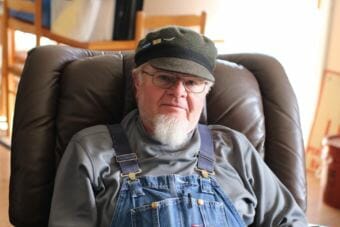
Vietnam veteran Troy Wise at his home in Homer (Photo by Renee Gross/KBBI)
Vietnam veteran Troy Wise wears the same grey hat everyday.
“It has three pins on there,” he said. “It has the combat infantry badge, the Vietnam campaign medal and aviator wings.”
He hopes those pins catch the attention of other veterans.
“If they recognize that and start up a conversation, then I know that they understand at least what they symbolize,” he said. “So they got to be a vet and that’s a start. I find that still a lot of them that I meet on the street, they don’t trust the VA. They are not going to go in.”
Wise knows this type of veteran. He used to be one. The first time he went to the VA was right after he served in the 1970s.
It wasn’t just the bureaucracy of the V.A. that made him hesitant to register. He didn’t want to admit that he was struggling with PTSD. Wise says he didn’t want to be defined by a diagnosis, but years later it came to a head.
“I entertained thoughts of suicide,” he said. “Didn’t act on them; I didn’t think it was a solution. I didn’t want to miss out on my grandkids so didn’t go down that path, but it was not something I could navigate on my own.”
It took him 42 years to seek counseling through the V.A., and he says it turned his life around. Now, he’s trying to convince vets with the same struggles to sign up in an effort to bring more V.A. services to Homer.
Director of the Alaska V.A. Healthcare System, Dr. Timothy Ballard acknowledges that many vets are in the position as Wise was.
“I think there are a number of veterans that are hurting,” he said. “There are 20 veterans across the country everyday who commits suicide. Fourteen of them aren’t engaging in our system or they aren’t enrolled.”
Ballard says that there’s an estimated 90,000 veterans in Alaska, the highest per capita in the country. Based on that estimate, less than half have signed up for V.A. services in the state. That’s a roadblock standing in the way of any attempt to expand services in Alaska.
“So it’s very difficult for my mental health care providers across the state to be able to help these veterans out if they’re not being seen, if we don’t have information on them, if they’re not actively using the system.”
Some veterans in rural Alaska intentionally isolate themselves and don’t wish to engage in a government or community programs. Some vets, like Mark Landwher, say others are more deserving of V.A. services. Landwehr did attempt to sign up with the V.A. but he says his initial experience with the bureaucracy was negative.
“It’s just to get all of us flakes all together and give us a substandard care,” he said. “Well, I have substandard care right now.”
Currently, the Vet Center, another branch of the V.A., provides monthly mental health services in Homer while the V.A. itself provides healthcare services a few days per week at South Peninsula Hospital. But there isn’t enough room to serve all of the veterans thought to be in the area.
Alaska V.A. spokesperson Sam Hudson says the V.A. put in the paperwork to build a stand alone clinic in Homer. But it’s difficult to justify when less than half of the estimated veterans are registered with the V.A.
“Imagine us saying, hey, we need some more things,” he said. “Whether it be materials, whether it be staffing, whether it be a building, whether it be whatever. Taking for instance, my grandfather. I used to say ‘grandad, I want a motorcycle.’ He was like, ‘why are you wanting a dirt bike when you got a bicycle you don’t use?’”
The V.A. is working to register more people in the Homer area. They’re trying to rebrand a notorious system.
“This is is not your father’s V.A.,” Hudson said. “We’re much different. We’re much better. Are we perfect? Absolutely not. But are we getting better? Absolutely.”
Hudson said they are making progress in registering more people. Now, it’s almost a requirement for people who are separating from the military to sign up for care.
But for older veterans, it continues to be a challenge. Still veterans like Wise are not backing down. His dream is to have a Vet Center in Homer, a center just dedicated to serving mental health of veterans and their families.
Besides now, he likes to identify himself as a vet.
“I decided to quit denying that it really was a very big part of me and it did define me,” he said. “I didn’t have a choice and that was kind of not embracing it so much, but it’s time to be who I really am and stop denying it.”
Wise said whether or not the V.A. expands its offerings in Homer, he will keep his hat on in an effort to attract more vets to its services.
The Veteran Association is having a town hall meeting on November 14 in Anchor Point to discuss veteran’s services.
Federal prosecutors say a Homer man illegally shipped several modified firearms with defaced serial numbers to New York. A New York grand jury indicted 25-year-old Benjamin Handley in late July on 15 counts of illegally shipping the weapons.
Handley allegedly mailed nine firearms that he is said to have illegally modified into “machine guns”, including a variety of 9 mm and .45 caliber pistols. Serial numbers on each of the guns were allegedly removed.
According to the U.S. Attorney’s Office in Buffalo, New York, Handley used the U.S. Postal Service to send the weapons. Charging documents say Handley mailed the firearms on four different occasions between February and late July.
Handley made his initial appearance in an Anchorage court Tuesday. He is being held without bail pending his arraignment in New York.
Prosecutors told the presiding judge that Handley allegedly directed his mother over the phone from jail to remove items from his truck and room, which they say could amount to destruction of evidence and obstructing justice.
Prosecutors also say Handley conducted business on the dark web and had the ability to obtain false identification, which they say adds to the likelihood of Handley fleeing.
Handley’s arraignment hearing in New York has not been scheduled.
Close
Update notification options
Subscribe to notifications
Subscribe
Get notifications about news related to the topics you care about. You can unsubscribe anytime.