KBBI is our partner station in Homer. KTOO collaborates with partners across the state to cover important news and to share stories with our audiences.

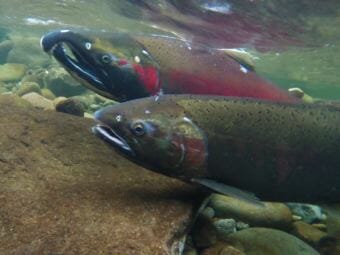
A new study has found that one of the coho salmon’s most valuable senses may diminish as more carbon dioxide enters the North Pacific Ocean — threatening their ability to avoid predators, find their way back to their natal streams and even find spawning mates.
Chase Williams is a post-doctoral researcher at the University of Washington. Williams worked on the study in conjunction with the National Oceanic and Atmospheric Administration’s Northwest Fisheries Science Center.
“We did this study because over the last almost 10 years, there’s been a lot of research coming out of Australia on tropical reef fish and couple of other places in the world looking at the elevated effects of CO2 levels and fish behaviors,” Williams explained.
In this particular study, Williams and his colleagues measured juvenile coho salmon’s ability to detect predators by injecting ground-up salmon scales into tanks holding individual fish.
“So normally a fish’s skin is lacerated, say by a predator munching down on a fish. There’s a chemical cue or cues — no one is quite exactly sure what yet,” Williams said. “But those odors are released into the water, and nearby species have a very strong avoidance reaction to it.”
For two weeks prior to the test, different groups of juvenile coho were exposed to current carbon dioxide levels in Puget Sound and estimated levels both 50 and 100 years from now.
The study measured each fish’s avoidance response when scales were injected into their tanks, and coho that were exposed to higher levels of carbon dioxide were increasingly indifferent to the smell.
“We found that the salmon are likely still smelling the odors. So there are no changes in the way their nose is detecting the odors,” Williams noted. “But we did pick up changes in the way that their brain was potentially processing those odor signals. So that’s what is likely driving the behavioral changes.”
Williams hopes to conduct similar experiments on other salmon species, but he said this study is a concern for all salmon from the Pacific Northwest to Alaska — particularly for populations that are currently struggling.
Pacific cod. (Photo courtesy Holland Dotts and the Alaska Marine Conservation Council)
The partial federal government shutdown has left some Alaska fishermen and others wondering whether federal fisheries set to start in January will open on time. The National Marine Fisheries Service has been affected by the shutdown and many employees aren’t there to answer phones, leaving some with more questions than answers.

Albert Duncan with the National Oceanic and Atmospheric Administration’s law enforcement office said his division is still running during the shutdown.
“In our Kodiak office as well as our Southeast office in Juneau, we have received a couple of calls from fishermen wondering if there’s been any change as far as those fisheries that were set to open on Jan. 1,” Duncan explained.
The federal Pacific cod season is set to open on Jan. 1. The good news is that fishery and other federal fisheries due to open on Jan. 20 will open on time despite the shutdown.
That’s also good news for Homer-based commercial fisherman Ian Pitzman. He sent two of his boats out to Dutch Harbor prior to Christmas without knowing whether the Pacific cod season would start on time or not.
“You know a three-week season, if you were to wait, let’s say keep the boat at home to determine whether or not there would be an opening Jan. 1, you’d be a week behind best case scenario,” Pitzman said. “You have to get the boat out and ready. That’s a process. It takes time.”
State regulators were also left with questions. Elisa Russ with the Alaska Department of Fish and Game helps manage state commercial shellfish and groundfish fisheries in Southcentral Alaska, where the state first runs what’s called parallel Pacific cod seasons.
“These parallel Pacific Cod seasons are established in both the Cook Inlet and Prince William Sound areas to coincide with the season dates and gear types set in the federal central Gulf of Alaska regulatory area,” Russ said, “and for us, that is for pots, jig and longline gear.”
These parallel seasons allow fishermen with both federal and state permits to target Pacific cod in state waters three miles from shore. Once each federal fishery closes, the coinciding state fishery opens 24 hours later.
However, Russ said Fish and Game initially wasn’t sure whether the shutdown was going to affect federal openings and subsequently the state’s parallel seasons.
“We weren’t certain. Although, there has been another shutdown since I’ve been in this position that overlapped with a Jan. 1 Pacific cod season,” she added. “In that case, the fisheries also did open.”
Several fishermen expected just that, but the shutdown doesn’t come without its hiccups.
The National Marine Fisheries Service won’t be able to issue or renew any federal fishing permits during the shutdown, but permits for Pacific cod only need to be renewed once every three years.
Some large catcher-processor trawl vessels may also not receive some required inspections in time, leaving them with no choice but to tie up at the docks waiting for a resolution in Washington D.C.
Homer High School could soon play host to club-level high school esports teams. (Photo by Aaron Bolton/KBBI)
Students in Kenai Peninsula schools could soon be forming esports teams.
The Kenai Peninsula Borough School District activities board considered officially sanctioning esports back in November, but decided to approve club-level teams.
District spokesperson Pegge Erkeneff said the decision to approve club-level video game — or esports — teams came after the Electronic Gaming Federation approached the district about joining a statewide league.
“So that began the whole conversation about the district and potentially any schools or principals (being) involved in the league,” she explained.
The Electronic Gaming Federation sets up both college and high school level esports leagues around the country. Teams compete in video games such as Overwatch and League of Legends.
Erkeneff said that no schools within the district have expressed interest in forming an esports team quite yet, and that was part of the reason the district strayed from officially sanctioning the activity.
“Due to possible budgetary costs and the cuts that might be coming, we decided to keep it at a sport or club activity level,” Erkeneff added.
The approval of club-level status allows schools within the district to use one of a set number of stipends to pay someone to coach and organize a club-level team. Teams could then compete against other clubs in the state, but those matchups would have to be organized by the individual clubs because there is currently no statewide structure for esports teams.
Alaska Schools Activities Association Executive Director Billy Strickland said that could soon change. The ASAA organizes statewide high school sports and activities. Strickland said the ASAA board will consider sanctioning esports in February.
“Sanctioning sets it up for potential state championship competition, if you will, and just some of those things,” Strickland explained. “Kids can now letter in an activity, per se, depending on how the school deals with those types of things.”
The Kenai Peninsula Borough School District activities board considered officially sanctioning esports back in November, but decided to approve club-level teams. (Creative Commons photo)
Students participating in esports would then need to meet the same grade and attendance requirements other student athletes do.
Strickland said there are club-level teams currently in the Matanuska-Susitna Valley and Dillingham that could help start a statewide league. He added that other districts and schools have expressed interest in forming teams as well.
“Homer could be playing Barrow in a competition that doesn’t involve any travel and travel expense and time out of school. I think that’s pretty enticing to schools,” Strickland said. “Also, we feel like this is an opportunity to engage some students and connect them to the school that may not be already participating in something as a school member.”
However, Strickland explains there are some concerns about the number of hours students would spend in front of a computer screen and the types of games they may be playing.
“Particularly anything that involves a first-person shooter game, just because the message that would be sending students,” he said. “But again, some of these games are really the electronic version of chess and involve a lot of high-level thinking skills and are very good for students.”
Both the Electronic Gaming Federation and a similar organization named PlayVS will give presentations to ASAA board members in February.
If the board does move forward with sanctioning esports, Strickland said the ASAA would likely work with one of the organizations to set up a statewide high school league.
However, he doesn’t expect the board to come to a decision until its April meeting.
A school computer lab. (Creative Commons photo by Harald_Landsrath)
Technology is becoming an increasingly vital part of education. But in Alaska, getting the right internet speed to support new technology isn’t always cheap or easy. There’s a state program that helps schools pay for internet. However, the need for faster internet is outgrowing the program.
Joshua Hinds is the principal of the Susan B. English School in Seldovia, and he says the school uses a lot of technology that allows his students to participate in classes that would otherwise be unavailable.
“We use a program called Polycom, which is a video conferencing program,” he said. “We also use Google Classroom or Skype instructions.”
Bringing more of this technology into classrooms is only increasing the need for internet speed. Up until about a year and a half ago, Susan B. English had about 10 megabits per second of bandwidth. Bandwidth is like the number of lanes you have on a highway. More lanes means more opportunity for cars to travel without getting stuck in traffic, or in the case of the internet, more people can use it without slowing down the connection.
The Kenai Peninsula Borough School District recently doubled Susan B. English’s bandwidth.
But that increase also cost the school some state funding under the School Broadband Assistance Grant, better known as the School BAG program. The program helps supplement federal money to make sure schools can afford 10-megabit internet speeds.
Patience Frederiksen is the state librarian with the Alaska Department of Education and Early Development, which administers the School BAG program. She said there’s a lot of support for the program from school districts.
“They all talk about it as sort of the bread and butter of what they need to provide good technology for their students,” she said. “Though that has tapered off in the past few years because the program needs to expand. We need to offer more money for higher bandwidth.”
Determining how much bandwidth every school needs is a complex process, and it largely depends on a school’s population. But the School BAG program set the floor at 10 megabits.
“It’s a thing in which a floor ends up becoming a ceiling: you go to the next higher level when you have a new floor and then you aspire to the next ceiling,” she said. “It’s just sort of climbing the internet mountain.”
Schools, such as Susan B. English, have outgrown the program and found other ways to pay for faster internet.
“So that’s what we’re watching is if school bag does not get revived with more money into a higher level to pull schools up to the next step, then this program is just going to wither away,” she said.
But the program is still critical for many schools. For example, last year the Kuspuk School District received roughly $400,000 toward its internet bill, which is incredibly valuable funding for a rural school district. And the Kenai Peninsula Borough School District still has two schools on the program.
But school bag officials want the program to provide funding for faster speeds, which could help more schools. A bill that would have helped schools pay for 25 megabits of internet speed failed in the legislature last year. Program officials hope similar legislation will be introduced during the next legislative session.
If a bill passed this year, schools like Susan B. English could be one of a handful in the Kenai Peninsula district that could requalify for the School BAG program. That would be good news for principal Hinds.
“I just know that moving forward we’re always going to be looking to do more and so we’re going to be wanting and needing more bandwidth for sure,” he said.
As the need for bandwidth increases, so does the potential for a wider digital divide between rural schools and their larger counterparts. Hinds said it’s critical that his students have the same access to educational technology as any other student.
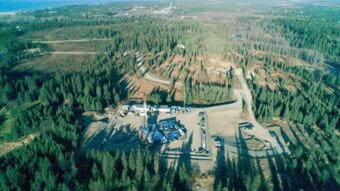
Hilcorp’s Seaview drill site located in Anchor Point. (Photo courtesy of Willy Dunne)
Earlier this fall, Hilcorp Energy Company began exploring for natural gas and oil in an Anchor Point neighborhood where many own their mineral rights. That’s making it difficult for some residents and landowners near the drill site to get information about the project and any future plans Hilcorp may have.
About a month ago, Lorri Davis woke up to a strange noise.
“I was laying in bed the other night. I thought, ‘What in the world is that?’ They had just put it up, and I opened the back door, and I thought, ‘Oh yeah, there it is,’” Davis recalled. “You can hear it constantly.”
What she was hearing was a drill rig owned by Hilcorp exploring for oil and gas about a quarter of a mile from her home in Anchor Point. She said it sounds like a dump truck is parked in her driveway.
Sarah Spencer lives in the same neighborhood, and she had a similar experience.
“I saw it. The lights are very bright and very tall. My first concern was about my well water, whether that would be affected by the drilling so close by,” Spencer explained.
Spencer said Hilcorp has done little to assure that her well will be unaffected.
However, Spencer and many of her neighbors knew this was coming. The Alaska Department of Natural Resources had to permit the drill site because Hilcorp is drilling through state land on the way to the private subsurface it’s exploring.
Hilcorp applied for an exemption to a state law limiting how close oil and gas wells can come to unleased private subsurface property. Spencer received a notice about that.
Spencer and her neighbors initially found out that Hilcorp planned to explore the area when, over the past few years, company representatives had asked them to lease their land. The company wanted to explore for oil and gas below their land from the drill site in the neighborhood.
Spencer said the lease was complicated, and she was worried about what she would be agreeing to.
“They were just like, ‘Well, everybody is doing it, everyone is signing it, and so you should sign it too,’” Spencer said. “I felt like I couldn’t get enough information to feel like I was comfortable to sign that document.”
Spencer owns the mineral rights to her land, which means she has control of all resource extraction on her property. But so do many of her neighbors, and that makes her nervous.
“If you’ve got somebody next door to you who’s wanting to develop something, you don’t necessarily have the right to go over and say, ‘Hey, what are you guys doing?’” explained Graham Smith, who works for DNR’s Division of Oil and Gas. “To a certain extent, it’s their land. It’s their business.”
He said this scenario is common on the Kenai Peninsula.
“It’s one of the first regions of the state to have oil and gas development, and it’s also one of the first regions to become heavily populated in that region,” Smith added. “And those two things sort of happened concurrently.”
That muddies the public process. A private landowner with mineral rights can lease their land to Hilcorp as a drill site or lease just the subsurface of their land without any requirement to tell their neighbors.
Smith added that public information about oil and gas exploration on private land comes with a lot of “what-if” scenarios.
Oil and gas wells themselves are permitted internally at the Alaska Oil and Gas Conservation Commission, and the location of wells is only made public after they are approved.
Other information can spring from peripheral development. For example, Hilcorp may need permits to build roads from the Army Corps of Engineers or a water usage permit from DNR. Each permit could provide snippets of information about Hilcorp’s plans.
“There’s certainly no template or boiler plate to which we can refer to,” Smith said. “A lot of times we just have to judge it on its merits and take it on a case-by-case basis.”
What Hilcorp might do in Spencer’s neighborhood is unclear. The company said it will assess its findings from the current well it’s drilling before it moves forward with more development in the Anchor Point area, though DNR’s permit for the drill site indicates it plans to drill a second well.
Late last month, Hilcorp leased five parcels on the western end of Anchor Point from the Kenai Peninsula Borough, and it indicated it had agreements with private landowners surrounding those properties.
That’s setting up a potential regulatory maze for landowners like Spencer who want to track any potential development Hilcorp has planned.
“I’m worried about it, but then at the same time I feel like there’s nothing I can do because I can’t stop them from drilling. I don’t think any of us can. The borough can’t,” Spencer said. “If a private landowner allows them to drill on their property, then they can do it.”
It’s not just her well water she’s worried about. It’s how development might affect her property value or just how the character of the town, known for its sport fishing opportunities, might change.
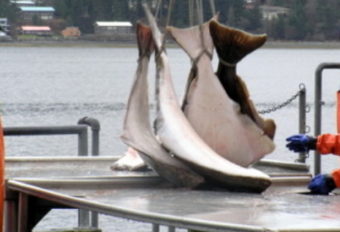
Crewmen load halibut near Juneau. (Creative Commons photo by Gillfoto)
The North Pacific Fishery Management Council could be taking additional steps to reduce the catch of halibut by the charter fleet in the central Gulf of Alaska next year. Those charters could see some regulation shifts in 2019 while the rules for Southeast-based charters will likely remain the same.
The council regulates halibut charters based upon the expected total allowable catch along the U.S. and Canadian Pacific coast. Those catch limits will be set by the International Pacific Halibut Commission in January.
Customers will be limited to four charter trips annually with a bag limit of two halibut per outing in the central Gulf of Alaska. The current size limit for one of those two fish could increase, but that will depend on if the IPHC increases catch limits in the region. However, that is unlikely as the latest stock assessment shows that Pacific halibut populations continue to decline in U.S. and Canadian waters.
Halibut charter fishing in the central Gulf was closed on Wednesdays this year in an effort to reduce the fleet’s catch. Some Tuesdays could be closed as well for a second year in a row. That number will depend on the catch limits set in January.
The Alaska Department of Fish and Game’s input will also determine how closures are scheduled.
This year’s preliminary harvest data indicates that central Gulf charters exceeded their allocation. The harvest in Southeast and the eastern Gulf came in below the total allowable catch for the region. The council isn’t planning additional restrictions for the Southeast charter fleet.
Close
Update notification options
Subscribe to notifications
Subscribe
Get notifications about news related to the topics you care about. You can unsubscribe anytime.