KBBI - Homer

KBBI is our partner station in Homer. KTOO collaborates with partners across the state to cover important news and to share stories with our audiences.
Lawsuit challenges Alaska Medicaid policy denying transgender-related health care coverage

A transgender woman is suing the Alaska Department of Health and Social Services commissioner for denying transition-related health care coverage under Medicaid.

The lawsuit, which seeks to be class action, was filed in federal court on Monday. The suit argues that prohibiting coverage for gender reassignment surgery and hormone therapy is discriminatory and illegal.

Homer resident Swan Being relies on Medicaid for some of her health care expenses. In January, her doctor asked that Medicaid pay for Being to travel from Homer to Anchorage so she could receive hormone injections and lab work related to her gender reassignment. But Being said that request was denied.

“I was real shocked when that happened and dismayed,” she said. “I need my care. It’s life or death.”

Though Being said she relies on different insurances, she said she hasn’t had a problem getting coverage for hormone therapy until this year. Attorney James Davis, with the Northern Justice Project, represents Being.

The Northern Justice Project is also representing plaintiffs suing the Sitka Police Department on discrimination allegations and the plaintiff who is alleging unfair collection of sales tax by marketing company LuLaRoe.

Davis said if Being doesn’t get this treatment, she’ll face negative consequences.

“The only reason the state denied it is because of a regulation that said you can’t have any Medicaid treatment for gender dysphoria, no matter what your doctors say,” Davis said.

According to the Movement Advancement Project, a nonprofit think tank that advocates for LGBT equality, Alaska is one of 11 states with a Medicaid program that explicitly excludes transgender health care treatment.

Davis said Alaska’s regulation that prohibits coverage for transgender treatment services under Medicaid violates the equal protection law under the 14th Amendment.

“Which provides all people need to be treated equally,” Davis said. “If some people are eligible to get medically necessary treatment, and others aren’t simply because we don’t like the treatment they’re getting or we don’t agree with their conditions, that’s illegal.”

Davis said the regulation also violates equal treatment under federal Medicaid law. He added that he expects there are more than 40 transgender residents in Alaska who are eligible to join the case against the state’s Health and Social Services Commissioner Adam Crum.

There have been similar challenges to regulations denying transgender-related health care across the country, including in Minnesota.

“So in that case, the federal court struck down the regulation,” Davis said. “We expect the same thing is going to happen in our case.”

The Department of Health and Social Services said it has not been served with the lawsuit and declined to comment.

Predicting marine heatwaves can have economic implications

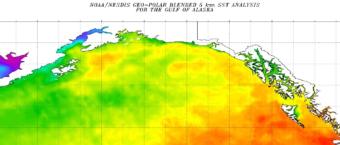
Sea Surface temperature map from the National Oceanic and Atmospheric Administration.
Sea Surface temperature map from the National Oceanic and Atmospheric Administration. (Contour chart courtesy NOAA)

The Gulf of Alaska is once again experiencing a marine heatwave. This follows the infamous warm-water event known as “the Blob,” that formed back in 2014, which scientists have tied to seabird die-offs and declining Pacific cod stocks.

Researchers want to predict when and where the world’s oceans will heat up, but there are economic implications to forecasting the future.

Scientists around the world are working to understand the impacts of marine heatwaves as they become more common. They also want to be able to predict when the heatwaves will happen.

“If I gave you this information about the future, what would you possibly even do with it?” research scientist Alistair Hobday said. “And people’s first reaction is, ‘Nothing. I don’t know what I would do.’”

Hobday works with Australia’s Commonwealth Scientific and Industrial Research Organisation. Hobday said the predictive models for marine heatwaves are about 60 percent accurate currently, slightly better than a flip of a coin.

He wants to boost that number to 80 percent, and he said marine heatwave forecasts have practical applications.

“In Australia, we do forecasting for the salmon aquaculture industry. If you get information that there is going to be a heatwave, you might choose to harvest your fish early. You might choose to provide more oxygen directly by aerating the water so that it has more oxygen in warm water,” he explained. “You might choose to move your cages to a slightly cooler part of the coast.”

Here in Alaska, the state’s Department of Fish and Game wants to provide more predictability in one of Alaska’s most valuable fisheries. Fish and Game biologist Richard Brenner is working to use sea surface temperatures in the Gulf of Alaska to predict when sockeye salmon will return to their natal streams.

“With warmer water temperatures, sockeye salmon sometimes have a difficult time finding adequate prey items,” Brenner said. “Their range where they would they find those prey items can be restricted, and it takes them longer to feed and to sexually mature and therefore return to their natal spawning areas in Cook Inlet and elsewhere.”

Brenner said accurate run timing predictions would help Fish and Game better manage sport, subsistence and commercial harvests, but processors and fishermen may also benefit.

Nate Berga is the plant manager for Pacific Star Seafoods in Kenai. Berga explained that Pacific Star typically purchases all the packaging and equipment it needs before the season begins. It also hires roughly 250 workers that need to be fed and housed.

Run timing predictions could allow Pacific Star to purchase supplies as it needs them and hire those employees in stages, significantly reducing the upfront financial cost every season.

“You’re sitting there waiting for the fish. People get discouraged, and they may want to leave,” Berga added. “That’s happened some seasons, where crew starts to go and all of a sudden fish starts to come in late, and now you don’t have an adequate crew size to handle the volume.”

Berga added that sockeye runs in northern Cook Inlet have been returning late in recent years. Fish and Game’s work may also allow sockeye managers around the state to provide more opportunity if they know a run is late.

Sockeye salmon delivered in Bristol Bay. (File photo by KDLG)

“I think if Fish and Game knew what was coming and felt pretty certain about that, my wish list would be that they would let us fish instead of letting all of the fish go up the river and we’re on the sideline watching that happen,” Berga said.

However, similar temperature-based forecasts have caused tension elsewhere.

Maine’s lobster fishery kicks off every summer as warmer waters cause the valuable crustaceans to molt. But a marine heatwave in 2012 caused the lobster population to shed their exoskeletons early, throwing a glut of lobster onto the market.

Annie Tselikis is the executive director of the Maine Lobster Dealers’ Association. She said the lobster supply chain wasn’t ready and prices dropped.

“So the Gulf of Maine Research Institute tried to time the molt so that they could say, ‘OK industry, this is when you should expect this product to arrive at your shores,’” she explained.

Researchers at the Gulf of Maine Research Institute thought they were providing a service to the industry, but Tselikis said grocery and restaurant wholesalers began using those predictions to haggle for lower prices.

“They just saw a report that said, ‘well the quantity is going to be high and the timing is going to be later, and so why would I buy lobster from you right now? Why wouldn’t I wait and wait for you to get me a better price?’” Tselikis explained.

After pressure from lobster dealers and fishermen, the research institute stopped publishing its work in 2017. It will be a year or more before Fish and Game decides whether it can reliably predict sockeye run timing in Cook Inlet on a day-to-day basis.

Those like Berga say the tool would benefit everyone in the sockeye industry, but he said processors and fishermen would likely wait a few years before hedging any bets on those predictions.

After all, he said, Mother Nature has been known to throw a curveball or two.

Researchers hope bill could help efforts to revitalize shellfish

Red King Crab
A red king crab. (Photo courtesy of ADF&G)

Some researchers want to adopt a model similar to what salmon hatcheries use in an effort to revitalize crab and other shellfish stocks around the state. Researchers are still hammering out the logistics for how shellfish hatcheries could work. State law is limiting the scale of that research. But a senate bill may change that.

Heather McCarty is co-chair of the Alaska King Crab Research, Rehabilitation and Biology Program, which is working with several organizations to research how shellfish hatcheries could replenish red and blue king crab stocks.

McCarty said the program was started to address the decline of crabs in the Bering Sea and the Gulf of Alaska.

“It basically went in the Gulf, for example, from a 20 million stock down to nothing because they closed the fishery and they haven’t reopened it,” she said. “So it was a huge part of the economy of Kodiak.”

She said shellfish hatcheries could work much like nonprofit salmon hatcheries and provide commercial, sport and subsistence fishing opportunities.

McCarty said the research program has already helped release red king crab in the Gulf but it has yet to release blue king crab in the Bering Sea.

Near Kodiak, the program has helped release up to around 11,500 crabs at one time. McCarty said the crabs were not expected to negatively affect the wild stock, and that the experiment’s results were positive.

“There is significant survival,” she said. “They track them for several days, then they went back several days later and that kind of thing, so there is some survival. It’s little bit subjective because it’s kind of hard to tell because they’re not in captivity anymore. They just sort of scatter, but some of them do survive.”

McCarty said programs such as these are limited by the current permitting process.

However, Senate Bill 22 would provide regulatory framework that would allow shellfish hatchery programs to produce on a larger scale, and it’s not just crabs researchers are interested in. There are programs related to other shellfish species, such as razor clams and littleneck clams.

Alaska Fisheries Development Foundation Executive Director Julie Decker foresees a promising shellfish enhancement industry, but she notes that SB22 won’t be the catalyst for the industry to take off.

“Well I think initially it won’t have a tremendous impact,” she said. “What it will do is allow the people that had been working on these king crab research projects to start broadening their scale and also it will allow the industry side to start thinking and planning larger.”

Right now, there are only two shellfish hatcheries in the state, and Decker said it could take decades for players to populate the industry. There are still plenty of logistical and economic problems that need to be figured out as well. Salmon hatcheries often catch and sell a portion of the returning run to fund their operations, but figuring out how to tell wild and hatchery shellfish apart could be problematic.

“Let’s say, you’re releasing king crab in a particular bay,” she said. “It’s likely some will move away from the bay and some will stay.”

That’s not the only barrier to a viable shellfish hatchery industry. Jeff Hetrick is the director of the Alutiiq Pride Shellfish Hatchery in Seward.

Hetrick said the program is mainly focused on providing subsistence and personal-use opportunities for razor clams, littleneck clams and other species.

He said more broadly, there is still question about whether shellfish hatcheries are economically viable on any scale.

“To be able to raise the organisms and release them is one thing,” he said. “But you have to be able to find out long-term what the survival rate’s going to be.”

Hetrick said his hatchery has released tens of thousands of crabs at a time, but he wants to release more than a half million, which SB 22 would allow the hatchery to do.

A similar bill failed in the Legislature last year. SB 22 has moved out of the Senate Resources Committee to Senate Finance, but some senators expressed concerns about how hatchery bred shellfish could affect wild stocks.

Alaska’s seafood industry says the U.S.-China trade war is costing it dearly

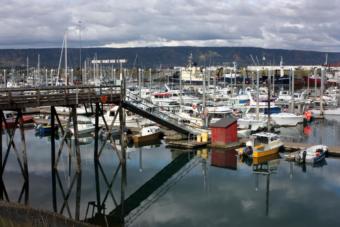
Homer Harbor
Homer Harbor. (Photo by KBBI)

The trade war with China is impacting Alaska’s seafood industry.

The Alaska Seafood Marketing Institute’s Jeremy Woodrow, citing a recent industry survey, told the House Fisheries Committee Wednesday that the industry blames Chinese tariffs.

“Of the members that responded back to us, 65 percent reported they had immediate lost sales from the increase of these tariffs, 50 percent reported delays in their sales and 36 percent reported that they lost customers in China just due to these tariffs” Woodrow explained. “Another 21 percent reported that they had unanticipated costs because of the trade conflict.”

Alaska sold nearly $989 million worth of seafood to China in 2017. Not all Alaska seafood is bound by the Chinese tariffs imposed in retaliation to the Trump administration’s own tariffs on Chinese goods. Flatfish like flounder are subject to tariffs, though Alaska pink salmon processed in China and re-exported are not.

But Woodrow said poor relations between the two countries makes some Chinese buyers reluctant to buy Alaska seafood anyway. China is Alaska’s largest foreign market, and Woodrow warned that finding new outlets will take time.

“I think everybody would love to be able to pivot and find new markets rather quickly, but the Chinese market is something that the Alaska seafood industry and ASMI has been actively engaging in for over two decades,” he said. “If we do get China back, that’s great. If not, we can expect it will take time to develop new markets.”

President Donald Trump has said an end to the trade war with China is imminent. But on Wednesday, a top U.S. trade official told Congress he’s less optimistic.

Shutdown puts strain on some Alaska Native tribes and tribal organizations

Ninilchik Traditional Council's transit building.
Ninilchik Traditional Council’s transit building. (Photo by Daysha Eaton/KBBI)

The partial federal shutdown is putting strain on some Alaska Native tribes and tribal organizations. Some are dipping into reserves in order to pay for services that the federal government usually covers.

Federally-recognized tribes in Alaska are missing some payments from the federal government during the partial shutdown.

Tribes are eligible for funding through federal agencies either directly or through contracts, grants or other agreements.

The Indian Health Service, or IHS, funds hospitals and various clinics throughout Alaska. The agency isn’t giving out any funding until the government passes an appropriation.

The Ninilchik Traditional Council on the Kenai Peninsula has missed payments from IHS, according to Ivan Encelewski, the tribe’s executive director.

“We’re definitely owed money from the Indian Health Services for a contract, and that is one of the ones that is affected by the shutdown,” he said.

Most of the tribe’s operations are related to health care. The tribe runs a clinic, behavioral health service programs and a health and wellness club, among other services. Encelewski said the tribe is still able to bill insurances, including Medicare and Medicaid, but it still needs to use its own money to fill in gaps in funding. He said last week that money won’t last for long.

“I would estimate around another month,” he said.

At that point, they will need to decide which services to cut and possibly furlough employees.

The Alaska Native Tribal Health Consortium, which provides medical care and telehealth services statewide, declined to say whether it missed a payment from IHS. Spokesperson Shirley Young said it’s operating normally.

“The Alaska Native Medical Center, ANMC, which is ANTHC’s largest division, is open and providing all usual services during the shutdown,” she said. “We have 25 specialty clinics, and they’re all operating as normal.”

Still, the shutdown is having an impact.

“Of ANTHC’s approximately 3,000 employees, about 180 of them are federal employees,” she said.

Those employees were working without pay, but the consortium decided a little over a week ago that it will use their own funds to compensate them. The nonprofit declined to say how long it could afford to pay those employees’ salaries.

It’s not just the tribal health system that may struggling during the shutdown. Tribes such as the small community of Beaver Village are missing out on funding for other services.

The village is located north of Fairbanks, and Chief Rhonda Pitka said the tribe is unable to access grant funding from the Bureau of Indian Affairs and the Environmental Protection Agency.

“The people that would approve it aren’t at work,” she said.

She said the tribe relies on those funds for critical services such as fuel deliveries, electricity and internet.

“We’ve been having to put off paying bills for a little bit,” she said. “Talk with our creditors, talk with the people that we owe money to, to make sure that we can still get fuel deliveries and just the basics.”

The tribe also relies on federal money to fund environmental programs, general tribal operations and scholarships for its higher education students. Pitka said they won’t be able to administer those scholarships during the shutdown.

Pitka said the tribe has roughly a month left — if that — before it will run out of reserves.

“Right now, there’s a lot of worry, a lot of concern,” she said. “The needs are large, and we don’t have a large amount of money.”

Just how long Beaver Village and others may have to go without federal funding is unclear. The U.S. Senate is due to vote on competing bills aimed at ending the shutdown this week, but stark disagreements between Democrats and Republicans may sink those bills’ chances of passing.

Communities reliant on Coast Guard services feel the pain of federal shutdown

The mold of a 37-foot catamaran sits in Eric Sloth's boat shop in Homer.
The mold of a 37-foot catamaran sits in Eric Sloth’s boat shop in Homer. (Photo by Aaron Bolton/KBBI)

The federal government’s partial shutdown shows just how important basic government operations are to Alaska’s coastal communities.

Most U.S. Coast Guard operations are suspended, and that’s holding up commercial boat and permit sales as well as some construction of passenger vessels.

“We’re really just coming into the busy season,” Doug Bowen, a broker for Alaska Boats and Permits in Homer, said. “The next few months will be the busiest time of the year for us.”

Bowen facilitates the sales of all types of boats, but commercial fishing vessels are his bread and butter.

However, fishermen trying to buy or sell those vessels are hitting the same wall.

“The shutdown is affecting us because we work every day with the United States Coast Guard re-documenting vessels,” Bowen explained. “When a title transfers from a seller to a buyer, all of that is recorded with the Coast Guard back in Falling Waters, West Virginia. They’re closed, so none of that recording goes on.”

Coast Guard registration is much like an automobile title. It details not only who owns the boat, but if there are any loans taken out on the vessel. Most commercial fishing vessels are required to be federally registered.

That means the boats Bowen sells can’t officially change hands during the shutdown. Sales that weren’t complete before the shutdown began are on hold as well.

“There’s several deals like that that we’re in the middle of,” Bowen added. “Needless to say, if you’re waiting for a couple or several hundred thousand dollars, you’re not happy about the delay, and there’s really nothing we can do about it.”

Commercial fishing permit sales are also affected. They can cost thousands of dollars, and fishermen commonly put their boats up as collateral on loans to finance them. It’s also common on loans used for major repairs to vessels.

But without a recent copy of a boat’s federal registration, private and state lenders often won’t move forward.

Figuratively speaking, that’s the boat Homer-based fisherman Larry Reutov finds himself in. Reutov hoped to use his vessel to secure a loan for new engines he needs by the March fishing season.

“I’m just waiting probably another week or two, and then if not, I’ll have to come up with something else,” Reutov said, “because the Coast Guard are closed and can’t do nothing with the boat.”

He’s considering putting his house up for collateral, but he’ll need to decide soon — the work will take more than six weeks to complete.

Boat builders are also feeling the pain of the shutdown. Passenger vessels such as large fishing charters and ferries are required to be inspected by the Coast Guard from the planning phase of construction to the day vessel touches the water.

Eric Sloth’s shop in Homer is filled with a mold for a 37-foot power catamaran.

“It will be a work boat that we hope to be certified by the Coast Guard, so probably a passenger vessel,” Sloth said. “We are prepared to submit plans, and we won’t be going any farther until we get approval.”

Sloth said the boat isn’t due to be complete until the spring of 2020, but every week the shutdown lasts is another week he can’t start the long process toward the finish line.

“The way the community works with the Coast Guard is really good, and I think things run pretty smoothly apart from politics,” he said. “I’d like to see it all get going again.”

That may just happen in some respects. Alaska Sen. Dan Sullivan supported a bill Tuesday that would provide pay for active duty Coast Guard members and payments to its retirees.

Correction: A previous version of this story mischaracterized the bill supported by Sen. Dan Sullivan, as well as his role in the bill’s promotion.

Site notifications
Update notification options
Subscribe to notifications