KBBI - Homer

KBBI is our partner station in Homer. KTOO collaborates with partners across the state to cover important news and to share stories with our audiences.
International study to shed light on the mysterious lives of salmon at sea

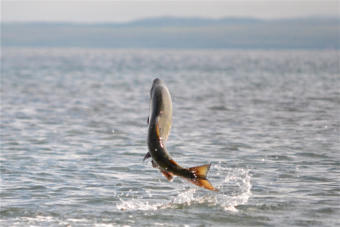
A chum salmon leaps out of the water in Cold Bay.
A chum salmon leaps out of the water in Cold Bay. (Creative Commons photo by K. Mueller/U.S. Fish and Wildlife Service)

Scientists know surprisingly little about a salmon’s life outside of their freshwater and nearshore habitats. But an ambitious study is attempting to change that.

The International Year of the Salmon put together an expedition with 21 international scientists in the Gulf of Alaska, all in the hopes of understanding more about the mysterious lives salmon lead in the open ocean.

The International Year of the Salmon is a quasi-international organization aimed at bringing attention to all five species of Pacific salmon, as warming ocean temperatures affect their survival at sea.

“We will set the conditions that we need for salmon and people to be resilient as we’re dealing with this change in climate,” Mark Saunders explained.

Saunders works for the North Pacific Anadromous Fish Commission, and he helped establish the International Year of the Salmon initiative. The project is bringing scientists, fishery managers and policymakers together from Japan, Russia, the U.S. and Canada in the hopes of making salmon management in the Pacific Ocean an international effort.

“We’re looking for those projects that we believe are transformational, and then going after the funding to do it,” Saunders added.

One of the projects was a five-week expedition that acted as a first-of-its-kind stock survey for salmon in the Gulf of Alaska.

“The central Gulf of Alaska is a nexus of where salmon — almost all of the species — utilize, in the winter, that environment. And so the question was, what are the mechanisms that are affecting abundance?” Saunders said.

By abundance, Saunders means an estimate of how many salmon are swimming in the ocean.

The expedition ended recently in Vancouver, Canada, and the scientists on board the ship are coming back with a wealth of material that will inform numerous studies. But Saunders said the most applicable will be at-sea abundance estimates for each species, something not currently utilized in the U.S. and Canada.

“In fact, the Russians utilize their abundance estimates for pink and chum from these late winter surveys to inform forecasts for the upcoming season,” Saunders noted. “It may have value from a from an annual fisheries management perspective. A big part of this is trying to make sure that what’s coming out of this is going to be useful for management.”

There are larger questions the study may be able to start answering, such as at-sea competition between hatchery and wild fish.

Humpies
Pink salmon, plus an occasional silver and red, congregate in a pool above the weir before spawning. (Photo by Matt Miller/KTOO)

One of the expedition members, Charlie Waters, is a research fish biologist with the National Oceanic and Atmospheric Administration. He said studying salmon toward the tail end of winter will allow researchers to understand how species are surviving during this time of low food abundance.

“If salmon don’t eat enough before they hit this winter period, they may not have enough energy stores to survive these harsh winter conditions,” Waters said.

He will use ear bones from both the chum and pink salmon he’s studying to identify whether they’re wild- or hatchery-origin fish. A hatchery fish’s otoliths, or ear bones, are marked by changing water temperatures while in incubators at hatchery facilities. Those marks act much like a bar code, specifically identifying which hatchery facility they came from.

Using other tissue samples, Waters can then assess whether the fish are starving and, therefore, if they might die. He also took stock of available food sources.

“We can estimate the amount of energy, the amount of food that’s available in the Gulf of Alaska. Then we compare that with the energetic needs of the salmon,” Waters explained. “So we can get a rough estimate of how many salmon potentially could the Gulf of Alaska support.”

That will help answer whether large releases of hatchery pinks and chums from Pacific Rim countries are impacting wild fish in the open ocean.

“For hatchery and wild chum salmon for example, you can estimate the degree to which they’re competing for food resources. But then you can also compare different species,” Waters added.

Still, he said this is only a one-year snapshot and that conditions in the gulf change from year to year. Both Waters and Saunders hope international surveys of the Gulf and the broader Pacific Ocean will become an annual occurrence.

Local residents show support after racist message spray-painted on Homer restaurant

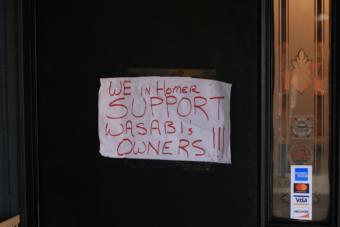
The same day racial slurs were spray-painted on the front of the restaurant, a sign from supporters was placed on the front door. (Photo by Aaron Bolton/KBBI)

A day after vandals spray-painted racist threats on the side of a Homer restaurant, community members have turned out to offer support. It’s unclear whether Alaska State Troopers are investigating this week’s attack targeting the inter-racial owners of Wasabi’s Bistro as a hate crime.
It’s 5 p.m. where Wasabi’s lies on a major thoroughfare just outside of Homer city limits. The bright orange spray paint used to scrawl racist slurs and threats against the inter-racial couple that owns the restaurant has been painted over.

The same day racial slurs were spray-painted on the front of the restaurant, a sign from supporters was placed on the front door.

In its place a sign reads: “We in Homer SUPPORT Wasabi’s OWNERS!!!”

The parking lot quickly fills up with cars full of patrons like Michael Lemay who have come to show their support.

“What happened here today is such an affront to our entire community,” he said. “So we will gather here this evening and stand against hate and white nationalism.”

After pictures circulated on social media Thursday, it didn’t take long for community members and even competing restaurants to put out a call for Homer residents to patronize Wasabi’s as a gesture of support.

Inside, it’s apparent that many heeded the call.

Homer resident John Mahoney had eaten there just hours before the attack Wednesday. He returned again Thursday evening to offer support.

“I know that people, they think all kinds of crazy stuff. We’re all different. I won’t really tread that water, but to have something painted on a building like that, I was surprised.”

However, others like Cindy and Alex Koplin are not. Like many in the restaurant, they blamed President Donald Trump’s divisive rhetoric for heating up an already tense political climate that’s emboldened racists.

“It hits home now. You know how it is when it hits home, it’s different, but it’s still pervasive,” Alex said. “We want to support this not happening.”

His wife Cindy chimes in saying that most Homerites would like to think this type of racial attack doesn’t happen in town, but “it does.”

Wasabi’s husband and wife owners say they have been targeted several times.

Co-owner Colt Belmonte, who is white, grew up in Homer. Hours after the vandalism, he pointed to bullet holes on the outside of the building.

He said they restaurant is about three years old, and as he began to paint over this week’s vandalism, he was clearly frustrated.

“My wife and I are done. We don’t want to be here anymore,” he said.

His wife of more than 20 years, Dali Frazier, is black. As she took a break from waiting tables Thursday evening, she explained that her car was vandalized with racial slurs in recent years, something she did report to police.

“But at that time when we did report it, the troopers felt that let’s just keep it on the down low. That way we can hear some street chatter and catch these people,” Frazier explained. “Well, obviously nothing happened, but yes, this time I did post something on Instagram because I was just really frustrated.”

Alaska State Trooper Sgt. Daniel Cox is asking the public for help identifying leads, and it’s unclear whether this week’s graffiti is being investigated as a hate crime.

A Homer restaurant owned by an inter-racial couple was targeted with racist graffiti on March 21, 2019. (Photo by Aaron Bolton/KBBI)

“It’s an active investigation. So, once the investigation is done, we may put more out, but at this point being active, we’re not putting too much out,” Cox told KBBI over the phone Thursday.

Frazier hopes the extra attention will help catch whoever painted such a hateful message on her restaurant.

However, she said after receiving hundreds of calls and text messages from well-wishers, her family is not going anywhere.

“This is home. Sometimes, events like that happen, you don’t feel like it’s home, but the rest of Homer is letting me know really quite loudly that this is home and that we are appreciated.”

With all the positive support, she expects a busy week ahead.

What happens when wild salmon interbreed with hatchery fish?

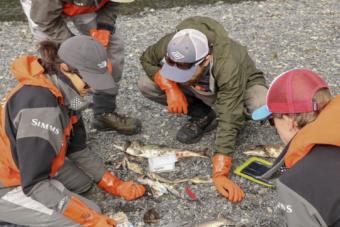
A group of researchers from the Prince William Sound Science Center sample pink salmon carcasses near Cordova as part of the Alaska Department of Fish and Game’s Alaska Hatchery Research Project.
A group of researchers from the Prince William Sound Science Center sample pink salmon carcasses near Cordova as part of the Alaska Department of Fish and Game’s Alaska Hatchery Research Project. (Photo by Aaron Bolton/KBBI)

A research project by the Alaska Department of Fish and Game looking at chum and pink salmon runs in Southeast Alaska and Prince William Sound is expanding to help biologists understand the interplay between wild runs and hatchery strays. There is concern that hatchery fish could alter the genetics of wild populations, posing a threat to their survival.

Homer-based Fish and Game biologists Glenn Hollowell and Ted Otis started tracking hatchery fish found in wild streams around Kachemak Bay in 2014. That was around the time when Cook Inlet Aquaculture Association’s Tutka Bay Lagoon Hatchery reopened after several years.

They wanted to examine how well the hatchery pink salmon homed back to the Kachemak Bay facility, but they found something strange: salmon from other hatcheries.

“When we initially started doing this, we were not anticipating finding any Prince William Sound fish in our samples whatsoever. It was just not something we even considered,” Hollowell explained. “We were very surprised to find that a number of our streams had very significant, double-digit numbers (of Prince William Sound hatchery fish) in 2014.”

The Prince William Sound pinks keep showing up each year, and just the idea that hatchery pinks could stray so far has heated up a dispute over the potential harm on wild runs — namely, whether they could alter the genetics of wild populations in a way that would threaten their survival rate.

That caught the attention Fish and Game’s top salmon geneticist, Chris Habicht in Anchorage. His lab has processed thousands of samples of both wild and hatchery Prince William Sound pinks through the department’s Alaska Hatchery Research Project.

At a recent Alaska Board of Fisheries meeting, Habicht told KBBI that biologists are just starting to understand the pink salmon’s genetic variation.

“So one of the things we’re doing in the study is trying to understand how related populations are to each other. And in particular in Prince William Sound where there’s a big hatchery program, we’re trying to identify variation among populations,” Habicht said.

The hatchery-wild research project found genetic variation in Prince William Sound: That means there are distinct populations. However, it’s unclear how much hatcheries are a factor.

Habicht said pinks in Kodiak and upper Cook Inlet are distinctly different from both hatchery and wild Prince William Sound pinks. He’s hoping to explore that variation in his own smaller study.

“The big question is, where does that break occur?” Habicht noted. “So the first thing we need to do is go out into the field and collect fish from lower Cook Inlet, and what we’re interested in doing is collecting fish that span from lower Cook Inlet up into upper Cook Inlet.”

Habicht said the project still lacks the necessary funding it needs to fully assess whether Prince William Sound hatchery pinks straying into lower Cook Inlet streams could alter the genetics of wild stocks.

But he’s still committed to the project. He plans to walk the banks of the Anchor River this summer, picking up dead specimens for further study.

A new men’s group in Homer aims to foster healthy masculinity. But getting new members is a challenge.

Men wait their turn to shoot at the Kachemak Gun Club and Range.
Men wait their turn to shoot at the Kachemak Gun Club and Range. (Photo by Renee Gross/KBBI)

There’s a new group in Homer just for men. The Homer Men’s Leadership Forum began late last year in part to address concerns brought up by the #MeToo movement.

The leader of the group hopes the discussions will attract men from all different parts of the community to talk about issues such as toxic masculinity. He hasn’t achieved that goal yet, but he’s going to keep trying.

On a Saturday morning at the Kachemak Gun Club and Range, about 10 guys are taking turns aiming at clay pigeons. The Homer Men’s Leadership Forum is putting on the event partly to encourage more men to get involved in the group. But some, like Doug Koester, have been a part of it since the beginning.

“Well so far, it’s been really great for me just to get together with people and maybe talk about things that are a little bit outside of the ‘man box’ that often society or social norms put us in,” he said.

He added that the group doesn’t have an agenda, and mostly he enjoys having a place to talk with other guys without judgment. Still, he’s passionate about discussing certain topics. Koester works for the domestic violence shelter in town.

“For me, that’s what I love to talk about, is like what is our role as men in our society, and why is (it) sometimes men perpetuating that violence,” he said.

Addressing that is one of the reasons that Erik Schreier began the group. He said he wanted to address issues raised by the #MeToo movement.

“Some people in my sphere had been asking me for advice — men and women — on relating to each other, and how men are relating to themselves and men and boys in the community and at large in society,” Schreier said.

He said his goal was to get different men together to start a dialogue about change. At the first meeting, about 15 guys showed up. Schreier showed a TED Talk about consent and “locker room talk.”

“It was great,” Schreier said. “It was a huge outpouring of guys coming together, talking about it. Some guys were confused. Some guys were like, ‘I don’t want to feel bad for being a guy. I don’t think I’ve ever done this, and here I’m being kind of vilified for being a man.’ So that’s fine. Let’s talk about it.”

Now about a handful of men attend the monthly discussions, and topics range from artificial intelligence to self-care. But most of the attendees are like Koester and are already committed to addressing issues of toxic masculinity.

“It’s like the guys who really need to talk about this stuff aren’t in here,” Schreier said.

That’s partly why he’s expanding the group beyond just discussions into monthly activities like volunteering and the shooting event at the gun range. Schreier said that event was successful at getting a variety of folks involved.

“(I came to) meet up with other guys and shoot a little bit,” John Carrico said at the range. “Haven’t been out to the range in about three and a half years, and it sounded like a good time.”

Carrico has volunteered with the men’s leadership group but has never gone to a discussion. He said he’s not sure he’ll attend one and doesn’t know if it’s important to have a space for men to be vulnerable.

“I think that friendships do a lot of that,” he said. “To go outside of that circle takes a little bit of trust.”

Schreier said the shooting event didn’t inspire any new members to join the last discussion group, but he partly blames the low attendance on lack of advertising. He adds that words like “vulnerability” and “feelings” usually turn guys off. But he said he’s happy with the regulars in the group and believes they are effecting positive change.

Still, he’s trying to figure out the magical words to get more men to come.

“Free coffee,” he said, laughing. “I try to get the guys to just want to come together and hang out. I want to let them know that there’s no obligation. You don’t have to come and hold hands and cry. We’re not trying to do that. Not a requirement.”

He said if his group just inspires one guy to make a change, it’s a success.

Legislator apologizes after criticizing letters from high school students

Homer High School senior Jesse Roach asks Rep. Sarah Vance to oppose cuts to education at a recent town hall.
Homer High School senior Jesse Roach asks Rep. Sarah Vance to oppose cuts to education at a recent town hall. (Photo by Aaron Bolton/KBBI)

A freshman House lawmaker took to social media to criticize local high schoolers who had written her office over proposed education cuts. Homer Republican Rep. Sarah Vance has since apologized and taken down the video on her Facebook page.
Vance posted a 7-minute video (full audio here) reading letters she’d received from Homer High School students. The school’s student council coordinated the letter-writing campaign.

In the video, Vance complained that many students didn’t apparently address her by her proper title.

“None of them have addressed me as Representative or Rep. Vance, not a one,” she said.

Many of the messages urged Vance to oppose Gov. Mike Dunleavy’s proposed cuts to K-12 education.

The Kenai Peninsula Borough School District has warned the governor’s budget would force it to eliminate sports and extracurricular activities. Vance said she sympathized with after-school programs.

“But I contend that perhaps we need to focus on academia. Do I want sports and extracurriculars? Absolutely,” she added. “But if our children are having trouble as high schoolers communicating well with their leaders, then we are missing something, if all they see is the value of a school is sports and extracurriculars.”

Homer’s high schoolers were not pleased with Vance’s response. Backlash on social media snowballed, and Vance apologized in a new video and removed the original video on Sunday.

Homer High School senior Avram Salzmann is student body president and one of the organizers of the letter-writing campaign, paid for by the student council.

“Until she’ll understand the message we’re sending, I’m not ready to accept any kind of apology, nor am I looking for an apology. I’m looking for understanding,” he said.

Salzmann said the council wanted students to write to both Vance and Kodiak Republican Sen. Gary Stevens, no matter their opinion on the budget.

“Because we think that being involved is the whole point of our organization. So however we can support students doing that, that’s what we want to do,” he explained.

While Salzmann notes that his comments do not represent everyone on the student council, he said students had a simple message for Vance.

“I think that a healthy balance of extracurriculars, sports and academics are what create the best kind of people,” he said.

The Kenai Peninsula Borough School District projects it would lose at least $22 million under the governor’s proposed budget.

District spokeswoman Pegge Erkeneff said that would force the closure of swimming pools, theaters and potentially a half-dozen schools on the Kenai Peninsula, including Chapman Elementary School, McNeil Canyon Elementary School, Moose Pass Elementary School, Nikiski Middle/High School, Seward Middle School and Soldotna Prep School.

“It would dramatically change the face of education, and we don’t want that to happen,” Erkeneff said. “With this list, we’re still $5 million shy of reaching the $22.4 million.”

The school board has scheduled a budget workshop on March 21, and it has until April 1 to forward its budget proposal to the Kenai Peninsula Borough Assembly.

But there’s a lot of uncertainty involved. That’s because both deadlines are well before the Legislature is expected to pass a state budget.

Sullivan weighs in on border wall, proposed state budget cuts

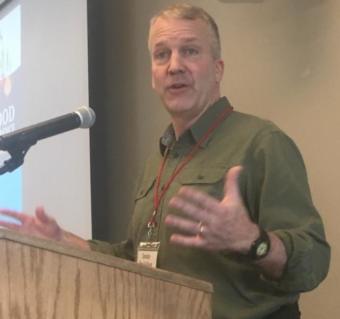
U.S. Sen. Dan Sullivan, R-Alaska, addressed the Alaska Food Festival and Conference on March 8, 2019.
U.S. Sen. Dan Sullivan, R-Alaska, addressed the Alaska Food Festival and Conference on March 8, 2019. (Photo by Jeff Lockwood/KBBI)

U.S. Sen. Dan Sullivan spoke at the Alaska Food Festival and Conference in Homer Friday and met with local press. The Republican senator highlighted his legislative victories surrounding resource development and his support for military projects.

During the conference, Sullivan painted himself as an ally to food producers and said he supported work on food security in Alaska.

He highlighted his efforts to modify the National School Lunch Program. The program helps schools purchase American-grown food.

“If the federal government is going to be helping buy products for our children in school lunches throughout the country, it’s traditionally been an issue where we want those products to be from American farms,” he said.

Historically, Russian pollock has made its way into the U.S. through China. That allowed schools to purchase the foreign-caught species after it’s processed domestically into fish sticks, but Sullivan said those products will no longer be considered domestic under a provision in a large farm bill passed back in December.

“My big thing was to just close the loophole, which was a huge loophole. It, like, dominated the entire school lunch program, which was fish that wasn’t from America,” he said. “And the whole point of the Buy American program and the school lunch program is to promote American (agriculture) and fishing. So we were just glad to be able to shut that down.”

In a meeting with local press, Sullivan highlighted other legislative victories he said were aided by the Trump administration.

“We got ANWR open, which is a 40-year quest,” he said.

Sullivan also wants to maintain money that Congress allocated for military projects in Alaska.

However, President Donald Trump’s plan to divert $3.6 billion from military construction funding to the building of a barrier on the U.S.-Mexico border could hamper funding for military construction in the state.

“Congressman (Don) Young and I sent a letter to the president on that very issue, and we’re still requesting information on that,” he said. “So we’re very focused on it, and I can say that because, as I mentioned at the outset, there’s a lot of really important military construction that’s going on in Alaska.”

Sullivan said that even if the president’s plan moves forward, he does not expect military projects in the state to be affected. And he has not said publicly how he will vote on a resolution to reverse Trump’s use of an emergency declaration to utilize military construction dollars for a border wall.

As for Alaska politics, Sullivan declined to comment on Gov. Mike Dunleavy’s proposed budget. The spending plan proposes far-reaching cuts.

Sullivan encouraged the state Legislature to stray from any proposed cuts that would impact federal spending in the state, including matches through the federal highway program.

“There’s a 90/10 match on that,” he said. “Ninety percent (federal), 10 percent state. So if it’s $750 million, the state would need to make sure that it passed $75 million in highway spending. Well, to me, that’s a very good investment.”

Sullivan also met with Homer city officials, veterans and other local groups on Friday.

Site notifications
Update notification options
Subscribe to notifications