KBBI - Homer

KBBI is our partner station in Homer. KTOO collaborates with partners across the state to cover important news and to share stories with our audiences.

DEC permit renewal would allow more wastewater discharge from Cook Inlet oil producers

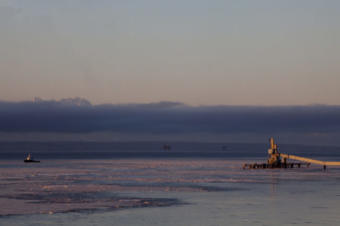
Cook Inlet oil platforms are visible from shore on Dec. 13, 2016 near Kenai, Alaska.
Cook Inlet oil platforms are visible from shore on Dec. 13, 2016, near Kenai, Alaska. (Photo by Rashah McChesney/Alaska’s Energy Desk)

Environmental groups are protesting the state’s move to renew a federal permit that allows oil and gas producers to release pollutants into Cook Inlet.

This is the first time the state has issued the permit. Environmental groups say the state should move the oil and gas industry away from the practice. Those groups are also pushing back against the state raising the volume of oily wastewater that producers are allowed to discharge.

Gerry Brown, who oversees the permitting process for the Alaska Department of Environmental Conservation, explained that the state permit for Cook Inlet oil and gas producers includes a number of discharge types. But treated oily wastewater from the drilling process, known as “produced water,” elicits the most concern.

“It is essentially the oily water that’s treated in order to take oil out of the formation water. Then what’s left is the treated wastewater that’s discharged as produced water,” Brown said. “That has been in the permit from the very start.”

The permit would boost the amount of produced water oil and gas companies are allowed to dump by about 1 million gallons per day. Most of the increase would stem from a single oil platform operated by Cook Inlet Energy.

It’s the first time the state agency has issued the permit for state waters since it asked to take over the process from the Environmental Protection Agency in 2012, citing that it wanted more control over all surface water discharge permits in the state. The EPA still issues the discharge permits for oil and gas operations in Cook Inlet’s federal waters.

Under the permit, produced water and other discharges can be dumped into areas known as mixing zones. DEC said Cook Inlet’s strong currents dilute discharges enough so the water can meet federal standards.

“So the mixing zone is a volume of water where they discharge, where they’re allowed to mix with the ocean in order to meet our water quality criteria,” Brown explained. “Because the treatment technologies available just can’t get there at this time.”

Brown said the permit also calls for larger mixing zones than in the past. It would cover all oil and gas producers in Cook Inlet.

Cook Inlet is the only region of the state where DEC allows oil and gas producers to discharge wastewater and other pollutants. Cook Inletkeeper Advocacy Director Bob Shavelson argues that mixing zones prevent adequate water quality monitoring, and he thinks the idea is a “toxic dumping loophole” that will harm northern Cook Inlet’s lucrative commercial and sport fisheries.

“So imagine three miles. That’s the area that they’re allowed to mix their waste where you don’t meet basic Clean Water Act standards to protect fish and people and so forth,” he added. “And so they’re just going back with the Clean Water Act, which was meant to eliminate pollution to our waters. Here we’re increasing it.”

Shavelson and others want oil producers to re-inject wastewater and other pollutants back into wells after they’re drilled — a more expensive option. Shavelson argues that the renewal of the discharge permit will lead to ever-increasing volumes of wastewater dumping.

“As oil fields age, the amount of water that’s produced increases relative to the oil and gas that you get out,” Shavelson said. “So you have more produced water, that’s the oily water. So they have to discharge it into Cook Inlet or they can re-inject it into the formation.”

Brown with DEC said it could take the agency over a month to sort through public comments, and it’s unclear when it may issue a decision. It closed the public comment period for the permit last week.

Bill aims to make health care coverage for school districts cheaper

Intensive-needs teacher Winter Marshall-Allen says something needs to be done about the rising costs of health care. (Photo by Renee Gross/KBBI)

Funding health care coverage in Alaska’s school districts is expensive, but a new bill is attempting to reduce those costs.

House Bill 156 would allow employees from municipalities, school districts and the University of Alaska to opt into the state’s health care program. It may help districts like the Kenai Peninsula Borough School District get a leg up when negotiating health care premiums.

However, not everyone is jumping on board with the idea.
Intensive needs teacher Winter Marshall-Allen is passionate about her work at Homer High School. But outside the classroom, she is struggling to pay for health care coverage: Marshall-Allen and her family are on the school’s high deductible plan. She’s required to pay $3,000 before insurance kicks in.

“My problem is I slipped and fell in my own home and hit my head and got a concussion, and incurred an emergency room bill,” she said. “Now I’m having a hard time meeting my premiums in order to have the insurance kick in to pay the rest of the bills that I’ve acquired from that incident.”

She’s one of many district teachers and staff who are demanding better coverage. Marshall-Allen is also on the executive board for the teacher’s union and was part of a vote to strike next fall over rising health care costs.

“I see what has been brought to the table, and I know that we are working hard on our end to try and provide solutions, and I really just don’t feel that the district is really helping to meet that need,” she said.

But the district is struggling to meet the unions’ demands.

Dave Jones is the assistant superintendent for the school district. He said the bottom line is that Alaska’s school districts pay some of the highest health care costs in the nation.

“Every year those costs are increasing by 7-to-9%,” he said. “The problem is, every year the school districts do not get additional revenue to pay for that.”

Homer Republican Rep. Sarah Vance is trying to reduce health care costs for districts and municipalities. She’s sponsoring a bill that would allow them to opt into the state’s health insurance pool.

Jones said that could give districts more leverage with providers. On the Kenai Peninsula, health care accounts for roughly 17% of the district’s fiscal year 2020 expenditures.

“The idea behind the larger pool is, that’s when we then have the ability to go to the doctors and say, if you want to serve the people in this pool, this is what we’re willing to pay,” Jones said. “We won’t pay any more.”

Jones supports the measure, but he worries about making participation voluntary. He said larger school districts may not have incentives to join the group.

Vance understands the concern.

“But when we mandate something, especially in health care, that causes more caution with people where they feel pushed that things are happening to them,” Vance said. “And I don’t want that.”

About a handful of states have implemented similar systems like the one Vance is suggesting, though they vary widely. And this isn’t the first time the idea has been floated: A 2017 feasibility study found that creating a bigger health care pool could save the state roughly $200 million a year.

For school districts, more state and local funding could be freed up for the classroom. Still, other school districts say it’s too early to say if they will participate if the bill moves forward.

The teachers union on the Kenai Peninsula has not yet taken a position on the bill, but its president expressed concern about districts relinquishing control over health care negotiations to the state.

Vance said that the state’s Department of Administration oversees the health care program.

“Everyone is able to communicate with the Department of Administration on the health coverage just like they would under their school plan,” she said.

Back at Homer High School, Marshall-Allen said as an employee, she’s worried how the bill could affect her coverage, which currently is still being negotiated by the teachers union and the district. Still, she said if the move could reduce the cost of her monthly premium, it may prevent her from having to look  for a new job.

“I know that my expertise as a teacher and in the field that I work at is definitely needed, and I shouldn’t have to take my talent and my ability and my passion and have to look in the private sector in order to be meeting my needs of myself and my family,” she said.

The district and union have until the fall to hammer out a deal over health care. If they don’t, teachers like Marshall-Allen plan to strike.

Palmer man dies in Prince William Sound floatplane crash

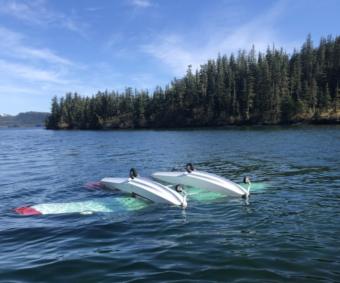
A Cessna A185F Skywagon is upside down in Cascade Bay, 20 miles southwest of Valdez, Alaska, May 21, 2019. (Public domain photo by Coast Guard)

A 75-year-old Matanuska-Susitna Borough man was killed in a Tuesday floatplane crash in Prince William Sound.

Alaska State Troopers identified the deceased as William Resinger of Palmer. He was one of two passengers aboard a Cessna 185 Skywagon that went down over Cascade Bay, about 20 miles southwest of Valdez.

The pilot, Scott Johannes of Wasilla, and the other passenger were flown to an Anchorage hospital. Their condition and the identity of the second passenger have not been released.

Coast Guard spokesperson Charly Hengen said the pilot and both passengers were underwater, but four vessels in the area immediately responded.

“(Coast Guard) Sector Anchorage issued out what’s called an urgent marine information broadcast, and some good Samaritans were in the area and they were able to provide assistance to the people,” she said. “Also an Alaska Air National Guard rescue helicopter crew was launched by Sector Anchorage watchstanders. They were able to medevac two of the people, and those people were taken to Providence Alaska Medical Center in Anchorage.”

Initial reports came into the Cordova Police Department, which received a 911 call. An Alaska State Troopers dispatch says the aircraft crashed as the pilot was attempting to land in Cascade Bay.

First responders performed CPR on Resinger, but he was unresponsive. He was later declared deceased.

Both the National Transportation Safety Board and the Federal Aviation Administration are investigating the crash. It’s the third fatal floatplane crash in Alaska this month.

Bear viewing industry brings in millions of dollars to Southcentral’s economy, study says

McNeil River is one of the largest gatherings of brown bears in the world. (Photo by Carl Chapman)

On the edge of bear viewing season, a first-of-its-kind study finds that the industry brings in millions of dollars to Southcentral Alaska’s economy.

University of Alaska Fairbanks economics professor Joseph Little is one of the authors of the study:

“In general we find that remote access bear viewing actually supports quite a bit in terms of economic contribution,” he said. “So we estimate about $34 million in sales. That would also extend to about $19 million in value added to the regional economy.”

Little and a graduate student worked together to produce the report assessing businesses tied into bear viewing such as lodges, air taxis and guides.

“We had a number of service providers indicate that bear viewing related revenues, that is them taking people out to, say Katmai or McNeil River, add anywhere up to 80 percent of their associated revenues tied to bear viewing,” he said. “So it’d be very important to a lot of small local businesses in terms of their financial viability.”

Little adds the industry has been growing. He says that Lake Clark National Park and Preserve in particular has seen an increase in visitors over the past few years.

He says he doesn’t know whether this most recent report will be reproduced annually and says both he and his students may assess other aspects of the industry, such as the impact that online bear viewing has on actual visitation.

Some are using Little’s economic study to oppose the Army Corps of Engineers draft Environmental Impact Statement for the proposed Pebble Mine. They say that the draft statement does not do enough to address the project’s impact on bear populations and the local tourist economy.
Women in Alaska’s fishing industry hope to curb sexual harassment

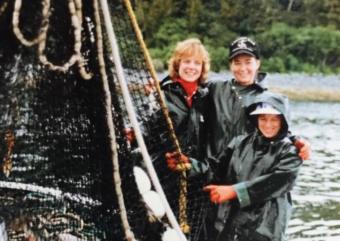
Robin McAllistar and two of her crew members on the deck of FV Valiant Maid during the late-1980s.
Robin McAllistar and two of her crew members on the deck of FV Valiant Maid during the late ’80s. (Photo courtesy Robin McAllistar)

Many women in the commercial fishing industry say sexual harassment is part of the job. But being on a boat for weeks or months at a time can make harassment hard to escape, and seeking help especially difficult.
Now there’s a push to make the seas safer for women.

Robin McAllistar was sitting on her couch when her younger friend Jude Huerta walked through the door. Huerta is 19 years old and wants to commercial fish for the first time this year. McAllistar fished commercially years ago, and recently the friends have been talking about how Huerta can remain safe as a woman new to the industry.

“It’s really sad that that has to be said, but it’s important to know,” Huerta said.

“It’s better to say it ahead of time than regret it later,” McAllistar replied.

McAllistar is speaking from experience. When she was fishing in the ‘70s and ‘80s, at times she was the only woman on the boat. Her advice for young fishers like Hureta: Find a way to get off the vessel if they feel unsafe.

“You can hop a tender when you’re done delivering fish,” she said. “If things have gotten bad, don’t negotiate with them that you’ll be dropped later. Get off the boat.”

McAllistar has experienced her fair share of bad situations. She said she once was stuck on a boat with a captain who was constantly drinking. She said he assaulted her in her room, and she had to fight him off.

“I mean physically grappling and trying to get through and get out and get away,” she said. “I wasn’t raped, but that was only because I got out.”

The next day, she hopped onto another boat. While the experience didn’t drive her to quit fishing altogether, that was her last season, and now she works as a therapist.

It’s hard to say just how common McAllistar’s experience was during her time fishing, and if things have changed in the decades since. Statistics on sexual harassment in the industry aren’t readily available. The Alaska State Commission for Human Rights does take complaints about sexual harassment and discrimination, but it doesn’t receive a large number from the fishing industry specifically.

Still, others say it’s a problem they want changed.

Elma Burnham is the founder of Strength of the Tides. It’s a grassroots movement that aims to support and empower women who work on the water. The organization hosts events, profiles women in the maritime industry on social media and fosters community.

But the main part of the movement is asking fishers, boat captains and others in the industry to sign a pledge demanding zero tolerance for sexual harassment and assault. Burnham publishes the list of those who have made the pledge online.

“Basically, another way to look at it is as an anti-harassment policy for this group of people,” she said.

Burnham is a commercial fisher, and she hopes the list will be used as a road map that will help women who are seeking work in the industry to stay safe. Eventually, she would like to push for boats and organizations to implement written policies on sexual harassment. But for some, a verbal agreement is enough.

Malcolm Milne owns the FV Captain Cook and manages a crew of four. He’s also president of the North Pacific Fisheries Association, a commercial stakeholder group.

“The one thing I don’t approve of is more paperwork, necessarily,” Milne said. “I have plenty to do as it is.”

He said he’s supportive of what Burnham is doing. He already talks to his crew about sexual harassment but doesn’t have a formal policy, because he said he’s not that official about things.

He added that it has been a topic of discussion in his industry group, most of whom are small boats employing a handful of people.

“People recognize that it does happen in circumstances,” he said. “But in the smaller family boats that I’m associated with, I think people don’t have any tolerance for it. So there’s not really an issue I would say.”

He said that his industry is already good at vetting people to make sure they are safe to work with.

Back at McAllistar’s house, she said more needs to be done to tackle the issue.

“The truth is, I really like the Wild West of the ocean just the way it is, and the fleets just the way they are,” she said. “But people should be sexually safe.”

McAllistar said she’s seen more women enter the industry over the years, which she said is the most promising sign of change.

Fire season kicks off with over a dozen wildfires across Alaska

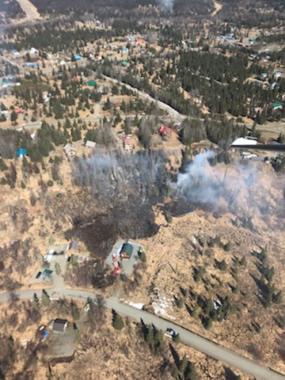
A 2.5-acre brush fire near Ninilchik on the Kenai Peninsula threatened homes Saturday.
A 2.5-acre brush fire near Ninilchik on the Kenai Peninsula threatened homes Saturday. (Photo courtesy Alaska Division of Forestry)

The Alaska Division of Forestry is warning Alaskans in the Southcentral region of the state about high fire danger.

Burn suspensions were issued for the Kenai Peninsula, the Delta and Tok areas through Monday, but those suspensions could continue through the week.

Division of Forestry spokesperson Tim Mowry said over a dozen wildfires cropped up around the state over the weekend.

“Yea, we had several fires pop up in Southcentral Alaska, mainly Mat-Su Valley, Kenai Peninsula over the weekend. We had more than a dozen fires on state protection areas,” he explained.

A 2.5-acre brush fire near Ninilchik threatened homes on Saturday and a snowmachine sparked a blaze on the tundra near Unalakleet in Western Alaska as well.

Mowry said that earlier snowmelts and later winters around the state have led to a longer fire season.

“That still does vary year to year. Last year for example, a real late spring and things didn’t get started up until early May,” he added. “It’s really weather-dependent and snowmelt-dependent. This year, we lost our snow around the state earlier than normal. So that did trigger sort of an earlier start to that pre-green-up fire season.”

The Division of Forestry is encouraging residents to track when and where burn suspensions are issued as the season wears on — and even when there’s no suspension, to keep a close eye on any burn barrels and open brush fires, especially near any homes or structures.

“People just need to be really cognizant of the fact that any kind of spark can start another fire and follow all the conditions on the burn permit so there isn’t that possibility — clear down to mineral soil around your fire, have water and tools on hand, never leave the fire unattended,” Mowry said.

Fire conditions aren’t expected to improve for much of Southcentral Alaska through this week as no major rain events are in the forecast. You can keep track of the latest burn suspensions and fire conditions on the Division of Forestry’s burn permit webpage.

Site notifications
Update notification options
Subscribe to notifications