KBBI - Homer

KBBI is our partner station in Homer. KTOO collaborates with partners across the state to cover important news and to share stories with our audiences.

As Homer’s Grewingk Glacier recedes, the risk of landslides and tsunamis grows

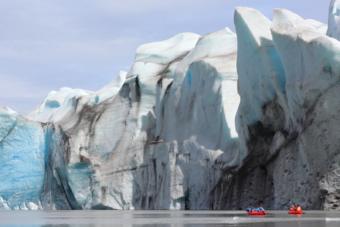
Two small boats row past the Grewingk Glacier.
Grewingk Glacier has receded roughly 1,500 feet this past winter and fall. (Creative Commons photo by Ground Truth Trekking)

One of the most popular landmarks in Kachemak Bay State Park is a glacier that’s becoming increasingly unstable. Scientists say climate change is raising the threat of landslides and tsunamis.

All year round, Dave Lyon transports hikers and day-trippers in his water taxi from Homer’s harbor to Kachemak Bay State Park. He said Grewingk Glacier is a top destination.

“They usually just love it,” Lyon said. “It’s beautiful. A lot of folks will swim in the lake and swim out to icebergs and climb up on ‘em, and they just say it’s a spectacular experience.”

The glacier flows into a wide lake which is surrounded by mountains. Lyon said he takes visitors from all over the world to see it.

“You’re going to be out there with maybe 30 to a hundred of your best friends on a given day in the summer,” he said. “It’s a crowded trail.”

But there’s cracks in the mountain slope beside the glacier. The rock there is weak and at risk for falling into the lake — that’s what happened in 1967. Lyon wasn’t there at the time, but he’s heard about it.

“It was a cataclysmic event, and Homer could hear it, and it was like a rumbling explosion,” he said. “It was the entire side of the mountain falling into the water.”

A crack on Alpine Ridge near Grewingk Glacier.
A crack on Alpine Ridge near Grewingk Glacier. (Photo courtesy of Brentwood Higman)

Scientists agree this landslide was one for the books.

“It would be in the list of probably the top 10 landslides that happened anywhere in the world in the 20th century,” said geologist Brentwood Higman.

Luckily, no one was there for the landslide and tsunami back in the late 60s, Higman said.

But things are different now. More visitors are at the glacier, which is receding. And with the retreating ice, so follows the natural buttress for the mountain rock beside it. More melting ice also means more water in the lake. So when rocks fall into the lake, it could make for a bigger wave.

That’s not to say there’s any certainty that a large landslide and tsunami will happen. But the possibility of more rains brought by more extreme weather — driven by climate change — makes Higman nervous.

“I mean we all take risks in life,” he said. “I think it’s worth going up to Grewingk Lake. I’m not really suggesting people don’t do that. I would suggest that camping on the beach is maybe not a good idea.”

In the meantime, he and his colleagues hope to get the tools to predict the next big slide.

A view of Grewingk Glacier and Grewingk Lake. (Creative Commons photo by Ground Truth Trekking)

“You can look for clues that suggests things might be starting to move,” said Ed Berg. He teaches geology at Kenai Peninsula College.

Berg said scientists in Europe are already monitoring mountains for landslides. If a mountainside is shifting at a measurable rate, that’s a bad sign.

“Then that would be a sign that it’s going to fail sooner or later,” Berg said.

Back at his water taxi, Lyon said a potential slide isn’t going to deter him.

“It’s a great hike, and what am I going to tell people? Stay home, be afraid, don’t go outside?” he asked.

He’s just returned from Kachemak Bay State Park, where he’d taken a load of day-trippers. His large brown dog Pica is at his side.

“There’s only so much time left to experience some of these great things that we have here before our world changes irrevocably,” he said.

In the meantime, he said it’s important to share the place with others.

Gov. Dunleavy’s veto to agriculture funding alarms advocates of local food

(Creative Commons photo by Michael (Miche) Spring)

Gov. Mike Dunleavy’s veto cutting funding to agricultural development has alarmed advocates for sustainable farms working toward food security. The veto would cut $1.2 million from the state’s Department of Natural Resources in addition to defunding a loan program for farmers.

Assistance for farmers

Robbi Mixon is the local foods director for Cook Inletkeeper in Homer. She said the governor’s veto will deprive Alaska farmers of crucial know-how and advice from the state’s agriculture division.

“They’re able to educate them,” she said. “They’re able to just give them a lift up. And farmers know that they have people that are supporting them and there are resources and they don’t have to do all the work. They can focus on farming.”

That assistance can be for things like marketing local produce, researching seed banks or for cutting-edge technologies. She said it’s worked: The number of farms in Alaska has risen 30% in the last five years, even as the number of farms decreases nationally.

Cook Inletkeeper has been able to create a network of farmers market managers and farmers as well as hold conferences using state funding assistance.

“That money is invaluable,” she said. “Most of the people working in the agriculture industry probably couldn’t afford to do this. To have that peer-to-peer information exchange, and also feel like you’re not in this alone. We share the same problems and how can we face them together.”

Food security

Kyra Wagner is the district manager for the Homer Soil and Water Conservation District, which directs local natural resource programs. She notes that while it is unclear exactly how the cuts may play out, she worries about a larger issue: food security.

“If there’s an emergency here, we do have three days of food in the state, but when there’s an emergency, it’s three hours because people panic,” she said. “So having some kind of stability, rely on something that’s local, dig into that root seller of potatoes.”

That’s why she said Alaska farmers aren’t the only ones who should be concerned about the cuts.

Wagner also works on combating invasive weeds on the Kenai Peninsula, and she worries that a loss of funding could make programs combating these threats suffer.

“Things like that, that nobody really sees or understands the impact of, can actually have long-range impacts that could cost the state tons of money trying to combat things that are harmful that had been introduced completely innocently,” she said.

The governor also vetoed $375,000 from the industrial hemp program, which would help provide research and support to producers of the crop.

The Legislature faces a Friday deadline to override the governor’s vetoes.

City of Homer works with state and Army Corps to battle erosion on the spit

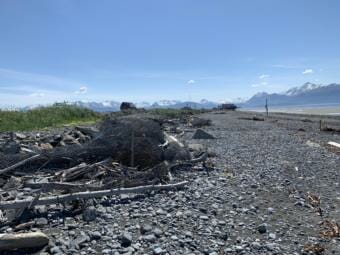
Handmade barriers used to protect against erosion wash up on the Homer Spit (Photo by Aaron Bolton/KBBI – Homer)

The Homer Spit’s future as an iconic tourist attraction is in danger of washing away. Erosion along the spit’s sea walls is not a new problem. City officials are working with state and federal agencies to find a lasting solution.
Driving onto the four-mile-long Homer Spit, you’ll notice a majority of the Sterling Highway is shielded by boulders. But as you approach the numerous restaurants and businesses that attract thousands of tourists here each year, that shield against erosion ends.

In their place are crude barriers made of chain-link fence and rocks. Apparently they were a futile attempt by the owner of a privately-owned campground to prevent the soil above the beach from washing away.

“Got some cleanup work to do, don’t we?” Harbor Master Bryan Hawkins said as he walked onto the beach. “You can see some over here. They didn’t hold up.”

Hawkins points to an old utility pole just about 100 feet off of the road that RVs and campers used to plug into.

“That was the ground elevation where those boxes are – what is that, probably 10 feet or so of beach elevation that has dropped in this area,” he said.

Erosion on the spit is nothing new, but both winter and spring storms are increasingly washing away soil along the road as the beach wears down. A spring storm this year washed away another nearby campground owned by the city, which has since been filled in with sand.

The city’s short-term solution to battling this problem is to rebuild the beach using dredge materials from the Homer Harbor.

“We average between 8,000 and 14,000 cubic yards a year of dredge materials and a good portion of that or all of that could be put back into the system,” Hawkins explained. “Probably try to get as much into the system as we could to begin with to start the process.”

That idea came out of a meeting the city called with state transportation officials and the Army Corps of Engineers last month. U.S. Senator Lisa Murkowski’s office also got involved.

Julie Anderson with the Army Corps office in Anchorage said there are some hurdles to clear before the city can move forward.

“So we have to go through an environmental permitting process and also a contract modification with our contractor to do that work,” she said. “So these are proposed actions from that meeting and we’re just starting those processes.”

Stakes mark the Alaska Department of Transportation’s right-of-way near the Sterling Highway on the Homer Spit. (Photo by Aaron Bolton/KBBI – Homer)

The Alaska Department of Transportation is also hiring a private consultant to assess the right-of-way on either side of the Sterling Highway.

DOT’s Todd Vanhove said the state will use their recommendations to design a project to protect the right-of-way only, which could include more large rocks along the road or other erosion prevention methods.

“We use another method when we get closer down toward some of the more congested areas. We would trench down and fill the trench with the similar rock, but then cover it back up with sand so that it would be there in place but not visible,” he explained. “Then the beach would still be usable.”

There’s no set timeline for any project. But the city is hoping to address the issue soon because the spit is a hub for commerce. It’s home to U.S. Coast Guard Cutter Hickory, the Homer Harbor, and the state dock used by the ferry Tustumena, connecting Kodiak Island and the Aleutian Islands to the mainland.

“We are a port community. So of course protecting the highway and the port and access is our highest priority,” Hawkins said.

He adds that the next step in protecting the spit is for the city, state and federal officials to craft a long-term erosion prevention plan.

As some sea star populations make a comeback, scientists may have found cause of ‘wasting disease’

One of a few Leptasterias sea stars, known as the six-rayed star, to be found outside of ecologist Brenda Konar’s survey plots. (Photo by Aaron Bolton/KBBI)

Along the West Coast, there are signs that sea stars are recovering from a wasting disease epidemic that began around 2013. Stars suffering from the disease literally melt away within 48 hours of the first sign of sickness.

Scientists once thought it was caused by a virus or another pathogen, but now they think it may actually be another sign of climate change.

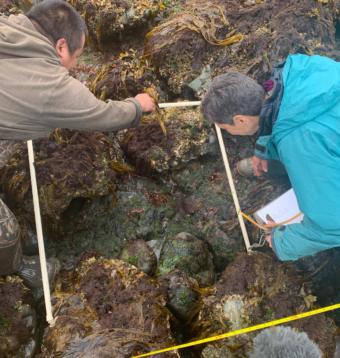
University of Alaska Fairbanks ecologist Brenda Konar and her graduate students begin to survey a beach on a small island in Kachemak Bay. They’re here to count sea stars and other intertidal plants and animals.

It becomes clear very quickly there aren’t many stars here.

“Here you’d see — I don’t know what the common name of Asterias is,” Konar says as she begins to list the species that normally are found here.

One of her graduate students chimed in with the answer: “The modeled star.”

“You’d see Pycnopodia, you’d see some Solaster, the sun star,” Konar adds. “Kachemak Bay, these islands in particular where we would sample, would have a lot of the molded star. Prior to the disease, the numbers were really high.”

Prior to 2013, Konar would find 50 or more stars at this beach alone. However, she’s only found a handful at the five sites she’s surveyed in Kachemak Bay over the past few days, which is the new norm since wasting disease began to spread across the entire West Coast of North America back in 2013.

Over 20 species from Mexico to Alaska have been impacted by the disease in some way, according to Melissa Miner of the Mutli-Agency Rocky Intertidal Network.

But things are improving for some species in Washington, Oregon and northern California. Kachemak Bay is also seeing sunflower and ochre stars come back.

“If we go diving around here, we’re seeing a lot more stars, which is really exciting and we’re happy about that,” Konar says. “And if you go to the heads of the bays, there’s a lot of sea stars coming back in those areas.”

University of Alaska Fairbanks Ecologist Brenda Konar and National Oceanic and Atmospheric Administration Oceanographer Dominic Hondolero survey for sea stars in Kachemak Bay.
University of Alaska Fairbanks ecologist Brenda Konar and National Oceanic and Atmospheric Administration oceanographer Dominic Hondolero survey for sea stars in Kachemak Bay. (Photo by Aaron Bolton/KBBI)

No one can really explain why stars are recovering in some areas and not others, but microbiologists like Ian Hewson think they’re getting closer to understanding what caused the die-off in the first place.

“Initially what we thought we had nailed it down to was basically a virus called the sea star-associated densovirus,” Hewson explained.

But Hewson and others now think that the presence of the virus in sea stars affected by wasting disease is just a side effect. He explained that the timing of wasting disease corresponds with runoff events in the ocean — think dying algal blooms, massive storms or other events that put a ton of organic matter into the ocean. That “dissolved organic matter” eventually covers sea stars and is broken down by bacteria.

“So bacteria utilized all the oxygen and basically deprives the starfish of that oxygen,” Hewson said.

Sea stars have a natural defense mechanism known as “programmed cell death,” which they can use to shed one of their arms, called rays, if it’s injured or developed an infection. But Hewson thinks sea stars are sending that signal to the entire body as they suffocate.

Kachemak Bay. (Photo by Shady Grove Oliver/KBBI)

“So they’re basically expressing genes that cause all of the surface tissues to suddenly collapse, and then it melts away,” Hewson explained.

He said more research is needed, but if his theory proves true, he said large-scale die-offs like the one sea stars are recovering from could be a symptom of climate change.

Less oxygen in the water due to rising ocean temperatures, along with extreme storm and flood events putting more organic matter into the ocean, could be some of the factors.

“If our hypothesis is correct, that would actually cause wasting disease to get worse,” Hewson added.

Work like Hewson’s could also help scientists understand more about the timing of wasting events in their area. Still, those answers could be a ways off.

In the meantime, researchers like Konar are more focused on the recovery of local populations, which in Kachemak Bay isn’t going so bad.

“It’s great. I love it when people send me texts and go, ‘Look at the stars I just found.’ Because it’s, like, great. There’s hope. They’re going to come back,” Konar said.

She added that it’s just a matter of time before numbers in Kachemak Bay return to pre-disease levels.

NOAA is trying to encourage more observers to report sexual harassment

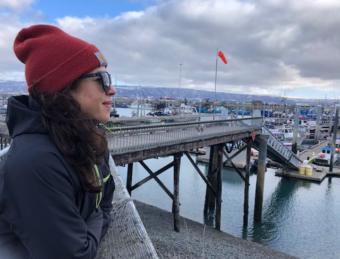
Alex Ravelo, a former NOAA Fisheries observer, looks out onto Homer's docks.
Alex Ravelo, a former NOAA Fisheries observer, looks out onto Homer’s docks. (Photo by Renee Gross/KBBI)

In the commercial fishing industry, National Oceanic and Atmospheric Administration workers — known as “observers” — jump on board hundreds of vessels each year to make sure fishers are following federal regulations. But many of the women who perform these duties say they experience sexual harassment.

NOAA is trying to encourage more female observers to report those instances, even if they seem insignificant.

Alex Ravelo walked toward a sailboat she might buy in the Homer Port & Harbor: It’s a roughly 22-foot vessel with a red hull that she’d like to use to sail around Kachemak Bay.

“Oh, she’s the perfect adventure boat. Needs just a little bit of love,” she said.

Ravelo loves adventure. In fact, it’s what partly inspired her to become a NOAA Fisheries observer in 2006 soon after she graduated college. An observer collects data on board commercial fishing vessels to verify that fishers are following regulations surrounding harvest practices and limits.

Ravelo said some boats created a more welcoming atmosphere for women than others. Sometimes she would see pornographic magazines lying around, and other times she was subjected to sexually inappropriate teasing and jokes.

But for the most part, she would just brush it off.

“I did want to show that I was capable, and that I could joke around,” she said. “And I wouldn’t get upset by little things.”

However, she said in one instance a male crew member tried to prevent her from leaving a room after they were joking around.

“Then he just kind of, like, grabbed me, and he was a very large man,” she said. “I felt very trapped, and I just pushed him away. But I had to use all my strength to get his arms from around me and stormed out of there.”

Ravelo never filed a report, saying it was an isolated event. Eventually, Ravelo moved on to pursue her graduate degree in marine biology.

Even if Ravelo’s experience is few and far between, others like former observer Bobbie Buzzell say it’s hard to know when less extreme interactions should be considered harassment and be reported.

“How am I supposed to distinguish whether or not it’s just in good fun? Or is it starting to cross a line with me?” she said. “There’s just a huge gray area, I think.”

Jaclyn Smith works for NOAA’s law enforcement division and said she hears those types of comments all the time.

“I’ve heard a lot of observers say things like, ‘Well, it’s Alaska, it’s the fishing industry. I should expect this type of behavior.’”

She said there are roughly 350 observers in Alaska, and about half are women. Smith sent an anonymous survey to observers deployed in Alaska in 2016 and 2017. About a quarter of female observers responded, and roughly half said they had experienced sexual harassment aboard vessels. They say they declined to report for several reasons, including fear of backlash and that nothing would be done about it.

“So that’s why I kind of started to adjust the training that I was doing, trying to encourage observers to come forward to report things that were happening to them, even things that they thought wasn’t a big deal,” she said.

Smith is incorporating role-playing scenarios into her training program and encouraging NOAA officers to be more personable with observers, hoping that it will make it easier for them to file reports of sexual harassment.

It’s hard to say if these efforts will create change. Under 20 reports have been filed annually over the past few years, and numbers can vary widely.

Ravelo thinks more training for observers could make a difference, but she said it’s only half of the problem — meaning that fishing crews need to address harassment from within.

“I’ve been on so many boats where the attitude and the relationships that were built on those boats were so healthy and so friendly and professional,” she said. “If it’s possible on some boats, why wouldn’t it be able to happen everywhere?”

While Ravelo left her observer position to pursue her graduate degree, she said a change in the commercial fishing culture could help reduce turnover of women in the observer program.

Dunleavy taps former aide for vacant Board of Fisheries seat

Alaska Board of Fisheries members meet in Anchorage for a work session earlier this year. (Photo by Aaron Bolton/KBBI)

Gov. Mike Dunleavy has tapped his former legislative aide to serve on the Alaska Board of Fisheries.

In the world of Alaska fish politics, Matanuska-Susitna Borough resident John Wood is not a big player. The governor’s appointee is largely unknown by fishing groups.

“Most of the response I’ve heard from UFA members is, ‘Who is he?’ People are not familiar with him,” United Fishermen of Alaska Executive Director Frances Leach said.

She said the commercial fishing industry group hasn’t had time to come to a formal stance about Wood, and the timing of his appointment – announced Thursday – surprised many.

The seat has been vacant since the Legislature declined to confirm Dunleavy’s choice of Karl Johnstone, a former Board of Fisheries member who’s been a polarizing figure and a magnet for criticism from commercial fishers.

The next Board of Fisheries meeting isn’t until October. So few expected an alternative so soon.

Kodiak Republican Rep. Louise Stutes chairs the House Fisheries Committee. She said she’d been in touch with the governor’s office over the vacancy.

“I was told that they were in no hurry to make this appointment, and it would probably be late summer, early fall. But obviously, that’s not the case,” Stutes explained.

So who is Wood? He’s a private-practice attorney in Willow and chairs the local branch of the state’s Republican Party. As an aide to then-Sen. Dunleavy, he worked on northern Cook Inlet allocation issues from 2012 to 2014.

“Since that point in time, I’ve served on the Matanuska-Susitna Borough’s board of fish and game as well,” Wood said, referring to the borough’s Fish and Wildlife Commission. “Between that and the amount of time I spent on it with Sen. Dunleavy’s office, I got pretty familiar with the issues as they pertain to this region. That doesn’t mean I’m up to snuff on other regions of the state, and that’s something I’ll have to work to catch up on.”

Wood supports increasing the amount of fish that swim upriver in areas of Cook Inlet, where streams aren’t at capacity. That would implicitly restrict the commercial harvest and benefit sport fishing — making commercial fishing groups nervous.

United Cook Inlet Drift Association’s David Martin has worked with Wood in the past. He said like Johnstone, Wood puts sport fishing interests first.

“It’s just unfortunate that we keep getting a lot of people on the board of fish that is really on the politics and allocation instead than the science and biology,” Martin added.

The Board of Fisheries sets fishing regulations for commercial, subsistence and sport fishing in state waters. Wood will go before the Legislature for confirmation during next year’s regular session.

Site notifications
Update notification options
Subscribe to notifications