KBBI - Homer

KBBI is our partner station in Homer. KTOO collaborates with partners across the state to cover important news and to share stories with our audiences.

Rescued harbor seal pups return to Cook Inlet

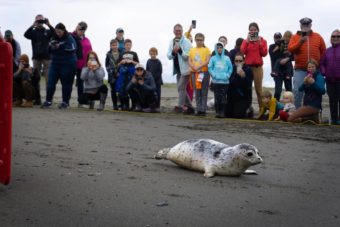
People on a beach watch at a distance as a harbor seal pup crawls towards the water
Admiral, a harbor seal pup rescued by the Alaska SeaLife Center, heads immediately to the ocean after being released from his crate on Aug. 24, 2022 in Kenai. (Photo by Hope McKinney/KBBI)

Two harbor seal pups who were rescued earlier this summer have returned to the wild.

The seals, named Cobalt and Admiral, spent the past two and a half months at the Alaska SeaLife Center in Seward, gaining weight and learning to catch and eat fish.

After passing their health checks, care specialists finally decided last month it was time for the seal duo to go back into Cook Inlet.

Dozens of adults and children came to watch on an overcast afternoon at Kenai North Beach. They were quiet as SeaLife Center staff opened the seals’ crates and the pups started to make their way to the ocean’s edge. Staff had warned the crowd to hold their applause and cheers until the pups were safely in the bay.

“We don’t want to spook them,” said Savannah Costner, an animal care specialist with the center’s wildlife response department. “This is the most people they’ve ever seen in their entire lives. So it’s going to be a little bit scary for them.”

The release only took about five minutes.

Admiral — a 50-pound male — booked it straight to the water, where he then waited for his sister Cobalt, who wasn’t so sure about the people hovering nearby.

She stared at the quiet audience and slowly waddled to the bay. There were other harbor seals swimming in the surf nearby.

As soon as the seals were in the water, the onlookers cheered.

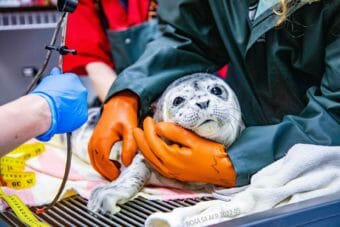
Wildlife rehabbers handling a harbor seal pup
The Alaska SeaLife Center Wildlife Response Program admitted the first two harbor seal pup patients of the summer on June 2, 2022. (Photo courtesy of Kaiti Grant/Alaska SeaLife Center)

The seals’ release back to the ocean was a long time coming. They were newborns when they were spotted in early June hauled out on a Kasilof beach, their moms nowhere to be found. And they were in rough shape — emaciated and dehydrated. Cobalt even had rocks in her stomach.

They spent all summer at the SeaLife Center. And when they got released, the only evidence of their time at the center was a small blue tag with an identification number on their tail fins.

""
Cobalt and Admiral have graduated from “fish school.” (Hope McKenney/KBBI)

Costner said it’s special every time the center releases a rehabilitated animal back into the wild, but there was something extra sweet about seeing Cobalt and Admiral swim away. She helped care for and train the seals and oversaw their release.

“We all put our time into it, our love, our hopes and dreams into these animals and we want the best for them,” she said. “I think the fact that we had to do emergency medicine on Cobalt her first day with us and the fact that we got her here to this day is crazy. It’s amazing.”

For release day, the SeaLife Center invited volunteers and members to the long sandy beach. It was the first time in several years the center has held a public release because of the coronavirus pandemic.

Wildlife rehabbers handling a harbor seal pup
The Alaska SeaLife Center Wildlife Response Program admitted the first two harbor seal pup patients of the summer on June 2, 2022. (Photo courtesy of Kaiti Grant/Alaska SeaLife Center)

Marie Mills is a member of the center and found out about the event when she got an email from staff. She loves pinnipeds – especially seals – more than almost anything.

“They’re cute and fat and chunky and jiggly. They’re just amazing,” she said, giggling on the beach.

Mills drove more than three-and-a-half hours from Wasilla for the release.

“I just love that the SeaLife Center can rehabilitate them and put them back in their home and not just stick them in a zoo somewhere,” she said.

There were some younger guests at the event too.

Hildy Coleman just turned seven and is in first grade. She was wearing a blue hoodie and boots as she pointed at the heads of harbor seals in the bay, hoping to spot Cobalt and Admiral who were just released.

Hildy’s mom took her and her older sister out of school in Kenai to watch the pups return home to Cook Inlet.

Wildlife rehabbers handling a harbor seal pup
The Alaska SeaLife Center Wildlife Response Program admitted the first two harbor seal pup patients of the summer on June 2, 2022. (Photo courtesy of Kaiti Grant/Alaska SeaLife Center)

She said watching them wobble back to the ocean was kind of “funny.”

“People took three steps back and then [Cobalt] started to go,” Hildy said. “She stopped a little bit, and then she went again. [In the water], they kept on diving, then coming back up and diving again.”

Sasha Coleman – Hildy’s mom – was born and raised in the area and said there’s no place like it. Although her kids just started the school year, she said she didn’t want them to miss this.

“It’s just a neat experience to see,” she said. “It’s really, really cool to think how they literally were just off of our beach next to our home. They got rehabilitated, and they’re back in the wild again. And they’re super cute, too. Not a lot of kids get to see this kind of stuff.”

A harbor seal pup on a blue blanket
The Alaska SeaLife Center Wildlife Response Program admitted the first two harbor seal pup patients of the summer on June 2, 2022. (Photo courtesy of Kaiti Grant/Alaska SeaLife Center)

As the Colemans pointed at the seal heads popping up in the bay, Mills – who came from Wasilla – stood further down the beach in the surf, her back turned to the other onlookers.

“Seeing them both get out into the water was amazing,” she said. “There’s a lot of seals out there right now. I’ve counted at least four. And so they’re with their own kind out there. It’s amazing. It just makes your heart feel happy that they’re home.”

While this might have been Mills’ first in-person seal release, she said it won’t be her last. Her love for seals runs deep. She even wrote a song about it.

Despite COVID and crashes, Homer cyclist finishes women’s Tour de France

A woman on a road bike in face kit, with injuries to her left leg
Kristen Faulkner continues despite injuries during Stage Three (Reims to Epernay) of the Tour de France Femmes on July 26, 2022. (Photo courtesy of Kristen Faulkner)

The Tour de France is arguably competitive cycling’s most famous race. The men’s tour is an almost month-long event that winds through the French countryside every July.

However, most people might not be as familiar with the women’s tour. That’s because this year was the first time in over three decades that women have competed.

While the men’s Tour de France is a several-week event with over 21 stages, the women’s course is scaled down in comparison, with eight legs stages.

Homer-grown cyclist Kristen Faulkner, who participated in her first Tour de France last month, believes there are several reasons for that.

“I think the organizers still have kind of this traditional mentality in Europe, that women can’t do as much as men,” she said. “I think the second factor is the finances that are required in the upfront investment. And right now they’re not willing to invest so much in women’s cycling until they know that there’s actually people willing to watch it.”

Faulkner first considered professional cycling while working in New York City as a venture capitalist.

Although she was athletic, she said cycling wasn’t on her radar. The then 23-year-old had just finished college at Harvard, where she majored in computer science. While in school, she broke records for rowing and held the school’s best time for indoor rowing in her weight class.

Before that, Faulkner said her cycling experience was limited to riding her bike down the Homer Spit after swim practice to help her family with housekeeping work, more than a decade ago. Her parents, John and Sara Faulkner own and operate Lands Ends Resort, a year-round hotel and restaurant at the tip of the Homer Spit.

It wasn’t until she took a class on cycling in New York City in 2016 that she fell in love with the competitive sport for both its individual and team components.

“Cycling is both a race and also a game,” Faulkner said. “You have the effect of drafting, which is when you ride right behind your teammate, and you’re able to save energy, because you’re not in the wind the whole time. And so teams use this dynamic. If you’re the sprinter, your teammate will go right in front of you, and kind of ride in front of you until the finish, and then at the very last minute sprint around them. And so that teamwork plays a big role in how riders race.”

Twenty-nine-year-old Faulkner says she had high hopes going into the Tour de France last month. The French race is one of three major stage races that make up what’s called “The Grand Tour,” which she’s hoping to complete. Faulkner already competed in one, the Giro Rosa d’Italia, successfully in early July.

During the Giro Rosa, she said she won two out of the 10 stages and also got to wear the coveted polka-dot jersey. It’s given to the strongest climber in the race, known as “The Queen of the Mountain.” But then, just before the Tour de France, Faulkner got sick.

“[The Giro Rosa] was one of my best races all year,” she said. “I was just really excited going into the Tour de France, [thinking] I might actually have a shot again on the podium or even winning. And then the day after the Giro, I came home and I tested positive for COVID. And I had COVID for the next 11 or 12 days. I tested negative the very last day that I was allowed to test negative and be able to race for the tour.”

But COVID wasn’t the only challenge, she said.

“So there were three crashes that happened right in front of me and there was really no way I could avoid them,” she said. “There were really big piles of crashes. And I have a lot of road rash on my legs and I hit my elbow and so it was really hard on my body. I actually didn’t know if I was gonna be able to finish the race.”

But she did finish.

Faulkner says she’s hopeful for two upcoming stage races later this summer and for the World Cycling Championships in September.

Faulkner said she plans on racing in next year’s Tour and hopes to make it to the podium this time. She said she’s hopeful for the future of women in the sport and wants more people to participate in cycling.

“I just encourage more people to get on bikes,” Faulkner said. “I think it’s a really great form of exercise. It’s fun. It’s sustainable transportation. And I’d love to see more women on bikes. It’s a really male-dominated sport. And if we can get more women on bikes, I think we can support more women’s sports in general.”

Homer tidepoolers get rare glimpse of undersea critters at very low tide

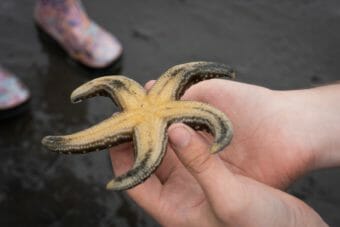
Hands holding a sea star upside-down
A sea star at Bishop’s Beach. (Photo by Hope McKenney/KBBI)

Soon-to-be seven-year-old Isa Santiago splashed through a tide pool at Bishop’s Beach Friday morning. She shrieked excitedly when she spotted a dark pink sea star glued to the rocks, surrounded by dark gray and green stars.

Isa and her family made the four-and-a-half-hour drive from their home in Eagle River to tidepool during one of the lowest tides of the year in Homer. Her mom, Kyra Santiago, said she started planning the trip nine months ago.

“I looked at tide charts months in advance to be able to book Airbnb [and] make sure we got here on the lowest tide possible of the season,” she said.

Friday’s tide was especially low, at –5.3 feet, only topped by a low of -5.6 in June. Homer only sees tides this low a few times a year.
People walking towards the water at a very low tide
Dozens of tourists and locals headed to the tide pools on Bishop’s Beach.

Biologists like Katey Shedden say it’s a great time to see critters who live at the bottom of the ocean, where they might normally be hidden under 25 feet of water.

Shedden is an environmental educator at the Alaska Maritime National Wildlife Refuge, which put on last week’s tidepooling events.

On Friday, she led a group of bundled up kids and adults along the long, sandy beach to the intertidal zone — where the sand meets the sea — to look for critters.

The first lesson: Be aware of where you’re going and respect the fragile ecosystem.

“Our main thing we want to pay attention to is where our feet are,” Shedden told the group. “There are lots of critters like anemones and even nudibranchs and sea cucumbers that have really soft bodies that would not be able to survive if you step on them. So it’s really important to pay attention to where your feet are going.”

The colorful starfish and anemones were the biggest hits Friday. One member of the group said they even spotted an octopus.

A woman in an orange safety vest holding a crab
Katey Shedden shows a crab to tidepoolers on Friday. (Photo by Hope McKenney/KBBI)

Chad and Pam Landes were visiting from Topeka, Kansas. Friday was their first time tidepooling.

“There’s no tide in Kansas,” Chad said, chuckling.

The couple was sloshing through the tide pools in tennis shoes — feet wet, but faces sporting big grins.

Chad said he liked the starfish, but didn’t want to touch any of them.

“I didn’t mess with it. I’m not as curious as my wife,” he said.

Pam, on the other hand, snapped photos of starfish and picked one up, using what Shedden called the “three-finger technique.” With her thumb, pointer and middle finger, Pam gently grabbed a star and tried to lift it from the sand.

The star resisted, she left it alone. But its neighbor was less resistant, gently releasing from the seafloor when Pam bent to pick it up.

“I’ve only seen them in aquariums,” Pam said. “To actually be walking out here and seeing it firsthand and exploring this whole area is just amazing. It’s so much fun.”

A group of people on a beach looking at a cluster of rocks
Payton Tobin talks to the Santiago Family about various sea critters. (Photo by Hope McKenney/KBBI)

Payton Tobin, a Youth Conservation Corps member, is interning with the Wildlife Refuge for the summer. He tagged along with the visitors, pointing out various sea critters and listing off facts about them.

“I’ve just been helping look around, see if I can find anything interesting to show the people, answering any questions they may have and giving some fun information about the critters,” he said.

Tobin’s studying computers at the University of Alaska Fairbanks. But he has tidepooling in his blood: his mom, Debbie Boege-Tobin, is the marine biology professor at the college in Homer.

His favorite, like many of the other adults at the event, was the somewhat rare six-rayed sea star. He said sea stars are fascinating because they can regenerate their arms and grow back from almost nothing after being attacked by a predator.

But Shedden, the environmental educator leading the outing, said while sea stars are cool, don’t overlook the barnacles.

“They’re so hardcore,” she said. “They are the toughest of the critters and they’re everywhere. “

For the first part of their lifecycles, she said, barnacles float through the water, looking for spots to anchor down. When they do, they hunker down in their little shells and send their feet out to collect food.

Barnacles are usually hidden beneath the sea in the intertidal zone or found covering rocks, pilings and buoys. Shedden said when the tide pulls back, tidepooling is a great chance to explore and see them up close.

“They’re so cool. I’m stoked on barnacles,” she said.

Isa Santiago holds a sea star while tidepooling at Bishop’s Beach in Homer on Friday. (Photo by Hope McKenney/KUCB)

For Isa Santiago and her 13-year-old brother Lucas, Friday was all about another critter altogether. Isa said she liked the pink starfish – pink is her favorite color – but it was the anemones that felt like “gooey soap” that caught her attention.

Lucas concurred.

“They’re like a big blob – or they could be small – with tentacles coming out of the top,” he said. “Sometimes, when you poke the base of it, the tentacles go back inside. But if you touch the tentacles part, you may feel a little suction, because it sticks on to you.”

Lucas said he thinks it’s “pretty cool” that when a little fish or other creature swims through the water next to an anemone, the anemone will shock it, pull it in and eat it. He said he definitely wants to go tidepooling again.

And that’s exactly what Kyra Santiago, Lucas’ mom, hoped her kids would say.

“This is great to be able to just see living creatures in their own habitat and learn the etiquette of how to treat the sea and [about] conservation efforts,” she said. “These are all the kinds of things I want our kids to be able to grow up with and see.”

Alaska SeaLife Center takes in 2 abandoned harbor seal pups

Wildlife rehabbers handling a harbor seal pup
The Alaska SeaLife Center Wildlife Response Program admitted the first two harbor seal pup patients of the summer on June 2, 2022. (Photo courtesy of Kaiti Grant/Alaska SeaLife Center)

The Alaska SeaLife Center in Seward admitted two abandoned harbor seal pups earlier this month after they were found on a beach in Kasilof.

Officials say the pups have been growing and eating in the center’s care, and vets hope to release them back to the ocean soon.

The wildlife response team at the SeaLife Center got a call in early June from a fisherman who spotted a skinny baby harbor seal on the beach.

“It just so happens that when he was talking to us about that pup, another pup came out of the water nearby,” said Jane Belovarac, the wildlife response curator at the center, which rescues and rehabilitates marine mammals like harbor seals.

Wildlife rehabbers handling a harbor seal pup
The Alaska SeaLife Center Wildlife Response Program admitted the first two harbor seal pup patients of the summer on June 2, 2022. (Photo courtesy of Kaiti Grant/Alaska SeaLife Center)

Belovarac said photos of the two pups showed they were emaciated and still had their umbilical cords attached.

Because there was no adult seal around, the center went ahead and got authorization from the National Oceanic and Atmospheric Association to bring the newborn pups into the rehab center for care, she said.

“I’d say 95% of the time we never know what happens to the mom when we have a pup that’s by itself,” Belovarac said. “We try to give a certain amount of time, depending on the species, for the mom to reunite with the pups, but sometimes if there’s danger to the pup or there’s danger of public interacting with the pup, and the pup definitely needs help, we’ll bring it in. But ideally, we try to give the pup time to reunite with its mom.”

Belovarac said that’s because often, as pups get older, seal moms might leave them on the beach or in the water to go hunting before coming back for them.

Wildlife rehabbers handling a harbor seal pup
The Alaska SeaLife Center Wildlife Response Program admitted the first two harbor seal pup patients of the summer on June 2, 2022. (Photo courtesy of Kaiti Grant/Alaska SeaLife Center)

“So that’s why when we have people who say they have an animal on the beach, and we establish that it’s a baby, one of the first questions we ask is, ‘Are there any adults in the area? Is there any interference going on?’” she said.

In this case, she said, the first pup — a female who appeared to be just a couple days old — was too skinny, indicating she hadn’t been fed by her mother. And the second one, a male, was brand new and didn’t have an adult in sight.

There are a number of reasons they could have been abandoned, according to Belovarac: The pups could have been separated from their moms or something could have happened to them. Or, she said, the moms could have been young or sick and unable to take care of the babies.

“Most of the time, we never know what was the circumstance that caused the animals to be separated from their mom,” she said.

Harbor seals are common in Southcentral Alaska, Belovarac said, particularly when the salmon start to run. People often see them from the beach or when they’re kayaking.

Harbor seals start to pup in May, and these are the first seals the SeaLife Center has brought in this year. But Belovarac said it’s hard to say how many more abandoned pups they might get.

A harbor seal pup on a blue blanket
The Alaska SeaLife Center Wildlife Response Program admitted the first two harbor seal pup patients of the summer on June 2, 2022. (Photo courtesy of Kaiti Grant/Alaska SeaLife Center)

“Some seasons in rehab, we’ve only had like two seals, and other seasons, we’ve had like 16 seals.” she said. “So it’s definitely common for us to get at least a couple of orphans every year. But how many we get is just the luck of the draw.”

She said the SeaLife Center plans to release the two baby harbor seals back into the ocean, but they first have to meet certain weight and maturity requirements from NOAA.
The two rescued in early June are off to a good start at just a few weeks old, she said, with the male pup having eaten his first fish all on his own on Thursday.

“Usually by the end of the summer, they meet all those milestones, and we can let them go back into their home in the ocean,” Belovarac said.

For now, they’re in two separate pools at the SeaLife Center. But she said they’ll soon be in a pool together where they’ll learn to compete and hunt for fish.

The rehab area is off limits to the public so the animals don’t get used to people, she said. But people can get updates on the pups by following the Alaska SeaLife Center’s Facebook or Instagram page.

Kenai community remembers longtime pilot killed in plane crash

Greg Bell, who was 57, was a co-owner of High Adventure Air, a lifelong Soldotna resident. (High Adventure Air Charter)

The central Kenai Peninsula community was shocked on Friday when two small planes collided above Soldotna, killing all seven people aboard.

The crash happened around 8:30 a.m., when a de Havilland Beaver from High Adventure Air Charter on Longmere Lake collided midair with a Piper PA-12 piloted by state Rep. Gary Knopp of Kenai. Both planes came down around Mayoni Street, just east of town.

It’s still not clear what happened. The National Transportation Safety Board is investigating. And the community is mourning the loss.

The pilot of the de Havilland Beaver was 57-year-old Greg Bell. Bell was a lifelong Soldotna resident, a longtime pilot and co-owner of High Adventure Air Charter.

Friends, colleagues and clients remembered him as a cheerful, skilled pilot and a man of faith.

“He was very, very conscientious, very personable,” said Gary Fandrei, of Kenai. “He was always aware of what other people’s need were, always wanted to make everyone comfortable.”

Fandrei took over at Cook Inlet Aquaculture Association, a nonprofit that works to protect and enhance salmon stocks, in the early 1990s. Back then, he said he flew with Bell and his brother Mark almost daily.

Fandrei said Bell was a leader in his family and business.

“I think Greg is going to be missed not only by the family and the community as well,” he said. “It’s unfortunate that this is the way things worked out for him. I wish the family the best of luck.”

Bell was born and raised in Alaska, and the charter business was a family endeavor.

Over the decades, the company grew. It now employs nine guides and multiple office staff and pilots.

In addition to the bear viewing, transportation and fishing charters, Bell also regularly worked with agencies like the Alaska Department of Fish and Game and Cook Inlet Aquaculture.

Sen. Peter Micciche of Soldotna remembered Bell’s dedication to safety and getting the job done.

On a trip to the west side of the inlet several years ago, Micciche said, Bell was supposed to pick him up, but the wind kicked up. Just as they thought they’d have to wait out the weather, they heard a boat motor coming down the river.

“After a little while we hear a little engine, look over and it’s Greg in a skiff,” he said. “That’s the kind of pilot he was. We all froze to death going back, but he didn’t want to leave us another night in that weather, and he wouldn’t consider taking off in the crosswinds on the river, so he took us all the way up the river to the lake where they had some other assets.

“So you just always knew you were in the best of hands — he would take no chances, he was a gentleman,” Micciche said.

He said Bell’s faith was strong and evident, describing him as a “perfect Christian gentleman,” but he added that didn’t stop Bell from being an excellent hockey player,

Micciche said Bell will be missed by the community, and he urged locals to support his family in every way they can.

“I ask the community to please do what they can to support the Bell family. His wife and everyone at High Adventure Air are going through a very tough time,” he said. “I think if they hear of opportunities to support them, do so, and obviously as well as Rep. Knopp’s family. But it’s a tough time for them.”

Bell was flying with five passengers: David Rogers, a guide, and four visitors from South Carolina. Caleb Hulsey, Heather Hulsey, Mackay Hulsey and Kirsten Wright were all in their 20s.

Tributes on social media from various community members, lawmakers and past clients offered prayers and condolences to the families involved.

The investigation into the cause of the crash continues. The NTSB reportedly went to the scene to collect the parts of the planes and will continue to investigate.

Alaska Department of Public Safety Commissioner Amanda Price offered her condolences to everyone who lost a loved one in the crash Friday, calling it an unfathomable tragedy.

A blind man’s complaint over voting accessibility prompted Kenai Peninsula election changes. But are they enough?

This phot shows the touchscreen of a Diebold voting machine.
The city of Homer’s ADA-compliant touchscreen voting machine. The Kenai Peninsula Borough does not have any similar equipment to help people with disabilities vote. (Photo by Renee Gross/KBBI)

Voting in the Kenai Peninsula may look different next year.

The borough was forced to rethink its election process after a blind person couldn’t vote. But the man who made the complaint worries whether enough changes will be made to make voting fully accessible.

When Rick Malley went to vote in a 2015 local election, he assumed it would be easy.

“I didn’t want to have to do a bunch of paperwork,” he said. “I didn’t want to have to argue with people about my access to voting. I just wanted to vote.”

Malley is visually impaired, and when the former Homer resident went to city hall, there weren’t any voting machines that could help him cast his ballot. None of them could read him the information through a headset.

Someone offered to assist by reading the ballot to him. But Malley declined, saying it was his right to vote independently. Malley never voted. Instead, he filed a complaint with the Alaska State Commission for Human Rights.

“It was my right,” he said. “I’m a veteran. I served my country. I have the right to vote, and it’s not something I’m going to give up easily.”

The commission for human rights found the Kenai Peninsula Borough to be significantly discriminatory toward people who are visually impaired and ordered the borough to fix the problem.

The borough formed a stakeholder group that came out with recommendations to make voting more accessible. Their advice: move to a vote-by-mail hybrid system. In this system, every registered voter would be mailed a ballot a few weeks before the election.

The group also recommended having at least five locations throughout the borough with accessible voting machines. Those will open two weeks prior to the election.

But Malley was disappointed with these recommendations.

“Well, I think every town should have accessible voting,” he said. “It shouldn’t be five communities in all the communities in the borough.”

There are 28 precincts in the borough. Some already have a vote-by-mail hybrid structure.

But Malley said finding transportation can be difficult for people with disabilities, especially in places like the Kenai Peninsula. Many areas have few, if any, public transportation options. And Malley said voting by mail doesn’t work for everyone.

“People who are dyslexic or visually impaired or just elderly and (don’t have) very good vision,” he said.

Johni Blankenship is the borough’s clerk. She provided support to the stakeholder group and said there’s a reason behind the vote-by-mail hybrid system: Voting machines that are compliant with the Americans with Disabilities Act are expensive.

“If we stay with this process, the way we currently do it, we would have to buy the ADA-compliant equipment for every single polling location,” she said. “If we go to a by-mail hybrid, we only have to buy the ADA-compliant equipment for the five vote centers. So there is a huge capital cost difference.”

Once the borough staff proposes new legislation based on the stakeholder group’s recommendation, it still needs to go to the borough assembly for approval.

The commission gave the borough a timeline to make voting more accessible. By mid-December, the borough must start implementing a new system.

Joyanna Geisler is the executive director of the Independent Living Center in Homer and was part of the stakeholders group.  She said the voting-by-mail system could make a huge difference for residents.

“For example, wheelchair users in an inaccessible voting precinct — I’ve heard complaints about that,” she said.

Geisler said this stops people from voting.

“Some people just stay away and don’t even bother because it’s too difficult,” she said. “And after a while it gets old, asking for help and asking for assistance, especially for a civil right.”

As for Malley, he now lives in the Boston area, where he said there’s always an accessible voting machine during elections.

But four years after he made his complaint, he still cares about what happens on the peninsula. He said he plans to call the commission to negotiate more locations with accessible voting machines.

“Maybe we’ll get something different or maybe something a little bit more. More communities or something like that,” he said.

But he said he’s not surprised by the group’s recommendations.

“Civil rights for people with disabilities is only guaranteed not by the Constitution, not by the courts, but by the amount of money it costs,” he argued.

Site notifications
Update notification options
Subscribe to notifications