KBBI is our partner station in Homer. KTOO collaborates with partners across the state to cover important news and to share stories with our audiences.

Halibut Cove on Aug. 30, 2022. (Hope McKenney/KBBI)
A Halibut Cove woman faces federal charges related to an incident involving a floatplane and boat last summer.
Marian Tillion Beck — the owner of The Saltry Restaurant in Halibut Cove — was indicted by a federal grand jury last week on counts of attempted destruction of aircraft and gross negligent operation of a vessel.
A video from Aug. 23, 2022 shows an aluminum boat circling a 1955 de Havilland Beaver as the wake rocks the small aircraft as it tries to leave the cove. (Reddit video screengrab)
A video from Aug. 23 shows an aluminum boat circling a 1955 de Havilland Beaver as the wake rocks the small aircraft as it tries to leave the cove. The floatplane was taxiing back into the bay with the pilot, Eric Lee, and seven passengers on board.
Beck can’t be readily seen driving the boat in the video, but people can be heard asking her what she’s doing. The video has 360 comments on Reddit.
The plane’s pilot, Eric Lee, is owner of Alaska Ultimate Safaris out of Homer, which takes visitors on bear viewing tours. He told the Anchorage Daily News back in August he was taking a group of people on a sightseeing tour of Katmai National Park that day when Beck’s boat headed “straight at” him.
The indictment contains very few details about the case. Beck and Lee could not be reached by phone Friday.
Save-U-More’s two main egg suppliers are Costco and SuperValu. Both companies primarily source their eggs from Washington State, which saw an uptick in highly pathogenic avian flu cases in December and January, straining supply chains. (Sean McDermott/KBBI)
Last week, the refrigerated egg section of Homer’s Save-U-More grocery store was lit, but completely bare. Sitting in the deli, manager Mark Hemstreet described a situation that is becoming familiar around Alaska — there simply aren’t any eggs. It’s the result of a nationwide outbreak of avian influenza.
Cases began surfacing in the United States in March of last year, and have since impacted nearly every state. Over 52 million domestic birds have died or been culled to try and stem the spread of this highly contagious strain, known as H5N1.
There are many different strains of avian influenza, which experts categorize as either low or highly pathogenic, reflecting the severity of symptoms. A low pathogenic avian flu virus generally causes mild to no symptoms, while highly pathogenic strains can cause severe illness and death — especially in domestic poultry.
Hemstreet said Save-U-More’s two main egg suppliers are Costco and SuperValu. Both companies primarily source their eggs from Washington State, which saw an uptick in highly pathogenic avian flu cases in December and January, straining supply chains. The disease has impacted both small backyard flocks and commercial-scale operations like Oakdell Egg Farms, which recently had to cull more than a million birds.
Like many stores around Alaska, Costco has restricted the number of eggs shoppers can purchase — when they are even available to purchase. Hemstreet said Save-U-More can only buy a limited number of cartons, same as any other customer.
“We used to get about a pallet, four or five feet high, of eggs three times a week. And now [all] they’ll give us — if they’re available — is two packages of each variety,” he said.
When they are able to order eggs, Hemstreet said the costs have gone up too. “The SuperValu supplier has increased their costs, so we’ve had to match it here.”
Amber Betts, spokesperson for the Washington State Department of Agriculture, said farmers have learned a lot since the 2014-2015 outbreak of avian flu, the last major epidemic in American poultry. Betts said those cases were often sparked by contaminated equipment or people moving between infected farms.
This time, the main way the H5N1 virus is spreading in Washington is through interactions with wild birds, which can carry the virus without showing symptoms. That makes the disease incredibly hard to control, Betts said.
Currently, Washington is reporting new incidents every couple of weeks, down from several a day at its peak last summer. But that offers little consolation for those who have had to euthanize their flocks.
“It’s devastating, just all around. It’s devastating for the flock owners, it’s devastating for our veterinarians, and it’s just a taxing virus for everyone, including the bird,” Betts said.
One of the best ways to protect birds is to keep them indoors, which can be a costly challenge for farmers, and uncomfortable for the poultry. H5N1 is highly contagious, and can spread through exposure to infected surfaces, as well as through things like ponds and food sources that might be shared with wild bird species.
That has major implications for Alaska. State Veterinarian Bob Gerlach said that there have only been five flocks reported as infected so far, but added that this is “probably a long-term problem that we’re going to be dealing with.”
With the seasonal migration of millions of wild birds just around the corner, Gerlach said a collaboration of state and federal agencies are watching to see how avian influenza is behaving in the Lower 48 and South America.
“There’s a lot of these high pathogen influenzas out there,” Gerlach said. “Wild birds are just one of the transport mechanisms, and they’re the ones that we don’t have any control of.”
While Alaskan poultry haven’t been hit hard yet, the state has tracked infections and mortality in shorebirds and raptors from the Southeast to the North Slope. Birds are more susceptible to avian influenza when under strain from other factors. Climate change is altering the timing of food availability for some migrating birds, making understanding environmental stressors along their difficult journeys even more important.
Avian flu is just one pathogen that migrating birds can carry, and a warming Arctic is increasing the risk that other parasites, like Asian longhorn and moose winter ticks, could find a hold in Alaska, Gerlach added.
“The health of the animal can impact the health of the environment, and the health of the environment and the animal can impact public health. So it’s all interconnected,” he said.
The idea is slowly taking hold that scientific research should look at the impacts of specific events — like outbreaks of avian flu — on an ecosystem-level.
Falk Huettmann, professor of wildlife ecology at the University of Alaska Fairbanks, said a big-picture approach is an absolute necessity. In his opinion, focusing primarily on mortality in poultry leaves glaring gaps in understanding how and why avian flu outbreaks occur.
“You need ecological perspectives and [to] include climate change in this,” he said. Without that, you’re missing 80% of the avian influenza picture, he added.
Since wild birds can carry multiple pathogens without necessarily showing symptoms, Huettmann said that it’s incredibly difficult to pinpoint or forecast how strains of avian flu may mutate or become highly pathogenic.
“In terms of these mutations, nobody knows when they happen. It’s like a time bomb,” Huettmann said.
He explained that even seemingly unrelated things like stress from climate change or environmental contamination like heavy metals could alter how seriously avian flu impacts birds.
Even the term “avian flu” is an oversimplification for a disease that can infect many different species, he said. Researchers, for example, have found low pathogenic avian influenza in animals ranging from farmyard horses and pigs to seals and whales. In Alaska and Montana, even bears have recently tested positive for H5N1.
That jump into mammals is something researchers are paying close attention to. In early January, a European study found a slightly mutated strain of H5N1 on a mink farm in Spain, which researchers suspect came from interactions with wild birds. World virologists are concerned because the virus has acquired a novel mutation that allows it to readily spread from mammal to mammal. This mutation is a concerning change because it makes it more likely that human to human transmission could occur in the future.
With migratory birds winging their way to Alaska from all over the world this spring, State Veterinarian Bob Gerlach said it’s important for people to be cognizant of avian influenza. Hunters and wildlife enthusiasts can report strange bird behavior or dead birds to U.S. Fish and Wildlife. People with poultry should be conscious of keeping feed and water sources inside, and keeping up with notifications from the state.
Gerlach cautioned Alaskans, especially those with poultry, against letting their guard down.
“We know from looking at the wild bird populations that it’s not over. And it seems that there’s going to be a risk come spring,” he said.
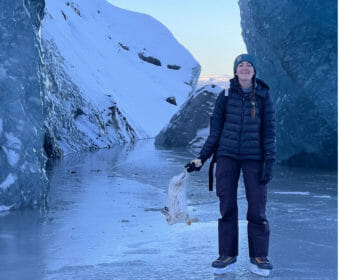
Kelsey Haas poses with the snowshoe hare at Grewingk Glacier on Nov. 26, 2022. (Courtesy of Kelsey Haas)
When Homer resident Kelsey Haas fell into an open patch of icy water earlier this winter, she didn’t panic. It was her first time falling through ice, but as a guide and avid adventurer, Haas did know a few techniques for getting out of frozen water.
None of those techniques involved the carcass of a snowshoe hare.
It was late November. Haas was skating to the Grewingk Glacier with a group of about a dozen others. The massive, 13-mile-long glacier has become a popular destination in Kachemak Bay State Park, especially in winter. After a boat ride from Homer, it’s about a two-mile trek, partly over a frozen lake, to get there.
The 29-year-old hiking and rafting guide had been there many times before, in warm and winter months, and her friends were also experienced adventurers. They had throw ropes and rescue gear in tow, and they were testing the thickness of the ice with ice screws.
While she was exploring around the glacier, Haas found the carcass of a snowshoe hare on the ice. She thought it was kind of mysterious.
“It wasn’t warm, it wasn’t super stiff, but it wasn’t like I wanted to eat it because I don’t know how it died,” she said. “It was interesting. There were no puncture wounds.”
Haas decided to hold onto the carcass. She wanted to take it home to skin it and save the fur.
Later, as the sun was about to set, Haas and her friends discovered an ice formation that Haas described as a “perfectly picturesque arch, right in the middle of an iceberg.”
“We all knew it was really thin ice and that it wouldn’t be a good idea,” Haas said.
But the arch was too beautiful and tempting, and she wanted to skate through it.
If anything did happen, Haas figured there was a trained group of well-equipped people who could help. And she had extra warm clothes in her backpack. So she tempted fate and skated through the arch as fast as she could.
Instead of thin ice, she found an open hole.
Haas said her instincts kicked in after she fell in the water. Instantly cold, she knew she had to go back the way she had come, toward where the ice was at least somewhat stable. She also knew that she had to position her body horizontally to pull herself out of the water.
A dry bag she carried on her back had air inside, which helped keep her afloat. And she still had the dead hare.
“I don’t know how I didn’t let that go,” she said.
When she reached the edge, she slapped the hare forward onto a shelf of ice. The wet carcass quickly froze onto the cold surface. Haas said she used the frozen snowshoe hare like an anchor to pull herself out of the icy water.
She was out before her friends could help.
“I just looked at them, and I was like, ‘I just have to skate as fast as possible and work my body temperature back up.’”
Once she made it back to shore, there was a group waiting for her.
“It was like a pit crew, like everyone just swarmed me,” she said. “[They] took off all my clothes. I looked like a giant marshmallow.”
Haas said one of the biggest struggles was taking her ice skates off because the laces were frozen solid. She remembered three people tugging on each skate, struggling to remove them. After she was able to get her skates off, she still had a mile and a half hike to the water taxi.
“My coldest thing was my feet,” Haas said. “On the hike back, my feet were definitely pretty numb the whole way.”
While Haas said she was able to laugh about the situation immediately afterward, she said it definitely affected her days later.
“Anytime I close my eyes, I kind of have a flashback,” she said. “I didn’t sleep for a couple of days. And that’s when I realized like, ‘Okay, this was probably more traumatic than I thought at the time.’”
Haas said the most important thing is to be aware of your personal safety while exploring places like Grewingk Glacier.
“It’s so important to recognize that level of risk,” she said. “Always have dry clothes, always use a dry bag, have a throw rope, have all the things you need to get people out of that ice, and just do it really safely.”
And as for the snowshoe hare that Haas used to pull herself out of the icy water?
“I want to make slippers,” she said. “Definitely want to make slippers out of it.”
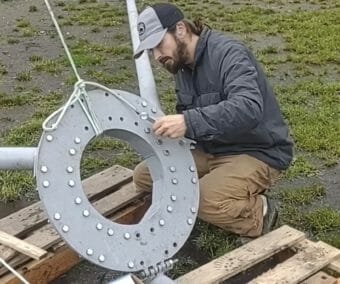
Lucas Wilcox assembles a tent frame in Lviv, Ukraine on Oct. 4, 2022. (Courtesy Lucas Wilcox)
Last spring, when many Ukrainians were leaving the country, Lucas Wilcox was on his way in. Russia had invaded eastern Ukraine two months earlier. It was mid-April and the 40-year-old Homer resident was on a train traveling from Poland to the western Ukrainian city of Lviv. Wilcox was traveling into the country with a mission: to build large, off-grid kitchens to feed people who had fled their homes.
“The conductor comes through and whispers something urgently to each one of the cars,” Wilcox said. “Everybody turns off the lights and closes the blinds and sits quietly. And then all of a sudden, it is absolutely pitch black and completely silent.
For two hours, Wilcox and the other passengers remained quiet in the dark, before the train reached the Lviv station.
It was Wilcox’s first time in Ukraine, and he didn’t know anyone and didn’t speak the language.
While, depending on your perspective, it may seem brave or foolish to be traveling into a war-zone, this is kind of what Wilcox does.
His non-profit organization, Altruist Relief Kitchen, or ARK, works with displaced people, from refugees in Tijuana to Syrians in Lesvos and Texans after Hurricane Harvey.
The idea for the organization came to Wilcox more than a decade ago while he was a student at Kachemak Bay Campus in Homer. ARK’s goal, Wilcox said, is to provide large amounts of food and supplies in off-grid areas that might not have access to fuel or running water during hard times, and to be adaptable to a variety of scenarios. He began developing the concept while witnessing tumultuous events happening worldwide.
“The financial crisis and the Arab Spring and Occupy [Wall Street] all happened during that time,” he said. “I really focused my attention on making an aid organization that would be able to respond to many different kinds of events.”
Wilcox said another one of his goals is to make the organization, as he described it, “radically transparent.” He said he’s skeptical of how other aid organizations may use their funding, and he wanted to change the model. He posts all of ARK’s receipts on its website, and the organization recently received 501(c)(3) non-profit status.
Now ARK has grown to a handful of dedicated volunteers who work across the United States. Wilcox said his current role in the organization is mostly to help engineer and build structures versatile enough to be mobile, yet big enough to accommodate large groups of people.
The field kitchen he helped set up in Ukraine, for example, looks like a giant tent. The structure is over 1,300 square feet — large enough to fit a school bus inside.
Many of the materials used to build the structure were salvaged, Wilcox added.
“The tent is made out of recycled drilling equipment, the stoves are made out of recycled steel barrels, the pots are made out of stainless steel kegs,” he said.
What wasn’t able to be salvaged was purchased in or around Lviv, and the building of the structure was mostly handled by Ukrainians who fled the war or live in affected regions. Wilcox said they are paid a “survival wage” of around $25 a day. The goal, according to Wilcox, is to bring and keep money in the area.
“The whole thing is manufactured in Ukraine with local materials,” he said. “All of the money that we’re spending on this project is going completely to Ukraine.”
Inside ARK’s tent in Lviv, six wood stoves meet in the middle at one large stack, which serves as both a heat source and a means of cooking. He said the kitchen can make 75 to 100 gallons of food at one time, or 30,000 to 50,000 meals a month.
The kitchen, which Wilcox said is the first of many, is situated on the grounds of a Catholic church which is being used to temporarily house people who have fled their homes. Although missiles can be heard in many of Wilcox’s self-produced videos, he said the site of the kitchen is relatively safe.
“Even though there is a bit of an incessant rain of missiles on the country, they’re really targeting infrastructure, primarily energy, and now healthcare infrastructure, bridges and rail stations and things like that,” Wilcox said. “But there’s a reasonably low likelihood of a stray missile hitting just a church on the outskirts of a city.”
Wilcox’s visa expired in October so he’s currently in Homer, but he plans to head back to Ukraine later this month. He said this winter, his work is more important than ever.
“It’s a country of 40 million people. And something like 10 million of them now are either internally displaced or leaving the country,” Wilcox said. “That number is certainly going to grow through the winter as the energy infrastructure is continuously taken out.”
Wilcox said the ARK kitchen will begin serving meals in Ukraine “any day now.”
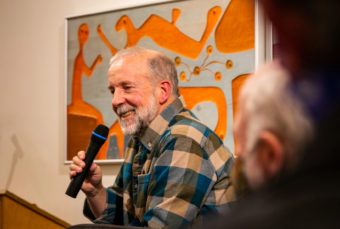
Tom Kizzia at Homer’s Pratt Museum in fall of 2021. (Photo courtesy of Jeremy Pataky/Porphyry Press)
A Homer local has been named 2022 historian of the year by the Alaska Historical Society.
Tom Kizzia is a journalist and author who came to the Kenai Peninsula nearly five decades ago. He spent three years with the Homer News in the late 1970s before moving to the Anchorage Daily News, where he worked for 25 years.
Kizzia’s award, formally known as the James H. Ducker Historian of the Year Award, is named for longtime Alaska professor James Ducker, who served for 30 years as editor of the Alaska Historical Society’s journal, Alaska History.
KBBI’s Hope McKenney sat down with Kizzia on Tuesday to discuss his writing, his inspiration and what’s next.
Listen:
Tom Kizzia: One of the things that made Alaska really exciting to me, right out of college where I was kind of an American studies, history and American literature-type major, was that everything was so new and fresh, and all these big decisions were being made that had been made in other states. It seemed like if I was a reporter in another state, I would be in a pack of journalists trying to cover some incremental decisions. And up here, huge decisions were being made, and there were no other reporters around to write about it. So I really felt like it was a historical moment that I was writing about. And it was with a kind of sense of this sweep of history that I was watching — Native land claims and building the pipeline and creating all the national parks up here. All those things that were happening in the ‘70s when I got here. It was a really exciting time, creating the Permanent Fund, limited entry, huge decisions, and it felt like history was being shaped.
And so, you know, there’s that cliche about journalism, that it’s the first rough draft of history. I really felt like I was almost writing as a historian, or providing information to future historians. So I always had that interest. And then, over time, as I began to realize, even though it’s a new state, it has a rich and deep past, and I would find stories within that past to start telling. So as I looked around for good stories to tell, some of them were in the past. And those were the ones I enjoyed digging out and had the indulgence of the newspapers to let me do that.
Hope McKenney: So you just received the 2022 Historian of the Year Award from the Alaska Historical Society. Why did you receive this award? Tell me a little bit about “Cold Mountain Path,” and also your Alaska journalism that led to this moment?
Tom Kizzia: Well, you know, my previous book was the one about the Pilgrim family, “Pilgrim’s Wilderness.” And it was set in McCarthy, in the early years of this century. And I had included a couple of chapters about how we got to that point in McCarthy, kind of the ghost town decades, that made my first draft of that book, and my editor in New York thought that it was slowing down the momentum of the family story, which was kind of a page-turner. And so they had me boil that down to a page or two. So I pulled that information out, I kind of wanted to find a home for it. And when I read from those deleted chapters out in McCarthy, when I had a public reading, everyone wanted to know more. So I set out to do a second book just about those ghost town years. And that was the origin of the “Cold Mountain Path” project. And it got to be a bigger project than I expected. But it was, you know, a local history, but it was a locality that had all these sort of mythic overtones, and so I tried to get some of that in the book as well. And it’s just been really great.
You know, we just published it last year, it was published by Porphyry Press, which is an Alaska publisher, who was just getting started out there. And the reception has been great. And I think the book seemed to capture for people something about the old Alaska that’s passing in our own memory. And one of the reasons I was drawn to the story was because it was recent enough history that I could still interview people and sort of use my journalistic techniques to write about history. I didn’t have the secondary sources that one usually has, I was kind of digging it all up myself. That was great, great fun and a great challenge.
Hope McKenney: And I’d like hearing you talk a little bit about your work as a reporter. I mean, you’re such a figure in this state. Your journalism spans nearly five decades at this point. I mean, how does your work as a reporter, as a journalist, inform this historical writing?
Tom Kizzia: I don’t know. I think one way is that I had developed as a journalist a sense of storytelling, and trying to find stories that would have a kind of, you know, their own page turning drama, or at least stories that would carry you down the column inch of the newspaper page. And I wanted to then take that storytelling quality and apply it to the history. So kind of a narrative history as opposed to something that was sort of a dry collection of facts.
Hope McKenney: And so, you have nearly five decades of being a journalist in this state. You’ve written three books, you’ve now received the historian of the year award. What’s next for you?
Tom Kizzia: What does it all mean? I don’t know. I’ve got a lot of things I want to write. And so a lot of things that I still want to write and I’ll do the best I can to get those things done. But I don’t have any grand plan at this point. You know, I think when I came up here to work at the Homer News, I thought I was going to write the great American novel. And I don’t feel a great compulsion to attempt that at this point. But maybe I’ll surprise everybody or surprise myself and head in that direction.
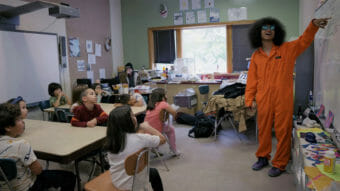
Last month, Arias Hoyle and a videographer out of Anchorage traveled across Kachemak Bay to capture videos of K-12 students in the small community of Nanwalek. (Photo courtesy of Arias Hoyle)
Juneau-based Lingít artist Arias Hoyle released a music video Friday featuring students from Nanwalek — a predominantly Sugpiaq/Alutiiq village on the southwestern tip of the Kenai Peninsula that is only accessible by air and water.
Hoyle, a hip-hop recording artist known by his stage name Air Jazz, traveled to the community to film the video in September as part of a residency with the Bunnell Street Arts Center in Homer.
Hoyle became involved with the arts center back in 2019, shortly before the onset of the COVID-19 pandemic. He recently produced an album entitled “Last Chance Chilkat” on behalf of the first peoples of Alaska.
“I often combine my Indigenous language, the Lingít from my people, with rap and hip-hop music,” Hoyle said. “I really like to do projects that are inclusive of Indigenous people, especially around Alaska. And I really like to manifest both my Lingít side and my African-American side into music. Essentially, I make Afro-Indigenous hip-hop.”
Hoyle performed in Nanwalek three years ago, as the community was experiencing a severe drought. Nanwalek got only a fraction of its normal rainfall, so local officials shut off water for 12 hours every night and the state issued a boil water notice.
Asia Freeman, artistic director at the Bunnell Street Arts Center, said Hoyle asked if he could teach his song “You’re The North Star” through an Artists in Schools program, which places professional artists in K-12 classrooms throughout the Kenai Peninsula School District.
“A few years back, we had brought Arias with the Indigenous Roadshow to Nanwalek, and the village just adored him and basically invited him back,” she said.
Last month, Hoyle and Hanna Craig, a videographer out of Anchorage, traveled across Kachemak Bay to capture videos of K-12 students in the small community.
“Day by day, we mapped out all of these locations, and all of these sports that we wanted the students to be a part of,” Hoyle said. “Then we rolled the camera, had them do all types of activities at their school, in the middle of class. And we tried to capture as many as possible.”
Hoyle said they wanted to focus on everyday activities in the village during the week he was there, from kids four-wheeling and playing basketball to making arts and crafts.
Hoyle said the song and video are dedicated to Nanwalek. His hope for “You’re The North Star” is to acknowledge and inspire the youth of small villages.
Major efforts to revitalize Indigenous cultures, languages and ways of life have taken root in recent years. Hoyle sees his music as part of that.
“When it comes to music, it’s a more accessible way to revitalize your people, because you’re taking an art style that everyone appreciates, and you’re doing your own Indigenous twist on the music,” he said. “And when it comes to me, representing the Black community as much as the Lingít community, that’s why I chose rap music. I think hip-hop and rap is so expressive, and it’s so fun, yet it still has a lot of representation of who I am. I love to rhyme and I love to sing in my native tongue.”
You can find Hoyle’s music on any of your favorite streaming platforms under the name Air Jazz.
Close
Update notification options
Subscribe to notifications
Subscribe
Get notifications about news related to the topics you care about. You can unsubscribe anytime.