KBBI - Homer

KBBI is our partner station in Homer. KTOO collaborates with partners across the state to cover important news and to share stories with our audiences.
As her Homer neighborhood slides downhill, this woman is fighting to hold someone accountable

Gee Denton is an artist, and her home is full of her work, including a stained glass door. (Photo by Renee Gross/KBBI)

A Homer neighborhood is at risk for a large landslide, and the erosion there has already severely damaged some residents’ homes.

But despite the risk, one homeowner won’t leave her spot.

Gee Denton lives on a coastal bluff downhill from the Sterling Highway. She walked around the back of her house where everything was tilted downward. Plants lean toward the bluff, and garden decorations have been migrating downhill.

“That fern used to be up there,” she said, pointing to a fern that’s drifted toward the edge of her house.

Denton’s house seems to be slowly falling toward the bluff. Her home squeaks and groans. Her windows are cracking, and tiles are popping off her bathroom’s tub.

And when you spill water, “it all runs to a corner. I don’t know if you can tell, but it’s all kind of going in that direction,” she said, pointing to a corner of her home.

Denton claims there’s an array of people to blame for her house moving: the Alaska Department of Transportation and Public Facilities, for installing a drain that pours thousands of gallons of water into the area; the city of Homer, for clear-cutting trees and vegetation; then there’s ENSTAR Natural Gas Company, which also chopped down alders and installed a natural gas line near her home.

Shortly after ENSTAR put the pipeline in, her cabin slid off its foundation and thick mud soup engrossed her house.

“I’m about 5 feet, 8 (inches) tall, and I got stuck in there,” she said.  “I think there’s still a boot down there somewhere. I was pumping a hundred gallons a day of water out of the back here.”

She spent years trying to fix the situation.

But it’s not just her shelter she’s trying to protect — it’s also her work. Denton is an artist, and inside her home she has handcrafted stained glass and intricately tiled tables. Outside, she built a decorated fence. She said she spent more than $100,000 on plants for her garden.

“It’s been a lifelong art endeavor to make it beautiful and plant beautiful gardens and invite people in, and welcome sick people to get well,” she said.

It’s too late to salvage some of her work. She used her cabin next door to store her artwork and antiques, but she said it’s too dangerous to go in there now.

Denton’s fence is tilted and uneven. (Photo by Renee Gross/KBBI)

But she’s not giving up. She takes photos of mudslides, ditches and cut-down trees and puts them into a large, white binder for evidence. She’s attended numerous city council meetings and brought up the issue with countless public officials and ENSTAR representatives.

“I’ve had to spend five-and-a-half years in this season of my life begging for people to be responsible for their responsibilities,” she said.

But she said her pleadings often go ignored, and the entities often blame one another.

The city of Homer sent a letter to the Alaska Department of Transportation, asking them to fix the drainage issue. The state agency sent a letter back, saying that the drainage wasn’t the problem and that the city designed the area all wrong. As for ENSTAR, the company said: Don’t look at us.

This summer, Denton’s attorney wrote a letter implicating all three parties, saying they could be liable in the event of a large landslide or other natural disaster.

But Denton said it seems she has found at least one ally: Homer Mayor Ken Castner.

Denton called the mayor about public works cutting in her neighborhood, and he quickly put an end to the project. He also sponsored a resolution that passed, prohibiting the cutting of trees and vegetation in public right-of-ways until May 2020.

“I’m really sorry,” he said to Denton over the phone. “I’m truly, truly sorry. I’m trying to advocate for community standards to be developed that the community wants, and not be levied upon them by the government.”

A tree near Denton’s home that used to stand upright. (Photo by Renee Gross/KBBI)

The city said it has met with Denton multiple times and has commissioned studies that will help them best address the issue. Also, the city said the public works department has improved the ditches there.

But Denton said their maintenance has only made things worse. And retired geologist Mike McCarthy said it’s not enough.

“The initial development of that property was done in such a way that the roads were not wide enough,” he said. “Drainage was not sufficiently engineered. The drainage is still marginal.”

McCarthy has helped Denton and her neighbors with analysis and advocacy. He said there’s a range of factors — from clear-cutting to climate change — that can put these residents at greater risk of a disaster. He adds that it’s hard to know exactly how big the risk is without a study, but the bottom line is that the soil there is incredibly unstable.

Some residents aren’t holding their breath for change. Denton’s neighbors moved away, citing safety concerns. They had to cable their home to pilings to keep it from falling off the bluff.

Denton said she’s ready to continue their fight against the government and the gas company.

“If I leave, there’s no pressure on them,” she said. “Nobody’s going to pressure them, because nobody’s life is being threatened.”

Denton said she knows some people don’t understand why she stays here. For her, it’s for justice.

“I’m willing to give my life, if I have to slide down this hill and die for something to happen here,” she said.

She argues that for all she’s been through, her ask for the city and state to reimburse her for her property isn’t unreasonable.

‘Pretty much our hometown voice’: Homer residents mourn loss of local newspaper

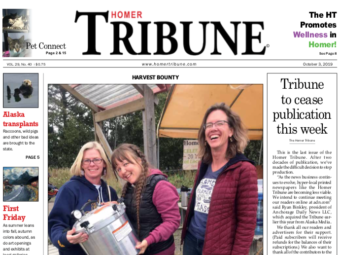
The front page of the Homer Tribune’s final issue. (Image courtesy of the Homer Tribune)

The Homer Tribune, one of the city’s two newspapers, delivered its final edition last week after more than two decades of printing. City residents are mourning its loss.
“It’s all local news,” said resident Lance Prouce while flipping through the last edition. “It’s about the election, the charging station, them stopping (publication). I mean, it’s Bristol Bay fishermen, it’s about fishing. It’s the stuff that affects us right here.”

Prouce was standing inside Captain’s Coffee, a local coffee shop that he owns. He said they sell about 8-10 issues of the paper every week.

He knew that print was struggling, but he was surprised to read that the Tribune was shutting down.

“I think it’s a sad thing,” he said. “This is pretty much our own hometown voice.”

It’s the news that he goes to and that he has a connection with. He said he was about to pitch the paper a story about coffee before it shut down.

He pointed to the picture of the last day of the Homer Farmers Market and said the newspaper’s local coverage was unique.

“I think just like that picture on the front, the gals holding the pressure cooker,” he said. “You’re not going to see those, that’s not going to be in any other paper. That only appeals to us because we live here. That’s the part that’s going to be missing.”

Alaska Media LLC used to own the paper but sold it to Anchorage Daily News LLC earlier this year.

The Tribune announced in its paper last Thursday morning that it was ceasing publication. The announcement said it was a difficult decision.

The article quoted Anchorage Daily News President Ryan Binkley saying “hyper-local printed newspapers like the Homer Tribune are becoming less viable. We intend to continue meeting our readers online at adn.com.”

Binkley did not respond to a request for comment.

Tommy Wells was the editor of the paper. He said he isn’t surprised that the paper was shutting down.

“Advertising revenue for weekly newspapers has been down, not only in Homer but everywhere,” he said. “I think that the powers-that-be above us looked at it, and they made a business decision.”

Wells used to live in Homer but moved to Texas a couple of months ago. He and the director of sales and marketing were the only full-time staff at the publication. But the paper employed numerous local writers.

“We did a great job of covering what we did,” Wells said. “It was just that added feature that you might not get in both papers, but you might find something in one that you liked. I think that’s the biggest thing.”

Last year, the newspaper won first place for best weekly paper at the Alaska Press Club’s annual award ceremony.

“I was proud of every issue in some way,” Wells said. “Some were better than others, but at the same time I think that anytime you can bring the news to the people — and that’s what all of us want to do, whether you’re in the radio business or the newspaper business — you want to get as much news as you can out to the people so they can be informed.”

He said he’s glad the community will still be served by one other newspaper and the local radio station.

Seldovia’s water shortage is over, but plans to avoid another one are just getting going

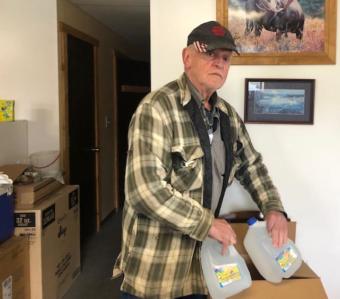
The city of Seldovia provided business owner and city Mayor Dean Lent with jugs of water during a 2019 shortage.
The city of Seldovia provided city Mayor Dean Lent with jugs of water during a 2019 shortage. (Photo by Renee Gross/KBBI)

Seldovia residents can now do a few loads of laundry and shower on a normal schedule. The city on the southern Kenai Peninsula announced last week that there is no longer a water shortage. Now, residents are trying to repair the damage and plan for the future.

Things are getting back to normal for the roughly 500 people who live in the area. Last week, the city’s reservoir returned to a healthy level. The city reinstated senior meals and the library is operating on a regular schedule.

But for some, recovery will take a while.

“So the damage was already done in August when it kind of tanked tourism,” said Jennifer Haerle, owner of the convenience store Owl’s Nest.

Haerle said the fires on the peninsula in addition to the water shortage had a big impact on the store. She had to let go of one of her employees.

“I typically have someone year around, and my hope is to have her back by the middle of October,” she said.

She said she’s hiring the employee back because another one is leaving.

Her business is not the only one that’s been hurt. Steve Bainbridge is a co-owner of the Seldovia Harbor Inn.

“I’m just hoping we do see some room rentals in October, November, December,” he said.

Bainbridge closed down his inn this month, and he shut down his café earlier than usual to conserve water.

He said that a group that made reservations to rent out his entire inn decided to relocate due to the water shortage.

“So that was the short-term, one-two punch: closing the cafe, having the room reservations for that week after Labor Day canceled,” he said.

City officials said the water shortage was a wake-up call. City Manager Cassidi Cameron told KBBI in mid-September that they are working with the Kenai Peninsula Borough on a plan to prevent this from happening in the future.

“There’s the absolute need to do that,” she said. “What those pieces will look like, we’re still identifying.”

But there’s one obvious problem.

“And so we know that there’s leaks in that aging infrastructure,” she said.

The city will have representatives from the Alaska Rural Water Association to check for leaks in their system in late September. And even though the city is out of the woods for now, Cameron still wants residents to make efforts to conserve.

“Just know that water is required for life, but it’s not necessarily a guarantee,” she said.

The city’s neighboring village of Nanwalek is still under a boil-water notice.
Nanwalek is rapidly running out of water

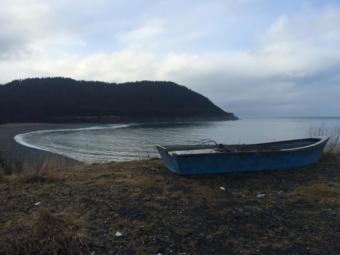
Nanwalek. (Photo by Daysha Eaton/KBBI)

Nanwalek is rapidly running out of water. Low snowpack and little rainfall has led the Kenai Peninsula village to declare a water emergency.

The predominantly Alutiiq village on the southern tip of the Kenai Peninsula is only accessible by air and water.

Priscilla Evans of the Nanwalek IRA Council said the roughly 55 households are getting desperate as the village’s reservoir is poised to run out.

“We never made a plan for this kind of emergency for the water,” she said. “So hopefully the state is going to help us out.”

The village has tried to conserve. Water has been shut off at night. Chugachmiut, a regional nonprofit, and the North Pacific Rim Housing Authority donated roughly 200 cases of water last week.

Evans said a fellow member of the village’s tribal council went looking for an alternative source.

“He found a stream, so he walked up the mountain and rerouted the stream to the dam, and that’s drying up now,” she said.

The village declared a water emergency on Tuesday. But Evans said if there’s no significant rainfall this week, they could be completely dry by this weekend.

“It’s mainly making everybody kind of worried and scared,” she said.

The state has issued a boil water notice.

“I get involved when the water may not be adequately treated,” said Jamie Bjorkman of the Alaska Department of Environmental Conservation in Soldotna. “Knowing that they were having low levels in their water storage tanks means that the water treatment plant and the treatment that they provide to the water may not be a completed process.”

Tribal Administrator Gwen Kvasnikoff said water pressure has been steadily dropping. So far no one has reported getting ill from the alternative sources or low pressure. But she warned that the village is on borrowed time as supplies run low.

“Even the bottled water has been depleted,” she said. “So we do have elders that depend on water with their health issues. And then we have newborn babies here, so we were in need of water very much.”

It’s not the first time Nanwalek has had to ration water. In 2003, the state barged in bottled supplies.­­­­

Alaska’s Division of Homeland Security and Emergency Management said it is closely monitoring the situation. But the state agency was noncommittal about what it plans to do if the village of 250-odd people indeed runs dry.

The agency is also monitoring a similar situation in Chignik Lagoon, a village on the Alaska Peninsula.

Swan Lake Fire takes a toll on Homer businesses

The Swan Lake Fire on Wednesday, June 12, 2019. (Photo courtesy of Kale Casey/Alaska Division of Forestry)

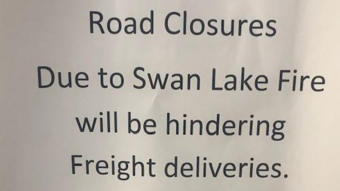
The Swan Lake Fire is causing major delays and closures on the Sterling Highway. And that’s having a big impact on local businesses in Homer, from a loss of tourist dollars to delays in goods.
Mark Hemstreet, the manager of Save-U-More in Homer, said the grocery store did not have a good week last week.

“Deliveries were definitely at least one day and sometimes two days behind, so we ran short on some of the perishable items like bread, milk and eggs,” he said.

He said the store began ordering more key items and is now in pretty good shape in terms of inventory. But shipments are still behind.

“This week, so far, our truck for Monday night delivery didn’t arrive till this morning Tuesday,” he said. “So we’re about a day behind on our stocking for our major shipment this week so far.”

Road closures and delays on the Sterling Highway are impacting companies across the Kenai Peninsula. Gary Stroh is the general manager for Country Foods IGA in Kenai. It’s a grocery store that supplies food and freight all the way down to the Homer area.

A sign that says, "Road Closures Due to Swan Lake Fire will be hindering freight deliveries. Sorry for any inconvenience."
A sign posted at Homer’s Safeway. (Photo by Renee Gross/KBBI)

“To date, we have not missed a load,” he said. “We have been late with several.”

He said the company has three drivers that go back and forth between Anchorage and Kenai every night.

“Last week, we did have one evening where the driver spent the entire night alongside the road, probably 7-or-8-hour period before they were able to get through, and that’s been the worst one so far,” he said.

For now, he said the biggest impact has been on overtime. He adds that the company has been rushing freight through the warehouse to avoid delivery delays.

Carri Thurman said the food delivery hasn’t been that bad. She’s a co-owner of Two Sisters Bakery in Homer. But she said there’s been another problem.

“We have seen, in the last five days to a week, probably 35% lower business, you know, people coming through. And it’s much less tourism — much more local traffic,” she said.

Debbie Speakman is the executive director of the Homer Chamber of Commerce. She said the tourism season was already slow this year due to the fires. But over the past week, it’s been dead.

“The news reports that folks up north are seeing are big walls of fire, and they’re thinking that Homer is full of smoke,” she said. “So really, our lodging folks are really seeing an impact with lots of cancellations.”

She’s hearing reports of people canceling their trips to Alaska altogether.

“We’re hoping that things will calm down and we can see the numbers come back up. But it is a big concern that we’ve got hotel rooms empty and people are still trying to keep their employees busy as they get through the end of the season,” she said.

Speakman said it’s unclear how the lodging industry will be able to recoup its losses.

As the Kenai Peninsula dries out, the likelihood for fires increases

A wetland near Diamond Creek Trail in Homer. (Photo by Renee Gross/KBBI)

The Kenai Peninsula is drying out. And this summer, fires have sprouted up in some unusual places. Scientists are warning that this trend could mean meaning bigger fires — and more of them.

Ed Berg is a retired ecologist from the Kenai National Wildlife Refuge. While digging a roughly 1-foot-wide hole in a wetland off Diamond Creek Trail in Homer, he found something noteworthy.

“So what I’m seeing in the plug are all these little woody roots that are from the crowberry and the dwarf birch drawers, and blueberry,” he said.

According to Berg, these roots are an indication of a profound change: For thousands of years, Kenai Peninsula wetlands didn’t see any woody shrubs like these.

“Within the last 50 years or so, the woody plants have come in gangbusters and (are) starting even earlier with some of the trees like black spruce, which are very moisture tolerant. Especially since the 1970s, we’ve seen these shrubs come in,” Berg said.

He said these plants are sprouting up because of warmer temperatures and less precipitation. And as a whole, wetlands across the peninsula are just less wet.

Now, in some places where you used to need rubber boots in the wetlands, you can get by with just tennis shoes. That might be a nice change for hiking, but it’s no good for stopping fires — which wetlands usually do.

“The fire just would burn up to the edge and wouldn’t normally burn across it,” Berg said. “Now these firebreaks are being turned into what you might call fire bridges.”

The Swan Lake Fire on Wednesday, June 12, 2019. The fire, burning in the Kenai National Wildlife Refuge, was sparked by lightning in early June. It grew to over 100,000 acres. (Photo by Kale Casey/Alaska Division of Forestry)

But wetlands aren’t the only landscapes changing. Essentially all the water stored in the soil has declined by roughly 60% on the Kenai Peninsula — drying out not just wetlands, but grasslands too.

“Well what’s changing now, with the climates we’re getting, is that spring window is getting a little bit longer, where are you have this exposure of dried grass on top of the ground there, so that’s getting longer,” said Kenai National Wildlife Refuge Supervisory Biologist John Morton.

On the peninsula, which is used to seeing summer forest fires, spring grassland fires are likely to become more common.

“This year, of course, we had two fires up in Caribou Hills that started in grassland, and what was so unusual about them is that these are the first fires that I’m aware of where they were actually caused by lightning in early June in a grassland situation on the Kenai,” Berg said.

That brings us to another big shift: Warmer weather is bringing early summer and late spring storms — with lightning. And lightning plus dry grass is a perfect recipe for fires.

Scott Rupp is the deputy director of the International Arctic Research Center at the University of Alaska Fairbanks. He said the number of lightning strikes happening in Alaska is unprecedented. Most strikes aren’t starting fires, but the ones that do are often hard to put out.

“We tend to be really good at putting out those fires that we start, partly because we tend to start them in populated areas, and we have resources available to very quickly jump on those,” Rupp said. “Whereas lightning is occurring all over the landscape and many times in very remote areas.”

https://twitter.com/TScottRupp/status/1149695948894822401

Back at Diamond Creek Trail, Berg said fire safety is something he wants residents here to think about. Even if they live by a wetland.

“They may think they’re protected if they have muskeg growing on all sides of their house,” Berg said. “But in the next 20 years, that muskeg may turn into a spruce woodland, and they won’t be as protected.”

He said residents should be prepared for the change.

Site notifications
Update notification options
Subscribe to notifications