KBBI is our partner station in Homer. KTOO collaborates with partners across the state to cover important news and to share stories with our audiences.
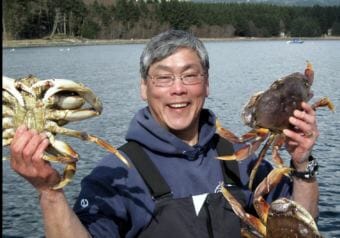
For possibly the first time in history, an Alaskan from the sport fishing industry has been appointed to the International Pacific Halibut Commission or IPHC. Richard Yamada was appointed to the commission along with Robert Alverson of Seattle, who currently serves as one of the U.S.’s three commissioners.
Yamada owns Shelter Lodge just about five miles outside of Juneau. He’s been involved in the charter fishing industry for 37 years and currently serves on the Alaska Department of Fish and Game’s Juneau-Douglas Advisory Committee. He also serves on the national Marine Fisheries Advisory Committee.
“We get together several times a year and we make recommendations about anything dealing with marine life to the Secretary of Commerce,” Yamada explained. “This work at the IPHC really falls in line with that. It’s something dealing with fisheries on a national and now international scale.”
Historically, commercial fishermen, processors and government employees have served both the U.S. and Canada on the commission. Yamada said despite his background, the goal on the commission will remain the same.
“At this table, the IPHC, we’re there to really look at managing the total entire stock in a sustainable fashion. The motivations might be different, but we’re working together at that level to really look at a sustainable fishery for generations to come,” he said.
Yamada takes over commissioner Linda Behnken’s seat, who has served on the commission since 2016. Yamada will be joining the commission at a fickle time in its history.
U.S. and Canadian commissioners have been at odds over cuts to catch limits and the distribution of the catch between regulatory areas in both countries.
“Last year we had some issues between Canada and the United States coming to an agreement on catch limits. I was at the meeting, but I was not privy to the negotiations behind closed doors,” Yamada said. “I’ll probably be introduced to that very shortly.”
Commissioners have been meeting informally to work out some of those differences this summer, though it’s unclear if they’ve reached an understanding.
It’s also unclear how long Yamada and Alverson will serve on the IPHC. The Trump administration is charged with appointing commissioners, but it did not make any appointments before the Aug. 31 deadline.
The Secretary of State and Secretary of Commerce appointed both Yamada and Alverson until Jan. 31, 2019, just long enough to make it through the commission’s annual meeting cycle.
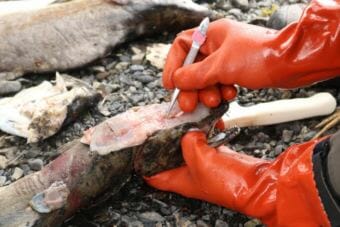
Pete Rand pulls otoliths from a pink salmon on Hartney Creek near Cordova. (Photo by Aaron Bolton/KBBI)
Recently, an argument over whether hatcheries are causing more harm than good has been heating up. The debate is nothing new, but an Alaska Department of Fish and Game study is about to take a step toward answering a question central to the debate: do hatchery fish that spawn with wild populations pose a threat to those stocks?
Pete Rand, a research ecologist with the Prince William Sound Science Center, is explaining to a group of new field staff how to sample pink salmon carcasses on the banks of Hartney Creek just outside of Cordova.
Rand picks up one of several pinks lined up on the rocks in front of him and cuts just behind its gills before using a pair of tweezers to tear off a tiny piece of its heart. Then, he cuts into the skull or “brain case” as he calls it and extracts two white otoliths, or ear bones. They’re smaller than the head of a pin.
An otolith after its pulled from a pink salmon carcass. It’s smaller than the head of a pin. (Photo by Aaron Bolton/KBBI)
“I put my fingers in the eye socket and you basically want to take the top of the head off,” Rand said as his knife crunched into the decomposing skull of a pink salmon.
Under a microscope, Fish and Game will be able tell from the ear bones if each fish was raised in a hatchery.
In just a few days, three field crews will travel to five remote streams on the western side of the sound where they will repeat this ritual thousands of times.
“We sample from the very beginning of the spawning season all the way to the end, and we sample daily,” Rand said. “The objective there is to sample as many of the spawning pink salmon as we can.”
This study and previous work has shown that the closer a wild stream is to a hatchery, the more likely hatchery fish will stray into that system. Rand says some streams near Prince William Sound’s four major pink salmon hatcheries can see high stray rates, varying from 70 to 90 percent each season.
The big concern is that when those strays spawn with wild fish, they’re passing on genes that could reduce future generations’ genetic fitness. In other words, does having a hatchery originated parent influence a wild salmon’s ability to survive in nature?
“That’s the ultimate question we’re trying to get at with this field project,” Rand said.
To answer that question, the samples are shipped to Fish and Game’s genetics lab in Anchorage. Any heart tissues belonging to hatchery fish are discarded, but the ones from wild pinks are processed.
“We take a small piece of that heart and then put it in a tube, add a bunch of chemicals, go through a bunch of different reactions and pull out the DNA,” said Chris Habicht, who manages the lab.
He explains that after about a week of processing, his team can identify lineages of wilds pinks and fish with varying degrees of genes passed down from hatchery stocks.
A pink salmon otolith under the microscope. The dark bands represent unique marks made by increasing the water temperature for timed intervals before hatchery fish are released into the wild. (Image courtesy of Alaska Department of Fish and Game)
The number of returning offspring each family tree produces will indicate whether hatchery fish reduce the productivity of the wild stocks they spawn with. But that’s about as far as the answers will go.
“If we do find a difference between these natural-origin, hatchery-origin fish in terms of how many progeny they produce, we won’t know what the mechanism for that difference is,” Habicht noted.
While that may be a step forward in Fish and Game’s eyes, the study has its critics, who argue the project, which received a large chunk of funding from hatchery operators and processors, is biased. Critics’ main issue with the project is that it doesn’t include a control stream with little or no hatchery influence to compare results to.
Bill Templin is Fish and Game’s chief fisheries scientist. In his Anchorage office, he acknowledges some of the study’s shortcomings.
“It’s very difficult to find a control,” he said. “What we did though is controlled for high stray-rate streams and low stray-rate streams. So, you get some idea of a contrast.”
Templin says what the study does provide shouldn’t be overlooked. He says the results will be valuable to the department and the Board of Fisheries when hatcheries request production increases or other permit changes.
But he cautions against any notion that this study will spark a major shift in hatchery management. He said it’s just a first step and that the results alone might not be the best way to answer the question at the heart of the hatchery debate.
“Questions of how much is too much or whether there’s harm or not are very difficult to answer,” Templin noted, “because they also require human valuation, human judgement. That has to be worked out in a different venue than in a scientific study. “
Those decisions may play out on the Board of Fisheries, which is scheduled to hold its first work session on hatcheries in October. However, it may do so without any results from Fish and Game’s hatchery-wild study. The first report is due in December.
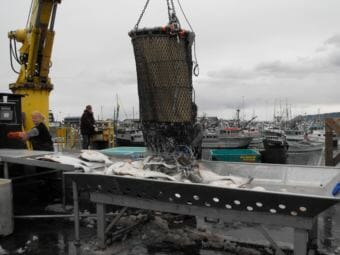
Fishermen offload halibut in Homer. (Photo courtesy Rudy Gustafson)
In the first round of what seems to be an escalating trade dispute between the U.S. and China, tariffs have been levied on billions of dollars worth of goods in both countries. The Alaskan fishing industry, which harvests roughly 60 percent of all wild seafood in the U.S., has been caught in the crosshairs of that disagreement.
But it’s not the Chinese tariffs that’s giving the industry heartburn. It’s a proposed tariff on seafood imported from China.
The Alaskan seafood industry has a unique relationship with China. Nearly $1 billion worth of Alaskan seafood was exported into the country in 2017, but that’s just the first step in a global supply chain.
“So much of our exports to China are reprocessed and re-exported,” Garrett Everidge said, a fisheries economist with the McDowell Group.
He explains that after those fish are reprocessed, they’re exported into markets around the world, including the U.S. Although, it’s hard to discern from trade data just how much winds back up in the U.S. market.
China kept it’s relationship with the Alaskan seafood industry in mind when it levied a 25 percent tariff on U.S. seafood earlier this summer.
“The majority of those exports are going to be excluded from those tariffs,” Everidge said.
The Trump administration is currently considering a list of retaliatory tariffs on $200 billion worth of Chinese goods. On that list is a 25 percent levy on seafood imported from China, including Alaskan products reprocessed in the country.
“As of right now, there’s no indication that product originating in Alaska would be excluded from those import tariffs,” Everidge added. “It’s kind of an unusual situation where the U.S. would in effect be taxing production from a U.S. state.”
Jeremy Woodrow with the Alaska Seafood Marketing Institute explains just the possibility of that tariff is already causing Chinese fish buyers to hold off on purchasing seafood from Alaska, which may create a backlog of frozen product in the U.S.
“I’m not really sure the volume of backlog,” Woodrow said. “I just do know that there’s some uncertainty in the market and there’s some hesitancy to pull the trigger on those purchases by our traditional buyers that we already have set in place.”
Woodrow explains that processing any backlog domestically would be costly both in terms of labor and in the volume the state exports.
“It’s easy to assume that we would keep that product here in the U.S., but the unfortunate part is that there might not be the capacity to process that product in the United States,” Woodrow noted.
However, demand for Alaska’s seafood is high and other countries may fill the void left by Chinese buyers.
At least one major processor, who didn’t wish to speak publicly, confirmed that other foreign buyers are picking up some of that slack.
That’s good news, but the processor also says this year’s pink salmon harvest came in under forecast, and that it may be harder to sell larger volumes of fish if the dispute lasts.
Pink salmon tops the list of Alaskan seafood imports into China in both volume and value. Alaskan processors exported $170 million worth of pink salmon in 2017 alone.
Woodrow also warns that selling fish to non-traditional buyers could put a strain on Alaska’s relationship with the Chinese market.
“This could be a short-term deal, and you don’t want to move away from a market that has a lot of value and a lot of potential,” Woodrow explained.
If it’s not a short-term deal, that frozen backlog could grow large and prices on the docks could fall. Morgan Jones is a commercial seiner based in Homer. Inside his boat, Morgan says prices have been good this year despite the trade dispute.
“The processors are still interested in buying all the fish we can get, and the initial price from last year is up a little bit,” Jones said. “So, we certainly haven’t see a negative impact yet.”
But ex-vessel prices are typically based on the previous year, and any impact on the docks is likely to be seen in 2019. Morgan has seen this happen before. He recalls prices for pink salmon being cut in half after the U.S. sanctioned Russia after it annexed Crimea in 2014.
“That was a huge deal for us. We always pay attention and watch these things with concern,” Jones added.
The U.S. Trade Representative’s office is taking public comment on the proposed list of tariffs. Many in the industry want Chinese seafood dropped from the list or an exemption for products originating in the U.S.
A spokesperson with the office said in an email Friday that there’s no set timeline for the list to be finalized after the comment period ends on Sept. 6.
But previous rounds of tariffs have been finalized and implemented within just weeks of the comment period ending, which could have Alaska’s fishing industry bracing for more uncertainty.
Mark Begich, Mike Dunleavy, Billy Toien, Mead Treadwell, and Governor Bill Walker answer questions at a forum sponsored by the Homer Chamber of Commerce. (Photo by Renee Gross/KBBI)
Gubernatorial candidates stopped in Homer on Tuesday to campaign, meet with residents and square off in a governor’s forum.
The event drew four prominent candidates including Gov. Bill Walker, Mike Dunleavy, Mark Begich and Mead Treadwell. It also drew lesser-known candidate Billy Toien.

Most of the governor candidates who arrived in Homer spent at least part of their day speaking to voters in an intimate setting such as a restaurant or coffee shop.
They spoke to a handful of voters at a time, reminding them of their accomplishments and addressing specific questions on topics such as the PFD, the fishing industry and state revenue.
But in the early evening, five gubernatorial candidates sat side by side on the Alice’s Champagne Palace stage to answer questions in front of roughly 150 residents.
The Homer Chamber of Commerce sponsored the forum and grilled candidates on issues from health care to the economy.
All candidates agreed health care expense was an issue but differed widely on how to address it.
Republican candidate and former state Sen. Mike Dunleavy said he wants to convene experts in the health care field along with providers and insurances to decide how to reduce health care costs.
“We need to interject some private health care plans for small businesses,” he said. “We need to look at potential block grants coming from the federal government to the state of Alaska in dealing with Medicaid.”
Block grants are a lump sum that the federal government would give the state to pay for Medicaid along with giving the state more control in managing the program.
Republican candidate and former Lt. Gov. Mead Treadwell also is a strong believer in block grants. He mentioned he has brought it up to Congress many times.
“I think that we do need to fix Obamacare,” he said. “I hope that our delegation comes together to do that. We do need flexibility to make deals with the major providers in the state so that costs down.”
He also proposed appointing an insurance director to lower cost and increasing competition.
Walker agreed that more competition is critical but otherwise took a much different stance.
The independent candidate touted his role in the Medicaid expansion, saying it helped to insure about 44,000 people and saved the state roughly $17 million. He also spoke about a bill he recently signed to ensure more transparency surrounding healthcare costs.
He said block grants are not the way forward.
“We’ve got to be really careful about that,” he said. “Alaska comes in last on a block grant because it’s done on a per capita basis on population. It does not work that way for us because our costs are higher due to the distance and how we’re separated. So I get nervous when I heard people talk about block grants. That’s very bad for Alaska.”
Democratic candidate and former U.S. Sen. Mark Begich focused on other ideas for decreasing costs.
“We have to change this issue of how we buy prescription drugs,” he said. “We should be allowed to import into Alaska from Canada. One state has done that through legislation. It helps lower costs.”
He mentioned concentrating on prevention, supporting community clinics and growing Alaska’s health care workforce.
Begich also proposed a new way of funding education by taking money from the Permeant Fund after 50 percent of it goes to dividends.
“The other 50 percent of it should go to education, constitutionally guaranteed,” he said. “Why do I say that? Because every single year at the last week of the session, for my lifetime, they negotiate away education.”
Begich also mentioned increasing the amount of Alaskan teachers and ensuring equal opportunities across the state.
Walker mentioned passing a bill earlier this year forward funding education. He also emphasized respecting teachers and adding more technical education.
“There are some incredible examples around the state, around this community, around the peninsula of what happens when a young person picks up a welding rod and learns how to weld, learns how to run equipment, learns how to pound a nail, pull some wire, weld something together, they becomes a different person,” he said. “We need to make sure that that’s available.”
Treadwell agreed that technical education was important but emphasized outcome versus input for education.
“We have to really seriously understand what works and what doesn’t,” he said. “That means the state and the school boards have to work much more closely together. If you want more money for education, keep more kids in school. That’s an automatic way to get more money for your school district.”
Dunleavy, a former educator, said funding education begins with fixing high health care costs.
“I proposed when I was in the Senate, a bill that would have consolidated the 54 school districts health care into the state’s health care system,” he said. “That would have saved upwards of a $100 million a year for school districts and taken that off the table so they wouldn’t have to worry about this escalating costs.”
Dunleavy also proposed a land endowment for public schools.
Libertarian candidate Billy Toien also was present at the forum.
“Although I am seeking the office of governor, I don’t want the job,” he said. “The only reason I’m seeking it is because so far I’m the only one that’s addressing the comprehensive finances of the state.”
At the end of the debate, Toien signed a pledge to protect and restore PFD and oppose taxes, among promises.
After the gubernatorial candidates spoke, seven candidates for lieutenant governor addressed the crowd. The primary election is Aug. 21.
Wildlife Troopers Detachment Commander Rex Leath said troopers observed operators of the commercial seine vessels Little Star, Relentless, Northstar and Windstar making a “dedicated effort” in Dog Fish Bay, south of Homer, to drive salmon out of waters closed to commercial seining.
Homer and Anchor Point residents Paul Roth, Mark Roth, Robert Roth and Eric Winslow worked for hours July 20, allegedly using “hand plungers” and the vessels themselves to push fish into open waters.
“The main seine boat started in open water and drove into closed water,” Leath said. “The three other boats in this situation pushed for almost two hours, pushed a large school of fish out of closed waters into the edge of closed waters and the open waters where that boat could ‘scoop them up real quick.’”
A fifth boat, the F/V Maranatha, also was said to be present.
Authorities said the vessel was staged in the area and later used to transport some of the illegally caught fish.
Troopers seized all 33,000 pounds harvested during the alleged incident, most of which were chum salmon.
“While some people may look at a closed water case and think it’s not the end of the world, it actually could literally be the end of a run in an area,” Leath said. “In this case, there’s 33,000 pounds of fish that will not make it back up that creek that were supposed to make it back up that creek to spawn. That’s a big deal for us.”
Charges were filed in Homer District Court, according to an online trooper dispatch.
Paul Roth is charged with driving salmon and commercial fishing in closed waters.
Winslow and Mark Roth are charged with driving salmon in closed waters among other charges.
Robert Roth is charged with failure to complete fish tickets and unlawful possession of commercial fish.
The fishermen could be required to pay several thousands of dollars in fines, and also could face jail time or have their commercial fishing permits revoked.
“As well as the fish themselves that were seized, whether or not the value of those fish is forwarded and forfeited to the State of Alaska would also be considered in the court process,” Leath added.
Court documents were not available as of Tuesday afternoon.
Fishermen offload halibut in Homer. (Photo courtesy Rudy Gustafson)
Halibut prices fell about $2 per pound at the beginning of the season.
But there’s good news for some fishermen: ex-vessel prices are increasing slightly around the state.
“We did see the ex-vessel price for halibut perk up a bit where we’re at $6.25, $6.50, $6.75 here in Homer today,” said Doug Bowen, who tracks halibut prices around the Gulf of Alaska for Alaska Boats and Permits, a vessel-and-fishing permit broker in Homer.
Those prices have a significant influence on the halibut quota Bowen sells for fishermen.
Five dollars per pound at the start of the season is the lowest price Pacific halibut fetched on the docks in several years.
Prices at the beginning of the season usually start high, McDowell Group fish economist Garrett Everidge said, and trend downward through the spring.
The recent spike in dock prices reflect typical market fluctuations, Everidge said.
“Maybe the market is working through some uncertainty that was present at the beginning of the season,” he said. “Around this time of the year, a lot of salmon fishermen who’ve done halibut are busy. It’s typically the slowest time of year and that could be why prices have appreciated a little bit.”
Experts hope the recent price hike signals that processers have sold most of their frozen halibut inventory from last year.
Prices typically drop in the fall as most salmon runs around the state come to a close and then rebound as the fishing effort declines toward the end of the season.
Bowen said that trend would be a welcomed sign.
“Hopefully as the effort spreads out there, we’ll see that price come back up – we hope,” he said. “Last fall was kind of scary because the price actually dipped in the fall and never did improve. We’re hopeful that we’ll go back to a more traditional model on the ex-vessel prices here this fall.”
Fishermen in Southeast Alaska and the central Gulf have pulled in more than half of this year’s total allowable catch, leaving about 3.9 million pounds to be caught before the season ends Nov. 7.
Close
Update notification options
Subscribe to notifications
Subscribe
Get notifications about news related to the topics you care about. You can unsubscribe anytime.