KBBI is our partner station in Homer. KTOO collaborates with partners across the state to cover important news and to share stories with our audiences.
Rep. Paul Seaton, R-Homer, responds to a question from a reporter during House Majority press availability in the Alaska State Capitol, April 3, 2018. The conversation centered on House Bill 286, the state operating budget passed by the House or Representatives the day before. (Photo by Skip Gray/360 North)
House Rep. Paul Seaton of Homer is taking a new route this election cycle.
Seaton has represented House District 31 on the Kenai Peninsula as a Republican since 2002, but he filed Thursday to run as an independent in the Democratic primary.
The party argued it had the power to exclude the lawmakers because of a court decision that allows independents to run in Democratic primaries.
The state Division of Elections ultimately denied the party’s request.
Party leaders have targeted the lawmakers since they joined a bipartisan coalition made up of mostly Democrats in 2016, which took control of the House away from Republicans.The party also sanctioned Seaton and the other two lawmakers that year.
Seaton now is taking advantage of the very same court decision Republicans tried to use against him.
He is the only candidate to file for the Democratic primary so far.
Sarah Vance of Homer, John Cox of Anchor Point and Henry Kroll of Soldotna have all filed to run in the Republican primary.
Homer’s first marijuana retail shop is set to open Thursday. Uncle Herb’s was approved by the state Marijuana Control Board back in September, and the shop will open its doors just in time for the busy summer season.
Store manager Aaron Stiassny will run the shop in Homer for his father Loyd. Stiassny currently manages the family’s shop in Anchorage under the same name.
The display cases in Homer were empty Wednesday evening, but Stiassny said the shop will be stocked and ready to go.
“I mean we’re just really excited to be the first cannabis shop in Homer. I know there’s a lot of residents eagerly awaiting the first cannabis shop,” Stiassny said as he stood behind the counter. “It’s a great opportunity to bring this business down here. This is going to provide good sales tax revenue for the community. We really want to be good citizens.”
Stiassny said the shop will offer about 15 to 20 marijuana strains to start. He adds that Uncle Herb’s will purchase a large portion of its marijuana products from cultivators on the Kenai Peninsula, but it will also feature strains grown by cultivators in and near Homer.
Stiassny explains that the shop will also offer strains high in CBD content, which are said to provide pain relief, in the future.
“Flower and pre-rolls will be the two main staples for our opening, and we have deliveries of concentrates and cartages and edibles,” he explained. “I don’t know if they are going to make the opening on Thursday, but we will definitely be stocked up sometime next week.”
Uncle Herb’s has hired eight part-time employees so far. Stiassny said that could change depending on business during the summer, and he said the shop’s hours will be 10 a.m. to 10 p.m.
“Those may change over the course of the summer depending on traffic. Opening day, we’re going to delay that, 2 [p.m.] to 10 [p.m.], just to give us some time to set up in the morning and get ready for the excitement,” he said.
Stiassny hopes to capitalize on Homer’s busy tourism season, but he said the shop will stay open year round.
Uncle Herb’s joins the roughly 30 marijuana cultivation, manufacturing and retail businesses in the Kenai Peninsula Borough. It’s the first retail shop to open on the southern Kenai Peninsula.
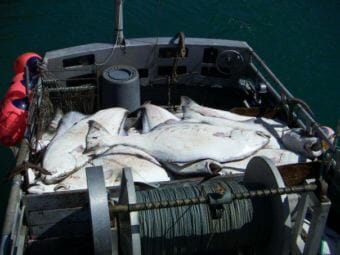
Pacific halibut on the F/V Vigor. (Photo courtesy Rudy Gustafson)
As prices and demand for Pacific halibut have fallen in Alaska, commercial fishermen say a new Canadian competitor is to blame. Since 2012, Canadian imports of fresh Atlantic halibut have grown roughly 60 percent.
Historically, Atlantic halibut has not competed with its close relative on the West Coast since New England and Canadian fishermen overfished stocks in the late 1880s. But as the catch continues to grow north of the border, fishermen in New England are working towards restarting a fishery in U.S. waters.
That could have a serious impact on Alaska’s halibut industry.
Atlantic halibut seems to have been on the tip of the commercial fishing industry’s tongue in Alaska as imports from Canada continue to carve out a significant slice of the New England fresh halibut market.
Prices on the docks in Alaska have fallen about $2 per pound, and there’s a surplus of halibut in the freezer from last year that isn’t selling.
Doug Bowen works with Alaska Boats and Permits, a vessel and fishing permit broker in Homer. Bowen and others in the industry say both are a result of Pacific halibut losing out to Canadian fish.
“So it’s a kind of a new world order in the ex-vessel prices, and it might be something that we’re going to be dealing with for some time,” Bowen explained.
But Alaska’s fishing industry is not the only one noticing the growth of the Canadian Atlantic halibut fishery.
“A lot of those boats are fishing on the U.S.-Canadian line and having very good results, and it’s been going on for a while,” Mike Russo said, a New England-based commercial fisherman. “Frankly, New England fixed-gear boats are missing out on this opportunity.”
Russo has been trying to strum up support for an industry halibut longline survey in U.S. waters.
Russo said the Atlantic halibut Canadian fishermen are catching are the same fish U.S. fishermen are seeing more of as they target other species.
“Somebody is going to make us prove it, but I believe that’s what would bear out,” he said. “Those fish don’t know political lines on a chart.”
Information on Atlantic halibut stocks in the U.S. is minimal. There are no extensive abundance surveys, and federal fishery managers don’t actively manage the stock as a commercial fishery. Fishermen are only allowed one fish per trip as bycatch.
Chris McGuire works with the Nature Conservancy in Massachusetts, which is trying to collect information on the valuable bottom fish. He’s been working with fish biologists and management officials to see if what U.S. fishermen like Russo are saying is in fact true.
“We’re working with commercial fishermen to do biological sampling of halibut to determine age and size at maturity. We’re some DNA sampling from that,” McGuire explained. “In a separate part of that project, we’re doing a little bit of pop-up satellite tagging to figure out where the fish we see off of New England go over the course of a whole year.”
McGuire is working with the Department of Fisheries and Oceans Canada to satellite tag the fish. That will help determine whether Atlantic halibut on both sides of the border should be treated as one stock, which is how Pacific halibut are managed by the International Pacific Halibut Commission.
Richard McBride is a fisheries biologist with NOAA Fisheries Greater Atlantic Regional Office. McBride teamed up with McGuire and New England fishermen to collect biological samples from the halibut they’re catching.
“I mean if we’re really to manage them as a renewable resource, we want fish to spawn at least once in a quality way and maybe have the potential to spawn more than once,” McBride said. “That’s the kind of thing that really accelerates the rebuilding.”
All of this fervor around Atlantic halibut could be another significant blow to Alaska fishermen and fish buyers, who have historically controlled the market on the East Coast. But both McBride and McGuire say it could be another five to 10 years before U.S. fishery managers have enough information to start an Atlantic halibut fishery.
Still, those in the Alaskan fishing industry like Andy Wink, a fisheries analyst, say depending on how things shake out, a U.S. Atlantic halibut fishery could maintain that new world order the Alaskan fishing industry is currently coping with.
“I guess the question there is whether it adds total supply or not – if they essentially get a cut of the Canadian halibut fishery,” Wink said. “It’s a domestic fishery, so it’s much more likely to go domestic, but it doesn’t have nearly the impact as if you’re talking about adding TAC (total allowable catch) onto the Canadian TAC.”
If scientists find that Atlantic halibut along the East Coast belong to one stock, setting up an internationally managed fishery in U.S. waters could push the process down the road.
Wink said, even if New England Fishermen are able to start fishing in five years, the Alaska fishing industry’s more immediate concern is still the growing number of truckloads filled with Atlantic halibut from Canada.
South Peninsula Hospital. (Photo courtesy South Peninsula Hospital)
Health care providers may go a few weeks without Medicaid reimbursements.
After it became clear that Medicaid funding will run dry about a month short of the new fiscal year, the Legislature included some funding to pay for Medicaid services until July 1 as it passed the capital budget over the weekend.
“The Medicaid Program required a $48 million supplemental to continue paying bills through the end of the fiscal year, which is June 30,” said Becky Hultberg, CEO of the Alaska State Hospital and Nursing Home Association. “The legislature approved $28 million of that necessary supplemental, leaving the program about $20 million short.”
The Alaska Office of Management and Budget estimates that the Medicaid program will run out of money about June 10.
Hultberg said there may be a couple of routes the Alaska Department of Health and Social Services may take when it does.
“In past years, the department suspended payments to providers who could best manage a cash flow disruption, and we expect that is likely the process the department will begin sometime in June,” she said.
There’s also a chance Health and Social Services could cover the gap.
Hultberg said that would be akin to looking in the couch cushions for change, but it’s too early to tell whether the department may be able to find the funds.
South Peninsula Behavioral Health Services CEO Jay Bechtol said the news is a mixed bag.
“It’s like Christmas when you get socks,” he said. “You’re like ‘oh great, it’s a present, yay!’ You open it, it’s socks. Twenty-eight million dollars is better than nothing, but it leaves a $20 million shortfall for the providers in the state of health care, which hurts.”
If behavioral health does experience a gap in funding, Bechtol said it will still provide services through June, but he adds that if Medicaid funding continues to fall short in future years, some providers may stray from expanding services.
“We don’t want to spend on long-term programming if the state is going to be out of money again and then we are going to have to go for three months instead of three weeks without any kind of funding,” he said. “It really does impact us long term and the services we need to be able to provide to the community.”
That may be an issue next year.
Legislators also budgeted $30 million less than what Gov. Bill Walker requested.
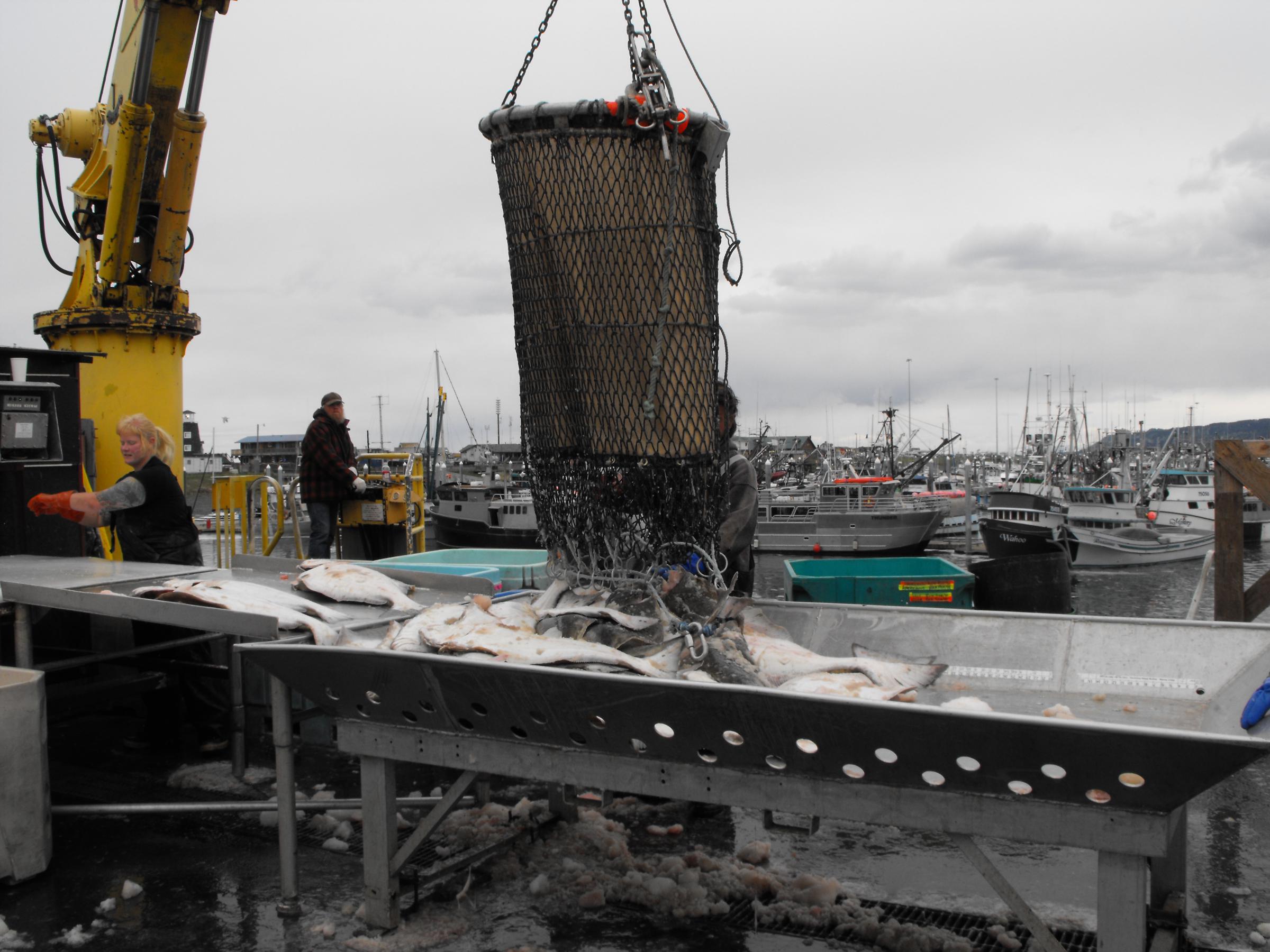
Pacific halibut is unloaded in Homer. (Photo courtesy Rudy Gustafson)
Halibut prices have fallen about $2 per pound, and decreasing demand has left plenty sitting in the freezer from last year.
Billy Sullivan owns a small fish-buying operation in Homer, and he said years of historically high prices – about $20 to $30 per pound at your typical supermarket – have driven consumers away from purchasing Pacific halibut.
That begs the question: will Pacific halibut maintain its spot on the menu or be replaced?
“Fish business goes: first you’re on the menu, then you go on the chalk board, then once you go off the chalk board, you’re done,” Sullivan said as he sliced open a rock fish. “Halibut is off the chalkboard right now.”
Consumers are reluctant to buy expensive fillets in grocery stores and restaurants. A new competitor also is taking over a large portion of the market.
“They went and found alternatives to expensive halibut and the East Coast fish fills in,” Sullivan said.
Fishermen cashed in on high prices last year. Fish buyers in Alaska were eager to buy loads of Pacific halibut, Sullivan said.
By the fall, the market seemed to soften as cheaper Atlantic halibut started to swallow up portions of the market on the East Coast.
“It’s safe to say and safe to assume that the East Coast has traditionally been a primary market for Pacific halibut,” Garett Everidge said, a fish economist with the McDowell Group.
Most of the Atlantic halibut showing up on the East Coast is coming from Canada, he said. Canadian fishermen on the East Coast landed about 8 million pounds of Atlantic halibut in 2016, double the catch 10 years earlier.
“For context, 2018 TAC (total allowable catch) for Alaska is about 17.5 million pounds,” Everidge said. “By comparison it’s still a relatively small amount, but it’s a material force in the market.”
The Canadian fishery is open year-round, making it easier to supply demand for fresh fish in high-end markets, such as Boston.
More Canadian fish buyers are shipping their product into the U.S. as the catch to the north increases, Everidge said, and there’s no substantial commercial fishery for Atlantic halibut in U.S. waters.
Everidge said increased competition along with high Pacific halibut prices might have led to the current backlog of Alaskan fish in the freezer.
Halibut doesn’t provide a very large profit margin, which may make selling that fish take longer, he said.
“There’s tension between selling that product and maintaining the value and maintaining profitability in the short term,” Everidge said.
The surplus of Pacific halibut combined with more competition from the East Coast is driving down prices here in Alaska. Fishermen at the docks have been getting about $5 per pound.
Homer-based commercial fisherman Malcom Milne said he saw this coming last fall after buyers began to turn away loads of halibut.
“When we were getting $7 per pound, it was great – great for the crew shares in the boat,” Milne said. “But it just didn’t seem like a sustainable price point.”
Milne said $5 per pound should still be profitable for most fishermen, and he thinks that price point may get Pacific halibut back on the menu.
“Hopefully we can rebuild some of the markets. I think we probably lost some market share due to substitution,” Milne added. “I know it’s always hard to get back on menus and back in peoples’ minds. Hopefully this will do it.”
That lower price point may not translate to consumers until the surplus of fish in the freezer is sold.
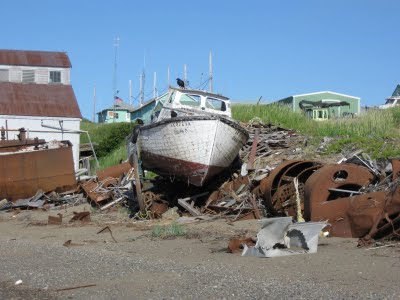
A derelict fishing vessel on the North Shore of Egegik in Bristol Bay. (Photo by Mike Mason)
Boat and fishing vessel owners will likely be required to meet new registration and title requirements next year.
The change is part of Senate Bill 92, which passed through the state Legislature last week. The bill aims to give the state, municipalities and individuals more tools to hold owners of derelict and abandoned vessels legally liable.
The Senate sent the bill to Gov. Bill Walker’s desk Thursday after the House passed the legislation earlier this week.
The bill makes three significant changes. It will make it easier to track vessel ownership via state boat registration requirements and a new titling program. It also lowers the legal bar to hold derelict vessel owners liable and would create a derelict vessel prevention program.
Alaska Association of Harbormasters and Port Administrators Executive Secretary Rachel Lord worked with a statewide task force craft the bill. She said the new registration and title requirements would create a better paper trail for vessel ownership.
“It ends up being people saying, ‘Oh no, that’s not my boat. That’s that guys boat. I sold it to him yesterday for $15 on a bar napkin,’” Lord explained. “It sounds silly and trite, but it happens all the time and all over the state.”
Currently, federally documented vessels are not required to register with the state, but that would change under the new law. Non-federally documented boats over 24 feet would also be required to have a title of ownership.
Homer Harbormaster Brian Hawkins also worked on the state task force. He said the bill would specifically help ports and harbors track down owners of federally documented boats at risk of becoming a problem, which he said tend to be old commercial fishing vessels.
“We didn’t know how many documented vessels were operating in the state, and it’s that fleet that often times would become the future derelict vessels – some of those as they age out,” Hawkins said.
The bill also allows the state and municipalities to impose civil penalties and individuals could take action against owners of derelict vessels in civil court.
Currently, derelict vessel owners can only be charged criminally, but the law also imposes stiffer penalties for those found guilty.
Holly Wells is Homer’s city attorney and is a shareholder at Birch Horton Bittner & Cherot in Anchorage.
Wells helped the task force craft the bill’s language, and she said the legislation not only lowers the legal bar, but it also clears the path for small communities and villages to give proper notice, impound and scrap derelict boats.
“Communities like Homer that have the resources to remove derelict vessels and have the luxury of contacting legal council to help craft local laws have been very lucky because they have been able to address this issue pretty efficiently,” Wells said. “The communities that don’t have those resources haven’t had the ability to take care of the problem. This is a really big step in the right direction.”
The bill also tasks the state Department of Natural Resources with creating a derelict vessel prevention program, which will be funded by title fees.
Harbormaster Hawkins said the program’s largest undertaking would be creating a cradle-to-grave plan for vessels in an effort to make sure they are disposed of properly.
“When you look at the fleet with a critical eye, you will notice it is aging,” Hawkins added. “There are a lot of vessels that are getting in the 30s, 40s, 50-year-old range, and many of these will eventually become vessels that need to be disposed of or something done with.”
Hawkins hopes the program will provide more avenues for vessel owners to scrap their boats rather than abandon them in local, state or federal waters.
It’s not clear when the bill might be signed into law, but Gov. Walker has 90 days to either approve or reject the legislation. The bill would go into effect Jan. 1, 2019.
Close
Update notification options
Subscribe to notifications
Subscribe
Get notifications about news related to the topics you care about. You can unsubscribe anytime.