KBBI - Homer

KBBI is our partner station in Homer. KTOO collaborates with partners across the state to cover important news and to share stories with our audiences.
Octopus eggs hatch at Alaska SeaLife Center

Alaska SeaLife Center’s family of octopuses is growing.

A 24-hour-old hatchling. (Photo courtesy Alaska Sealife Center)

Gilligan, a giant Pacific octopus,  laid thousands of eggs about a year ago. Less than a hundred hatched this month.

Aquarium curator Richard Hocking expects the remaining eggs to hatch by the end of May.

Once the eggs hatch, staff transport them to a separate tank where they can feed on zooplankton.

Young giant Pacific octopuses are about a quarter-inch long and have fully developed eyes. An adult is between 9 and 16 feet long.

But the odds the hatchlings will make it to adulthood are slim.

The survival rate of hatchlings is 1 percent in the wild, and there is only one documented case of a giant Pacific octopus successfully being reared in an aquarium.

Alaska SeaLife Center has attempted to raise hatchlings twice before.

Both attempts were unsuccessful. The center says the babies are extremely delicate and have complex nutritional needs. Still, the staff is hopeful this time will be different.

Visitors can see Gilligan and her hatchlings in the aquarium’s Octopus Grotto exhibit.

Annual flood of tourists may be eroding Homer’s long-term rental market

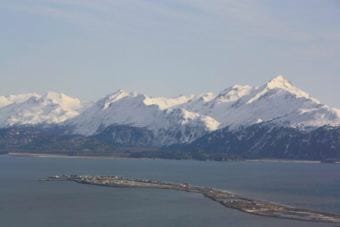
Homer Spit. (KBBI Database photo)

Finding a place to live Homer can be a challenge.

The growing tourism industry makes it more difficult for year-round Homer residents to find long-term housing.

With just a handful of hotels in town, visitors have been relying on vacation rental websites and other vacation rentals, which may mean fewer rental options for Homer residents to choose from.

Anna Vanbuskirk is hunting for rental housing during the worst time of year in Homer.

After moving to town two years ago, she’s use to the scramble every spring.

“The first year I didn’t find anything really, and I ended up living in a 1978 tour bus on a gentlemen’s property because I couldn’t find housing with my dog and I,” Vanbuskirk said.

Vanbuskirk has moved four times since then, and she has just two weeks to find another place for the summer.

Homer Property Management’s Daniel Yager said several people come in with the same story every spring.

“They showed up in the offseason, they found a nice vacation rental that was going for a decent market price. When they talk to the owner, they expressed great interest in long-term tenancy, and those owners told them whatever they needed to hear,” Yager said. “At the end of the six-month term, the tenant basically just got the notice that the lease agreement isn’t extending and they must move out by this day at this time.”

Vanbuskirk moved into her house knowing it was just for the winter, but others are unexpectedly moving.

Kelli Parker moved into her current house last year with a six-month lease and the promise she could sign on for a full year come the spring.

Parker signed a year-long lease at the beginning of April, but couple days later, she was told her landlord had not signed the lease because he plans to list the house on Airbnb.

“I signed the lease and handed it back to him, not thinking I needed to have him sign his part right then,” Parker said. “After so many confirmations over the winter by email and then a personal one-on-one confirmation, I just didn’t see it as that important. I just took him at his word.”

Bay Reality realtor Gina Pelaia has been getting more calls every year from frantic renters like Parker.

“I know sometimes when I first answer the phone they say, ‘This isn’t a seasonal place, is it? We aren’t going to have to move out in May are we?’” Pelaia said.

Pelaia said more vacation rentals are making the long-term rental market incredibly competitive.

“This time of year, I’d say we’re closer to a 1 percent vacancy rate. More in the winter, we’re looking at probably less than a 5 percent vacancy rate,” Pelaia added. “I manage about 150 properties, and I think I have two available apartments right now.”

More property owners are capitalizing on the demand for vacation rentals in the summer.

Airbnb data shows the number of listings in the Homer area have grown more than 500 percent since 2014, with 160 hosts listing 250 properties.

Almost all of those are either apartments or complete houses.

What seems to be driving the growth is profit.

“On a monthly rental, the three properties, you bring in around $30,000,” Kit Barnett said. “On a vacation rental, you can bring in about $60,000.”

“It’s definitely worth the work,” Barnett’s wife, Phyllis, said.

The Barnetts are retired teachers and they say they need the supplemental income.

They listed the upper and lower levels of their duplex on Airbnb and other sites four years ago after one of their long-term tenants moved out.

After that filled up consistently, they converted their small house next door from a traditional rental to an Airbnb as well.

Phyllis Barnett knows plenty of people jumping into the market, but doesn’t think it’s anywhere near being saturated.

“I haven’t heard anybody complaining about their bookings,” Phyllis said with a chuckle. “I don’t know everybody, but nobody I know is complaining about it.”

She does think vacation rentals will eventually become less profitable as competition grows, but she said if that happens, she’ll turn her properties back into long-term rentals, which would be welcome relief for renters on the housing hunt.

Homer residents, officials get up-close look at oil spill response

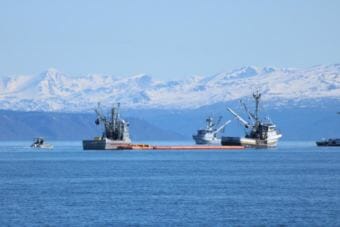
Several fishing vessels in Homer run through oil spill response drills put on by Alyeska Pipeline Service Company. (Photo by Aaron Bolton/KBBI)

Every year Alyeska Pipeline Service Company trains more than 2,000 fishermen from Valdez to Kodiak how to respond to an oil spill in Prince William Sound and surrounding areas.

Homer residents can see a mock response every spring off shore in Kachemak Bay.

The Prince William Sound Regional Citizens’ Advisory Council gave the public and local decision makers a chance to get a first-hand look Saturday.

The demonstration is part of an effort to help Alaskans better understand what goes into planning for a potential oil spill.
Advisory council volunteer Jim Herbert is giving Homer residents a play-by-play as local fishermen run through oil spill response drills in Kachemak Bay.

“The reason these boats are involved is not necessarily to gather up all the oil at the very beginning of a spill, but in order to protect shorelines and gather up oil that’s formed in sheens in different areas,” he said to passengers on the Rainbow Connection.

Boats two and push several booms, targeting orange buoys that represent oil sheens on the water as several Homer residents, students and local officials watch from two boats.

Advisory council spokeswoman Lisa Matlock said the non-profit has put on these narrated trips in Valdez and Cordova over the last two years.

The initiative is cycling through each of the six communities required to respond spills in Prince William Sound, Matlock said.

The idea is to inform the public about oil spill response, but also to get local decision makers on board.

“Because when they’re asked to provide input on part of the public about contingency planning and prevention of oil spills, they have a better understanding of what it looks like on the water as well,” Matlock said.

Kenai Peninsula Borough Assembly member Willy Dunne  responded to the Exon-Valdez spill in 1989.

He spent about a month and a half capturing wildlife on the outer coast of the Kenai Peninsula.

While Dunne has not been on the assembly while it’s given input on spill response contingency plans, he said giving local officials a chance to watch training in action is valuable.

“I know the borough has an interest in oil spill contingency plans. Our borough is vulnerable to oil spills. A lot of our borough is coastline: Kachemak Bay, Cook Inlet, the outer coast and areas that were harmed by the Exon-Valdez oil spill,” Dunne said. “It’s in our interest to protect the fisheries and the industry that could be impacted by the oil spills.”

Alyeska contracts with about 450 boats total in order to make sure enough vessels are on hand for any given scenario. Boats in Cordova and Valdez are required to respond faster than others.

Homer has about 60 boats in the program, most of which are required to respond within 24 hours.

In the case of a spill in Prince William Sound, local boats would most likely be sent to the outer coast of the peninsula or into the sound, but there are some plans to protect local sites.

The advisory council took residents across the water to Peterson Bay.

Matlock outlined plans to protect water fowl, fisheries and aquaculture operations in the area to passengers.

“There’s three red lines. Those represent what we call exclusion booms,” Matlock said. “There’s this boom that would be anchored, whether that would be with rocks or trees. They would anchor that boom – often across a salmon stream is a real common one.”

Homer Flex High School students are wrapping up a program with the advisory council.

Students learned about the Exon-Valdez spill, but they’ve also learned how spill response technology has changed since and about potential job opportunities.

“I really appreciate being educated about it because if it ever did happen, I would want to be able to help as much as I could,” Homer Flex High School senior Mckenzie Hill said. “But it was nice to be able to learn how they use the skimmers and how the boom works and everything. It was really a good experience.”

Matlock said Saturday’s trip won’t be the last time Homer residents can watch the training up close.

The advisory council plans to host trips in one of the six communities every year, returning to Homer in 2025.

Kennicott cancellation leaves some ferry passengers stranded in Homer

Alaska Marine Highway System ferry Kennicott
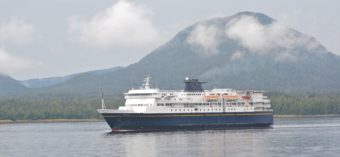
The Alaska Marine Highway System’s ferry Kennicott near Ketchikan in August 2010. (Creative Commons photo by Jay Galvin)

Mechanical issues canceled a Saturday sailing for the state ferry Kennicott. Several people and their vehicles may be stranded in Homer for two weeks.

The vessel remained docked in Kodiak for 33 hours before arriving in Homer for its Sunday sailing, but several passengers with reservations for Saturday are asking why the ferry service can’t schedule another sailing.

Alaska Marine Highway spokeswoman Aurah Landau said mechanical issues with the Kennicott’s elevator, responsible for loading vehicles on and off the vessel, and computer problems caused the delay in Kodiak.

“There have been $29 million in total funding cuts from FY13 to now, and two boats have been removed from the fleet,” Landau said. “There’s not a lot of flexibility in dealing with weather or mechanical issues throughout the system.”

The Tustumena, which sails from Homer down the Aleutian chain, is in Ketchikan for its annual layover and was not able to pick up the slack.

Landau was not able to say how many passengers were affected by the cancellation and does not know how much an extra sailing would cost in total.

She said staffing costs would run about $80,000, which the Marine Highway System deemed unfeasible.

The Kennicott, which supplements the Tustumena’s service in Western Alaska, was supposed to leave Homer for Kodiak about 2 a.m. Saturday.

Several passengers in Homer said they were notified about the delay Friday.

Several slept in their vehicles, stayed with friends or paid for hotels.

Brandon West, his fiancée and two kids are moving to Kodiak Island. He said they weren’t notified about the cancellation until Sunday morning.

“For a family like us, we’ve already spent $2,500 to move from Palmer to here. We don’t have that expense. We’re pretty much out of cash and everything. We even had to stay in a hotel here and everything,” he said. “There should have been a lot better communication for sure.”

West and his family were scheduled on two separate sailings Saturday and Sunday. He said they were able to get their U-Haul with all their belongings on the ferry Sunday, but they will likely have to leave their personal vehicle behind.

“If our vehicle don’t get on, it won’t get on until May,” West said early Sunday afternoon. “We’re going to be stuck without a vehicle.”

Other passengers were told they could either walk onto the Sunday sailing and leave their vehicles or wait until April 21, the next available sailing for Kodiak.

Landau said the Marine Highway is not charging customers for leaving their vehicles at the Homer terminal and that there is space for them on the sailing later this month.

Evi Monay-Yonemura and her kids also are in the midst of a move to the island.

Her car was loaded with personal belongings and pets. She said her dog, which just gave birth, died while she waited because she couldn’t find a vet over the weekend.

“Had I been able to get on the ferry, I would have been able to get to a doctor,” she said as she waited near the terminal. “We’ve just been stuck out here for two days now. I have to leave my car behind.”

Landau said several people with non-essential travel plans late Sunday evening canceled their trips.

Landau added several passengers on standby and their vehicles were able to fit on the Kennicott Sunday evening. She did not have an estimate for how many passengers were forced to wait for the sailing later this month.

Nikolaevsk man dead and one Alaska State Trooper injured after officer-involved shooting

A Nikolaevsk man is dead and one Alaska State Trooper is injured after an officer-involved shooting Saturday evening. Troopers received a report that 42-year-old Nikolai Yakunin was in contact with a female, a violation of his probation conditions.

Troopers received the report around 2:30  p.m. and responded about four and a half hours later at about 7 p.m.

According to a trooper dispatch, the responding trooper was incapacitated after Yakunin attacked him. The release does not say if the trooper was shot or how Yakunin attacked the officer.

Additional troopers were dispatched for backup. Troopers say Yakunin continued his “assaultive behavior, and he was shot to prevent further assaults on any trooper or bystander.”

Yakunin was pronounced dead on the scene and next of kin has been notified. The injured trooper was transported to the hospital for medical treatment. His condition is unknown.

The trooper who shot and killed Yakunin has been placed on 72-hour administrative leave.

Troopers say the investigation is ongoing.

Correction: A previous version of this story reported the time of the initial report at 4:30 p.m. It came in at about 2:30 p.m. This story has been updated.

NOAA rule sets dates for 2018 halibut season

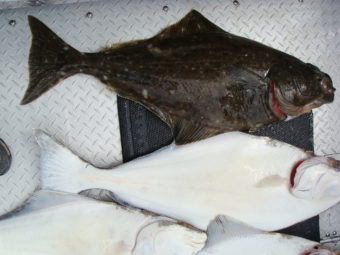
Pacific Halibut caught in Cook Inlet in June 2010.
Pacific Halibut caught in Cook Inlet in June 2010. (Photo by Jlikes2Fish)

The National Oceanic and Atmospheric Administration published an interim rule for the 2018 halibut season Friday that sets the season opening and closing dates to March 24 and Nov. 7. The rule also put quotas from 2017 in place, but that is likely to change.

The International Pacific Halibut Commission, which regulates halibut in U.S. and Canadian waters, typically sets both season dates and quotas.

But after surveys indicated halibut stocks were on the decline, U.S. and Canadian commissioners could not agree on cuts to the total allowable catch at the IPHC’s annual meeting in January.

When the commission cannot come to an agreement, quotas from the previous year are to be reinstated, but both sides did agree 2017’s numbers were too high.

Both countries indicated they would set their own quotas through their domestic rule-making processes.

U.S. commissioners asked the National Marine Fisheries Service, which has the power to make federal fishery rules, for a combined commercial and charter catch of 4.5 million pounds in area 2C in Southeast Alaska, a cut of about .75 million pounds.

In the central Gulf of Alaska, area 3A, U.S. commissioners wanted to set the catch at 9.5 million pounds, a roughly 500,000-pound drop from 2017.

Canadian commissioners plan to set the catch along the coast of British Columbia at roughly 6 million pounds, down about 1.5 million pounds from 2017.

Friday’s rule says another regulation is likely to be published in order to set quotas at the levels U.S. commissioners requested. NOAA Spokesperson Julie Speegle confirmed to KBBI via email that another rule is likely to be published later this month.

Site notifications
Update notification options
Subscribe to notifications