KBBI is our partner station in Homer. KTOO collaborates with partners across the state to cover important news and to share stories with our audiences.
A 12-year-old male student from the Ninilchik School is in custody after making threats about bringing a gun to school.
According to an Alaska State Troopers dispatch posted Thursday, troopers received a call from a concerned parent Tuesday about the student.
Troopers determined the student had made repeated threats and planned to bring a gun to school.
Troopers took the student into custody and transported him to the Kenai Youth Facility.
Kenai Peninsula Borough School District spokesperson Peggy Erkeneff said school principal Jeff Ambrosier was notified about the threat after school hours.
“He sent home a message to all parents and staff was fully briefed as well,” Erkeneff said. “Then a school counselor was available the next day at school for any of the students who just wanted to talk about school safety or their school culture and what was happening in their own school that day.”
Troopers still are investigating the incident, and Erkeneff said the district will determine what actions need to be taken after the investigation is complete.
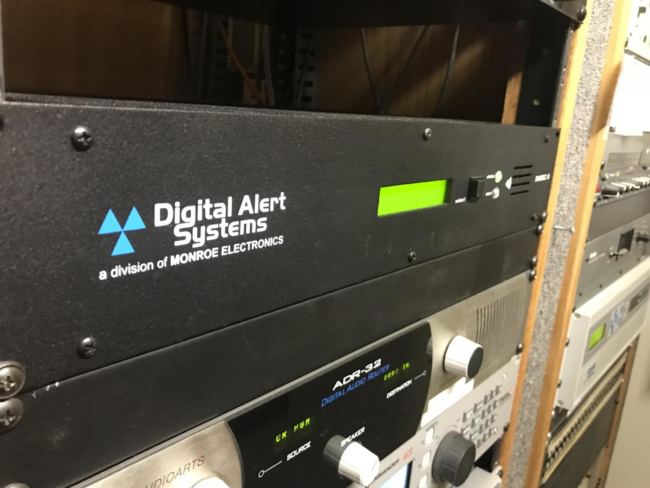
KBBI’s DASDEC box, which monitors for Emergency Alert System messages from IPAWS, NOAA Weather Radio and KSRM in Kenai. (Photo by Aaron Bolton, KBBI)
When a powerful 7.9 magnitude earthquake in the Gulf of Alaska hit early Tuesday morning, it sent a host of people and systems into motion. Tsunami sirens were blaring and Emergency Alert System, or EAS, messages were broadcasting over radio and TV stations. But there were parts of the EAS that failed. Local, state and federal officials are now working to sort out those kinks.
When the National Tsunami Warning Center in Palmer decided to issue Tuesday’s tsunami warning, it had to get that message out to the public as fast as possible. The National Weather Service operates the center and it passed the warning on through three primary systems.
National Weather Service offices around the state broadcast the warning over weather radios. Those radios can activate EAS messages at radio and TV stations, but they also set off tsunami sirens and alert those listening to them.
The warning is also sent out through two internet-based systems. The first is called EMnet, which stands for Emergency Management Network. The state contracts out for that service. The other, known as IPAWS or the Integrated Public Alert and Warning System, is run by the federal government.
Both of these services are constantly listening for a signal from the Tsunami Warning Center.
“The FEMA IPAWS system listens to that. Comlabs, who runs EMnet, listens to that feed as well, and it appears that there is a programming error in that link,” Bryan Fisher said, Chief of Operations at the State Division of Homeland Security and Emergency Management. “So, it said specifically, ‘do not send it across EAS.’”
Fisher explains that EMnet and IPAWS were supposed to pick up Tuesday’s tsunami warning and send it across the Emergency Alert System.
The systems also listen to each other incase one gets the initial signal and the other doesn’t, but since both were told not to send the message across the EAS, that message stopped there.
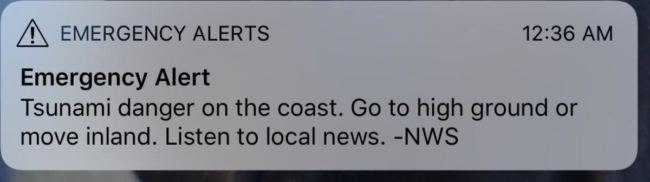
However, IPAWS didn’t completely fail. It’s is also responsible for push notifications to cell phones.
“So, it said send it over the cell phone piece, which did work, the wireless emergency alert system, and it blocked it from going to EMnet and EAS,” Fisher said.
Tsunami push notification sent out through the wireless emergency alert system on Jan. 23 via IPAWS. (Screenshot by Aaron Bolton, KBBI)
The state and boroughs also have the ability to send a signal to EAS equipment, but when warnings are in the National Weather Service’s purview, both typically refrain from doing so.
That left one more method to initiate most EAS equipment, weather radios. When the tsunami warning was issued, National Weather Service offices in Juneau, Kodiak and Anchorage took that message and broadcast it over those radios, triggering EAS equipment across Southeast Alaska and in Kodiak.
But there were some hiccups on the Kenai Peninsula. The National Weather Service in Anchorage said it transmitted four messages to weather radios, but only one made it.
“So, what we’re investigating now is what happened to the second, third and fourth messages that the National Weather Service sent out over NOAA weather radio,” Dennis Bookey said, co-chair of the Alaska State Emergency Communications Committee.
Bookey is one of many people trying to sort things out.
“We’re pretty certain that the audio message, should you have been listening to NOAA weather radio, you’d of heard the whole thing,” he explained. “But there’s electronic coding that gets inside that message that then triggers receivers at the broadcasting and cable facilities. That apparently didn’t trigger them.”
GCI in Homer successfully picked up and broadcast the lone message, but at KBBI, the signal wasn’t clear enough for its system to decode, something the station is working to fix.
KBBI’s system can also be triggered by IPAWS and KSRM in Kenai, but KSRM General Manager Matt Wilson said it received nothing from the National Weather Service in Anchorage.
Officials at every level of government are working to dissect the problem, and Alaska Senator Dan Sullivan expressed concern at a U.S. Senate Commerce Committee meeting Thursday, which happened to be holding a hearing on Emergency Alert Systems.
“Fortunately there was no tsunami, but it was very scary for hundreds if not thousands of my constituents. It would be good to learn from this so we can be ready next time,” Sullivan said.
Bookey said an event with no actual threat like Tuesday’s tsunami warning will be a great lesson because it’s the best test the system could ever have.
“We try our best to do that every March with our annual test, but because of regulations and a lot of variables at play, there’s only so far we can go,” Bookey said. “So, nothing could be more valuable than having a real event and dissect what did and didn’t work.”
Bookey adds that once the issues are diagnosed, changes will likely be made to the system.
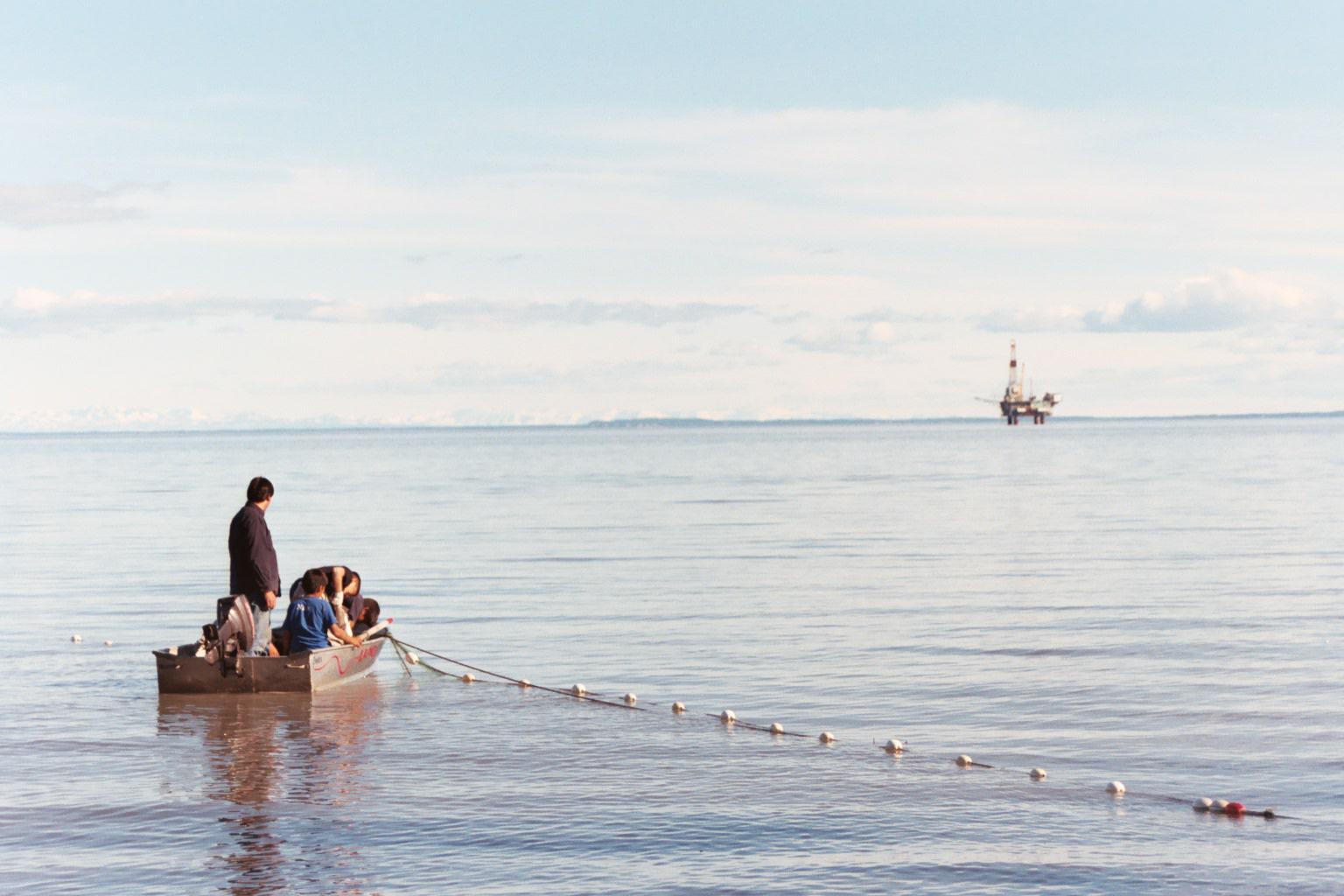
A family fishes near Tyonek. (Photo courtesy Davin Holen)
The Trump administration proposed last week to drastically increase the amount of Alaska waters open for oil and gas leasing.
Along with keeping Cook Inlet open, it would also make areas near Kodiak and the Gulf of Alaska available for drilling, both of which are currently closed.
It’s unclear whether companies will be interested in drilling there even if the plan is approved.
The move worries local environmentalists and fishermen.
Trump’s administration’s plan would mean big changes for most of Alaska’s coastal communities.
They might see water open to drilling that has never been open before.
For Homer residents, the nearest federal water has already been open.
Stephen Wackowski, the senior adviser for Alaskan affairs for the interior secretary, said, “We just had a lease sale in the Cook Inlet this last summer that was very successful. It was our first successful lease sale in 20 years.”
The new plan would not open up Kachemak Bay, which is considered state waters, but it would allow drilling in nearby Gulf of Alaska and Kodiak.
“I think you’re going to see us go down the path to not shortcut any environmental protections but to allow for companies and stakeholders to participate in the wealth of resources we have in our offshore,” he said.
Trump’s administration proposed rolling back safety regulation measures. Regardless, it’s unclear whether any companies will want to drill in these areas.
“There hasn’t been high interest from the industry and nor is there high potential,” Wackowski said. “I think what our point is that we put everything on the table to see if industry is interested in that and it’s just a plan.”
Despite the uncertainty, the plan still worries local fishermen and environmentalists.
It puts the areas at risk of spills, Cook Inlet Keeper advocacy director Bob Shavelson said.
“It’s well established whenever you drill for oil, when you transport oil, you spill oil,” he said. “Spilled oil around fisheries is never a good thing. I think you’re putting a renewable resource in our fisheries which brings in billions of dollars a year to the U.S. economy against a non-renewable resource.”
Shavelson said if a spill happens in the Gulf or Kodiak, then it could travel here.
Spills are something commercial Gulf of Alaska fisherman Erik Velsko worries about too.
“When you make you’re living off the environment, you want to make sure it’s treated how you would treat it,” he said. “It doesn’t seem like the oil companies and mining companies really have the environment in their best interests”
Matt Hakala, who also works as a commercial fisherman in the Gulf, knows that Alaskan oil could end up fueling his boat one day, but he doesn’t think oil companies can drill responsibly.
“We either need to figure out how to live without oil and just not harvest it or figure out how to get the oil a lot safer than what they got going now,” he said.
The 60-day public comment period for the draft proposal began Monday.
“It’s going to be a big deal to a bunch of us,” Alray Carroll said. “I’m guessing we’re going to be looking for stuff to do by the end of February at the latest.”
Carroll works as an engineer for Bering Marine Corporation in the summer, but during the winter months, he fishes for Pacific cod in state waters near Kachemak Bay.
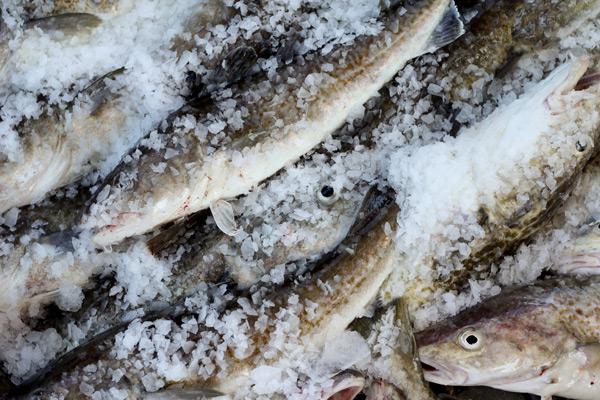
Pacific cod is Alaska’s second largest fishery by volume, bringing $186 million in 2015, and the fishery is open during a time when there’s not much else going on.
Once 2018’s total allowable catch of 13,000 metric tons has been landed, the season is over.
Some fishermen wonder if it might be better to just wait for other fisheries to open, but Carroll said he’s still plans on fishing.
“It won’t be any different. It’ll be just a little shorter. Last year we fished from December until April 8 or something like that. It was a long season,” Carroll said. “This one is going to be pretty fast and furious. I’m thinking federal pot quota will be caught in three weeks and state-water pot quota I don’t think it will last a month.”
Others aren’t so sure.
Erik Velsko fishes for Pacific cod, but also targets halibut and sablefish, which usually ramp up in March. Velsko also uses his boat as a fish tender in the summer.
Velsko may just wait for those fisheries, but halibut quotas are also expected to be on a downturn, which doesn’t leave much room for either halibut or sablefish to pick up the slack.
“It just may be a few lean years. We’ll just have to try to pick up as much longline quota as we can and maybe extend the tender contract, try to do whatever we can to maintain what we’ve been doing,” Velsko said. “I think we’re going to be well under what we’ve been bringing in for the last few years here.”
Others say next year’s quota doesn’t necessarily mean the season is doomed.
Mike McCune, who manages Homer-based processor Fish Factory, said he will keep the plant operating through February despite the decline.
“We don’t know where the fishing is going to be good, where it’s going to be poor,” McCune said. “The quota for the federal season is of course quite small. However, if the fishing is slow in other regions and relatively decent in our area, that will allow for us to stay busy longer than the 80 percent cut would indicate.”
The market may also compensate for the decline.
Pacific cod hovered around 45 cents per pound in 2017. As for what prices might jump up to, McCune said that’s something he can’t predict.
“I’ve got no idea on that. If I knew the answer to that, I’d probably wouldn’t have to work for a living anymore,” McCune added.
McCune did say that he doesn’t expect prices to jump more than $1 per pound because other cod fisheries around the U.S. and in other countries may stabilize prices.
But cod fishermen like Carroll say if prices jump up to 60 cents per pound, that may help carry them through the winter months.
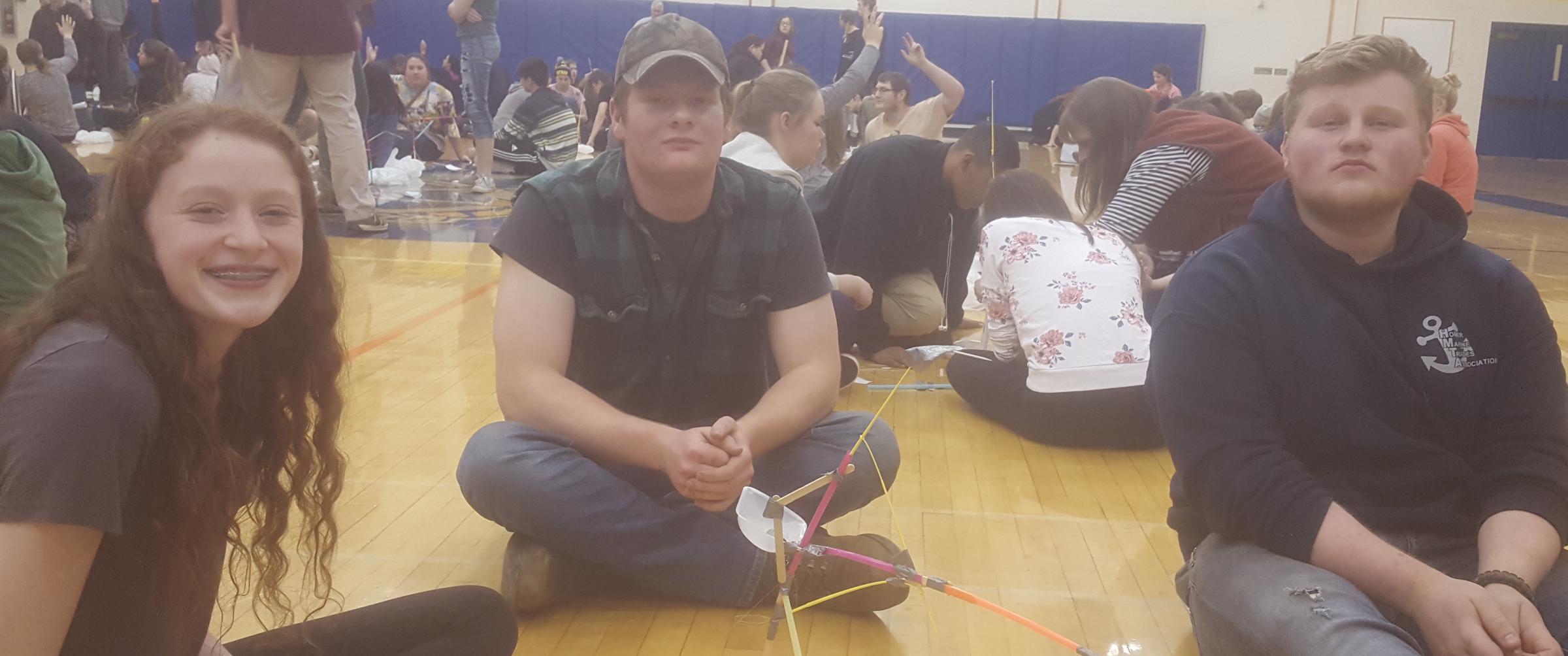
Becca Chapman, Troy Lane and Kalen Molodih pose next to their bridge. (Photo by KBBI)
Homer High School students often get free time to catch up on their work during the last period of the school day.
But one Wednesday, students did something a little different.
They participated in the high school’s first school-wide problem-solving event.
All high school students filed into the gym as teachers helped them find their teams.
Some had an idea of what this problem-solving event was all about.
But some, like Elijah Gunderson, had no clue what was in store.
“I think it’s going to be some science thingamajig,” he said. “But I don’t know. I don’t know. I’m excited though.”
In groups of four or five, students built single-support-bridges out of random materials such as straws and paper clips.
Judges awarded them points on different elements like the length and width of the bridge.
Science teacher Bruce Rife said the goal was to change things up. He said teachers get this tendency to teach to standardized tests.
“We wanted to create scenarios that was creative (and) innovative,” Rife said. “One thing I’ve observed — it’s the kid that struggles with academics that really excels at this.”
Anything goes with this exercise. There was just one rule: no cell phones. But inside the gym, phones weren’t a problem as students were completely focused on the task at hand.
“We have a bunch of straws standing up and down and we have one straw supporting the original straw,” said student Becca Chapman, describing her group’s unique structure. “Then we have an arm coming off, holding a bowl thing of marbles and then on the other side we have another bowl of marbles just duct taped on.”
It didn’t look like a traditional bridge.
Instead, it looked like a crane with two bowls of marbles attached to either side of the arm.
Not everybody was happy with their creation. Some teams didn’t have time to finish.
When asked what their creation was, one team laughed and answered: a failure.
Teachers gave prizes to the bridges with the most points.
But they said the purpose wasn’t to get students to build the best structures, instead it was to inspire them to work outside of the box and outside of their social circles.
“I learned that it’s really fun to meet new people basically,” student Tristyn Romeril said. “Even people that are older than you. It is really kind of intimidating at first but as you get to know them, it gets fun.”
Overall, most students seemed engaged in the project throughout its entirety.
Teachers said that engagement was what made this event a success, and they hope to do more events like it in the future.
Close
Update notification options
Subscribe to notifications
Subscribe
Get notifications about news related to the topics you care about. You can unsubscribe anytime.