
KBBI is our partner station in Homer. KTOO collaborates with partners across the state to cover important news and to share stories with our audiences.
Two men who allegedly had 33 pounds of methamphetamine in a backpack after leaving a ferry in Whittier made their initial court appearances Monday in Anchorage.
Whittier Police arrested Eric James Hansen and Marshal Parke on Thursday. Federal authorities say Hansen brought the meth – worth about $225,000 in wholesale quantities – from Bellingham, Washington, to Whittier on the state ferry Kennicott.
The ferry made stops in Southeast Alaska on its way to Whittier, the closest state ferry terminal to Anchorage, about 60 miles away.
According to the charges, Alaska Marine Highway employees notified Whittier police about a “suspicious passenger.” That passenger later turned out to be Hansen, the charges say. The charging document does not say what made Hansen seem suspicious but notes he had been seen with the backpack in the Whittier ferry terminal.
The charges say Parke was driving a GMC Yukon with Alaska license plates when police stopped the SUV, and Hansen was in the passenger seat. An unnamed woman rode in back. The charging document says police brought in a drug-sniffing dog that indicated the odor of narcotics coming from the vehicle.
The charges say that after getting a search warrant, police found the backpack filled with meth, as well as $8,000 cash in a briefcase, a scale with drug residue on it, a glass pipe with burnt edges and a small baggie with white powder.
Whittier police arrested two men Thursday for allegedly possessing a backpack filled with 33 pounds of methamphetamine.
Eric Hansen transported the bag filled with about “$225,000” worth of meth from Bellingham, Washington, on the state ferry M/V Kennicott, authorities said.
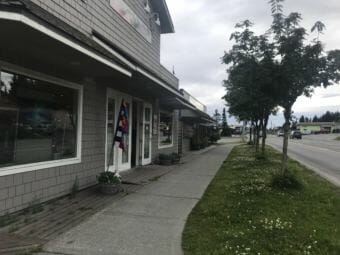
Alaska Marine Highway employees notified Whittier police about a “suspicious passenger,” who later turned out to be Hansen, according to an affidavit filed Friday by the Alaska District Attorney’s Office.
The charging documents do not say what made Hansen suspicious, but documents say Whittier Police pulled Hansen over after leaving the ferry terminal in a GMC Yukon.
Marshal Parke was also in the vehicle, according to police.
After obtaining a search warrant, police found the backpack filled with meth, which authorities say is the same bag Hansen carried onto the ferry in Washington.
Police also retrieved $8,000, a scale and drug paraphernalia. Investigators also say a boarding pass for Parke from Seattle to Anchorage was found.
Both Parke and Hansen are charged with possession with intent to distribute and conspiracy to distribute 500 grams or more of methamphetamine.
Shops line Pioneer Avenue in Homer (Photo by Aaron Bolton/KBBI)
The U.S. Supreme Court changed course on taxing online sales this summer.
The Kenai Peninsula Borough currently seeks to tax major online retailers, namely Amazon.
While taxing those sales may help cash-strapped boroughs like the Kenai Peninsula, local retailers hope the change will benefit their bottom line.
In June, the Supreme Court overturned a 1992 decision preventing states and municipalities from taxing online retailers without a presence in their jurisdiction.
States and communities that are not home to warehouses, stores or offices belonging to major online retailers can now tax their sales.
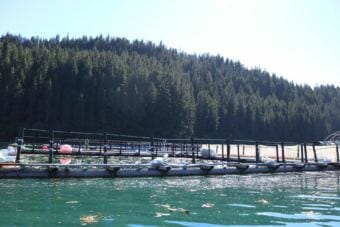
Kenai Peninsula Borough wants to tax most online purchases, and the Assembly likely will take up the issue this fall with the aim is to target consumers like Homer resident Danielle Meyers.
“I was born and raised in Alaska. So, I’ve resorted to online shopping most of my life,” Meyers said as her one-year-son sat on her lap at the kitchen table. “It has varied, but now as a mother, most of my online shopping is through Amazon.”
Meyers and her husband mostly buy household items like cleaning supplies, diapers and wipes through Amazon’s subscribe and save program.
“I even get my quinoa and my rice through that program,” she said.
Meyers would be happy to pay into the borough’s coffers through her online purchases, but local brick-and-mortar retailers hope taxing online sales will incentivize consumers like her to shop locally instead.
“I’m not sure how sensitive people are to the sales tax in the Homer area, especially with a $500 cap. The maximum impact on any transaction is $37.50,” said Patrick Mede, co-owner of Ulmer’s Hardware Store, which sells everything from firearms to gardening supplies. “Theoretically, you should see some change. How much of a change will it be for our business? I’d be interested to see. I don’t know.”
Having managed the store for the past two years, Mede said it’s difficult to determine how much business he loses to online retailers overall, but he said the largest impact he has seen is on high-end sporting goods like fishing rods and skis.
“People do more research online and they’re more apt to buy those online where they can get a deeper discount than here,” Mede said. “Lower value items, items that they need immediately, we see much less decrease in sales due to online sales — at least we think so.”
How online shoppers’ habits might change as a result of online sales taxes is hard to say.
There are more factors than just price, according to Mouhcine Guettabi, associate professor of economics at the Institute of Social and Economic Research.
“There’s the big question of are people actually buying the same things they would otherwise buy in their community online or not,” Guettabi said.
There isn’t a lot of data on what Alaskans are buying online and how many of those products are available in the communities they live in.
When it comes down to the fundamental question of whether consumers will be more apt to buy items from local retailers because of a sales tax, Guettabi said that still largely will depend on the base price of the product, though he does acknowledge taxes make a difference.
“When, for example, a community across the border from a state levies a tax, we do see people crossing the border to buy things that are not taxed,” Guettabi said.
On high-priced items like a fishing rod, the Kenai Peninsula Borough and Homer’s combined 7.5 percent sales tax might not be enough to close the gap between what consumers pay online and locally.
It might make a difference on items such as paper towels and cleaning supplies purchased from Amazon, where savings can vary and some items are actually more expensive.
But consumers like Meyers said she is still saving money.
“It’s still cost effective for me to keep shopping this way,” Meyers said. “I don’t think it will change the way that I shop online at all.”
Meyers adds that all those savings are delivered to her front door, providing a convenience with which local retailers may not be able to compete.
This is the latest skirmish in a battle over whether pink salmon hatcheries are causing more harm than good.

“This is the incubation room in here, and what we’re having here is stacks of incubators,” Cook Inlet Aquaculture Association executive director Gary Fandrei said, pointing toward stacks of incubators that look like the drawers to a really large tool chest. “We actually have a total of 359 incubators that we have available to us in here.”
The facility will harvest up to 125 million pink salmon eggs this summer. Depending on survival, most of those eggs will hatch in the fall.
Like other pink salmon hatcheries, the one at Tutka Bay has attracted scrutiny in the past couple of years over growing environmental concerns.
“The big issue that’s confronting us right now that seems to come up is the ocean carrying capacity,” Fandrei said. “Whether we’re putting too many fish out in the ocean for the ocean to be able to support that number.”
Critics raised another issue: a growing body of research indicates that biological problems can arise when pink salmon from hatcheries spawn with wild fish.
The Alaska Department of Fish and Game also is in the midst of a multi-year study on hatchery pink and chum salmons’ interactions with wild stocks. Several hatchery nonprofits and fish processors funded the study.
“What we’re really interested in understanding is how aggregates of pink salmon in Prince William Sound and Chum Salmon in Southeast Alaska genetically vary from one another,” Chris Habicht said, a geneticist working on the project.
Habicht said some species like sockeye can genetically vary within a single river system, but on the other side of that spectrum are pink and chum.
“Species like pink salmon have a much shallower population structure,” Habicht said. “In other words, genetically, they are more similar across a larger geographic area than other species of salmon.”
Habicht hopes the project will get researchers closer to understanding whether hatchery fish can skew the genetics of wild pinks and chums enough to make them less resilient over time.
Researchers also question whether too many hatchery fish are being released into the waters of the Pacific between Russia, Japan and Alaska.
Seattle-based Natural Resource Consultants president Greg Ruggerone has published several studies on the abundance of salmon and their diets.
By his estimates, pink salmon make up nearly 70 percent of all the salmon in the North Pacific.
Even though hatchery pinks are only 15 percent of that total, it’s still a lot of fish.
“That 15 percent of hatchery pink salmon translates to about 82 million hatchery pink salmon,” Reuggerone said.
Pink salmon are aggressive feeders, and Ruggerone’s latest study found large numbers of them are severely depleting zooplankton supplies in the Bering Sea.
“The plankton are the building blocks for the north Pacific, supporting sockeye salmon,” he said. “Those zooplankton also support other species that are consumed by chinook salmon or coho salmon.”
Ruggerone said seabirds also may be suffering from that ripple in the food web, and research like this is leading to more scrutiny for hatchery operators like Fandrei.
He said the industry takes these topics seriously, but when it comes to emergency petitions like the one the Board of Fish will consider next week, Fandrei is nervous about the outcome.
“I don’t want to see knee-jerk reactions, and I don’t want to see just an overzealous type change that could come up,” he said. “That might be something that would be negative to the hatchery program when it’s totally not necessary.”
It’s unlikely that the latest petition over the Solomon Gulch Hatchery will definitively tip the argument one way or the other, but both sides say it could signal a change in how the Board of Fish handles the growing body of concerns.
The board will take up the emergency petition on July 17, and its hatchery committee will meet for the first time in October.
Greg Gerard holds his latest guitar at his shop in Homer. (Photo by Aaron Bolton/KBBI)
David Gerard is an aspiring guitar maker who passes his skills onto young students around Homer.
Earlier this year, Gerard was one of three from the Homer area to receive project grants from the Rasmuson Foundation.
This is Gerard’s second Rasmuson, and he said this time, he wants to use that money to try his hand at building other stringed instruments.
His workspace below his house looks like any other woodworking shop — tools line the workbenches; Stacks of wood and other materials sit in the corner; and the smell of yellow cedar, Sitka spruce and other woods fill the air.
Gerard spends his time in the shop building custom countertops during the day.
“Counter tops and custom mill work. My brother made these actually, speaking of nice tone wood,” Gerard said, pointing to a couple of unfinished doors in the corner.
“That’s some old-growth yellow cedar from Southeast Alaska that was handpicked by the customer. None of it gets thrown away,” he said. “Any scraps from this that are as small as a ukulele, I will save it, repurpose it into an instrument.”
Other than a few guitar cases on one of the workstations, there aren’t many signs of guitar work, but that changes in the winter time.
After a long workday, Gerard returns to his shop in the evening long after the sun has set or on weekends to slowly pick away at his next project.
Gerard said it keeps him busy during the winter months, and he added that “it’s become a bit of an addiction.”
His affinity for guitar making started about seven years ago when he began performing in friends’ bands, and he decided he needed a professional guitar.
A Martin dreadnought was his first choice, but with a retail price of about $3,000, Gerard said that just wasn’t in the cards for him at the time.
“I just kind of had an idea. I had this great fully outfitted woodworking shop and I have skills, maybe I’ll look into building one,” Gerard said.

Over that winter, Gerard and a friend each built a guitar in his shop, following only the steps from a book on guitar making.
Gerard built his Martin D28 dreadnought, complete with herringbone accents and a small herring skeleton on the headstock.
“I thought that the herring skeleton would be appropriate, especially since we live in the maritimes,” he said. “We have herring here, fishermen and so on. (That’s) me being a little cheeky.”
After the first build, another friend approached Gerard about making a guitar and that annual tradition continued over the next couple of winters.
Eventually, Gerard decided to pass on the skills he had learned.
After his fourth build, he started taking on young guitar players from around Homer as students.
Gerard works with a local teenager weekly each winter, and it can take two years to finish a build.
“By the second winter, close to the end, the kids are twitching. They can’t wait to get strings on these guitars. That’s the real magical part,” Gerard said. “There’s levels of that throughout the build. Towards the bitter end, they can sense that we’re getting close.”
Although Gerard has spent the majority his time building acoustic guitars and a few eclectics with his students, he tries building other instruments.
He built his daughter a mandolin, and he’s also interested in learning to build other stringed instruments such as bouzoukis and citterns.
Gerard may spend his grant money from the Rasmuson Foundation on learning to make those instruments
“I’m either going to do that, or the other choice I really want to do is to learn to build archtops,” he said. “I have contacted an instructor in Pennsylvania that I may go work with this winter.”
Gerard said that will likely prevent him from taking on another student this winter, but he said whatever he chooses, whether its violins or mandolins, he hopes to eventually pass on those skills as well.
The Homer City Council’s meeting was canceled Monday after a mayoral proclamation caused some controversy.
The proclamation celebrated the LGBTQ community in Homer, and declared June as “Homer Pride Month.”
More than 70 emails both for and against the proclamation poured in throughout the day, City Clerk Melissa Jacobsen said.
Council members Tom Stroozas, Shelly Erickson and Heath Smith alerted the city that they could not attend, which forced the cancellation of the meeting.
Council member Tom Stroozas pulled out of the meeting because of the proclamation, he said, and said that it had remnants of a resolution from 2017 regarding inclusivity.
The “inclusivity resolution” as it’s known was the basis for a divisive recall attempt against three council members last summer, Stroozas said
Mayor Bryan Zak’s proclamation is similarly divisive.
“We’re trying to prevent that from happening again and creating a brouhaha in the council chambers tonight,” Stroozas said.
Council members Donna Aderhold and Caroline Venuti said they were both surprised by their peers’ actions.
“I think it’s kind of a slap in the face to the voters particularly and the people of our area that wanted Homer to accept the diversity that we have,” Venuti said. “When they just don’t show up and you cancel an entire meeting, it really is too bad for our city that this can happen.”
Local political group Citizens AKtion Network, known as CAN, also condemned the council members.
“This actually is dereliction of duty, and it certainly seems to be an offense that is worthy of recall,” CAN said in a press release. “I’m not in favor of recalling these three for a number of reasons, but we need to beat them soundly at the ballot box,”
Smith and Erikson could not be reached in time for this story.
Close
Update notification options
Subscribe to notifications
Subscribe
Get notifications about news related to the topics you care about. You can unsubscribe anytime.