KDLG - Dillingham

KDLG is our partner station in Dillingham. KTOO collaborates with partners across the state to cover important news and to share stories with our audiences.
After 33 years, Fish Radio’s Laine Welch hangs up her mic

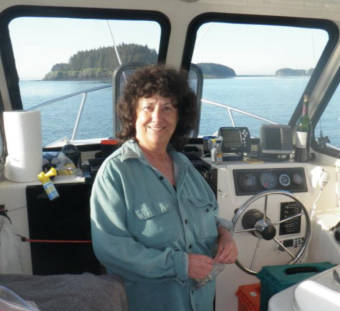
Laine Welch, producer of Alaska Fish Radio, known by her listeners as “Ms. Fish.” (KTOO file photo)

If you listen to radio in Alaska, or if you’re involved in the fishing industry, you’ll probably recognize the voice of Laine Welch.

“When I came here, I had never even seen a salmon,” she said. “My life was cod fish and haddock and lobsters.”

Welch served as host of Alaska Fish Radio for more than three decades, bringing news and perspectives on the fishing industry to listeners around the state.

Now, at age 72, she’s hanging up the mic.

“I have a lot of mixed feelings,” she said. “I really feel like the time is right. I mean, radio is my passion. And I think radio rules in Alaska, because of its remoteness. I have to admit that once I hit 70, I really got tired of the daily deadlines. But when I originally had decided to get out of everything, the writing and the radio, I really had some difficulty accepting that, because I still love what I do. I still learn something new every day.”

Welch came to Alaska in 1986 from Cape Cod, Massachusetts. She got a job producing the Alaska Fisheries Report at KMXT in Kodiak, where she learned the rhythms of commercial fisheries across the state.

“I really, really cut my teeth on not only the fishing activity around the state, but marketing impacts and how Alaska fits into the whole global network of the seafood commodities trade, which is the largest in the world,” she said.

Over the six years she worked there, the longtime news director of Dillingham’s radio station, KDLG’s Bob King, helped Welch learn the ropes of the industry.

“Five different species fished with different gears at different times. I was clueless,” she said. “And Bob King there in Dillingham just sort of took me under his wing and explained to me about the different salmon species and how they were fished. And he really saved my bacon, I’ll tell you.”

King helped Welch learn about salmon and crab, because of Bristol Bay’s sockeye and red king crab fisheries. And he suggested that Welch start writing for trade magazines.

“I had name recognition with radio by that time, after doing the Alaska fisheries report for six years,” she said. “So it was really easy for me to get sponsors. I started writing a newspaper column at the request of the Anchorage Daily News in 1991. And, you know, the rest is history. Here I am 30 radio stations and nearly 20 print publications, including three nationals, 30 years later.”

When Welch first started reporting on the seafood industry, she said, the state was flush with money. That extended to public radio, which meant she was able to travel to fisheries meetings.

Welch said what captured her attention was how fish influenced the economy.

She thinks it’s important for anyone who reads or listens to her work to understand how Alaska fits into the global commodities market. Those are her favorite shows – and they’re the most popular.

“On my website, those are the ones that I’ll get huge spikes if I talk about crab markets, or salmon markets, or what the catch forecasts are,” she said. “To me, it’s all about the marketing of the seafood. And you know, where it goes, what makes it sell what the trends are? Those are my favorites.”

Reflecting on her work, she said much has stayed the same. But there have been some major changes.

“Yes, Alaska has made big inroads in adding value to a lot of its products,” she said. “For example, in your region, gosh, you know, 20 years ago maybe 70% of the sockeye pack would go into cans in Bristol Bay. Now, that’s more like, you know, maybe 20, 25% going into cans because the processors have diversified their markets more into filet and specialty products.”

But she said most of Alaska’s seafood industry isn’t as efficient or as innovative as places like Canada, Iceland and Japan. A couple communities, like Kodiak, are using all of the fish. But that’s an exception to the rule.

“All of the other places, for the most part, are grinding up and dumping all those heads in the skin, and livers and other parts that could go into you know, a global, multi gazillion-dollar market for collagens, chondroitinase and oils. So to me, that’s something that I find that Alaska is getting left behind on.”

Welch will continue to write a weekly column for the Anchorage Daily News. And she’s ready for a new adventure.

“Maybe I’ll get into podcasting,” she said. “I want to get into some blogging. And who knows, I think there’s going to be a lot of unexpected things that will come my way that I haven’t even thought up yet.”

New Stuyahok man found alive more than 18 hours after he went missing

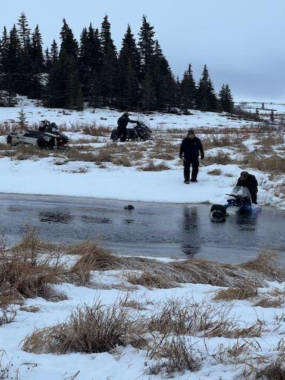
Several people looking at a snowmachine half-sunk in a frozen river
Searchers examine a snowmachine submerged in a creek about 40 miles from Dillingham. Thursday, Dec. 30, 2021.
(Courtesy of Frank Woods)

Searchers found New Stuyahok resident Andrew Wyagon alive last week, more than 18 hours after he was reported missing, said Alaska State Troopers.

Wyagon, 68, had left Dillingham on his snowmachine Wednesday morning, headed for New Stuyahok, a village roughly 50 miles away. But he didn’t arrive. He was reported overdue Wednesday evening.

Searchers couldn’t find him that night, according to troopers.

At daylight Thursday, the search resumed, said Frank Woods, coordinator for Dillingham Search and Rescue. He said a team of volunteers on snowmachines came across Wyagon’s trail. In less than three hours, they found him.

“Followed that until we came across him and his snowmachine in the river,” Woods said.

Wyagon was about 40 miles from Dillingham, about five miles from Portage Creek on the west side of the Nushagak River.

“It was really miserable conditions yesterday — foggy and really hard to see,” Woods said. “The rivers and the creeks had filled up with water. So it looked like he had tried to cross a flowing creek and his snowmachine submerged.”

Fortunately, he said, Wyagon was well prepared.

“He saved everything on the snowmachine, and went up, built a fire, dried off his clothes and changed into dry clothes,” Woods said. “Amazingly, he had a space blanket that helped keep all the chill off all night. Sitting in space blankets works wonders.”

He said Wyagon appeared to be in good condition and they took him to Dillingham. They also pulled his snowmachine out of the water and towed it back to town.

Woods said they were able to find him today because of a break in the snow.

“Like now would have been impossible, and last night it would have been impossible cause the tracks we were following were just etchings in the crust,” Woods said.

Woods said the search was a joint effort between volunteers in Dillingham, New Stuyahok and Ekwok, as well as the troopers, who looked for Wyagon by plane.

Youth art contest will envision what clean harbors mean for Dillingham

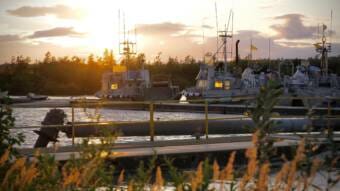
Boats in the Dillingham harbor. August 24, 2020. (Photo by Brian Venua/KDLG)

A youth art competition will help determine messaging for signs in Dillingham’s harbor in an effort to keep the water clean.

Alaska Sea Grant fellow Tav Ammu said elementary, middle and high school students in Dillingham can submit a design that shows what a clean harbor means to them.

“Just to remind folks when they’re using the harbor, that people care about pollution and to remind folks not to pollute, and that there are other options and good ways to manage waste while they’re there,” he said.

Along with Alaska Sea Grant, the competition also has support from the Bristol Bay Native Association.

Ammu is organizing the contest as part of his fellowship, which focuses on the Alaska Clean Harbors project. It’s the state’s branch of the Clean Marinas program — a national effort to clean up harbors, marinas and ports and keep them free of pollution.

While the effort is a big deal in the Lower 48, Ammu said, it hasn’t gained much traction in Alaska.

“So we’re trying to bring a little bit more life back into it and see what harbors and areas want more attention, and want to make it more of a priority because we all want clean waters for our salmon and our lifestyles,” Ammu said.

The state’s Division of Water began tracking water quality in Alaska ports and harbors in 2015. In 2020, there was a decrease in ship traffic during the pandemic. The division expanded the project to evaluate how that decline affected water quality.

The division selected sites to represent potential pollution — like small boat harbors, cruise ship ports and commercial shipping docks. It conducted testing at 16 ports from Nome to Ketchikan, and at 20 sites along major shipping lanes throughout southeast Alaska.

According to the tests, the amount of fecal coliform bacteria exceeded water quality standards in some Southcentral and Southeast ports, often around small boat harbors. There is no direct link between increased fecal bacteria and harbors, Ammu said. But raising awareness of pollution is a first step toward cleaner water.

“It starts with harbors, and there’s a huge amount of folks in harbors. And so if bad practices are being done there, it can get worse and worse and worse and get beyond manageable and really impact local ecosystems — and people.”

The state hasn’t monitored harbors in Bristol Bay yet. Ammu will continue to survey fishermen and residents on how they would rate the harbor’s cleanliness until Jan. 15.

The deadline for students to submit art for the signs is Jan. 31. The winner’s design will be featured on signs around the harbor, and they will receive a $50 gift card.

Send submissions via email or bring them to the Dillingham Elementary School. For more information, call Tav Ammu at 907-631-8361.

How a Dillingham teen turned an ancient epic poem into a rap

Tracen Wassily (Photo by Kendra Kapotak/KDLG)

Tracen Wassily wasn’t sold on the hefty “Epic of Gilgamesh,” a poem that dates back roughly 4,000 years.

“At first, I didn’t like it,” said Wassily, who is 16 years old. “But what I wrote about was the part I like most.”

Wassily is an 11th grader at Dillingham High School. He and his classmates in world literature recently got a unique assignment: transform the “Epic of Gilgamesh” —  the world’s oldest surviving epic poem — into a skit, essay or song.

For those of us who aren’t fresh out of high school, the story of Gilgamesh is a Mesopotamian poem about a hero who sets off on a quest to find the secret to immortality. Along the way, he forms a deep friendship and fights many battles.

When Wassily got the assignment to create something new based on the ancient text, he went right to work.

“Not even a day after — like right after school — I got to work producing a beat, a good rhythm, like a fast-paced rhythm for what I’m going to be doing,” he said. “’Cause that’s what I’m most comfortable on.”

Wassily said he drew inspiration from some of his favorite artists, like Denzel Curry, XXXTentacion and Zillakami.
“They just have really good energy, really good lyrics,” Wassily said. “And their delivery is just, like, perfect, for me. Their production team, their engineering, it’s just all really good.”

His song is called “G and Enkidu,” and it’s about a minute long. He said to compose it, he focused on matching the rhythm he created on an app on his cellphone to the emotion in the poem.

For example, take Humbaba, a monster in the story. Gilgamesh and his friend, Enkidu, embark on a journey to kill Humbaba.

Gilgamesh is the son of a goddess and a mortal, and a fierce king. But he’s also undiplomatic and greedy. So his mother helps create another man, Enkidu, out of a piece of clay to serve as Gilgamesh’s friend and distract him from his immoral ways.

“The stuff I was rapping about, or singing about, was fast-paced as well, so it kind of fit really good,” said Wassily. “They were fighting Humbaba.”

Wassily chose to rap about Gilgamesh mourning Enkidu because of the powerful emotions each sentence evokes.

“He’s laying him down on a magnificent bed, a bed of honor,” Wassily said. “He’s saying the rulers of the underworld will kiss your feet. Like, all of this stuff, just for him.”

Looking ahead, Wassily said he wants to continue producing music, but it probably won’t be based on ancient poems.

Listen to “G and Enkidu”

Lyrics by Tracen Wassily:

G and Enkidu on a quest for glory
slayin Humbaba is the start of his story
our heroes make it to the gate
but before they serve H his fate
they feel their knees shake
they feel their stomachs ache
couple minutes later kidu slashin with his saber
the repercussions of this act kidu gonna feel later
enkidu lay down before G
his tears flow down both his cheeks
in his dreams
he could see
that the underworld is where he will be
his side kick
12 days sick
enkidu will cease to exist
accepted by his mother
un replaceable by another
G left without a brother
now his heart is in the gutter
no more Enkidu G alone now
he let everybody know in his hometown
that he and Enkidu separated no more bro now
now he walk around like a husk with a bold frown
he can’t process that he’s gone now
this is the end of Gilgamesh’s song now

Bristol Bay, like Bethel, recorded its coldest November in 80 years

Snow in Dillingham (Izzy Ross/KDLG)

Bristol Bay has recorded its coldest November in 80 years (and so has Bethel) after low temperatures settled over much of Alaska last month.

“This is going to be by far the coldest November of record in King Salmon,” said University of Alaska Fairbanks climate scientist Rick Thoman. “In fact it’s going to be so cold, that if this were December, it would be a top 10 coldest December.”

On Nov. 27, the temperature in King Salmon plunged to 28 degrees below zero, which tied an all-time record for November. In Dillingham, the temperature hit negative 21 degrees.

“While we don’t have as good climate records for Dillingham as we do King Salmon, it sure looks like this is the lowest temperature in Dillingham since 1963,” Thoman said. “The all-time record for November was set that month at 26 below.”

A graph showing temperatures from the Alaska Climate Research Center’s station in King Salmon, Alaska. (Image from Alaska Climate Research Center/Geophysical Institute, University of Alaska Fairbanks)

Dillingham set another record early Nov. 29 with wind chills at negative 41 degrees. That’s the lowest November wind chill for the area in the past 50 years.

Thoman said that weather patterns in the Bering Sea have directed storms south of the Aleutian Islands and the eastern Gulf of Alaska. That’s kept a cold northerly wind blowing across the western part of the state.

“As a result, most places have not had very much snow and the cold has hung in,” he said. “And it’s really the stability of that pattern. It’s not like cold snaps in November don’t occur but they’re often punctuated by Bering Sea storms that come along and warm things up. Not this year.”

The cold air helped create sea ice growth in the Bering Sea and Bristol Bay. Thoman said that early season ice growth is the best it’s been since 2012.

“And that of course will also contribute to the potential for cold weather,” he said. “Now if we go into a sustained warm pattern, especially in Bristol Bay, that ice could get eaten away. But we’re off to a much better start than we have been in nine years.”

According to NOAA’s Climate Prediction Center, temperatures will likely lean below average for the Bristol Bay region through February. La Niña conditions at the Pacific equator are also supporting high pressure systems over the Bering Sea — which means those cold northerly winds should continue for the region over the next three months.

Bristol Bay salmon processors boost prices amid favorable markets for sockeye

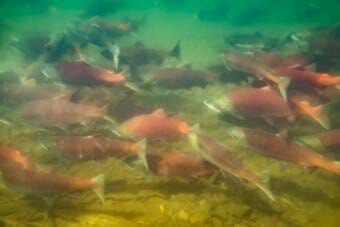
Sockeye in Yako Creek. July 18, 2021. (Photo by Brian Venua/KDLG)

Salmon processors in Bristol Bay are boosting the prices per pound for sockeye amid favorable markets. Preliminary data released by the Alaska Department of Fish and Game in November suggests better prices and increased demand over 2020’s salmon season. That improvement extends beyond Bristol Bay, as more fisheries across the state had better harvests this year.

Processors like Silver Bay Seafoods and Peter Pan Seafoods have adjusted their ex-vessel price or price per pound for sockeye this fall. Silver Bay is now paying out $1.45 per pound of sockeye to fishermen — a 20-cent increase from the previous total of $1.25. Both processors are also offering more money for better quality fish.

Abby Frederick is a spokesperson for Silver Bay.

“Obviously the base price comes out or it’s announced earlier in the season,” Frederick said. “Now that we can see where it’s at, where sales are going and really have a confident look we’re excited to celebrate that with our fleet.”

Peter Pan Seafoods is also upping its base price by 20 cents, to $1.45 per pound, according to a statement from Vice President of Operations Jon Hickman.

Before the 2021 season started in June, Peter Pan set an initial price of $1.10. It was the first time in decades that a Bristol Bay processor had told fishermen what they’d make before the season started. After some record-breaking runs in July, they bumped the price to $1.25.

They’re notable increases compared to last year. According to preliminary data released in October from the Alaska Department of Fish and Game, the region’s final adjusted price in 2020 was $1.06.

Bristol Bay Regional Seafood Development Association’s CEO Andy Wink says the COVID-19 pandemic and poor salmon runs made last year unusual.

“The only thing COVID did was, it created a massive increase in general business risk,” Wink said. “If we all think back to March April May, we didn’t know what the next two weeks were going to look like. Makes it very difficult for businesses to make long-term plans and so that affects how buyers buy.”

Sockeye supply declined by 23% in 2020. Wink says if you exclude the Bay, 2020 was one of the lowest harvests since 1979.

“Some years you can have other species not doing as well,” Wink said. “You know just not as much product and not as much revenue to work with that year. It’s hard to say what sort of impact that has exactly, but it’s not great if you’re trying to run a processor business. Fishermen and processors are linked pretty closely right? What affects one affects the other.

But this year, preliminary data suggests that global sockeye production is up by 10%, or 330 million pounds. That’s attributed not only to Bristol Bay but better runs and harvests outside of the region.

In Alaska, the estimated total harvest went from 517 million pounds of sockeye in 2020 to 858 million in 2021.

A few areas more than doubled their harvest per pound this year. In Southeast, harvest went from 74 million pounds to 198 million. The Prince William Sound area had the largest increase of 102 million pounds of sockeye to 236 million. And the Alaska Peninsula and Aleutian Island areas jumped from 35 million pounds to 97 million. Bristol Bay’s harvest was consistent with last year’s total at 200 million pounds.

On top of better salmon runs and harvests, the demand for sockeye in the U.S is also on the rise. Wink says more retailers are starting to carry sockeye. And the rise in demand is driving up the price. For example, Bristol Bay’s first wholesale value for frozen headed and gutted salmon through the months of July and August are up by $1 at $4.33 per pound, while frozen fillets are up by 75 cents.

The average price of sockeye fillets retails at $12.94 per pound. It was $11.99 in 2020.

“Typically, they’ll either sell it frozen, or they’ll slack it out and sell it out of their case as a chilled product,” Wink said. “The more stores that are doing that, the more demand there’s going to be. People that have a Costco near them probably have seen sockeye in Costco as well as Sam’s Club and a lot of other places. But that’s probably not something that was there several years ago on a year-round basis.”

Overall, it’s estimated that seafood processors paid fishermen working in Alaska a total of $643 million this year. That’s more than double last year’s total. Bristol Bay leads all areas with a value of $248 million which is about 40% of the statewide total. It was also a record year for salmon runs in the Bay, with 65.8 million fish.

Next year could also be another record year for Bristol Bay. Fish and Game’s preseason forecast predicts a run of 75.2 million fish.

Site notifications
Update notification options
Subscribe to notifications