KDLG is our partner station in Dillingham. KTOO collaborates with partners across the state to cover important news and to share stories with our audiences.
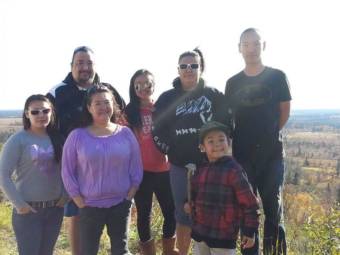
Dillingham resident Leo Roehl was one of three names drawn last week as a winner of $49,000. He says he’s still in shock.
“I mean, I couldn’t believe it,” Roehl said. “Still kind of a dream — still waiting to get pinched.”
Roehl and his son both got sick toward the end of September. They thought it was the flu, but then they tested positive for COVID-19. Both quarantined for 10 days, which is required under the City of Dillingham’s current emergency orders.
After those 10 days, Roehl decided to get the shot on his way to get a COVID-19 test before a doctor’s appointment.
“I figured, well, I’m here at the clinic — I might as well get my COVID shot too,” Roehl said. “I told my son Jaden I wasn’t going to do this COVID shot without him. So I pulled him out of school. We went to the clinic, filled out the paperwork, got our COVID shots, he got back to the courtesy van, went back to school and I went on to my appointments.”
And that night, Roehl and his son signed up for the sweepstakes. About a week later, Roehl won. He says he plans to use that money to address some health issues.
“Physical, mental and emotional with the stuff I’m going through,” he said. “I had a stroke in February. Trying to get help here and I get referred, referred. So now this will give me a nice nest egg to be able to move closer to a hospital in a place where I can get the assistance that I need.”
Roehl says he encourages others to get vaccinated as well.
“Definitely,” he said. “Let’s do it for our elders and our children.”
The deadline to enter the sweepstakes is Oct. 30.
The sweepstakes launched on Sept. 2, 2021. About 123,500 vaccinated people entered the competition before the first week, according to the Alaska Chamber. Since then, 7,789 newly vaccinated people have signed up for the sweepstakes.
Screengrab of the Alaska Earthquake Center map showing the 6.9 quake that hit 70 miles east of Chignik. Monday, Oct. 11, 2021.
A 6.9 magnitude earthquake struck about 70 miles east of Chignik Bay shortly after midnight Monday morning, according to the U.S. Geological Survey.
Jennie Grunert lives in the neighboring village of Chignik Lagoon with her husband and two children.
“We woke up to hearing the rattling of everything in the house. We got up, we ran to the kids’ room to make sure they were OK. And then we got our earthquake bucket that we have ready, as well as our survival kit, and just waited for the tsunami warning, which never happened,” she said.
“That one was really big. And that one lasted a really long time. This one was actually a really short earthquake, so it didn’t last very long,” Grunert said.
Because there was no tsunami warning, Grunert and other residents didn’t have to evacuate their homes.
Still, Grunert said they were ready to head to higher ground. She and her husband came up with the idea for an earthquake bucket after the 7.0 magnitude quake hit Anchorage in 2018.
They lived in Anchorage at the time, and two friends from out of town were watching their dog.
“They were not prepared for an earthquake whatsoever, cause when you usually go into Anchorage you’re not ready for something like that,” she said. “So we came up with the idea of putting a bucket together.”
The bucket contains basics like an emergency radio and flashlight. Since they have little kids, Grunert said they also have snacks, extra clothes and games.
“And then also ways to communicate — cell phone chargers, things like that. So when we have to go we can just grab our five-gallon bucket and pretty much head out the door. Take some water and then we are set for at least 24 hours,” she said.
The Associated Press reports that this is one of the largest aftershocks since the 8.2 magnitude quake struck the region in July. It says that so far, the state’s emergency management center has reported no major damage.
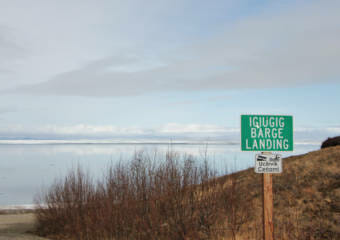
Igiugig’s barge landing in March, 2019. (Izzy Ross/KDLG)
In 2015, the Village of Igiugig paid Michael Dismer to build a tugboat.
The village had received a federal economic development grant for the vessel, and hired Lakeland Marine Builders, the company owned by Dismer, to construct it. The Igiugig Tribal Council would go on to pay a total of $242,375 for the tugboat.
But Igiugig never received it.
According to a news release Friday from the Department of Justice, the village was one of 22 customers defrauded by Dismer between 2013 and 2018.
Last April, Dismer admitted to the fraud and pleaded guilty to tax evasion.
The Justice Department says that to avoid taxes, Dismer stopped operating under business names that owed taxes but continued to make money through newly created businesses. Since 1993, he operated at least eight different businesses that built a range of vessels.
In December 2015, the Village of Igiugig paid Dismer $96,0000. Dismer immediately used $70,000 of that money to purchase a construction facility in Stockton, Missouri. He then transferred the title of that property to another company, Cardgames on Motorcycles, Inc. The sole shareholder was a 21-year-old — an effort to keep the real estate beyond the reach of the IRS and other creditors.
In all, Dismer received more than $4 million from customers for the construction of vessels. But he never fully delivered on his promises, instead spending much of the money on personal expenses.
He claimed that construction was on schedule and provided misleading documentation, like photographs, to his customers to convince them to make their next payments.
Fourteen customers received vessels that the Justice Department called “incomplete, inoperable, or unseaworthy” after they paid Dismer more than $2.9 million. At least seven customers paid a total of more than $1.3 million but saw no vessels at all.
Dismer did not file business or personal income tax returns for 2009 through 2017. To evade paying taxes, he used 28 different bank accounts at six banks and transferred funds between those accounts. Between 1996 and 2007, he also collected payroll tax from his employees but withheld $430,000 of federal income and payroll taxes from the government.
A federal judge sentenced Dismer Friday to five years in federal prison without parole for failing to pay more than $768,000 in state and federal taxes, which he now has to repay.
The court also ordered him to pay $4.3 million in restitution to the fraud victims.
As part of his plea agreement, Dismer had to sell the property he bought with Igiugig’s money and liquidate all other assets.
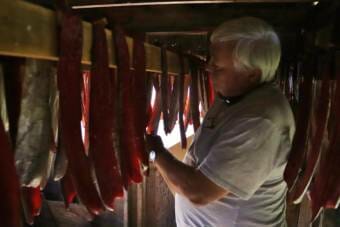
Gene Carlson checks red salmon strips in his smokehouse on July 16, 2021. Carlson was born in Chignik Bay but lives in Washington state now, usually returning in the summer to fish. He says this may be his last season. (Izzy Ross/KDLG)
Gene Carlson drove the streets of Chignik Bay one afternoon in July, between quiet wooden houses and old cannery buildings.
“That used to be a restaurant there,” he said. “That’s a web loft over there, which is shut down now. Here’s another one of my cousin’s houses. He’s not living there anymore.”
The Chignik River’s salmon runs have sustained generations in the century-old small fishing communities along the Alaska Peninsula.
But, for the fourth year in a row, the runs came in severely low. For years, residents have struggled to earn a living fishing and to put up enough fish for the winter, and some worry their villages will disappear, taking with them a fishing tradition that connects their families to the region.
Carlson was born in Chignik Bay, which is now home to around 90 people. He has fished commercially since he was a kid in 1961. Now he lives in Washington state and usually returns for the summer. Driving through the quiet village, he says this may be his last season.
“If we have another prediction like this year, I don’t think I can come back,” he said. “It’s expensive. ‘Cause you know, we come back, we bring food for the whole summer, ‘cause we’ve got to feed our crews, which you can’t find anymore.”
Gene Carlson with his nephew. July 16, 2021. (Izzy Ross/KDLG)
The area comprises Chignik Bay, Chignik Lagoon, Chignik Lake, Perryville and Ivanof Bay, and it’s been home to Native people for millennia. The village of Kalwak was previously located there, but it was destroyed when Russians came to the area during the fur boom in the late 1700s, according to the Lake and Peninsula Borough. Chignik Bay and Lagoon were established as fishing communities in the late 1800s, and more people of Alutiiq, Aleut, Russian and Scandinavian descent moved to the area.
The salmon runs are central to people’s lives in many ways. The economy has developed around the commercial fishery, and fish also provide food for the winter.
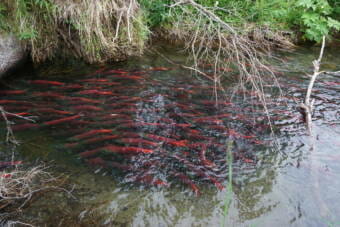
Some people think climate change is causing the runs’ decline. Others point to fishermen in other places catching Chignik-bound fish. Regardless of the cause, people are anxious that without the runs, the communities will die.
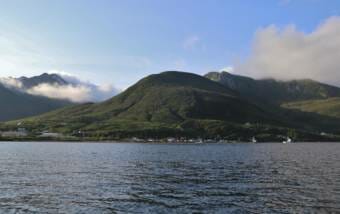
Chignik Bay. July 16, 2021. (Izzy Ross/KDLG)
The village of Chignik Lagoon, home to about 70 year-round residents, is an hour’s boat ride along the bay’s shoreline.
“It’s protected by that sand spit, which is a natural breakwater,” George Anderson said as he navigated his boat through the lagoon.
Anderson fishes commercially and for subsistence. He’s also the president of the Chignik Intertribal Coalition, which was formed after the run collapsed in 2018.
Earlier this summer, the run was so low that some people chose not to put out nets for subsistence fish. They were worried about harming the fragile run.
“We had something that we took for granted in the past — that the fish were just always going to be there for, you know, smoking, salting, freezer, whatever,” he said. “And to have that not be there for you is just something we were never prepared for. Never imagined even not subsisting.”
The low runs prompted federal managers to restrict subsistence fishing for sockeye to all but rural residents. King salmon fishing was closed completely in state and federal waters.
George Anderson on his seiner. July 16, 2021. (Izzy Ross/KDLG)
Since the Chignik run collapsed, much of the debate has centered on another state-run fishery to the south, called Area M. Critics see it as an intercept fishery, where sockeye traveling through are harvested before they can reach fisheries closer to spawning grounds, like Chignik.
This year’s early sockeye run didn’t meet its escapement goals — the minimum number of fish that managers want to see make it up the river. The late run did, and some people were able to fish. But the commercial fleet was just a fraction of its normal size. The area biologist said 15-20 boats fished, instead of around 60.
Some scientists have connected fishery failures in the Gulf of Alaska to marine heat waves in the past decade. But state research biologists also say it could be because of habitat changes in the salmons’ spawning grounds.
Salmon are notoriously difficult to research because part of their lives are spent in the ocean — a vast expanse that is mostly inaccessible to biologists. Along with warmer waters, a loss of spawning habitat might increase competition for habitat between Chignik’s two sockeye runs.
Anderson said the Chignik villages are shouldering the burden of conservation. He pointed to Area M, where South Peninsula fishermen landed more than 3.8 million sockeye this summer, and said the state wasn’t considering studies that showed Chignik fish caught further south in its management decisions.
Kevin Shaberg, a finfish research coordinator for the Alaska Department of Fish and Game based in Kodiak, said the situation is tough.
“It’s hard to understand that, you know, everybody else gets to go fishing, but you got to sit home next to the river and watch no fish go by. And that’s tough. And it’s something that we’ve, we’ve tried to handle in the past,” he said.
In previous years, he said, the department has limited fishing in nearby areas when Chignik was low. But Shaberg said the burden of conserving a run usually falls on the areas closest to where those fish should be returning to spawn.
“[Area M is] a traditional fishery that’s mandated and directed by the Board of Fish for us to prosecute, and we follow the management plans that are put in front of us,” he said.
The village of Chignik Lagoon. July 17, 2021. (Izzy Ross/KDLG)
Many people have asked for genetic sampling of harvests further south, in Area M, to figure out where Chignik fish are being caught. The state conducted tagging studies in the 1960s, and as late as the 1980s. In the 2000s, it conducted genetic studies in Area M in a project known as the Western Alaska Salmon Stock Identification Program, which showed fish from several stocks moving through — some of the sampled salmon were headed to the Chigniks, while in certain places, most of the fish were going to Bristol Bay or areas to the east. The state continued sampling in the early 2010s in parts of the area; the majority of fish caught during those studies were bound for the Chigniks, though percentages varied between areas and sampling groups
Still, Shaberg said, distribution of those catches change from year to year, so managers don’t know whether that applies to a given season. And the department hasn’t done additional testing in the area in years, he said, mostly because the state doesn’t have the budget for it.
Another question is what a study would seek to accomplish. Shaberg said a snapshot of genetics from one year, in one area, doesn’t help understanding of what’s happening or how to address it.
“One of the big issues for myself is that, you know, how long are we going to do this?” he said. “What’s the design for this? What are we really trying to answer?”
Shaberg said the department does plan to research the watershed, to try to figure out if something in the freshwater environment is affecting fish.
The Chignik Intertribal Coalition, along with state and federal agencies, has plans to research the river’s dwindling king salmon. That depends on funding approval, which they’ll find out about next year.
One of the coalition’s members, the Ivanof Bay Tribe, also received a $65,000 Tribal Resiliency Grant from the Bureau of Indian Affairs; it will partner with the coalition to gather environmental observations from Tribal members in the area.
But Chignik residents have had to contend with other forces, too. Anderson said they haven’t yet received the federal disaster relief money they were promised after the 2018 run failure. And due to the COVID-19 pandemic, the next Board of Fish meeting, which was supposed to take place this year, has been delayed until 2022.
Some industry organizations have tried to help as well. Last summer, Northline Seafoods, a commercial processor, donated thousands of Bristol Bay sockeye to the Chigniks. Lots of people said receiving that fish was helpful, but subsistence isn’t just about food; it is also a connection to place and family, as people work together to harvest.
A Chignik Lagoon beach. July 15, 2021. (Izzy Ross/KDLG)
On a warm evening in Chignik Lagoon, Al Anderson shucked clams with his wife, the shades of their house drawn to keep the heat at bay.
“It’s our lifeblood. Chignik’s going to go away — all the Chigniks are going to go away if we can’t get this run back up to where it used to be,” Anderson said. “You know, the young people are moving away. There’s not much for them here.”
Many of those who have moved away return in the summers to fish, including one of Anderson’s daughters.
“It’s so important that she comes back every year to do it. Typically it doesn’t take her three weeks to get her subsistence fish, you know,” he said, laughing. “Of course she comes back to visit, too, so that’s good.”
Elder Vivian Brandal, 80, and has lived in the Chignik area all her life. Now, she goes to Kodiak in the winter.
She said it’s difficult to comprehend what is happening.
“Subsistence fishing is a lifeline. I mean, we depend on that. That’s something we’ve done all our life,” she said. “It’s something we really depend on actually, not only fishing, but we used to be able to get caribou. We’d get caribou every year. You can’t even do that anymore.”
Brandal said the lower sockeye runs have changed the future of the Chignik communities.
“That’s five villages that depend on this fishery, and you look at it, you think, how can the state let this happen? How can they just let this happen without doing anything about it. I have grandchildren that thought this was their legacy,” she said.
Vivian Brandal in her backyard. July 16, 2021. (Izzy Ross/KDLG)
Brandal doesn’t think the state has managed the fishery correctly. She, along with many others, wants the state to be more responsive to the drop in the run and thinks it should conduct studies on why the fish aren’t coming back.
Still, Brandal is hopeful; she’s inspired by Katie John, an advocate and defender of Alaska Native subsistence rights who petitioned the state and federal government to allow for traditional fishing in her home.
“She fought for what she believed in, and that’s what I think we should do,” Brandal said. “We believe in this and we should fight for it. I won’t be able to anymore, but I just think the young people really ought to. It’s just, it’s very emotional for people. I’m sorry, I shouldn’t be crying, this is crazy. But it’s very hard.”
Brandal thinks they should work together to find a way forward, too.
This article has been updated to include additional context on the state’s genetic testing in Area M.
Sockeye in a creek in the Wood River watershed. July 28, 2021. (Stephanie Maltarich/KDLG)
This summer, Bristol Bay set a record for the largest sockeye run: 65.86 million salmon returned. That’s much higher than the pre-season forecast of 50 million salmon, and the run hasn’t finished yet.
But why Bristol Bay is such a sockeye hotspot poses a puzzle for scientists.
“The question of why so many sockeye have returned to Bristol Bay the last seven or eight years is a bit of a mystery to I think most people, if not everyone,” said Daniel Schindler, a professor and ecologist in the school of Aquatic and Fishery Sciences at the University of Washington.
Schindler is also the principal investigator at the Alaska Salmon Program — a research project that has documented the watersheds surrounding parts of Bristol Bay since the late 1940s.
This was Schindler’s 25th year exploring and researching the Wood River system, one of the nine rivers feeding into Bristol Bay.
As part of the job, he spends most of his days from mid-June through mid-September walking a couple miles up and down obscure creeks and rivers, counting salmon as they return to their spawning grounds.
This was Dan Schindler’s 25th year researching the Wood River system. July 28, 2021. (Stephanie Maltarich/KDLG)
By the end of July, only a fraction of sockeye have returned to spawn.
“I mean, this looks like a lot of fish, but the peak is still about 10 days away,” Schindler said while tallying sockeye on a July afternoon.
But not every area of Alaska is seeing a lot of fish.
With access to decades of data, Schindler and his colleagues are trying to make sense of what sets Bristol Bay apart.
One factor, he said, might be water temperature.
Western Alaska is one of the fastest warming places on earth, and scientists have had to re-scale their charts over the last decade to adapt.
“Climate warming seems to have actually benefited Bristol Bay sockeye — warmer temperatures, more food, more growth opportunities, and they are still in the sweet spot of water temperatures that are still profitable,” Schindler said.
Other parts of the state aren’t as lucky. Ocean waters are a few degrees warmer in the Gulf of Alaska, and that slight difference has challenged fish populations south of Bristol Bay.
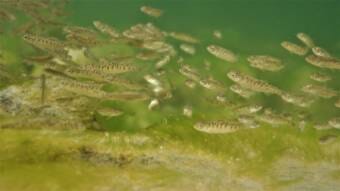
Schindler said another possibility for Bristol Bay’s success is the area’s large and intact habitat. The surrounding watersheds are uninterrupted by roads, dams and other development.
“That’s one of the reasons Bristol Bay is so unique, is that all of that habitat diversity is still here, and all of that genetic diversity in the salmon and life history diversity is still here,” he said. “And it’s interesting scientifically, but it’s also important for the fishery, because all of that diversity stabilizes how many fish come back from year to year.”
Sockeye carcasses. June 28, 2021. (Stephanie Maltarich/KDLG)
It’s normal for fish populations to fluctuate. And while at some point Bristol Bay will likely see a smaller run, Schindler said he remains optimistic.
“It’s hard to believe the 50 to 60 million fish per year that we’ve been seeing — never mind the 64 million fish that we’ve seen this year — is going to continue at that level forever,” he said. “But if we look into a crystal ball for the next century and look at the fact that the world is warming, there is no reason to believe that Bristol Bay salmon populations won’t continue to flourish even under substantially warmer temperatures.”
But Schindler admits the ocean is a complex place full of many unknowns that scientists still don’t fully understand.
“Really the question is how much more warming these systems can withstand before they get too warm, like California and other places in the Pacific Northwest,” he said.
Schindler plans to return to Bristol Bay each summer to count the salmon and better understand how the warming climate is impacting the world’s largest sockeye salmon fishery.
Salmon fry swimming through rocks. (Brian Venua, KDLG)
Bristol Bay is home to the largest sockeye run on the planet. But while the size of this year’s run broke records, the fish are getting smaller.
Last year’s average weight for sockeye was 5.1 pounds. But the 2021 average was just 4.5 pounds, according to the McKinley Research Group.
Jon Hickman, the executive vice president of operations for Peter Pan Seafoods, said the smaller fish play a role in how much time processors spend processing.
“Smaller fish are going to take longer to process,” he said. “So you’re handling a 4 pound fish or a 3 pound fish, as opposed to a 5 pound fish, so every time you handle one there’s a two pound difference. There’s more labor going into those smaller fish. You get more labor into them, there’s more costs associated with those smaller fish.”
Hickman said he isn’t worried about how the smaller fish will play in Peter Pan’s markets — demand is good, and he’s comfortable with the market for fish big and small.
But why are Bristol Bay’s salmon shrinking? First, the returning fish are younger than normal.
A salmon’s age is measured by how many years it spends in the ocean. A 2-ocean fish, for example, has spent two years in the ocean before returning to its spawning grounds.
Greg Buck, a biologist for the Alaska Department of Fish and Game, said most fish that returned this year only spent one or two years in the ocean instead of three.
“I’m gonna be gambling like it’s somebody else’s money when it comes to the age of 1-2s in the next year’s forecast,” he said. “I’ve been burned a couple of times. I’m normally kind of conservative when I forecast, but this year I might not be.”
But Dan Schindler, a researcher with the University of Washington’s Alaska salmon program, said fish are also smaller for their age.
“The size of fish has declined for their age,” he said. “So the size of 2-ocean fish has been declining slowly over time, and the size of 3-ocean fish has been slowly declining over time.”
The sheer number of fish can lead to more competition for food in the ocean. Large runs — like this year’s record — tend to have smaller fish.
There were record-high catches of salmon in the North Pacific in recent years, according to the North Pacific Anadromous Fish Commission. Last year was an anomaly in the trend toward larger populations, as catches dropped to the lowest levels in four decades.
Schindler thinks the recent abundance is due to an increase in hatchery pink and chum salmon.
“This declining size at a given age is really a function of more hungry mouths from lots of Bristol Bay fish, but also more hungry mouths that we’re dumping out into the ocean,” Schindler said.
Until recently, scientists and the fishing community didn’t pay much attention to the shrinking salmon trend. That’s because in the 1970s, more salmon started to spend an extra year in the ocean. And older fish usually come in bigger than their younger counterparts. But Schindler says in the last 10 years, more fish have returned after two years.
“So right now, we’re sort of seeing the effect of a double whammy on fish size,” says Schindler. “And the last four or five years — we’ve seen a lot of really small fish in the catches and the escapements,” he said. “That’s because there’s a lot of 2-ocean fish, and those 2-ocean fish are relatively small given the history of Bristol Bay.”
Warming oceans also may play a role. But Schindler said the connection is less direct. Warmer oceans have been correlated with increased survival for Bristol Bay salmon, which means more competition for food.
Correction: This article has been updated to reflect that while there were record harvest numbers for North Pacific salmon in 2018 and 2019, the 2020 catches were the lowest in four decades.
Close
Update notification options
Subscribe to notifications
Subscribe
Get notifications about news related to the topics you care about. You can unsubscribe anytime.