KDLG - Dillingham

KDLG is our partner station in Dillingham. KTOO collaborates with partners across the state to cover important news and to share stories with our audiences.
Rapid erosion threatens set net fishery in Southwest Alaska village

A truck bed equipped to chill a set-netter’s catch. In Ekuk, fishers are able to set nets by truck, and the local processor collects catches from truck beds. (Brian Venua/KDLG)

It’s midmorning in Ekuk, as people get ready to pull nets from the beach and pick fish. Kay Andrews, an Aleknagik resident, is cutting a Chinook salmon for dinner later.

“I think what makes us unique is, we have Ekuk fisheries,” Andrews said. “They support their fishermen by providing eyes and we deliver by vehicles, trucks.”

Kay Andrews with a Chinook salmon. (Brian Venua/KDLG)

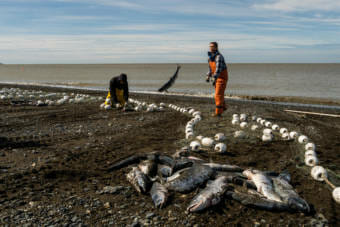
Ekuk is different from many other beaches in Bristol Bay. Fishers are able to set nets by truck, and the local processor collects catches from truck beds rather than a tender collecting fish from skiffs. The beach acts as natural infrastructure for the fishery. But the rapidly eroding coastline takes away a top layer of gravel. That causes weight issues for the trucks delivering large catches to the processor about a mile away.


The village is southeast of Dillingham, and two winter watchmen live there year-round. Andrews and her family have a long history of set netting in the village. Her grandfather ran Columbia Ward Fisheries for over 20 years, and her grandmother has sites along the bluff where her cousin fishes. She says set netting by truck gives Ekuk fishers a slight advantage over those that transport their catch by boat.

“I think we can get our fish processed quicker versus getting it into a holding cell, in a processor, then getting it barged to the cannery sight,” Andrews said. “So we pick the fish out of the net, place it in the slush water or ice water, then we deliver it to the cannery.”

That advantage has waned in recent years, with the introduction of ice and refrigerated seawater systems to chill fish on boats.

A truck pulls a net from the beach, while boats in the distance fish from the sea. (Brian Venua/KDLG)

“You know, I think days are different now, compared to what my grandfather used to do,” she said. “They used to pick fish one by one with a pick on the beach. With no ice, but that was all canned back then.”

Further down the beach, another set netter, Julie Wiss, is picking fish with her son Ryan. Wiss grew up fishing in Ekuk and each season they return to work on the family site. She says some of that change is due to a demand for higher-quality salmon.

“Now there’s a lot of fillets and people want pretty stuff and everyone’s aware of it,” Wiss said. “You know people pick their nets and clean them, much more — the ropes, the nets, the lead lines — all much better. So in that way, it’s changed a lot but same concept.”

Julie Wiss (right) and son Ryan (left) pick fish at their site in Ekuk. Wiss grew up fishing in the village and returns each summer. (Brian Venua/KDLG)

Beyond new tech and products, the rapidly eroding coastline looms over the fishers. The village is losing about 5 feet of coastline per year, a rate that’s doubled over the last century. Set-netter Jamie O’Connor grew up in Ekuk. As a kid, O’Connor would play and climb the bluffs.


Jamie O’Connor outside a cabin in Ekuk. (Brian Venua/KDLG)

“It’s been really interesting to look at it through that lens and see how the changing shore ice conditions in the winter are impacting how quickly the bluff is eroding,” O’Connor said. “It’s made of silt and composite rock that is vulnerable to the ocean.”


Weather events like severe wind storms rip away large chunks of the coastline.

Each season, Fish and Game sets regulations for how big or wide a site can be. O’Connor says they have to make constant adjustments to their sites.

“We’re happy to do that, but it makes you a little more aware of how the coast is changing,” she said. “But at the same time, it’s been changing my whole life and my great-grandparents’. I mean my great-great-grandmother had a wall tent at first creek and she would stay there and watch the net. That’s the site people in our family still fish but it looks very, very different.”

Researchers from the University of Alaska Fairbanks traveled to the region this summer to install new erosion monitoring equipment. Ekuk’s Village Council also recently applied for a climate change and resiliency grant.

Kay Andrews hopes to see a long-term solution for the village.

“I could tell this year the tides, are a lot higher. I’ve never really witnessed 24-foot tides as much as we have this season,” Andrews said. “And I think it’s our grandmother’s prayers that are still being answered, that our cabin is still up cause we’re right on the beach here. I think, in all, we need to have a sea wall that starts at the cannery.”

Despite the threat of rapid erosion, optimism thrives in Ekuk.

People are happy to return to their sites with family and friends, like the Andrews, Wiss and O’Connor families. And a surge of salmon is providing hope for a bountiful season.hat morning was the start of a record-setting push of sockeye up the Nushagak. While some people said it was a slow morning for most camps, the trucks never stopped hauling fish.

One dead, two saved after fishing boat sinks in Nushagak Bay

A tender in the Nushagak District. Wednesday, June 30, 2021. (Stephanie Maltarich/KDLG)

A commercial fisherman has died after a fishing boat sank in the south end of Nushagak Bay on Thursday morning with three people on board.

Authorities on Friday identified the deceased as Lance Eric Norby, 45, of Arlington, Texas. He captained the F/V Pneuma. Norby’s next of kin has been notified.

An Alaska State Troopers report says they got a call around 5 a.m. Thursday morning that a commercial vessel was taking on water. Two wildlife troopers responded immediately. Before they got there, they heard reports that the three people on board were in the water.

The report says good Samaritans on the scene helped in the rescue. Among those was skipper Caleb Mikkelsen, who said his crew was getting ready for an opener when he got a call on the VHF radio from a friend saying there was a vessel in distress.

“We could hear that there were two boats and a skiff trying to help this vessel that was sinking out on those Snake River flats there,” he said.

The people at the scene said they still needed more help. So Mikkelsen piloted his boat, the F/V Fortress, about seven miles to the area.

“Pounded my boat through all the waves and stuff to get down there, and by the time I got there I realized the two boats were two deep tenders,” he said. “They draft about 10 or 15 feet, so they were practically useless. And then the skiff was a trooper skiff. And there were six- or eight-foot breaking curlers going on that bar.”

Mikkelsen said the troopers had one of the people in their skiff. By that time, the boat had fully submerged in breakers. So he and his crew started looking for the rest of the crew.

“You could barely see the skiff, and I could barely drive my boat in the breakers,” he said. “So we were driving around, I was just zigzagging, had all my crew on the very top flying bridge of my boat, scouting out. And saw a buoy light, went for that, and one of the guys had the buoy light, was holding it. So we pulled him up on the jet guard.”

They found Norby and conducted CPR and attempted other lifesaving efforts.

Coast Guard Petty Officer Nate Littlejohn said a Jayhawk helicopter arrived on scene.

“The Coast Guard lowered a rescue swimmer and determined that a third person was, in fact, deceased,” he said.

Littlejohn credited the good Samaritan vessels with providing aid and said it was a rough morning for everyone involved.

“It’s always difficult when we arrive on scene and find that it’s too late to save a life,” he said.

Littlejohn also thanked the good Samaritans on the F/V Fortress and the F/V Last Frontier.

Mikkelsen said that after the ordeal, he and his crew were in shock and talked about what had happened before they headed back out to fish for the rest of the day.

This story has been updated with the name of Lance Norby of Texas and with the name of the boat that sank, the F/V Pneuma.

For first time in decades, Peter Pan fishermen know price for Bristol Bay sockeye ahead of season

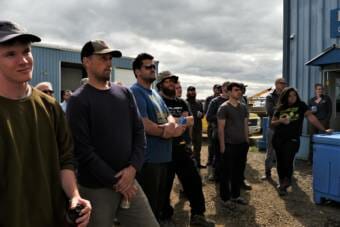
People listen to Peter Pan’s announcement in front of its office at the PAF Boatyard in Dillingham. Saturday, June 19, 2021. (Brian Venua/KDLG)

Fishermen gathered at the PAF boatyard in Dillingham on Saturday evening. Peter Pan Seafoods had invited them there for a surprise announcement.

Travis Roenfanz, the company’s Bristol Bay manager, got up on a small wooden stage to speak.

“I’m going to announce our 2021 Bristol Bay sockeye salmon base price. We will be paying a dollar ten,” he said.

That’s one dollar and ten cents for every pound of sockeye caught in Bristol Bay.

It’s the first time in at least 25 years that a Bristol Bay processor has announced its base price this early in the year, Roenfanz said. The move has to do with the processor’s new ownership.

“Peter Pan is a new company this year, and they are really remodeling how they’re thinking about things, more vertically integrated and trying to get a better quality product to the market,” Roenfanz said.

The company said in a news release that it set the base price early to “put the fleet at ease that they will receive a fair price for the long hours and hard work they are about to endure” during the fishery.

Fishermen in the crowd cheered the announcement.

The base price is significantly higher than last year’s price of $0.70, but it’s still lower than the 2019 price of $1.35.
Even so, the fact that fishermen know that price now — in June, before they get out in the water — is a big deal.

Fisherman Andy Peitsch said knowing what he’ll earn now takes away a lot of stress.

“It’s way better. Everyone has a better attitude. Deckhands can kind of do the math in their heads, skippers can do the math in their heads about what you’re catching, about what you’re going to make,” he said.

Peitsch has fished in the bay for 37 years. He thinks the announcement will put pressure on other processors to follow suit.

Peter Pan has also told fishermen the bonuses it will pay this year for icing, chilling and bleeding salmon. And it plans to have a production bonus in September.

In an interview after the announcement, Roenfanz said that setting the base price early also allows the company to better plan for the season.

“We know where the base is going to be set now, we can look at the market and know what we have coming up for our fresh markets and our frozen markets, and it gives us a good base starting point,” he said.

Another fisherman in the crowd, Pete Canon, said while he’s excited about this year’s base price, he still thinks it could be higher.

“Well, the price in the market hasn’t gone down at all for the consumer, so I think they could be a little more generous than that,” he said. “But a dollar ten, and then we have refrigeration prices on top of that, and other incentives. So I do believe it’s a step in the right direction, that’s for darn sure.”

At the beginning of the year, Japanese seafood company Maruha Nichiro sold Peter Pan to three buyers, including the Anchorage-based investment firm McKinley Capital Management.

Since then, the owners have been aggressively promoting their new vision for the company. The deal vertically integrated Peter Pan: Now, all stages of production and marketing — often operated separately — are under one owner.

Bristol Bay processors all usually pay the same base price for sockeye, though bonuses vary by company. Whether Peter Pan has set a precedent for other processors remains to be seen; No other company has set its base price yet — they usually wait until the end of the season.

Halibut fisherman weathers freak storm on trip back from Togiak

Kaleb Westfall, captain of the F/V Peter. (Brian Venua/KDLG)

Kaleb Westfall has fished for salmon in Bristol Bay for two decades.

Earlier this month he was fishing for halibut in the waters near Togiak. He and his crewmate were headed home to Dillingham when is voyage home was met with an untimely storm as the winds and waves picked up.

“We got around the corner to Protection (Point) and then it was a straight east wind on the other side there,” Westfall said.

He had expected four-foot waves on his trip back but encountered giant swells after they rounded the tip of the Nushagak Peninsula.

“Those four-foot waves were now 16 plus, and every once in a while, 20,” he said. “Surfing a 32 footer on those — a little difficult, absolutely.”

A heavy east wind meant he had to keep the bow of his boat, the F/V Peter, pointed towards King Salmon to face the swells. As the waves struck his boat, he realized they needed help.

“First we hit the radio and did a distress vessel and explained we’re not sinking but any wave here could take us over and capsize us,” he said.

As they called for help, fatigue started to set in.

“At some point I’m thinking my arm’s failing, my body’s cramping and I’m losing control in my dexterity,” Westfall recalled. “Those thoughts creep into your head that you can’t do this forever — you are going to fail. And it’s hard to multitask and disallow those thoughts, so I had to put it to one wave at a time.”

Westfall said they were about five miles from shore. He didn’t get a response to his call right away, but he kept reaching out.

“Through the AMSEA training they say even if you can’t hear anybody keep yapping because they might be able to hear you and you may not be able to hear them back,” he said.

It turned out that multiple people heard his call. The Coast Guard flew to the location in a helicopter and OBI Seafoods sent a 100-foot tender. The tender broke waves and allowed Westfall to follow its surf while the Coast Guard monitored the situation.

Westfall said he was lucky to get back to shore, and it was thanks to the extra effort he put into safety precautions.

“It turned out to be a hellacious storm, but all my training and all my safety equipment worked,” he said. “I tell people I work super hard, and 95% of the time it doesn’t matter, but 5% of the time there’s an opportunity for things to get better or that extra hard work paid off.”

Westfall thanked his training with the Alaska Marine Safety Education Association to help him maximize his odds for survival.
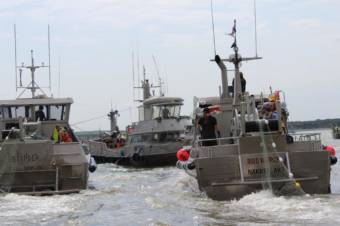
“I don’t think I would have been nearly as comfortable or maybe not without the AMSEA training. It’s a wonderful program,” he said.

They returned to the Dillingham harbor around 2 a.m. the next morning after fighting the storm for around 8 hours.

“I had to make that decision on ‘how much longer can I do this?’ The whole thing took 25 hours coming from Togiak so I was driving 25 hours straight and about half of those hours were panic hours,” he said.

Westfall urged everyone on the water should make sure their safety equipment is up to date — and to be prepared for emergencies.

More information about the AMSEA and their training can be found on www.amsea.org. In case of an emergency, the Coast Guard can be reached at (907) 463-2000.

Record-high Copper River prices boost optimism for Bristol Bay fishery

Naknek’s in-river opener on July 18, 2019. (Sage Smiley/KDLG)

It’s been a tough spring for Copper River’s sockeye fishery.

The run is picking up, but so far the season has been similar to 2020, which finished with some of the lowest sockeye catches on record. But one thing is very different this year: A record-high price for salmon.

“Markets were hot. And we were able to pay that price and pass it on to the fishermen,” said Jon Hickman, the executive vice president for Peter Pan Seafoods.

This year it’s even hotter. In May, the company announced it would pay triple last year’s prices for sockeye and kings, at $19.60 per pound for kings and $12.60 a pound for sockeye. In 2020, sockeye went for around $4 and kings were $6 per pound.

The Cordova Times reported retailers’ pre-orders for sockeye fillets were as high as $54 a pound. King fillets went for up to $80 a pound.

Hickman said the reason for the price hike is straightforward: Copper River is the first fishery of the season. Competition is low and demand is high — Peter Pan’s customers include restaurants and other high-end retailers, and as COVID-19 restrictions relax, restaurants are welcoming more diners.

The record prices are stoking optimism within the industry just ahead of another important fishery: Bristol Bay, the largest sockeye fishery in the world. Unlike Copper River, it runs at the same time as fisheries in other parts of the state, starting in earnest in mid-June.

Hickman said the size of Bristol Bay’s run — and the size of the fish — will determine which products they will focus on, and what the price will be.

“Fish size is going to be a huge deal for us, and how we handle fish size and put them in the right places for the best return,” he said. “Keeping things fresh and keeping our fishermen with their nets in the water.”

Andy Wink, executive director for the Bristol Bay Regional Seafood Development Association, said while Bristol Bay is a much different fishery, those high Copper River prices are encouraging.

“I think seeing strong pricing in the early going for Copper River is definitely a good sign, as far as where the market’s at and how much demand there is,” he said. “Pretty much all that product goes into the fresh market and is sold fresh. We do marketing promotions with many retailers around the U.S. and already there’s a lot of demand for that.”

There was a lot of demand for seafood from retailers last year, and Bristol Bay saw less competition from other fisheries which experienced weaker runs. Still, prices were really low: The base price in Bristol Bay dropped to just 70 cents per pound, about half of what it was in 2019.

And even the market dropped, processors had to spend tens of millions of dollars on COVID-19 mitigation plans.

Dan Lesh, an economist with the McKinley Research Group, said while there will still be additional costs this year associated with the pandemic, he expects them to be much lower.

Another factor that might help fishermen earn bigger paychecks is higher personal income, Lesh said.

“I think people have more money to spend and seafood is what they want to spend it on nowadays,” he said. “We do know that personal income rose last year, between things like the stimulus bills and also less spending on different services. (That) helped with pushing up prices for premium seafood products, and I think Bristol Bay sockeye salmon can be in that category.”

Fishermen’s concerns about the low base price in 2020 prompted the Bristol Bay Regional Seafood Development Association to publish a report laying out some of the reasons the price was so low. That included business risk due to the pandemic, higher operating costs and losses in other fisheries across the state.

This year, the association said risk is down. Wink, the executive director, thinks the season may be better for fishermen.

“I guess the price remains to be seen, but I think when you look at the market factors that are in place now versus this time last year, things do look more bullish, and kind of appear more favorable,” he said.

Bristol Bay’s fishery kicks off in mid-June.

On Dillingham trip, Murkowski pushes permanent protections for Bristol Bay

U.S. Sen. Lisa Murkowski, R-Alaska, talks to reporters in the Alaska Capitol in Juneau after her annual address to the Legislature on Feb. 18, 2020.
U.S. Sen. Lisa Murkowski, R-Alaska, talks to reporters in the Alaska Capitol in Juneau after her annual address to the Legislature on Feb. 18, 2020. (Photo by Skip Gray/KTOO)

U.S. Sen. Lisa Murkowski visited Dillingham last week to gather ideas to permanently protect Bristol Bay against development such as the proposed Pebble mine.

Murkowski used to chair the Senate Energy and Natural Resources Committee and has historically been a strong supporter of resource development. For years, she declined to support or oppose Pebble, arguing it was important to wait for the federal permitting process to play out.

As the Army Corps of Engineers neared its final permit decision last year and undercover tapes emerged of Pebble leaders doubting she’d take a stand against the project, Murkowski did just that.

In Dillingham, Murkowski met with people from commercial, subsistence and recreational fisheries. She also held a closed meeting with community leaders at the Dillingham Middle/High School.

“This is kind of the beginning of stakeholder engagements and meetings, and we will be continuing this throughout the process,” she said in an interview with KDLG on Friday.

Murkowski said the best way to ensure long-term protection is for Congress to pass a law. In the past, groups that opposed Pebble have pushed for a preemptive veto from the Environmental Protection Agency.

“That clearly is a tool that provides for a level of protection, but it doesn’t necessarily ensure that any entity coming beyond the Pebble proposal would be prohibited from mining activity. So if that’s what’s being sought, it’s legislation,” she said.

Earlier this year, regional and statewide groups opposed to Pebble put forward several options for protecting the area. One was to create a National Fisheries Area, which would bypass the need for a state designation.

Murkowski said possibilities include the federal government taking over state land, which would give the feds the authority to protect it from any future development.

“There have been discussions about whether it’s exchanges, or ways that you can ensure that the mineral rights that currently exist with the state are exchanged, are conveyed,” she said. “So these are the types of things that we are exploring at this point in time.”

Site notifications
Update notification options
Subscribe to notifications