KDLG is our partner station in Dillingham. KTOO collaborates with partners across the state to cover important news and to share stories with our audiences.
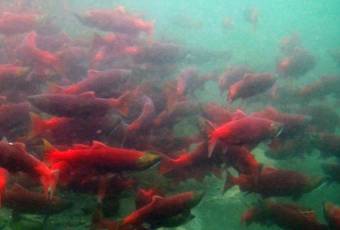
As of June 1, sonar had counted just 63,585 sockeye in the Copper River, the 13th lowest run on record so far. (Katrina Mueller/USFWS)
The Copper River’s sockeye run is far below the state’s goals so far this year.
The Alaska Department of Fish and Game announced Wednesday the latest in a series of closures this season. The district has opened only for three 12-hour fishing periods so far on May 17, 20, and 24.
But as of Tuesday, the department’s sonar tower counted just 63,585 sockeye in the Copper River, the 13th lowest run on record so far. The state’s in-river count goal is more than double that at 148,048 fish.
The department said the commercial harvest is the fourth lowest to date in the last 50 years.
But while the harvest may be low, prices for Copper River salmon were high even before the fishery opened in mid-May. Peter Pan Seafoods announced that it would pay triple last year’s prices for sockeye and kings. This year, it will pay $19.60 per pound for kings and $12.60 a pound for sockeye, while in 2020, sockeye went for around $4 and kings for $6.
The Cordova Times reported retailers’ pre-orders for sockeye fillets were as high as $54 a pound. King fillets went for up to $79.99 a pound.
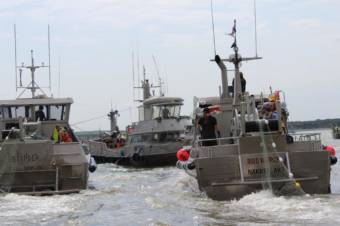
Naknek’s in-river opener on July 18, 2019. (Sage Smiley/KDLG – Dillingham)
Joe Trotter has fished in Bristol Bay for 13 years, in Egegik on the East Side of the bay. He strongly disagrees with the federal rule that would require people on commercial vessels to wear face masks to mitigate the spread of COVID-19.
“I think it’s ridiculous that they’re asking us to wear masks,” he said.
Trotter’s crewmembers on the F/V Seahag will all be vaccinated, and he said that since they don’t come into contact with anyone else during the season, spreading the virus to others isn’t really a possibility.
“If you go into shore, or you go into Dillingham, you go into Naknek, if you go on land somewhere, yeah, OK. But requiring us to have a mask on our fishing boat while we’re fishing? No. That’s ridiculous,” he said. “I’m not going to have my crew do that. It’s a safety issue, if nothing else.”
But he’s up against the federal Centers for Disease Control and Prevention and the Coast Guard.
Both agencies say crew on commercial fishing vessels need to wear a face mask.
The Coast Guard says crew members can take off their face masks for specific tasks if it’s unsafe to be wearing them, but when they’re done they have to put the masks right back on.
U.S. Sen. Lisa Murkowski is frustrated by the rules.
At a recent Senate hearing, she said she worries fishing crews will be more concerned about the liability of noncompliance with the mask requirement rather than their immediate safety.
“This is more a safety hazard than anything out — you’re out on a boat, the winds are howling, your mask is soggy wet. Tell me. Tell me how anyone thinks this is a sane and a sound policy to do,” she said.
This week, Murkowski and New Hampshire Democratic Sen. Maggie Hassan wrote a letter to the CDC and Coast Guard asking them to work together to exempt commercial fishers from the mask requirement.
They pointed out that the CDC has loosened its recommendations for fully vaccinated people in general, but not commercial fishing crews.
The CDC has lumped commercial fishing vessels in with all other forms of public transportation where face masks are required.
Murkowski and Hassan said they support masking on public transportation like planes, trains and buses, but commercial fishing vessels are different.
Trotter, the Egegik fisher, agrees.
“Most of the time we can’t hear each other on the boat, and we read lips or facial expressions,” he said. “It’s kind of important to have that on the boat for communication, for safety. And when you can’t hear what they’re saying, facial expressions are important.”
According to the letter, the Coast Guard told the senators it couldn’t change its mask requirements until the CDC changed its order. The CDC did not immediately respond to a request for comment Thursday about if it had plans to change the rules.
The mask rules do come with penalties. According to the Coast Guard, repeated failure to comply could result in “civil and/or criminal enforcement action.”
In an email, Coast Guard Chief Warrant Officer Kurt Fredrickson said, “We will be checking for compliance during the course of regular business.”
But they won’t deploy separate teams to check for face masks.
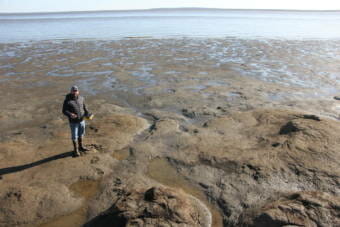
Gabe Dunham with UAF and Alaska Sea Grant at Dillingham’s erosion monitoring site by the sewage lagoon, fall 2019. Dunham was part of the initial Stakes for Stakeholders project in 2016 and continues to support erosion research in the region. (Tyler Thompson/KDLG)
Researchers from the University of Alaska Fairbanks will travel to Dillingham this week to continue erosion research in Bristol Bay’s coastal communities.
An ongoing project that started in 2016 as Stakes for Stakeholders, it aims to help residents monitor erosion with affordable time-lapse cameras and survey equipment on wooden stakes in 10 communities.
In Ekuk, Environmental Coordinator Jennifer Robinette has observed the dangers of an eroding coastline in the village. She started tracking erosion on her own before joining the “Stakes for Stakeholders” effort with UAF.
According to Robinette, Ekuk is losing about five feet of coastline per year. That rate has more than doubled in the last century, from 1921 to the present. Before the erosion project began, the last recorded studies were done in 2007. She says erosion is narrowing the beach and causing issues for set-net fishers.
“The erosion actually takes away the top layer of gravel, so then fishermen are just driving on mud,” Robinette said. “That causes a problem with weight and getting big catches back to the processor from down the beach. So that beach is natural infrastructure for our fishing.”
Fishers in Ekuk are able to set nets by truck, and the local processor is set up to collect catches from truck beds rather than skiffs, like a tender would. Robinette says land lost from erosion is also causing a buildup of material near the dock, making it difficult for the barge to come and go.
“The processor has to actually dig out some every year to be able to process,” she said. “Just to get their equipment in for the summer and catch out for the end of the season.”
Robinette and the researchers will get feedback from residents about their experiences with erosion and flooding. She adds that the partnership with UAF and the state gave the village council better tools and data to apply for grants.
Ekuk’s Village Council recently applied for a climate change and resiliency grant from the Bureaus of Indian Affairs to come up with solutions for the eroding coastline.
The University is partnered with the Bristol Bay Native Association, Alaska Sea Grant and Alaska Department of Geological and Geophysical Surveys, with funding from the state, Alaska Sea Grant and Bureau of Indian Affairs.
Courtesy of Chris Maio
In Dillingham, the erosion monitoring site is by the sewage lagoon near Wood River. The city loses up to 20 feet of coastline per year.
Chris Maio, with UAF, said they are expanding the research area from the harbor to Kananak Hospital.
“So we’ll be out there measuring the slope of the beach, we call this cross shore profiles,” Maio said. “We’ll measure the bottom of the bluff there. So once we collect that information, then when we go back to repeat those surveys, we’ll have a real good idea how that beach is changing. So we can more accurately project when infrastructure like the houses and things like that are actually going to be impacted by those changes.”
The researchers will ask residents how they can make their findings more digestible on the local level. Maio and others will also introduce new products for tracking erosion, like a high resolution real time kinematic GPS system that can measure loss to the coastline within centimeters of accuracy.
Maio says they will also deploy a yellow wave buoy, acquired by the Alaska Sea Grant right outside the harbor in Dillingham to measure waves, wind speeds and temperatures in real time via satellite.
“As scientists, we’ll use that to assess storm surge heights and be able to model flooding events in that area,” Maio said. “For the local fishermen and other community members, it will be a place where they can sign on to a website and see the real time conditions right outside the harbor there.”
Storm events can accelerate erosion at an alarming rate. Three years ago, a storm in Dillingham tore off 10 to 15 feet of coastline by the sewage lagoon. Maio and others will spend five days in Dillingham surveying coastline and will travel to Ekuk, Pilot Point, Chignik Bay and Ivanoff Bay.
Ivanoff Bay will be a new monitoring site for the erosion researchers. Earlier this spring, they traveled to Port Heiden and Levelock to gather data at existing sites. In 2019, Port Heiden’s Goldfish Lake breached and dumped into the Bay.
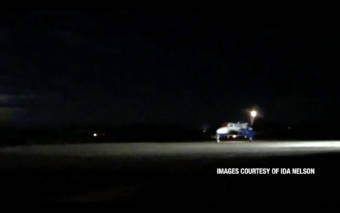
A medevac plane flew above Igiugig last August. It was late, around 11 p.m., but a child needed to be transported to Anchorage for intensive care.
Ida Nelson had just finished taking a steam when she heard the plane overhead.
“Somebody needed extended care, and the only way to get it is to get them on a medevac and out to Anchorage,” she said during last week’s Red Cross Real Heroes awards ceremony.
When the plane didn’t land, she went to the runway manager. The runway lights were out.
“I was like, ‘Well, can I light up the runway?’” Nelson said. “He was like, ‘Well, you can try.’”
But the light from her lone four-wheeler wasn’t going to be enough. As they communicated with the LifeMed pilot, Nelson’s neighbor started to get people to the airport.
“She was busy calling everybody in the village, waking them up and asking them, ‘Hey, run to the runway. We need to light up the runway so the plane can land,'”Nelson said. “Everybody came from the ages of like eight to 70 years old.”
Residents lined the runway with their vehicles to light the pilot’s way. The plane landed, and the child who needed care was transported to the hospital.
The story received international coverage. The Red Cross reached out to Nelson to offer her a Real Hero Award in the Alaska safety category.
Nelson said that for her, lighting up the runway is just another example of the community coming together.
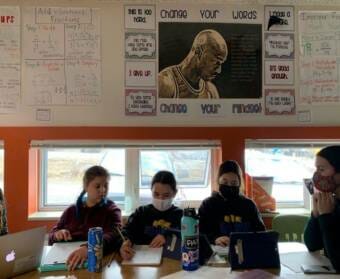
“It’s something that we in Igiugig do constantly, like almost every day,” she said. “It’s just normal for us to go run out and help somebody when they need help. You don’t question the day or the time. If someone is in need you just go for help. That for us is — to me, at least, it’s normal. Someone needs help, they’re calling for help, you get up and go.”
There are 10 different categories for Alaska’s Red Cross Real Hero Awards, which started in 2000.
Nelson was one of 10 people to receive awards around the state. You can hear the stories of this year’s recipients at redcross.org.
The students approached their teacher, Stephanie Jenson, after learning about the history of the creek and The Seven Sisters. From left: Trista Wassily, Alora Wassily, Harmony Larson and Stephanie Jenson. (Tyler Thompson/KDLG)
Alora Wassily, Trista Wassily and Harmony Larson were learning about the history of colonization in social studies class. They visited with the Curyung Tribe and learned the story of “The Seven Sisters.”
“They landed by Squaw Creek and they were looking for a white husband to have kids and stuff,” Wassily said. “Then there’s also white men looking for a Native wife. So ‘squaw’ usually meant young woman or female anatomy. Then when white settlers came, it became a derogatory word towards Native women.”
The sisters were named: Constantine; Natalia Palanka; Okalena; Anuska; Catherine and Massa. They traveled to Dillingham from Nushagak Point, a fishing village to the south.
An illustration of The Seven Sisters, by Amber Webb. Trista Wassily said the sisters are shown inside a water monsters mouth. The monster is what makes the water muddy by churning its teeth. (Image courtesy of Amber Webb, Stephanie Johnson, Alora Wasilly, Trista Wassily, Harmony Larson)
The sisters settled there and lived between Squaw Creek and Lake road. At a presentation to Dillingham’s School Board, tribal administrator Courtenay Carty shared how the creek and road got its name.
“Because there was a place where white men could go to find a Native wife,” Carty said.
After that visit, the girls told their teacher Stephanie Jenson they wanted to change the name. Jenson was ecstatic and contacted Carty, Amber Webb and Tiera Schroeder. Jenson says they worked on changing the name before COVID-19 put that effort on hold.
“They came in and shared everything they had done in spring and then we reached out to Robyn Chaney who kind of helped us with the planning as well,” Jenson said. “So we had a really great group of women who’ve been working together on this. And it’s been really inspirational to see what these girls have done”
The students want the name changed to Seven Sisters Creek to reflect the community’s connection to the sisters. Carty, Webb, Schroeder and Chaney used a family tree to show how each of them is a descendant of the sisters.
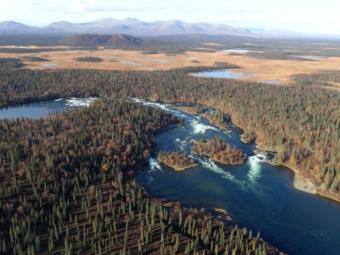
“And me, Harmony and Alora, we were all sisters five generations ago,” Trista Wassily said.
The family tree Courtenay Carty, Tiera Schroeder, Amber Webb, Robyn Chaney and the students put together, showing their connection to The Seven Sisters. (Image courtesy of Stephanie Jenson)
During a presentation to the Dillingham school board, the students said they spoke with Elder Dora Andrew-Ihrke about Yu’pik names for the creek. Jenson lead a call with Andrew-Ihrke, who shared Yup’ik words for Seven Sisters Creek.
“Creek by itself is ‘kuigat.’ But then when you say like you’re talking ‘Seven Sisters Creek,’ it becomes ‘Malrunelgen Alqaqellriit Kuigat’ or ‘kuicuariit.’ It’s a small creek, not a big one,” Andrew-Ihrke said.
The presentation shared other examples across the country of name changes from terms that are offensive, racist or sexist. Cleveland’s professional baseball team announced that it will change the name. They also removed the image of their mascot — Chief Wahoo, a caricature of a Native American — from their uniforms and stadium, but continue to sell merchandise displaying the image. A ski resort in Nevada also announced its changing the resort’s name to remove the use of the offensive and derogatory word.
Alora Wassily said she counted six signs displaying the word on her way home from school. The last slide in the girls’ presentation shows a road sign displaying the words “Squaw Creek” on Kanakanak Road. Wassily explained why she chose that picture.
“Because it shows when people come to Dillingham, the second sign they see is a derogatory word,” she said.
At the end of the presentation, Robyn Chaney shared how the adults helped the students put this project together. Chaney and others asked them to consider traditional decision making — or not just what’s best now, but what’s best for future generations.
“So we determined that not only are we all connected to The Seven Sisters, but some of us are also seven generations from those seven sisters, which is significant to us in our traditional decision making,” Chaney said. “So that’s something I asked them to consider, was the impact to their seventh generation. How would that impact the school? What bus stop might their kids get picked up at?”
The girls worked closely with the adults to put together an action plan and presentation for Dillingham City School District, Curyung Tribe and City of Dillingham. (Photo courtesy of Stephanie Jenson)
The fifth grade students requested that the Dillingham City School District write a letter of support to rename the road. They also asked the Curyung’s Tribal Council for a tribal resolution to change the name. Their next step will be to meet with the City.
But changing the name may be a challenge: It’s a private road, and the city’s code has no process to make that change happen.
City Planner Cynthia Rogers said in an email that a change to the code would be needed to provide a renaming process.
“I believe the appropriate route for this would be to request that the city council take action to send the issue to the code committee for consideration,” Rogers wrote.
Dillingham’s municipal code states that “no application for a private road name change may be submitted to the planning director or planning commission.”
Rogers acknowledged that the city was contacted about the process of changing the name. That meeting has yet to be scheduled.
The students and adults also want to change the name of the creek itself. They will have to present a proposal to the Alaska Department of Natural Resources and Historical Commission.
According to the commission, to change the name of a landmark, the proposer must present a compelling reason to change it and local support. The proposer must also establish as appropriate, that the current name is derogatory to a racial, ethnic, gender or religious group.
This piece has been edited to correct the spelling of “Malrunelgen Alqaqellriit Kuigat.”
A shot of the Nuyakuk Falls. Nushagak Cooperative is proposing to build a hydroelectric project at the falls, located three miles inside the Wood-Tikchik State Park. (Photo credit Alison Eskelin)
The U.S. Department of Energy chose 11 communities nationwide to receive federal assistance for projects aimed at reducing their reliance on diesel fuel. Five of the communities are in Alaska, including Dillingham and Aleknagik, which are listed as one project.
Renewable Energy Alaska Project, or REAP, is an Alaskan non-profit that promotes renewable energy development and energy efficiency. Executive Director Chris Rose says the communities were chosen for their remote locations and the high cost and heavy reliance on diesel fuel. In Dillingham and Aleknagik, REAP wants to help explore the effects of the Nuyakuk River Hydroelectric Project.
“There’s a lot of ramifications with big projects,” Rose said. “And REAP is just there to make sure that the community gets its questions answered and get access to who they need to at the national laboratories.”
REAP will act as a liaison for Nushagak Cooperative, the local utilities co-op. It will arrange for resources from the National Renewable Energy Lab, Pacific Northwest National Lab Lawrence Berkeley National Lab and Sandia National Labs to help with the co-op’s Nuyakuk project proposal, and with plans to scope the hydroelectric project this summer.
REAP’s Rob Jordan said the organization will not be involved in the regulatory process. Instead, it will focus on maximizing the project’s efficiency.
“In terms of really being able to help the utility to squeeze every drop of electricity out of the project that’s possible,” Jordan said. “But also to allow them to have a better understanding of the many risk factors that come along with a project like this.”
Heading into fall, they will conduct economic impact statements for both the generator’s productivity and its potential impacts on fish passage in the river. Work is expected to last for up to 18 months.
Close
Update notification options
Subscribe to notifications
Subscribe
Get notifications about news related to the topics you care about. You can unsubscribe anytime.