KDLG - Dillingham

KDLG is our partner station in Dillingham. KTOO collaborates with partners across the state to cover important news and to share stories with our audiences.
New report estimates at least $5M cost to replace subsistence salmon with other protein sources in Bristol Bay

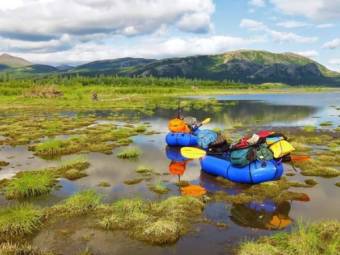
Apay’uq Moore subsistence fishes each summer. Moore has put nets out in Aleknagik, Wood River and Scandinavian Beach. (Photo courtesy of Apay’uq Moore)

A third of the state’s subsistence salmon harvest was caught in Bristol Bay in 2017, according to a new report from the McKinley Research Group. The subsistence economy is critical to Bristol Bay’s culture, and it’s the oldest and most continuous use of salmon.

The report, “The Economic Benefits of Bristol Bay”, attempts to quantify what it would cost to replace subsistence salmon with other protein sources from stores in the region.

A snapshot of subsistence salmon harvested by district in 2017. (From “The Economic Benefits of Bristol Bay“)

Bristol Bay subsistence fishers caught over 500,000 pounds of salmon in 2017, according to the latest data available. The research group estimates that it would cost $5-$10 million to replace that catch with other sources of protein. Rebecca Braun is one of the researchers who worked on the report.

“Because the world speaks in dollars, we tried to translate the subsistence harvest into dollars,” Braun said. “And it’s kind of an inherently impossible exercise because subsistence values goes beyond economics.”

Braun and her colleagues recorded meat prices from six different stores. They found that meats like chicken and ground beef are about $6 a pound, and steak was projected as high as $18 a pound.

Two of those stores also sell salmon. One imports farmed salmon for $17 a pound and another offers smoked Alaska salmon for $25.

“We called grocery stores and it’s funny,” she said. “We asked, ‘What would it cost to buy salmon local, wild caught?’ They laughed and said, ‘Why would anyone do that?’ Because people catch their own out there. We discovered it would be quite difficult to replace it in a grocery store.”

More than 750 residents in Bristol Bay reported a subsistence harvest in 2017. Artist Apay’uq Moore lives in Aleknagik, a small community north of Dillingham. She grew up in the region and participates in the subsistence fishery each summer.

“Yeah, I’ve done it for five years now as the head of my smokehouse. Well, my mom helped me out for the first few years,” Moore said.  “I’ve put a net out in Aleknagik, I’ve gone down the Wood River a little bit and I’ve worked with my friend Suzie a lot at her sight down on Scandinavian [Beach].”

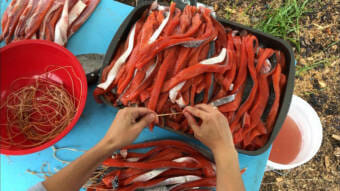
Strips of salmon (Photo courtesy of Apay’uq Moore)

Moore agrees that the value of subsistence fishing goes beyond protein replacement and dollar figures. She says it’s a generational practice and provides a mental getaway from day-to-day stress.

“It shares a little bit of the values that we have here as Indigenous people,” she said. “And that there isn’t just one economy out there; we have our spiritual economy and emotional economy. Those are the returns and gains that we’re looking for when we’re subsisting, practicing our humble beginnings and sort of connecting with our ancestors through that emotional and spiritual space.”

Alaskans elsewhere harvested just under a quarter of Bristol Bay’s subsistence catch. Half of those residents came from Anchorage and the remainder were from 26 communities across the state.

Bristol Bay B&Bs hope for a boost in tourism this summer

Courtesy of Beaver Creek Bed and Breakfast

Each year, the Bristol Bay region draws tourists from all over the world to visit and fish its rivers and lakes. But in 2020, travel restrictions and quarantine requirements led to a drop in tourism.

Several of the region’s sport fishing camps closed or operated at a reduced capacity during the 2020 season. Some did so to prevent bringing COVID-19 to the region, while others cited changing travel rules.

The lack of tourists affected many of the small businesses in the area — including bed-and-breakfasts.

“We really can’t afford to shut down our business two summers in a row — it just doesn’t make good business sense,” said Susan Isaacs, an owner of the Beaver Creek Bed and Breakfast in Dillingham.

Isaacs said she applied for and received CARES Act funding from both the City of Dillingham and the state.

“Even though you don’t have business customers, paying customers, you still have a lot of fixed expenses that don’t go away,” she said.

Due to the limited number of flights to the region, sport fishermen often stop in villages in the region on their way to camps and cabins on the Nushagak or other rivers.

The B&B lost out on tourism, but Isaacs said she has been able to host essential workers coming to Dillingham. She also implemented new policies to protect both herself and the travelers.

“Of course they wear masks if they’re with me and they wear masks around me,” she said. “They can take their mask off when they’re not around me — I’m not going to tell them what to do. If they’re driving with me, if I have them in the van, then they will have a mask on.”

Looking out over Lake Aleknagik. (courtesy of Silver Fin Lakefront Bed and Breakfast)

Usually, B&Bs will pick guests up from the airport, but the Silver Fin Lakefront Bed and Breakfast in Aleknagik asks guests to drive themselves with a rental car in order to socially distance. Owner Sherol Mershon said that when her guests arrive, she asks that they follow several safety precautions.

“We did social distancing, we wore masks, we always serve everything clean and we clean up the cabins nice and have everything looking ship-shape when they get there,” she said.

Mershon said Silver Fin could have applied for CARES Act funding, but she felt her business wasn’t affected as heavily as others.

“I think I wanted the money to go to the people that really need it,” she explained.

On the east side of the Bristol Bay, Blue Fly Bed & Breakfast owner Patricia Edel said in-state tourists helped her business the most.

“Especially in the fall, I really feel like Alaskans carried the business because they’re willing to travel from Anchorage and come out for trout fishing and that was really helpful,” she said.

Edel said that when her clientele came to the region, they were receptive to safety precautions.

“Most of my clients are pretty flexible and will be willing to adhere to any CDC guidelines or anything like that, so I don’t see it being much of a problem,” she said.

All three owners look forward to the 2021 season and hope that vaccines and more knowledge about the virus will lead to a more prosperous tourism season.

Lake Clark Air plane damaged after hitting chunk of ice on Chignik Lagoon runway

Chignik Lagoon. July 10, 2019. (Alex Hager/KDLG)

A passenger plane was damaged after it landed and hit a chunk of ice and frozen gravel on the Chignik Lagoon runway last week. No injuries were reported.

Lake Clark Air operates the Beechcraft C-99 turboprop airliner.

The company’s chief pilot, Glen Alsworth, Jr., said the plane left Merrill Field Airport in Anchorage with a load of passengers and landed in Chignik Lagoon shortly after 10 a.m. on April 16.

“Had an uneventful landing, beautiful weather, no mechanical issues, very light winds,” he said.

Alsworth said the plane slowed down and was preparing to turn off the runway.

“There was a chunk of frozen ice and gravel that was not visible to the pilot, kind of right out in the middle of the runway there, until he was right on top of it, and the right main gear hit that and broke the right main gear, so the plane tipped down on its right wing,” he said.

https://www.facebook.com/photo.php?fbid=10215215783906762&set=a.1021239710101&type=3

The plane can hold up to nine passengers. Alsworth didn’t say how many people were on the plane at the time.

Alsworth said they won’t know the extent of the damage to the plane until they begin repairs.

“Anytime the plane tips down on its wing like that, it’s going to do damage to the prop on that side, and of course the landing gear if the flaps were down. So it would have got that flap as well,” he said.

He said the insurance company will examine the plane before they start repairs.

Big sockeye runs and struggling kings leave Bristol Bay managers with a complicated balancing act

A chinook and sockeye in a net. June 24, 2016. (KDLG file photo)

Fifty-one million sockeye are forecast to return to Bristol Bay this summer.

If that holds, commercial fishermen will be able to harvest around 37 million reds. That’s 13% more than the average harvest of the past decade.

But concerns remain about the numbers of chinook salmon in the Nushagak District on the west side of Bristol Bay — which leaves the biologists who manage the fishery with a complicated balancing act.

Faced with another huge sockeye run this summer, managers in the Nushagak District say they will try to allow fishermen to harvest the sockeye and also conserve chinook.

Tim Sands, the district’s area management biologist, describes the job as trying to walk a fine line between “getting as many kings up the river as we can, but still provide opportunity to harvest sockeye salmon.”

For years, biologists around the state have wrestled with declining numbers of chinook, fish that are central to subsistence ways of life across Alaska, and also targeted by sport fishermen. Since 2007, the state’s chinook runs have consistently declined, forcing managers to restrict or close fishing in certain areas.

A stark example: the chinook run to the Chignik River. Last year, just under 1,300 fish returned, which is below the minimum escapement. Both state and federal managers restricted subsistence fishing for chinook in July, and residents struggled to get enough fish.

In the Nushagak District, managing harvest is tough because chinook and sockeye runs overlap, so when the sockeye harvests increase, so does incidental chinook bycatch.
Chinook escapements up the Nushagak River, 1975-2017.
(ADF&G)

The Nushagak is the only commercial fishing district in Bristol Bay that still counts the chinook runs, which can vary widely from year to year. For the past two years, the run hasn’t met its minimum escapement of 55,000. That means too few fish have reached the spawning grounds for the run to be sustainable. In 2019, escapement was roughly 47,880. Last year, it was just over 43,000.

Fish and Game has acknowledged that its counting methods are designed to count sockeye, not chinook, so it likely isn’t providing an accurate estimate of the king run. The department counts fish with sonar, which is designed to cover the areas closer to shore, where sockeye swim. chinook tend to swim in deeper water toward the center of the river.

Last June, managers postponed commercial fishing in the Nushagak District for days to allow more kings to escape upriver. In doing so, they let hundreds of thousands of sockeye swim through the district unharvested. This summer, the commercial and sport fish divisions will work to conserve as many chinook as possible, according to Sands, the management biologist.

A map of the Nushagak River drainage. (ADF&G)

“Hopefully more than the minimum of kings up the river,” he said. “So it’s going to be one of those day-by-day, looking at things, evaluating the information we have and trying to make the best decision we can with the information we have.”

In other areas of the bay, managers don’t count chinook escapement anymore, but they do count incidental harvest. Last summer, the chinook harvest across the bay was the lowest on record, at 10,000 fish.

It’s not just the chinook runs that are declining, but the size of the fish is also shrinking.

A study in the journal Nature Communications shows their body length has declined by 8% over the past six decades.

Daniel Schindler is a professor at the University of Washington who has researched salmon in Bristol Bay for decades. He said chinook are returning to spawn at younger ages, particularly in western Alaska rivers.

“What we’re seeing is that the oldest, biggest fish are disappearing, or their body sizes are getting smaller at an accelerating rate,” he said. “Particularly during the last 10 or 15 years, when fishery pressure has been relatively low compared to where it was 20, 30 years ago.”

Schindler said climate change in the Pacific Ocean may slow their growth. But he said research indicates that if fish grow more slowly in the ocean, they return to freshwater later.

“That’s not what we’re seeing,” he said. “We’re seeing them come back to spawn at earlier ages. So that does suggest that there’s increased mortality on the oldest, biggest fish.”

A lot of factors can affect salmon survival. The state has said the overall declines are likely due to more fish dying out in the ocean. The decline in bigger fish could also be due to more predators targeting them.

Still, Schindler said, salmon are resilient. Chinook can rebound if their habitat quality remains intact, and if enough fish are allowed to pass through fisheries to spawn during years of low returns.

Gillnetters will get first shot at record-forecast of Togiak herring

Herring generally spawn in the Togiak District in April and May. May. 3, 2020. (Izzy Ross/KDLG)

The Alaska Department of Fish & Game projects a biomass of 236,700 tons of herring for the Togiak district — the highest forecast since 1993, when the state started to use its current forecasting method.

The total allowable harvest is 47,300 tons. The purse seine fleet is allocated 80% of that, and the gillnet fleet can harvest the remaining 20%.

Dutch Harbor Food and Bait will receive 7% of the remaining allocation, and Togiak’s spawn on kelp fishery has a fixed allocation of 1,500 tons.

But so far, only two processors indicate they will participate this spring, according to management biologist Tim Sands.

“I would be shocked if they took more than 15,000 tons total. So there’s going to be a lot of herring that just isn’t harvested,” he said.

In recent years, the fishing effort for herring in Togiak has declined. Last year, two seine boats and one gillnetter participated and Icicle Seafoods was the only processor buying Togiak herring.

For those who plan to fish this spring, the lower effort could be a plus.

“That might result in a little better price for fishermen, but there’s not going to be a huge fleet out there fishing for herring,” he said.

Togiak herring fishermen target the fish for their eggs. But the market for roe has declined for years from its peak in the 1990s — back then, roe was priced at $1,000 a ton. According to Sands, the 2020 price was at $100.

Sands said the weather also determines when fishermen can participate — especially for the gillnet fleet.

“Whether or not they’re going to be there at the start of things. We’re going to try to maximize the area for whatever fleet’s there,” he said. “Past couple of years there’s not been as much gillnet effort around and we’ve held areas closed to the seine fleet in anticipation of the gillnet fleet showing up.”

Sands said that this season, Fish & Game will open the area from Kulukak Bay to Right Hand Point to gillnetters first, as usual. If there are none, it will open fishing to seiners.

Curyung Tribal Council joins new effort to address epidemic of missing and murdered Indigenous persons

Courtesy of Amber Webb

At the beginning of the year, the U.S. Attorney’s office for Alaska announced that the Department of Justice would embark on a pilot project to address the missing and murdered Indigenous persons epidemic in the state.

The Curyung Tribal Council in Dillingham is one of three Alaska tribes that volunteered to be part of the project, along with the Native Village of Unalakleet and the Koyukuk Native Village. As part of the project, each tribe will develop a tribal community response plan tailored to its needs, resources and culture.

Tribal Administrator Courtenay Carty said that as part of Curyung’s action plan, the tribe will work to determine the scope of the epidemic in the region.

“Part of the reason that we decided to engage in this work is that we don’t have adequate data to quantify the issue and its impact on our communities,” Carty said. “And part of engaging in this pilot project is to begin gathering those statistics ourselves. It’s very important in tribal governance to not only exercise the tribal council sovereignty on these issues in general, but especially in terms of gathering our own data ourselves.”

Amber Webb’s 12-foot-tall qaspeq featuring portraits of 250 missing or murdered Indigenous women, presented on stage at the Alaska Federation of Natives convention in Fairbanks in 2019. (Casey Grove/Alaska Public Media)

According to a study by the Urban Indian Health Institute, out of 29 states, Alaska ranks fourth in the number of missing and murdered Indigenous women.

lack of historic data is a major obstacle to effectively addressing the epidemic.

Carty stressed the importance of gathering statistics on a local level.

“All too often, Native communities are researched by outsiders,” she said. “In this situation. It’s very important that, especially with such a sensitive topic, that our council is able to work with families directly to quantify the issue and demonstrate that ourselves, versus having an outside organization do that for us.”

This project is another in a series of MMIP initiatives the federal government has announced in recent years. Savannah’s Act, a bill sponsored by Alaska Senator Lisa Murkowski, requires the Department of Justice to address and educate the public on the epidemic. The other is Operation Lady Justice, a White House initiative formed in 2019 to address unsolved cold cases and improve law enforcement response.

Curyung Second Chief J.J. Larson said that as part of their community action plan, the tribe will facilitate communication between investigators and families when tribal members are missing or may have been murdered.

“Of course we’re not getting involved in investigating and things like that, but we can do some of the side stuff,” Larson said. “Making sure that these cases don’t get dropped off after so long — which is kind of what you see happens — and making sure family stay informed of what is going on in the investigation.”

Larson said the tribe also hopes to establish education campaigns as a preventative measure to make its members aware of potentially dangerous situations.

“Especially with the internet age it’s so tough,” he said. “It’s so easy for people to get caught up in scandal or a scam on the internet. And talking to some of the law enforcement agencies, there’s a lot of Internet scams going on.”

The tribe meets with the U.S. Attorney’s office as part of a forum to increase communication between communities and public officials. The forums include a wide array of law enforcement agencies and many other entities like VPSO supervisors, community advocates and other tribes in the state.

Ingrid Cumberlidge is the MMIP coordinator for the U.S. Attorney’s Office in Alaska. She said that a key to reducing cases is to establish connections between tribes and agencies and to implement solid response plans.

“We really just need to build those relationships and make sure people are reporting as soon as possible so that we can get working on any incidents at the quickest possible moment,” Cumberlidge said.

As part of the federal initiative, troopers will get involved in investigations as soon as possible.

“The Alaska State Troopers in our working group have explained to us that they’re going to provide oversight,” said Cumberlidge. “Even if they’re not on site, they’re going to communicate with the folks on the ground to help support whatever activity is happening until they can get there.”

Curyung’s plan will serve as a model for hub communities, like Bethel and Nome.

Brian Schroder, the U.S. Attorney for Alaska, says the plans are meant to serve as a foundation for communities to build on as they respond to MMIP.

“They can go through their plan and say, ‘Okay what else can we do? What other resources are available to us? What victim’s resources are available to us?’” he said. “They can better move toward helping to deal with a case because they fought through all these aspects ahead of time.”

Schroder also stressed that it is important to establish communication and transparency before crises occur.

“A large part of what this is getting all the parties involved — all the stakeholders involved — to start talking to each other now,” he said. “You want to be able to talk ahead of time and know each other and open those lines of communication and set up protocols in place that will help. To me, a large part of this is getting all the key players to talk to each other.”

More information about the pilot project can be found by contacting the U.S. Attorney’s Office in Alaska at (907) 271-5071.

If someone you know may be missing or murdered, contact your local state troopers office as soon as possible to begin an investigation. Resources for people impacted by MMIP can be found on the Association of American Indian Affairs website.

Izzy Ross contributed reporting to this story.

Site notifications
Update notification options
Subscribe to notifications