KDLG is our partner station in Dillingham. KTOO collaborates with partners across the state to cover important news and to share stories with our audiences.
Mount Veniaminof (center right) with ashy eruption plume, seen from Perryville on March 4, 2021. (Alaska Volcano Observatory capture from the FAA Perryville NW webcam)
A small explosion was detected at the Mount Veniaminof volcano early Thursday morning. Veniaminof is on the Alaska Peninsula, north of Perryville.
Satellite and webcam footage revealed small deposits of ash near the summit. The ash cloud stayed below 10,000 feet.
Aerial view of Mount Veniaminof summit cone and 2018 lava flow. (Alaska Volcano Observatory)
The Alaska Volcano Observatory raised the aviation color code to orange to warn pilots in the area of possible ash emissions. Color code orange means there is heightened unrest at a volcano with an increased potential for eruption, but that the risk is limited.
Geologists observed sulfur in the area over the past few days and a rise in surface temperature Wednesday night.
Ash emissions and lava spray and flow are typical for Veniaminof. Ash usually stays contained in the summit crater but can occasionally fall in nearby areas. A satellite link at Port Heiden is out, so local seismic activity is offline at this time. The volcano observatory continues to monitor the situation.
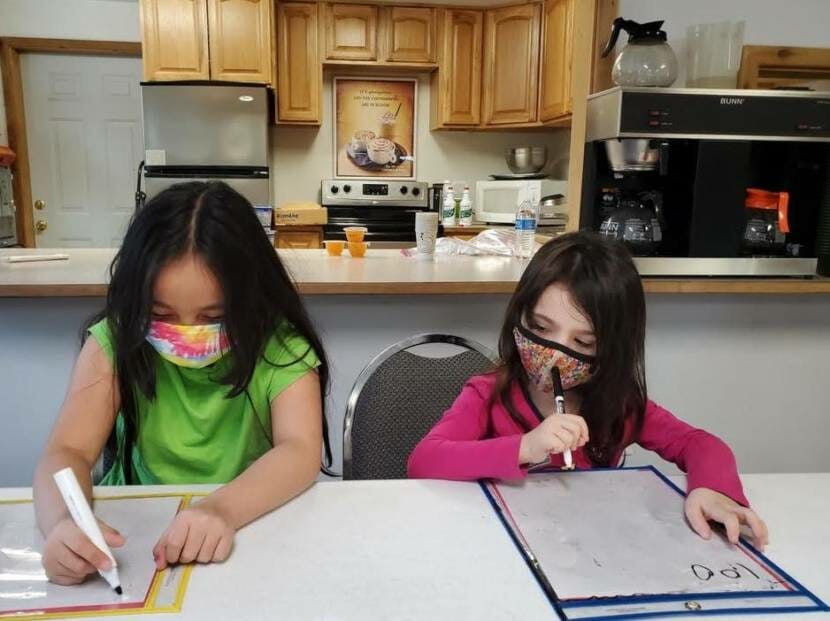
Bristol Bay Borough students learn in a makeshift classroom. February 2021. (Courtesy of Shannon Harvilla)
Students and staff at the Bristol Bay Borough school have weathered a rough year.
The district planned for a renovation of the school building to finish months ago. The project derailed this summer when construction crews discovered asbestos in the building.
“That kind of delayed our project on the interior,” said Superintendent Bill Hill. “We moved to the exterior of the school and found a significant amount of dry rot. And that delayed the exterior renovation as well. Basically derailed the project by about three months, as an estimate.”
Bristol Bay Borough students at Silver Bay Seafoods’ facilities in February, 2021. (Courtesy of Shannon Harvilla)
All the while, students and staff dealt with restrictions to in-person learning due to COVID-19. The construction limited the ability to safely instruct students at the school while observing safety protocols. Principal Shannon Harvilla said students have attended school remotely, and teachers have brought in small groups for in-person instruction.
“We’ve only had access to our cafeteria, so it’s really been, you know, half of a class at a time,” Harvilla said.
The district had hoped to bring kids back to the school building after the holidays, but the delays were relentless.
“We were not provided with a firm date on when we could return to the building,” Hill said. “Long story short, we decided to explore some other options.”
Community organizations offered their facilities as temporary classrooms.
High school students attend class at the Silver Bay Seafoods fleet office and bunkhouse. Seventh- and eighth-grade students are attending class in the school building’s one available room. Third- through sixth-grade students are at the former offices of the Paug-Vik Native Corporation. Pre-K through second-grade students are at to the Naknek Community Bible Chapel.
The need for classroom space prompted an outpouring of support.
“All of our communities in the borough offered up facilities for school to happen,” said Hill. “These ones were just kind of located closer to the school where we could expedite lunch programs and delivery and transportation of students,” Hill said.
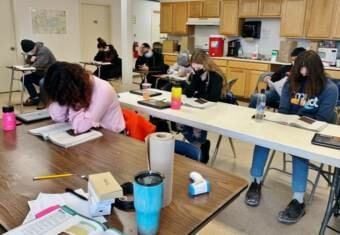
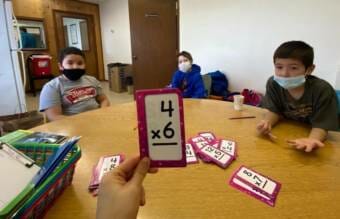
Bristol Bay Borough students attend in-person classes in chapels, offices, and fish processing facilities in February and March. (Courtesy of Shannon Harvilla)
The pandemic has forced schools around the country to rethink their approach to learning and shift to remote classes. Many of those models rely on the internet.
But in rural Alaska, internet is limited — and expensive. Hill said delivering instruction online is a challenge.
“Anybody who lives in bush Alaska knows that the cost of internet services is so extremely high, and then the stability of those services is sometimes questionable. That’s been a huge issue for us,” he said.
Hill said the school’s staff stepped up to the challenge: they drove the 15-mile stretch of road from Naknek to King Salmon to deliver meals and homebound instruction packets.
“Our staff has really stepped up, and they’ve been very flexible, and we’ve had students in and out of school. We’ve been delivering meals since last March. We’ve provided every family with a stipend for internet,” he said.
Those stipends cost the district a total of approximately $100,000 for this school year.
The borough’s online learning system experienced glitches and delays throughout the year. So, Principal Harvilla said, it’s a big relief for teachers to be back in the class.
“The isolation that teachers feel working from home, not being connected to colleagues,” he said, “Then just the delays in being able to get materials out here due to changes at the post office, things like that, have been difficult to overcome.”
The borough’s students are spending four days a week in their makeshift classrooms through mid-March. One day a week will be reserved for those learning from home to have in-person classes and for teachers to work on homebound lesson plans.
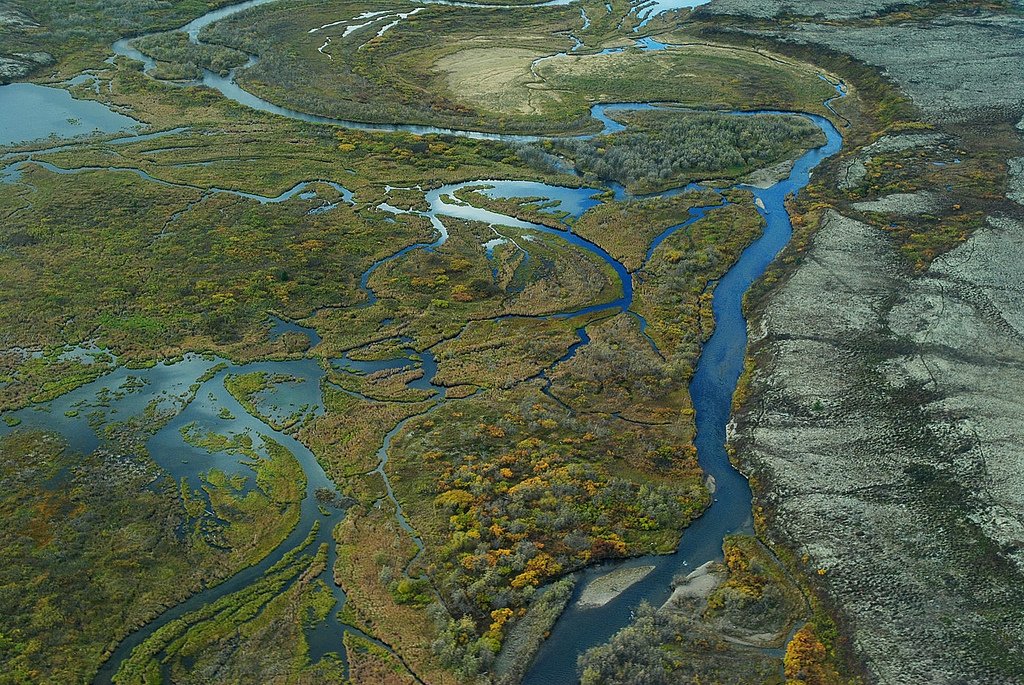
Aerial view of braided wetlands and tundra that is typical of the Bristol Bay watershed in Alaska. Upper Talarik Creek flows into Lake Iliamna and then the Kvichak River before emptying into Bristol Bay (Photo from the United States Environmental Protection Agency)
The United Tribes of Bristol Bay, Bristol Bay Native Association and Bristol Bay Economic Development Corporation published “The Call” in December after the Army Corps of Engineers denied Northern Dynasty’s permit application for the proposed Pebble Mine. UTBB is a tribal consortium that represents 15 tribes in the region. The Bristol Bay Native Association and the Bristol Bay Economic Development Corporation support UTBB’s proposal.
At a virtual town hall earlier this month, UTBB presented a road map for the two-part plan.
“Tribes in the region and Bristol Bay leadership have come together once again, to revive their previous request for 404c action, and we put a proposal forward for both administrative and legislative action to permanently protect Bristol Bay,” said UTBB Deputy Director Lindsay Layland said.
The 404c section of the Clean Water Act restricts discharged dredged waste in defined waters or wetlands. Tribes in the region called for that veto over 10 years ago, when Pebble was first proposed.
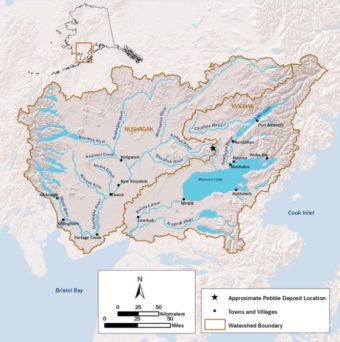
Map of the Bristol Bay area that is being studied in EPA’s “An Assessment of Potential Mining Impacts on Salmon Ecosystems of Bristol Bay, Alaska.” (Map courtesy of EPA)
In 2014, the Environmental Protection Agency proposed a “preemptive veto” of a larger mine in the area under Section 404c based on the agency’s Bristol Bay Watershed Assessment. But it was never finalized, and the Trump Administration withdrew the proposal.
Renewing the veto process could prevent Pebble and future companies from dredging at Bristol Bay’s headwaters. The Native American Rights Fund supports the region’s call.
Attorney Matt Newman said the second step of the plan — could solidify permanent federal protections for the watershed.
“Proposing and seeking out legislation that will offer similar kinds of protections from hard rock mining, through the creation of a National Fisheries Area,” he said.
A national fisheries area in the region would be the first of its kind. Through this designation, the groups supporting the plan want to ban any large-scale mines from waste disposal in Bristol Bay’s waters.
A focus on water protections would bypass the need for a state designation. Newman is looking to federal water protections for fish habitat in other parts of the country for guidance.
“It’s something that is uniquely suited for a unique problem — mining in Bristol Bay,” he said. “By threading this needle carefully, we can achieve the protection of Bristol Bay and fisheries resources, but without land statuses like a park or reserve, which locals do not want to see.”
If the land is declared a park or conservation system, it could bar fishing in the protected area. The potential for federal protections in the region could happen under the Biden Administration.
The administration proposed a plan at the end of January to conserve 30% of land and water in the U.S by 2030, known as the “30×30 Executive Order.” The Department of Interior named tribes and fishers as some of the key stakeholders.
Tyson Fick is a commercial fisher who works for Salmon State, a conservation group based in Juneau. Fick is cautiously optimistic about the possibility of permanent protections.
“There’s a lot of reason to be skeptical,” he said. “What the federal and state governments are actually going to follow through on. This is just the beginning and time will tell. It is becoming rapidly apparent that we don’t have a lot of time. It is great to see that we’re going to take bold steps head-on rather than hiding it from it.”
There is currently no timetable for when legislation could be presented, or what the “30×30 Executive Order” will look like.
Other groups support resource and job development in the region. Iliamna Natives Limited sees projects like the Pebble Mine as an opportunity for their village to grow economically.
Northern Dynasty, Pebble’s parent company, also submitted an appeal at the end of January to the Army Corps challenging the permit denial.
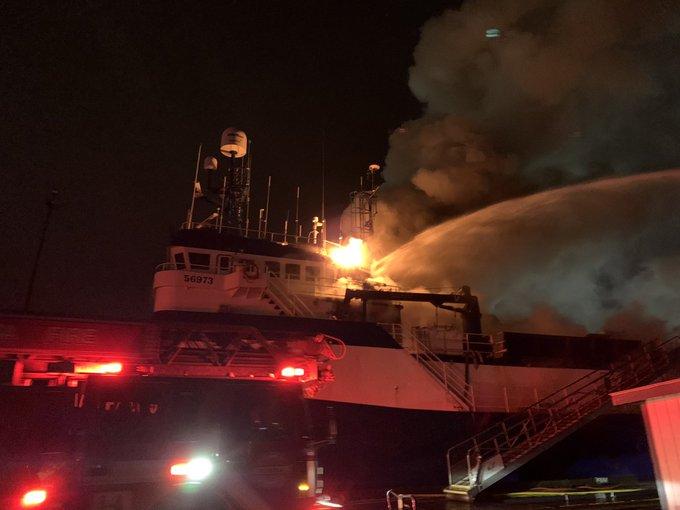
The 233-foot Aleutian Falcon caught fire shortly before midnight Wednesday, according to the Coast Guard. It was one of two floating processors Trident operates during the herring and salmon seasons in Alaska. (Courtesy of Tacoma Fire Department)
A 233-foot floating processor owned by Trident Seafoods caught fire shortly before midnight Wednesday. The processor, the Aleutian Falcon, was docked at the Port of Tacoma, Washington.
Trident has said the vessel is a total loss, according to multiple news outlets.
The Aleutian Falcon was one of Trident’s two floating processors that operate in Alaska. According to the company’s website, the processors follow herring from Southeast Alaska to Bristol Bay and then operate in salmon fisheries throughout the summer. The Aleutian Falcon could support 120 crewmembers.
The Tacoma Fire Department responded to the scene. Firefighters on the pier and three other boats used water to fight the blaze. They were joined by a Coast Guard response boat.
Coast Guard Petty Officer Steve Strohmaier said they worked to minimize the damage to the surrounding area.
“When they were fighting it, they had to be very careful about ensuring that the vessel would not capsize to cause a further problem of marine pollution,” he explained. “That being said, there was chlorine, there was ammonia, and then of course oil and diesel fuel on board.”
Strohmaier said that at this time, the amount of each substance on the ship is unknown.
On Friday afternoon, Tacoma Fire said in a Twitter update that it and a salvage company were coordinating to extinguish the fire and turn the vessel over to Trident.
The dewatering of the vessel has been successful, there is still a small part of the vessel that has active heat/fire deep in the hull, and TFD will be working with the salvage company on a remediation plan.
The cause of the fire is under investigation by multiple agencies. So far, no injuries have been reported.
Trident has not responded to phone calls or emails requesting comment as of this story.
Trident has faced a number of challenges since the start of the year. A large COVID-19 outbreak at its huge processing plant on the remote Aleutian Island of Akutan has infected more than a third of its workforce and forced the plant to shut down in January — just as the lucrative winter fishing season kicked off.
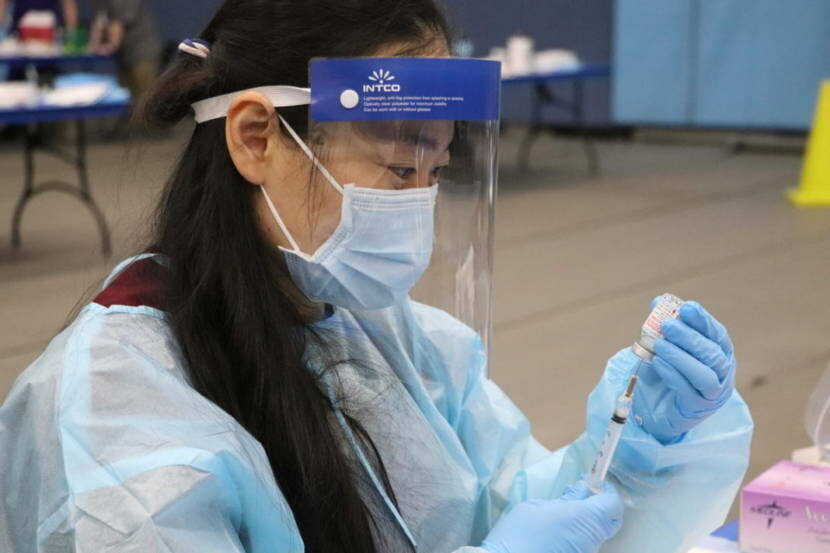
A health care worker fills a syringe with a dose of Moderna’s COVID-19 vaccine on Feb. 13, 2021. (Izzy Ross/KDLG)
The Dillingham High School gym hummed with activity Saturday. Health care workers sat at tables spread across the room as people waited for a dose of the Moderna vaccine.
It was Dillingham’s second weekend clinic, and the first since the Bristol Bay Area Health Corporation opened the vaccine clinic to anyone over the age of 18.
Patricia Owens was among a group waiting patiently on the gym’s hard plastic bleachers. She had just received her second shot of the two-dose vaccine.
“I want to be healthy for my community and the people around me. I want to be able to see my mom and my grandkids,” she said.
People who get vaccinated may still be able spread COVID-19. But Owens said getting the shot gives her hope that it’ll be safer for her to travel and see her family. Her mom is 87 and lives in Palmer.
“In fact, I wanted to ask somebody when can I go see my mom. And my grandkids!” she said. “I’ve got lots of grandkids. They live in Anchorage, so it’s been over a year since I’ve seen them.”
Kimberly Williams, a Curyung Tribal Council member chief, was among those who volunteered at the clinic. She is also an essential worker with Tanana Air, so she had already received her second dose.
“I got my second dose and I went smelting on Saturday and Sunday, so you can tell the vaccine didn’t hit me at all,” she said.
The clinic was organized by the health corporation in partnership with the tribe, the city, and the state-run Dillingham Public Health Clinic.
Once people got their shot, workers with the tribe handed them a blue tote bag.
“So the tribe, through our CARES money that we have received from the Department of Treasury, have put together CARES kits,” she explained. “We have our tribal administrator here and some workers giving out masks, gloves, a thermometer, an O2 sat machine so that if you do get COVID you’re able to monitor your oxygen saturation level.”
Williams said the clinic is going well, although they’re not as busy as she’d like to see.
“I’m helping with the vaccination and filling out the cards, and they have nine stations here, and not every station is busy at the same time,” she said. “I would love for us to all be busy giving out the vaccinations.”
The clinic was structured to serve Elders and those considered high-risk during separate hours. But the stream of people showing up to get the vaccine was slow enough that nobody was turned away when they arrived.
Sierra and Joseph Roehl received their second dose of the COVID-19 vaccine Saturday, Feb. 13, 2021. (Izzy Ross/KDLG)
In the bleachers, Sierra Roehl, 22, waited with her younger brother, Joseph.
“I’m relieved, yeah,” said Joseph, who is 19 and works at the N&N grocery store.
“We got our second dose today,” Sierra said. “It was so short. We actually came a little earlier than noon, and we were kind of able to sneak by and get our shots right away. And it feels pretty good — a lot faster process than the last time.”
Sierra is the assistant manager of Bayside Diner and the Bristol Inn, and receiving the vaccine brings her hope.
“I can’t wait to open more, for the community to have dine-in at the diner, and then have more business. Because obviously this whole summer, winter has been so slow,” she said. “So the summertime — we’re really hoping that a lot of people in the community are able to be a lot more comfortable with this situation going on to allow us to get more income and revenue for the business during the summer here.”
The tribal health organization is sending teams of health care workers into the villages to offer the vaccine throughout the Bristol Bay region.
In all, approximately 425 people received either the first or second dose at the clinic.
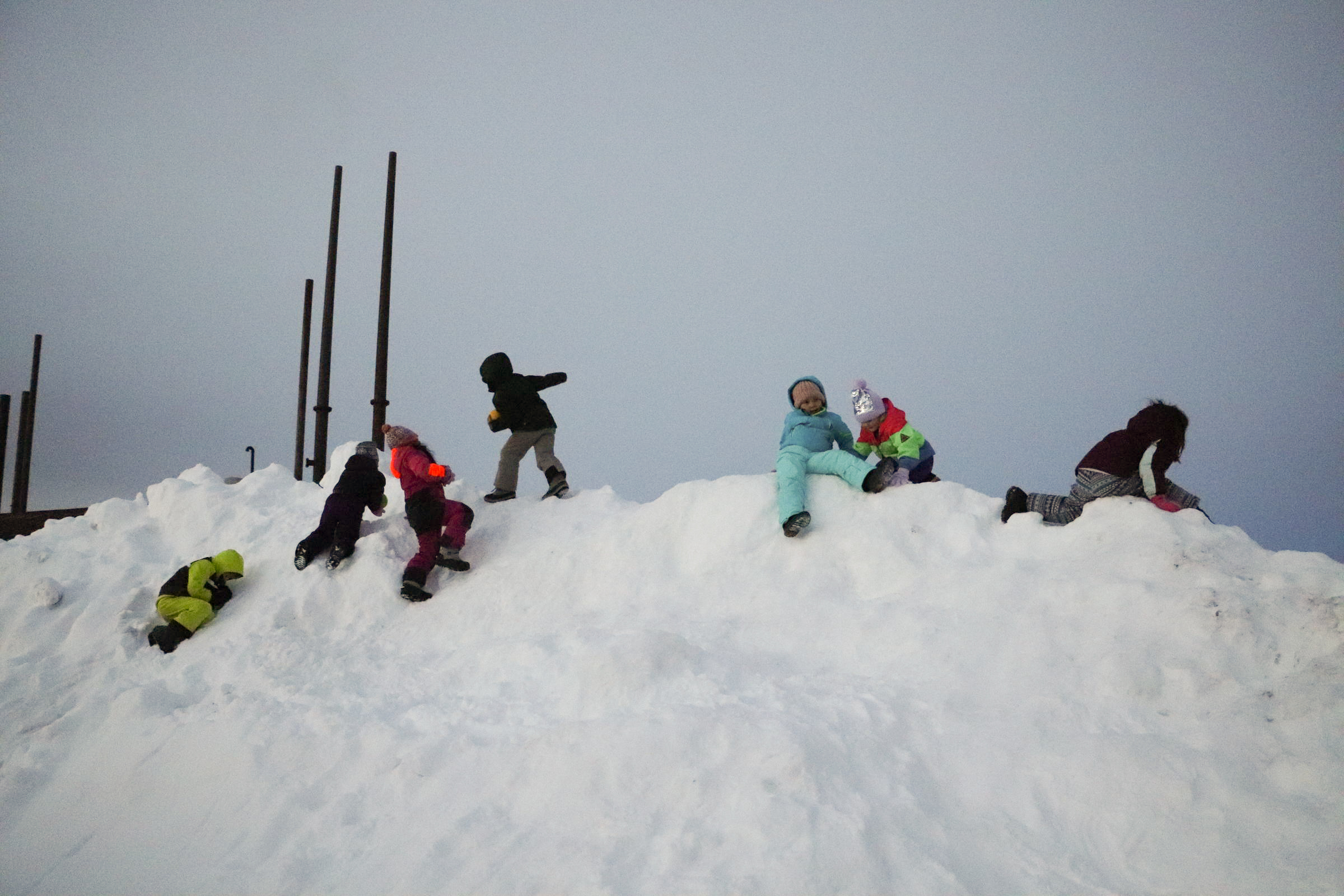
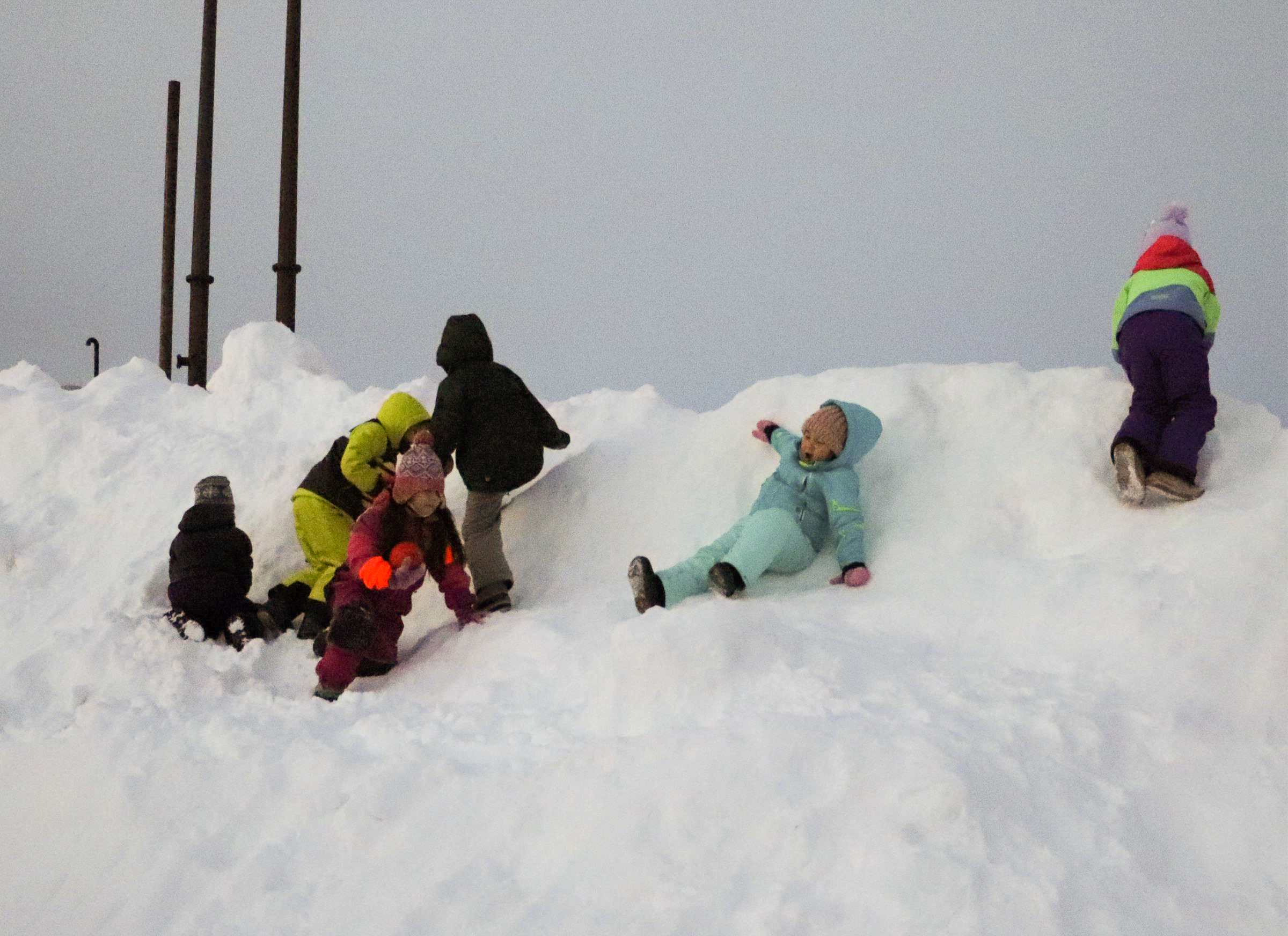
Kids playing on a hill of snow near Dillingham Elementary School. Feb. 1, 2021. (Izzy Ross/KDLG)
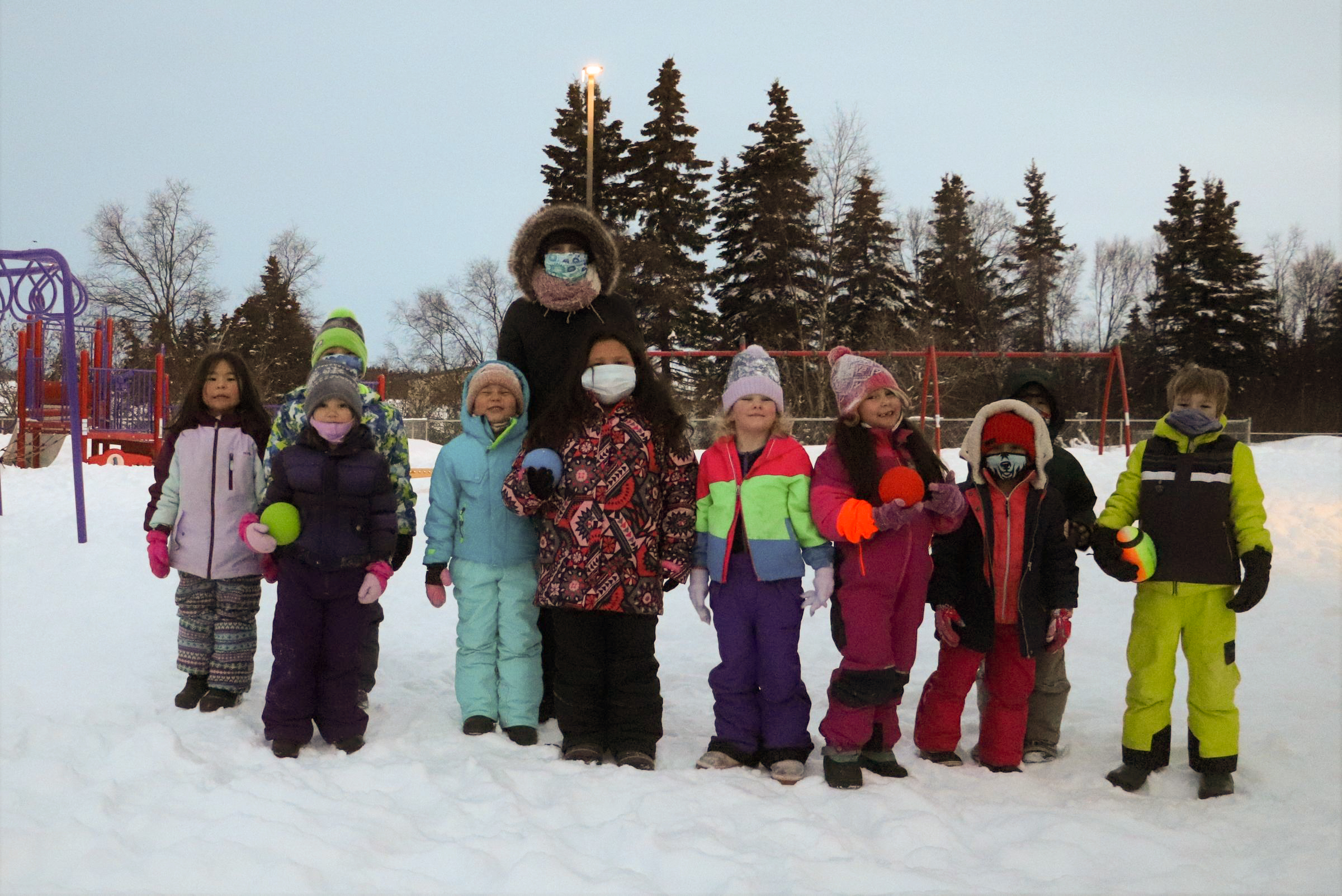
It’s bitterly cold outside, but the kindergartners playing on the jungle gym and a hill of snow next to Dillingham Elementary School don’t seem to mind.
“I like being in school,” said Juliette Olson. “I like seeing my teacher. And it’s been fun to see my teacher!”
Cooper Roenfanz agreed.
“I like being in school,” he said. “I like to see my friends.”
Dillingham city schools have had to close the classrooms after two and a half weeks. That’s because people at the were potentially exposed to COVID-19. The 13-day window of in-class instruction was a welcome respite for the kids, who hadn’t been in a classroom since last November.
Kids playing on a hill of snow near Dillingham Elementary School. Feb. 1, 2021. (Izzy Ross/KDLG)
“My favorite thing is to play out. And making snow angels,” said Myia Womack.
“I like to play outside and go to the monkey bars,” said Wesley Active.
“I like to look at the stars,” said Isla Jones.
I asked Isla what she liked to play most. She thought about it for a moment, then said, “Legos!”
The kindergartners are hard at work on the basics — Wesley said right now they are learning letters and numbers.
School isn’t just a place to learn. It’s also where children can spend time with their friends, kids their own age. For Hoku Messer and Les Kayoukluk, that’s the best part of being back.
“Playing with our friends,” Les said.
“Playing with our friends,” Hoku agreed. “Keeping them safe from the virus, cause there’s virus coming on.”
Both Hoku and Les said their favorite subject is math.
Myia Womack playing at recess. Feb. 1, 2021. (Izzy Ross/KDLG)
I asked them what was hardest about not being in school.
“It’s sad,” Hoku said. “I’m sad why I don’t get back to school.”
“Sad,” Les echoed.
In the background, kids gathered at the top of a snowy hill howl at the waning gibbous moon hanging in the cloudless sky.
Faye Borden said they were playing “lions,” which is also her favorite game.
“It’s when we pretend to be lions and do a lot of lion-y stuff,” she explained.
“Cool, like roaring?” I asked.
“Yeah, like I do that like, ‘Rawr!’ she said.
Everyone is excited to be here, said teacher Julien Deljanovan.
“It’s really great being back in school. It’s absolutely the best scenario for us,” she said. “Distance learning is a big challenge for everyone, but especially for the young learners.”
Distance learning presents particular problems for young kids; Deljanovan said that’s partly because they need a lot more guidance.
“They can’t pick up their iPad and say, ‘I’m going to get on Schoology and find my reading lessons for today!’” she said. “There’s so many skills that they’re working on at once. There’s so much to teach. And not being able to just see what they’re learning and adjust accordingly, too. Something that I assign might be really easy for one student and really hard for another student and I can’t give the support that they would need. So it just makes it very difficult.”
Deljanovan said the transition back to in-person learning was smooth.
“They’re just so eager to participate, and they knew the routines coming in, and they clean up so quickly and go to the next thing,” she said. “So they’re eager to be here, and it’s been going mostly well.”