KDLG - Dillingham

KDLG is our partner station in Dillingham. KTOO collaborates with partners across the state to cover important news and to share stories with our audiences.

Bristol Bay sockeye a high point in the state’s unpredictable salmon season

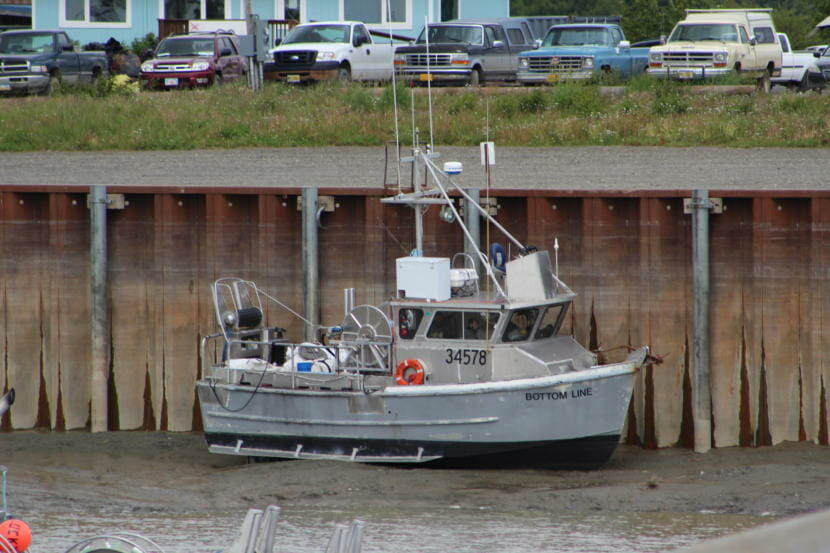
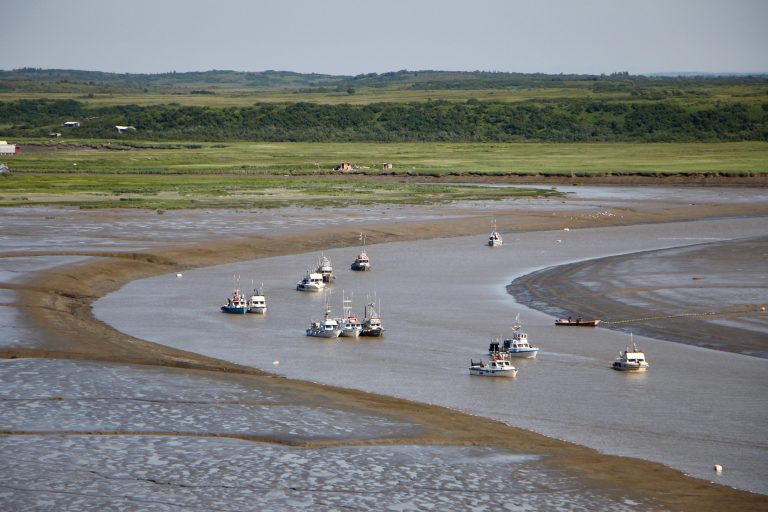
A boat at low tide in the Dillingham harbor. (Sage Smiley/KDLG)

More than 58 million sockeye salmon returned to Bristol Bay this summer. It’s another in a series of enormous runs for the fishery. The commercial harvest was just as impressive. Bristol Bay’s fleet hauled in 39.5 million fish, the fifth-largest harvest on record.

But while the Bay’s run exceeded 50 million fish for the sixth year in a row — 46% above the 20-year average — many other parts of the state were far below their forecasts.

“When you take Bristol Bay out of the picture and look at sockeye harvests in Alaska, the non-Bristol Bay sockeye harvests this year were the lowest on record since 1976,” said Dan Leash, an economist with the McDowell Group.

Across all species, the value of the state’s commercial salmon season dropped more than 50% from last year — 56% below last year. The 2020 season was valued at $295.2 million, while last year was valued at $673.4 million. Harvests were also down by 44%.

“Sometimes when you have a low harvest year, the prices will rise. But that didn’t happen this year,” Leash said. “It was sort of a death by a thousand cuts in terms of the impact of the seafood on the harvesters this year.”

Southeast fisheries saw their worst salmon runs in more than four decades, and the commercial harvest there took a big dive this season.

“It’s been the mid-70s since we’ve seen a total harvest in Southeast Alaska this low,” said Andy Piston, a biologist with the Alaska Department of Fish and Game in Ketchikan

Piston said harvests were down not only for sockeye, but across all species — from chum to silvers to pinks. The chum harvest was the lowest since 1991, and the silver harvest was the lowest since 1977. According to Piston, the sockeye harvest of 458,000 was the second-lowest since the late 1800s and the lowest since 1975.

“It’s the lowest pink salmon harvest since 1976, and pink salmon are often the most abundant species in the catch down here. So that brought our total harvest of all species way down for this year,” he said.

Still, that’s not totally unexpected. Piston said surveys of the 2017 parent year for pink salmon showed low numbers, and sockeye and chum were low as well.

Many factors can affect salmon mortality. For Southeast pinks, Piston said trawl surveys used for forecasting suggest that lower survival in early marine waters might lead to lower returns — there just aren’t a lot of juveniles leaving fresh water. On top of that, he said, there might also be problems further out at sea.

“For some species, we’re also seeing indications that fish aren’t growing well out in the ocean,” he said. “For example, with sockeye salmon, you know, we collect scale samples from some of our stocks out here in southeast. And what we’ve seen in a lot of years since about 2015 is very little growth in their last year at sea.”

Meanwhile, Kodiak’s pinks did well, although the sockeye harvest was down from last year. Fishermen brought in more than 21 million pinks — more than three times that of 2018.

Copper River also had one of the weakest sockeye runs on record. Fish and Game closed the fishery after just a few openers. It met its escapement, but the commercial harvest was 92% lower than the average over the past decade.

In August, the Cordova City Council passed a resolution asking the state and the U.S. Secretary of Commerce to declare disasters for both the 2018 Copper River sockeye and king runs and the 2020 sockeye, chum and king runs at the Copper River and Prince William Sound.

The Chignik River had its worst run on record this year. It was 40% smaller than the disastrous run of 2018. Chignik’s runs over the past three years have been extremely low. This year, there were no commercial openers for sockeye, and the fishery didn’t meet its minimum escapement for its early or late runs.

“It was a very bad year. Folks out there really struggled, obviously, not just with the commercial fishery but with the subsistence as well,” said Ross Renick, an area management biologist at the Chignik Weir. “It was very difficult for folks to get fish in Chignik this year.”

The U.S. Secretary of Commerce this year allocated $10.3 million in relief funding to the Chignik fishery. The state is now working on the final draft of a plan to allocate that funding to Chignik fishermen, communities, and research.
One man dead, another missing, after Chignik Lake boating accident

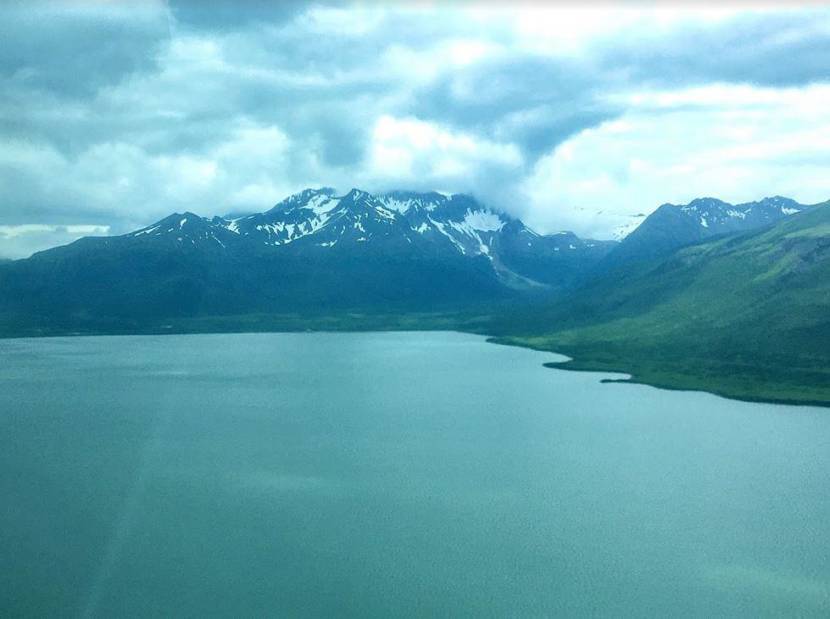
Chignik Lake. July 2019. (Alex Hager/KDLG)

One man died and another is missing after a boat capsized in Chignik Lake Saturday afternoon, according to a dispatch from Alaska State Troopers.

The Coast Guard recovered the body of 42-year-old Fred Shangin of Chignik Lake Saturday evening. He died from cold water exposure, troopers said.

Nicholas Garner, 39, also of Chignik Lake, is still missing. Taylor Lind, 24, was also in the boat and was rescued.

According to troopers, the three men had loaded a snowmachine on the bow of a skiff.

“Three individuals were transporting it to the north side of Chignik Lake when they hit a wave and the boat capsized,” said Austin McDaniel, a public information officer with the state troopers. “The skiff floated for around half an hour until they were able to get to the edge of the ice on the lake.”

Lind was able to save himself.

The troopers report that Shangin could not get off the top of the capsized skiff and succumbed to the cold while it was drifting. Garner hung onto the side of the boat but eventually went underwater and did not reappear. Troopers say the men were not wearing life vests.

Two people, 24-year-old Kevin O’Domin and 21-year-old Denise Bereskin, were on shore but could not get to the boat to help with the rescue, according to troopers. A second boat, driven by Jamie O’Domin and a 16-year-old minor, arrived to help, but troopers say they could not reach the capsized skiff because of ice.

Troopers were called to the area around 3 p.m. Saturday, and the Coast Guard arrived around 6:30 p.m.

The Coast Guard transported Lind and those trying to help with the rescue to Chignik Bay. All are from Chignik Lake.

Troopers say local residents have been unable to search for Garner due to a winter storm, but that search efforts will resume once the storm clears.

2020 was an eventful year for the Pebble Mine project

Several fishing boats in Bristol Bay
Fishing boats in Bristol Bay in 2019. (Alex Hager/KDLG)

It was a momentous year for people who have fought for and against the proposed Pebble Mine.

The U.S. Army Corps of Engineers in November denied Pebble’s request for a federal permit, stopping the mine likely for good. The decision was met with mixed emotions from people in Bristol Bay.

Sue Anelon works for the Iliamna Development Corporation. She said the mine would have been a significant boost to village economies.

“I’ve seen the good and the bad,” she said. “When Pebble was here and a lot of people were working, they were paying for their own groceries, they were paying their own fuel. They were buying trucks, they were buying Hondas. People were paying for things. Now they can’t do that. They have to rely on the government.”

Billy Trefon Jr., a Nondalton resident, was elated by the decision.

“I was raised up listening to Elders telling me that, if you take care of the land, the land will take care of you,” he said. “And it has been doing that for centuries, milleniums. So to us this land is important. The water is important.”

Two attendees at a public hearing on the draft environmental review of Pebble, which the U.S. Army Corps of Engineers held in Newhalen in March 2019. (Izzy Ross/KDLG)

Opponents of the project, like the United Tribes of Bristol Bay, have said that despite the Army Corps’ permit denial, they want to continue to push for long term protections for Bristol Bay.

Northern Dynasty and the Pebble Limited Partnership have promoted the controversial mine for more than a decade. In February, the companies proposed sewer repairs to three villages to help offset wetlands through sewer repairs. But some communities, like Nondalton, said they would reject any aid from the company.

“Our position is, we do not want anything from Pebble. Nothing,” said George Alexie, president of the Nondalton Tribal Council, which opposes Pebble.

The months leading up to Pebble’s permit denial were rocky for the company. In August, the Pebble Limited Partnership was told it needed to provide a new mitigation plan.

“I think it’s just, they have to go into more mitigation. That’s what I believe,” said Lisa Reimers, a board member of Iliamna Natives Limited. “Figure out what they need to get to the Army Corps to continue with getting them the information to get a [Record of Decision]. So I don’t think it’s the end of the story for Pebble, like everybody wants to believe it is.”

A few weeks later, secretly recorded tapes of Pebble CEO Tom Collier were released by the Environmental Investigation Agency. Collier resigned after the tapes were released.

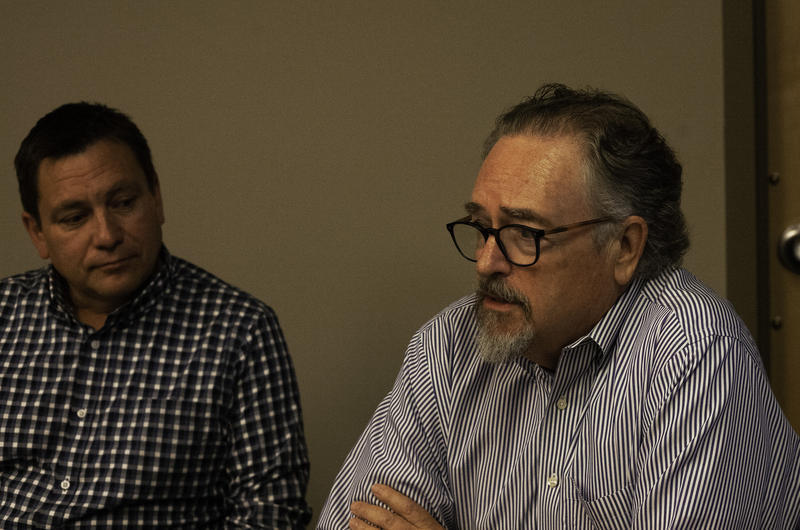
Abe Williams, left, director of regional affairs for The Pebble Partnership listens as Pebble CEO Tom Collier answers questions during an Institute of Journalism and Natural Resources roundtable in Anchorage, Alaska. September 5, 2019. (Photo by Tripp Crouse / KNBA)

The tapes also triggered new scrutiny of the state’s involvement in the permitting process.

“What the state chooses to do in order to create some fantasy mitigation plan that could satisfy legal requirements with the Corps has yet to be seen,” said Alannah Hurley, the executive director of the United Tribes of Bristol Bay. “And unfortunately, especially clear from this letter, they have a very strong advocate and partner in our governor.”

The mine would have been built at the headwaters of Bristol Bay. Scientists and environmental groups have continuously spoken out about its potential impacts to the ecosystem. A biologist talked about how the project could reduce the vitality of salmon in Bristol Bay.

“When you realize that the fish that breed and succeed in the Koktuli River are adapted to that specific place, then you realize that the fish are not interchangeable from place to place and in terms of impacts of development, that specific population is distinctly at risk, because the whole population is downstream of where a mine would be,” said Dan Schindler, professor of fisheries sciences at the University of Washington.

Pebble’s proposal also could have been another hindrance for beluga in the Cook Inlet.

“So when you look at all those things: the oil and gas dumping; the seismic testing; the regular spills from pipelines and leaks; the beluga whale faces a myriad of threats,” said Bob Schavelson, advocacy director for Cook Inlet Keeper.

“We’ve gotta do a better job of looking at these things. And the Pebble Mine is one more risk, one more stress that we don’t need for this declining population,” he said.

The Pebble Partnership said in a statement that the Army Corps’ decision was a “lost opportunity” for the region and that they plan to appeal the denial.

Class-action lawsuit claims company misled shareholders about viability of Pebble Mine

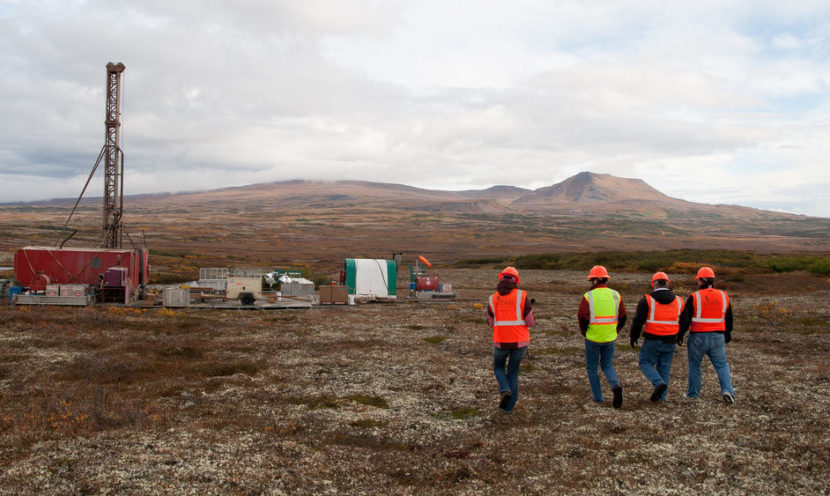
Members of the media walking up to an exploratory drill rig in 2012. (Photo by Jason Sear/KDLG)

A shareholder of Northern Dynasty Minerals is filing a class-action suit against the company and its directors for allegedly misleading shareholders about the viability of the proposed Pebble Mine. People who bought stocks between Dec. 21, 2017 and Nov. 25, 2020 have until Feb. 2, 2021 to join the lawsuit as lead plaintiffs.

Canadian-based Northern Dynasty is the parent company of the Pebble Limited Partnership, which has been promoting the mine to investors for more than a decade.

The U.S. Army Corps of Engineers last month denied Pebble a federal permit. It said that the project went against Clean Water Act guidelines, as well as the public interest.

The lawsuit holds that the company did not disclose to its investors that the proposed mine was contrary to the guidelines and public interest. The lawsuit also cites the secretly-recorded “Pebble Tapes,” which the Environmental Investigation Agency, an environmental group, released in September. In the tapes, Northern Dynasty CEO Ron Thiessen and former Pebble CEO Tom Collier say that once the mine went into production, the company planned to pursue a larger mine and extend its lifespan beyond what was being proposed.

Because of that, it alleges, Northern Dynasty misled the public and violated the Securities Exchange Act of 1934. That act is aimed at promoting greater transparency and requires that companies disclose relevant financial information.

The suit claims that in doing so, Northern Dynasty artificially inflated its stock prices. It holds that had investors been aware of the situation, they would not have bought shares at that price, or at all.

Northern Dynasty declined to comment for this story.

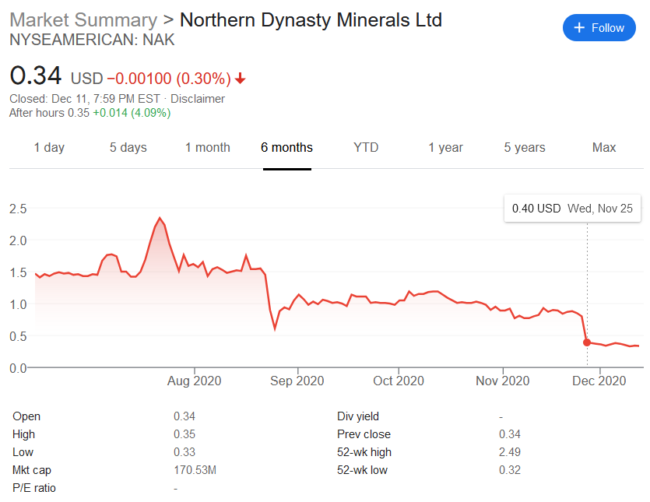
Screengrab of the Google Finance Market Summary for Northern Dynasty Mineral (NAK) shares. Dec. 12, 2020. (Source: Google Finance)

The months leading up to Pebble’s permit denial were rocky for the company, and that was reflected in its stock prices. The suit claims that that damaged investors.

When the Army Corps announced in August that Pebble needed to submit a new plan to mitigate the impacts to wetlands, the lawsuit points out the shares dropped by almost 38%, and when it denied Pebble a federal permit at the end of November, Northern Dynasty stocks dropped almost 50%, to 40 cents a share. As of Friday, they were at 34 cents a share.

The next annual Northern Dynasty shareholder meeting is on Dec. 17 in Vancouver.

Relief and disappointment as Bristol Bay reacts to Army Corps’ Pebble permit denial

Two attendees at a public hearing on the draft environmental review of Pebble, which the U.S. Army Corps of Engineers held in Newhalen in March 2019. (Izzy Ross/KDLG)

When the U.S. Army Corps of Engineers last week denied the Pebble Limited Partnership a federal permit to develop a mine under Section 404 of the Clean Water Act, it surprised people on both sides of the issue.

“I was ecstatic. I was elated. I was so happy to hear that it was finally over,” said Billy Trefon, Jr. from Nondalton, one of the villages closest to where the mine would have been built.

To the south, in Iliamna, Iliamna Development Corporation CEO Lisa Reimers said people feel hopeless.

“Well, we feel like it was — we were lied to by the Army Corps because they said politics wouldn’t be involved. And it ended up being politics,” she said. “The Army stated they’d recommend to build a mine, then out of nowhere they changed their minds.”

Pebble would have been one of the largest gold mines in the world. The Army Corps said last week that the mine proposal didn’t follow Clean Water Act guidelines.

For Trefon, in Nondalton, the project also went against the traditional teachings of elders.

“I was raised up listening to elders telling me that, if you take care of the land, the land will take care of you,” he said. “And it has been doing that for centuries, milleniums. So to us this land is important. The water is important.”

People around Bristol Bay, including Trefon, have focused on Pebble to the point of exhaustion, investing years to understand the issues around the project and its potential impacts.

Many were resigned, and for opponents of the project, the Army Corps’ decision released a wave of relief. Lindsay Layland is the deputy director of United Tribes of Bristol Bay, one of the regional groups opposing the mine. She’s also a commercial fisherman.

“As a fisherman, I’m just… I’m so happy, you know, I’m so proud of the effort that folks in the bay and beyond have put forward, and come together on,” she said.

Opposition to Pebble has been a unifying issue for the three major sectors of Bristol Bay’s fishery. Much of the advocacy over the past decade and a half has been centered on protecting Bristol Bay’s sockeye salmon run — the largest wild salmon run in the world.

“It really comes down to this amazing coalition, this amazing, diverse group of people — from commercial fishermen, to tribes, to sport fishermen, to subsistence fishermen, to hunters and anglers,” Layland said.

The debate has influenced people of all ages. Hailey Carty is a 13-year-old from Dillingham who’s in eighth grade. Pebble has always been a topic close to home.

“This has been something I’ve been protesting against for a few years now, and for it to finally be denied is really, really exciting,” she said.

Many of the people who live in the region and opposed the project also see this as a win in a fight to prioritize and protect subsistence practices.

“This is our land, our food sources, our animals, everything kind of runs off the water,” Carty said. “And for something to be taken away, can affect so many different things. It can just destroy many, many things.”

But for those who backed the project, the decision comes as a harsh blow. The mine proposal had recently seemed poised to succeed.

Sue Anelon works for the Iliamna Development Corporation. Iliamna is another community close to where the mine would have been. Anelon says the area is economically depressed. She sees the Army Corps’ denial as a bad decision for the state as well as the Lake Iliamna region.

“I’m very worried right now, because there’s a lot of people without jobs — they’re depending on the government,” she said.

Anelon said people have to wake up to the economic reality in the state. She pointed out that when Pebble was operating in the area several years ago, it provided jobs. That meant they were able to more fully participate in a cash economy.

“I’ve seen the good and the bad,” she said. “When Pebble was here and a lot of people were working, they were paying for their own groceries, they were paying their own fuel. They were buying trucks, they were buying Hondas. People were paying for things. Now they can’t do that. They have to rely on the government.”

Reimers, the CEO of Iliamna Development Corporation and a board member for Iliamna Natives Limited, has supported the project for years. She disagrees with the Army Corps determination that it was “contrary to the public interest.”

Reimers believes that regional entities like the Bristol Bay Native Corporation have not provided viable economic opportunities for communities like Iliamna, and she said that people who live near the proposed mine site and wanted the project are deeply disappointed.

The Pebble partnership said in a statement that the Army Corps’ decision is a “lost opportunity” for the region, and that it plans to appeal the denial.

Environmental groups say Pebble could threaten the endangered Cook Inlet beluga whale

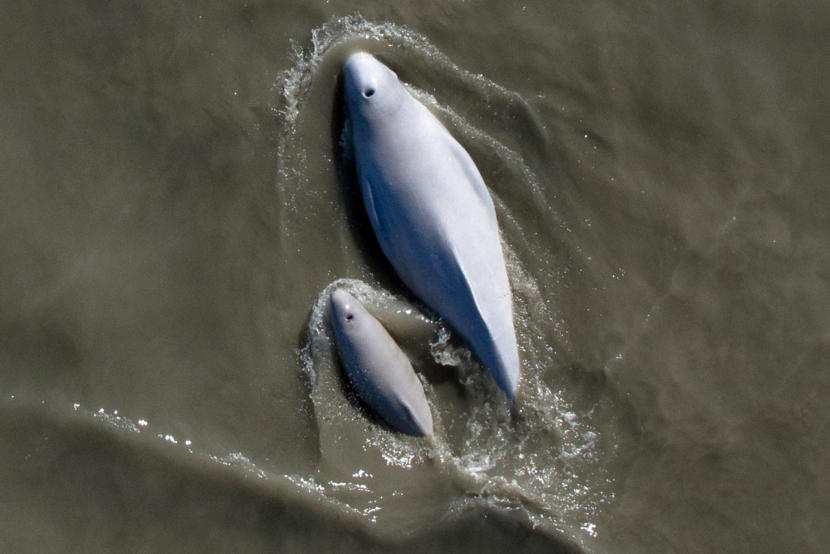
A Cook Inlet beluga whale mother and neonatal calf swim together. (Public domain photo by Hollis Europe and Jacob Barbaro/NOAA Fisheries)

Beluga whales in the Cook Inlet are nearing extinction as an accumulation of threats endanger the whales’ habitat. Now conservationists in the region are raising concerns about adding yet another stressor to a disappearing whale population — the proposed Pebble Mine.

A new documentary provides a brief look at how the mine would operate in the area and what that could do to the belugas.

“Is it possible that the Pebble Project activities could lead to these threats against Cook Inlet belugas? Yes,” said Mandy Migura, a wildlife biologist speaking at a panel hosted by the Environmental Investigation Agency last month.

The environmental group recently released “White Whale, Gold Mine,” a short documentary about how the mine could affect belugas.

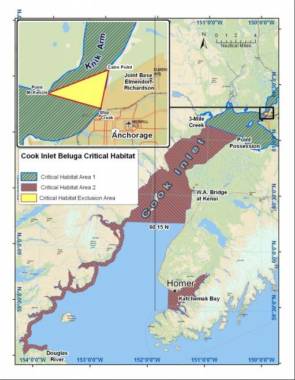
All 3,013 nautical miles designated as critical beluga whale habitat. (Courtesy NOAA Fisheries)

NOAA Fisheries has ruled that Cook Inlet’s beluga whales are endangered. The belugas are unique to the region because the Aleutian chain acts as a barrier, so the whales never travel in or out.

In 2011, NOAA designated 3,000 nautical miles of the Cook Inlet as critical beluga whale habitat. Migura says that a portion of Pebble’s developments cut through that area.

“Part of that includes the western shoreline of lower Cook Inlet,” Migura says. “And they have said that it includes two nautical miles seaward of the high-water mark.”

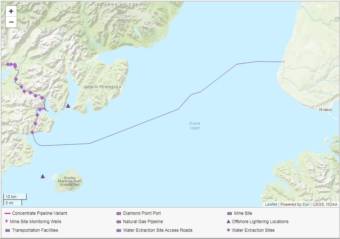
The Pebble Limited Partnership is planning to build a port on the shore of Diamond Point in the Iliamna Bay, with a dredged navigation channel. It would also run a 74-mile natural gas pipeline and fiber optic cable across the water basin.

The Marine Mammal Commission is an independent government conservation agency. It estimated that 1,300 belugas were in Cook Inlet in 1972. Now there are fewer than 269 whales left. The population is decreasing at a rate of 2.3% per year.

NOAA’s recovery plan, the Critical Habitat for the Cook Inlet Beluga Whale, lists 10 potential threats to the population, which the plan classifies as high, medium and low concerns. The top concerns are catastrophic events like oil and gas spills, noise from on and offshore activities and the combined effects of all individual threats.

Bob Shavelson is the advocacy director for Cook Inlet Keeper, a non-profit focused on protecting the watershed. He said a combination of threats could be behind the population’s decline.

“So when you look at all those things: the oil and gas dumping, the seismic testing, the regular spills from pipelines and leaks — the beluga whale faces a myriad of threats,” Schavelson said. “We’ve gotta do a better job of looking at these things. And the Pebble Mine is one more risk, one more stress that we don’t need for this declining population.”

According to the state Division of Water, there are over 100 facilities that have permits to discharge wastewater into the Cook Inlet area. The region’s primary oil company, Hilcorp, uses mixing zones authorized by the state for its nine offshore platforms. Those zones are meant to dilute oil and gas waste when it’s released. There are 17 oil and gas platforms in the basin.

Diamond Point port in Cottonwood Bay and Iliamna Bay, adjacent to the Iniskin Peninsula. The purple line running across Cook Inlet represents the concentrate pipeline and fiber optic cable.
(Pebble Project EIS)

The state Department of Environmental Conservation has said that Cook Inlet’s currents are strong enough to meet federal water standards. But Hilcorp has a troubled history of waste discharge in the watershed. Three years ago, the company had to halt production at two platforms due to an oil spill and gas leaks. 

The U.S Army Corps of Engineers’ final environmental review of the Pebble Mine concludes that the impacts of the project in critical beluga habitat would be minor but permanent. 

In an email, Pebble spokesperson Mike Heatwole said, “as our port will operate in Cook Inlet, we will utilize best management practices to ensure no negative impacts to Cook Inlet belugas.”

Pebble says it will work with the U.S Fish and Wildlife Service and other relevant agencies to finalize its mitigation efforts.

But Mandy Migura, the wildlife biologist, is worried that the mine may be a tipping point for the whales’ survival.

“It kind of does beg the question at one point are we getting to the threshold,” she said. “Right now there’s not a whole lot going on in the lower Cook Inlet. If that area is able to be somewhat of a refuge of the other threats, we’re now adding stressors into an area that had relatively low stressors.”

Migura said that if the population is depleted, those whales will be lost forever.

Site notifications
Update notification options
Subscribe to notifications