KDLG - Dillingham

KDLG is our partner station in Dillingham. KTOO collaborates with partners across the state to cover important news and to share stories with our audiences.

In the wake of Pebble Tapes, scrutiny for state involvement in wetlands mitigation plan

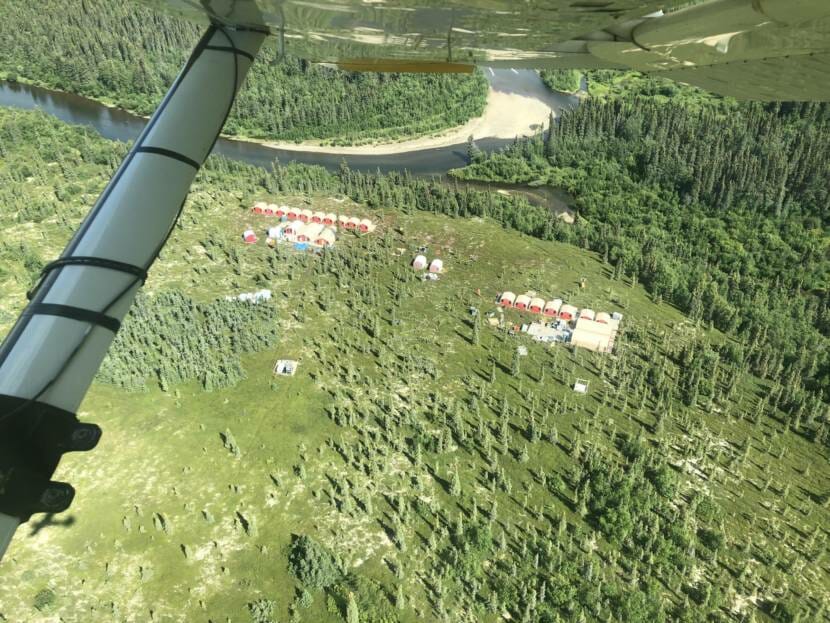
Over the summer, the Pebble Limited Partnership set up two camps along the Koktuli River to conduct wetlands studies about 27 miles away from its base camp at the proposed mine site. Aug. 4, 2020. (courtesy Alaska Department of Fish and Game)

Pebble is now less than a month away from its deadline to submit a new mitigation plan to show how it will  make up for the wetlands damage expected from construction of the mine. The plan is key to obtaining a federal permit, and Pebble says it will meet that deadline, but the secretly-recorded “Pebble Tapes” have triggered additional scrutiny about the state’s apparent assistance with the plan.

The U.S. Army Corps of Engineers told the company at the end of August that its plan has to include improving parts of Bristol Bay’s Koktuli River watershed to make up for the damages. That’s called in-kind compensatory mitigation — a departure from Pebble’s original proposal.

In the tapes, former CEO Tom Collier said the state plays a crucial role in meeting that new requirement.

“This mitigation plan that we’re putting together, almost all of the land is state land. And so, the state has to be a partner with us,” he said to the person posing as an investor for the Environmental Investigation Agency, which released the tapes. “And what we’re gonna do with that land is we’re gonna turn it into a preserve. We’re gonna set it aside, put a conservation easement on it.”

Collier continued, saying the land “will be available for hunting and fishing only in the State of Alaska. And we would not be able to respond positively to this letter we got today if the state weren’t there as our partner moving forward with this plan.”

House Speaker Bryce Edgmon and Representative Louise Stutes wrote a letter to Gov. Mike Dunleavy at the end of September asking him to stop working with Pebble on the plan, which would include actions on state land in the Koktuli River watershed. In the letter, they said, “We see no way that PLP can advance a compensatory mitigation plan without the State’s involvement.”

But so far, Dunleavy hasn’t pulled back. Instead, in a letter on Oct. 6, he maintained that it is his job as governor to allow for as much responsible development as possible.

Alannah Hurley is the executive director of the United Tribes of Bristol Bay, a group that opposes the mine. She said that Edgmon and Stutes were “spot on” in their request for the state to stop working with Pebble.

“What the state chooses to do in order to create some fantasy mitigation plan that could satisfy legal requirements with the Corps has yet to be seen,” she said. “And unfortunately, especially clear from this letter, they have a very strong advocate and partner in our governor.”

Construction of the mine would result in the loss of more than 2,800 acres of wetlands and nearly 130 miles of streams in Bristol Bay’s Koktuli River watershed, according to the Army Corps.

Over the summer, the Pebble Limited Partnership set up two camps along the Koktuli River to conduct wetlands studies about 27 miles away from its base camp at the proposed mine site. Pebble says they were on a Native allotment.

“None of this is being done with any type of public process, any type of transparency. We had no idea they were up there until people saw their man camps along the Koktuli,” Hurley said.

Following the release of the Pebble Tapes, several Bristol Bay organizations asked the Army Corps for a public comment period on the mitigation plan. Norm Van Vactor, CEO of the Bristol Bay Economic Development Corporation, said the Army Corps responded saying there was no mechanism for additional public comment. For Van Vactor, the Koktuli camp was another example of a lack of transparency in the permitting process.

“It was a large facility which we were subsequently told after we discovered it was put in by Pebble to assist them in developing their wetland mitigation plan,” he said. “It confirmed to the rest of us what we’ve known all along. And that is that the Army Corps of Engineers and others have been dealing behind closed doors with the Pebble Partnership, and have basically been in cahoots with each other.”
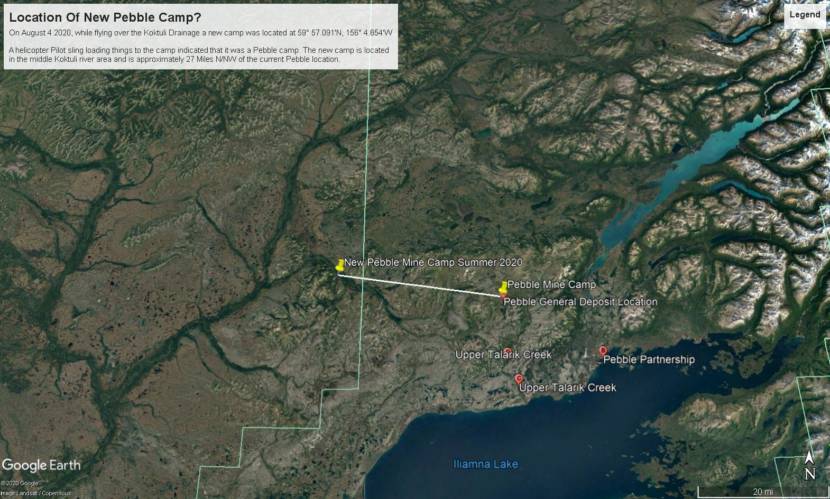
A screenshot of the location of Pebble’s camps on the Koktuli River. Aug. 4, 2020. (Courtesy Alaska Department of Fish and Game)

Company spokesperson Mike Heatwole confirmed that Pebble set up two camps in mid-July to map wetlands in the Koktuli drainage to meet the Corps’ new mitigation requirement. Camp size was limited to 20 people, and Heatwole said they had an additional camp for when the workload required more than that. He said basing that work away from the village of Iliamna was the best way to protect the community from COVID-19.

“We know that they look at furrow conditions, map the vegetation, and take photographs of the wetlands, really just to characterize the wetlands in the area,” he said. “And all of that is getting rolled up into our compensatory mitigation plan.”

Heatwole said they were aware of the Army Corps’ new mitigation requirement in early summer, although the Army Corps’ August letter was the first formal request for mitigation to the project’s wetlands impacts. He also said that Pebble notified the state about the Koktuli camps and secured the necessary permits for an operation on private land.

Laura Achee, the information officer for the Alaska Department of Environmental Conservation, said in an email that the state’s Food Safety and Sanitation Program issued two sanitation permits for Alaska Peninsula Corporation to operate temporary camps in the region of the Koktuli River. She said that based on their review of the submitted application, no other DEC Environmental Health or Water permits were required.

Not all reactions to Pebble’s mitigation efforts are negative. Lisa Reimers is the CEO of Iliamna Development Corporation and a board member of Iliamna Natives Limited. Reimers supports Pebble and she said she thinks the governor is doing the right thing. In her view, the company is simply following the directions of the Army Corps in its efforts to produce a plan.

“I agree with him,” she said. “Mitigation — depending on what the Army Corps is asking, they’ve been pretty good about their science. I’ve trusted the whole process that the Army Corps has gone through with Pebble.”

Pebble says it will meet the Army Corps’ Nov. 18 deadline for submitting the new mitigation plan. A final Record of Decision on the mine is expected this year.
Alaska judges on the ballot, explained

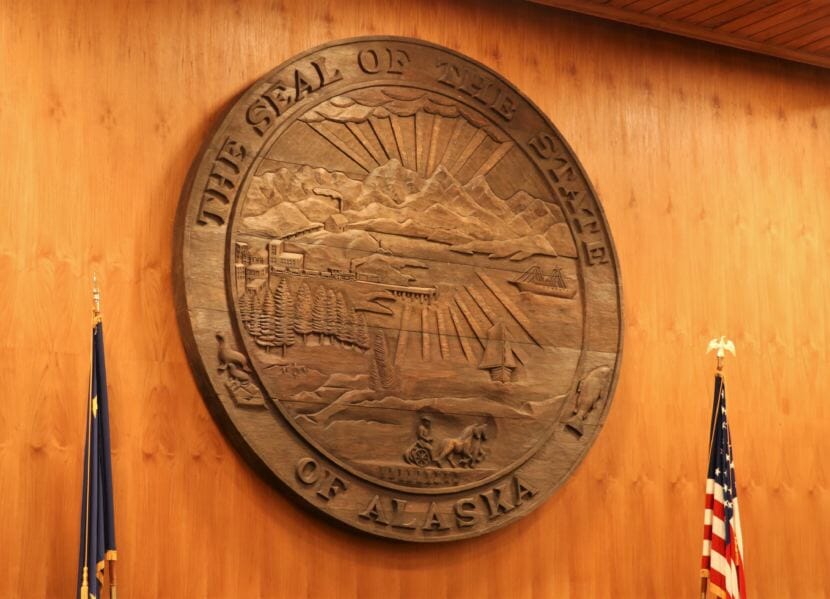
This seal of the state of Alaska, pictured here on Jan. 4, 2019, hangs on the wall behind the dais where the Alaska Supreme Court hears cases in the Boney Courthouse in Anchorage.
The seal of the State of Alaska, pictured here on Jan. 4, 2019, hangs on a wall in the Boney Courthouse in Anchorage. (Photo by Wesley Early/Alaska Public Media)

Eight Superior Court and seven District Court judges are on the ballot in Alaska’s 3rd Judicial District, which stretches from the Aleutian Islands, to Anchorage and Cordova.

But the process for judges to get on the ballot is far from self-explanatory.

First, the Alaska Judicial Council oversees the nomination of judges. Then, it sends a list of judges to the governor for appointment. The council re-evaluates judges after their first terms, which last six years for the Superior Court and four years for the District Court.

Then, the council issues recommendations on whether the judges should be retained. It’s left up to the voters to make the ultimate decision on whether each judge should keep their job.

Suzanne DiPietro is the executive director of the judicial council. She said the system is meant to give power back to the people.

“In Alaska, judges serve set terms in office unless the voters give them permission to have an additional term in office,” DiPietro said. “The founders wanted to preserve the independence of the judiciary but also to give the citizens some say so if the judges should continue in office.”

She said the council also considers feedback from thousands of people the judges have worked with before issuing recommendations.

“That includes attorneys, municipal and state police officers and law enforcement, correctional officers, social service professionals — people like social workers, guardians ad litem. The council surveys court employees, the council also surveys jurors,” DiPietro said.

She also pointed out that judges aren’t allowed to run campaigns for their reelection.

“One of the things that I find not a lot of people are aware of is that even though judges’ names appear on the ballot, the judges are prohibited under the Code of Judicial Conduct to campaign unless there’s an active campaign against them,” she said.

The Alaska Judicial Council has unanimously recommended all judges on the Nov. 3 ballot for retention. The council publishes recommendations and information on its website.

Bristol Bay Borough police arrest Naknek man for alleged burglary of fishing vessels

A westward view of downtown Naknek in the summer. (Creative Commons photo by Todd Arlo)

A man is facing more than a dozen charges after Bristol Bay Borough police say he burglarized six fishing vessels in the Leader Creek area of Naknek and also stole a vehicle.

The Bristol Bay Borough police arrested 34-year-old Ryan John Roehl of Naknek on Thursday.

The incident was reported by a person who witnessed the theft taking place and called the police last Tuesday, according to Chief of Police John Rhyshek. Police say Roehl hid an ATV near the boatyard and the witness took his keys and backpack from it to prevent him from fleeing. Police say they later identified Roehl from an ID which was with his backpack.

“There was an ATV parked right outside the gate hidden in the high grass,” Rhyshek said. “The community member that observed the theft taking place snuck over and actually took the keys out of the ATV, and took the backpack off the ATV because he didn’t want the individual to flee.”

According to a press release from the police department, Roehl faces one felony count of theft in the second degree, six counts of burglary in the first degree and one count of criminal mischief in the fourth degree.

The police had investigated the burglary of three other fishing vessels and lockers as well as a stolen vehicle for more than a month when Roehl was arrested on Thursday.

Police say Roehl was in possession of the stolen vehicle at the time of the arrest, leading to two additional counts of vehicle theft in the first degree as well as two counts of theft in the third degree, one count of burglary in the first degree and one count of burglary in the second degree.

“We don’t have a timeframe for the other burglaries. All we know is they hadn’t been reported yet,” said Rhyshek. “The way that we were able to correlate the burglaries are Mr. Roehl was in possession of the stolen vehicle and upon serving the search warrant to search the vehicle, we were able to locate tools in the vehicle with fishing vessels’ names on them. We had to do the leg work of contacting the individuals of why tools were in the vehicle.”

After the police obtained a search warrant for the stolen vehicle and Roehl’s personal belongings, they found tools with the names of various fishing vessels on them as well as methamphetamine and heroin. Roehl was further charged with possession of burglary tools and two counts of misconduct involving controlled substances in the fifth degree.

Roehl is currently being held at the Bristol Bay Borough Detention Facility with cash bail set at $2,500.

747 wins heavyweight title in Katmai’s annual Fat Bear Week

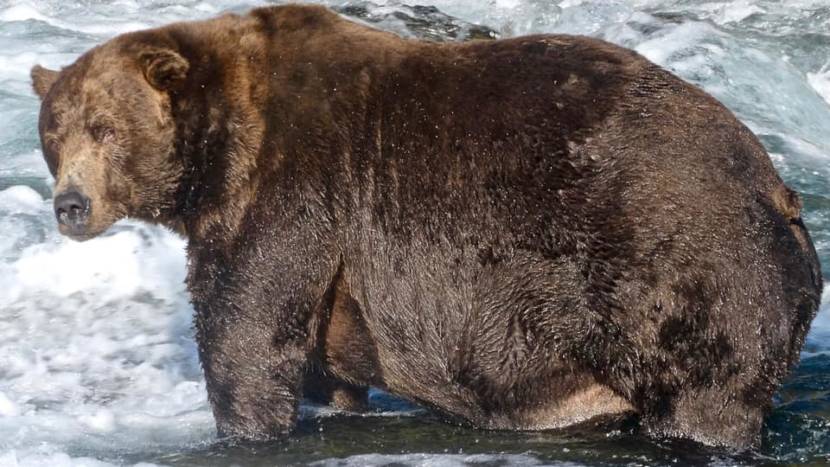
Bear 747 is the 2020 winner of Katmai National Park and Preserve’s Fat Bear Week. (N. Boak / National Park Service)

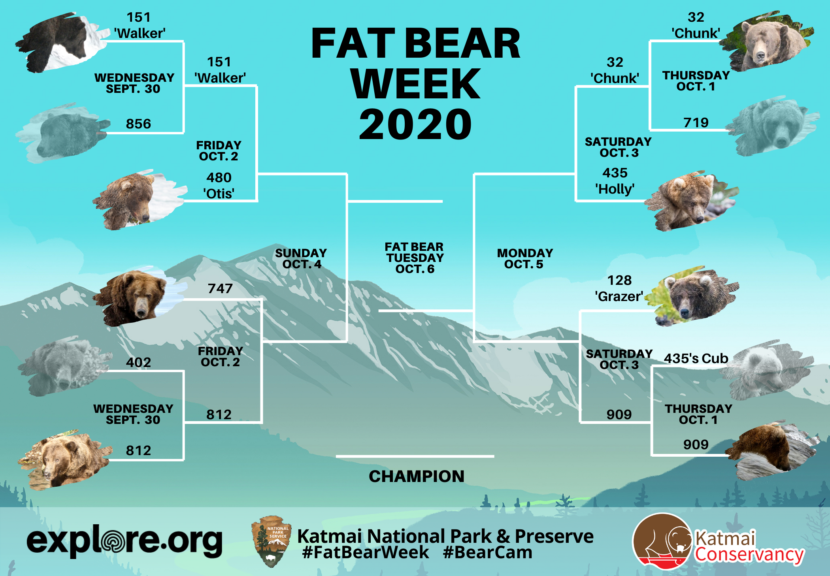
The results are in for Katmai National Park and Preserve’s Fat Bear Week competition. This year’s champion is Bear 747. He got over 41,000 votes, defeating runner-up, Chunk.

Bear 747 placed second in last year’s contest with an estimated weight of 1,400 pounds, but he lost to the “Queen of Corpulence” number 435, Holly.

Former Katmai National Park Ranger and naturalist Mike Fitz said last week that 747 met all the criteria of a winner and that he benefited from record salmon runs in the Brooks River, which flows through the park.

“He spent most of the summer just sitting at Brooks Falls fishing. He’s certainly the largest brown that I’ve ever seen fishing at Brooks River over the last ten years or so. He’s a real giant among brown bears.”

Fitz said that by the end of July, most of the bears looked fat enough to hibernate but they continued to feast. The 800,000 sockeye salmon that returned to the river provided plenty of food to make this year’s competition one of the biggest yet.

This year’s runner-up, 32 Chunk, defeated Holly in the second round of voting followed by a victory over Bear 128, Grazer in the competition’s semifinals. Holly’s cub did not make it out of the first round and Bear 480 Otis lost to Bear 151, Walker, in the second. Walker challenged 747 but lost in the semifinal.


‘The fattest Fat Bear Week ever’: Large salmon runs key in this year’s competition

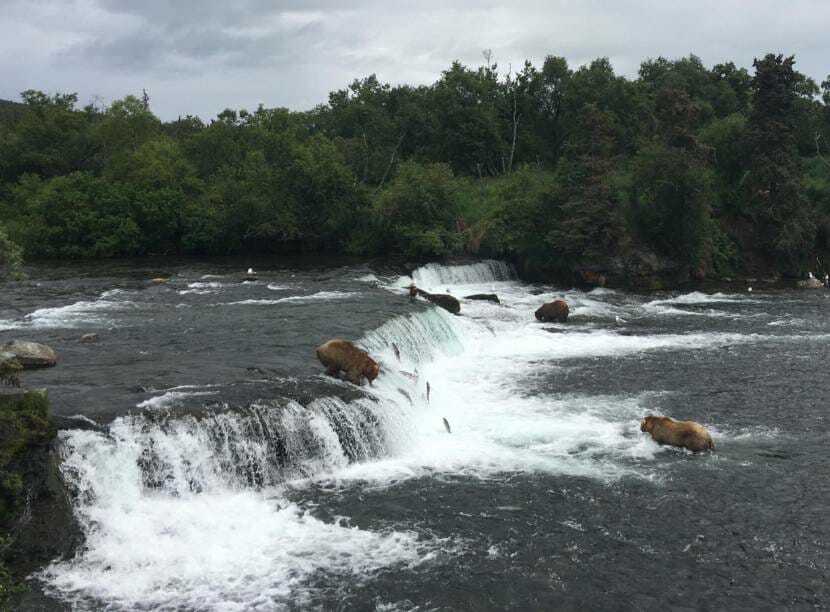
Brooks River had its largest salmon run ever at 800,000 fish. (courtesy Katmai National Park and Preserve)

“This is probably the fattest Fat Bear Week ever,” said Naomi Boak, a media ranger for Katmai National Park. “We had the largest salmon run ever. We had 800,000 salmon come through the Brooks River, and we had three or four previous years of great salmon runs. So those bears are really fat.”

Typically bears will vie for prime fishing spots to bulk up for the winter. But this year’s surplus of salmon led to less competition along Brook River Falls. Media Ranger Brooklyn White said the peaceful harvest also saw bear cubs playing with other family groups.

“Which was really odd,” White said. “It’s not something that many people have seen or experienced before because of such a successful salmon run that allowed for a more relaxed season for the bears this year.”

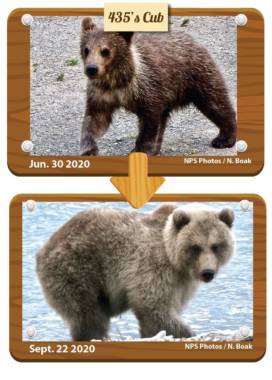
Progress pics of 435 Holly’s cub in her rookie season. (Courtesy Katmai National Park and Preserve)

One of those playful cubs belongs to returning champ and “Queen of Corpulence,” Bear 435 Holly. Her spring cub is also competing for the top spot. Cubs born in the winter weigh around one pound, but can grow up to 60 times that in their first year.

Boak says the rangers can’t play favorites, but she says 435’s cub could be a sleeper favorite.

“She is part of the royal family. She was very popular on the Explore.org bear-cam this year, so I’d watch her.”

Another bear packing pounds for the top spot is 480 Otis, a former champion and one of the park’s most renowned animals. Bear 747 also returns. He was 2019’s runner up and was assumed to weigh almost 1,400 pounds.

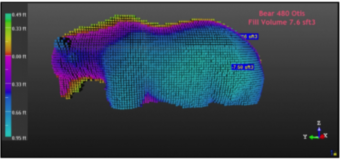
That estimation was calculated using terrestrial laser scanning technology, normally used in civil engineering projects to scan buildings for volumes. White says the National Park Service started experimenting with the scanners last year.

“With that info, we’re able to collect data that previously would only be accessible by invasive maneuvers by people,” he said. “We’re able to collect data in a hands-free way that allows the bears to be as wild as they can be.”

This is the second year the park is using scanners. So far 12 bears have been scanned successfully. Instead of guessing weights this year, researchers will focus on volume — that is, how much space the bears occupy.

This year’s contest is also the most popular to date. Viewership of Katmai Conservancy and explore.org’s bear cam has doubled since last year. Mike Fitz is a naturalist for Explore.org and was a ranger at the park for 11 years. Fitz hosts online presentations interpreting bear behavior captured by the cam.

A 3-D projection of 480 Otis made using terrestrial laser scanners last year. (Courtesy Katmai National Park and Preserve)

“People are looking for nature-based experiences even though they weren’t physically at Brooks River. And also, the bears are charismatic animals,” he said. “They’re mindful animals, they’re individuals and we get to see that on the webcams. We get to see the differences of a very dominant bear like 747 for instance. And one of the past champions 435 Holly who is very tolerant of other bears.”

Fitz says that Fat Bear Week is also a celebration of the environment. He was unable to travel to Katmai this year due to the COVID-19 pandemic, but he’s thrilled to see so many healthy bears.

“Bristol Bay offers that opportunity for people to see what salmon runs truly can be like,” Fitz said. “Some of us don’t have that opportunity to experience an ecosystem that’s functioning at its fully realized potential. That’s one thing when I moved to Bristol Bay, King Salmon, Katmai that truly opened up my eyes. I had not expected that.”

You can check out Fat Bear brackets on Katmai National Park’s Facebook, Twitter, and Instagram. People can vote for their favorite bears at fatbearweek.org through October 6. To the victor goes the salmon.

An updated bracket from Oct. 2, 2020. (Courtesy Katmai National Park and Preserve)

For Alaska’s seafood processors, COVID-19 has cost tens of millions of dollars

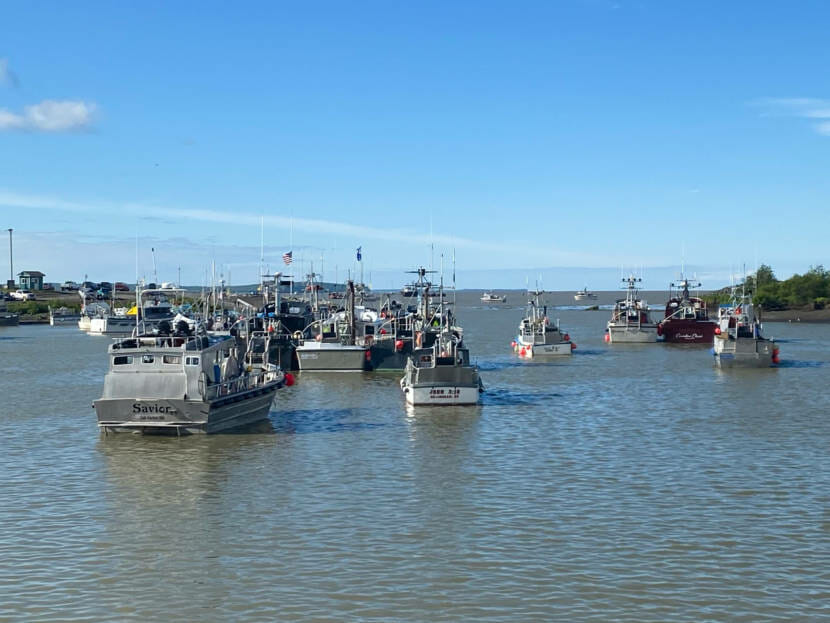
Boats leaving the Dillingham harbor on June 24, 2020. (Izzy Ross/KDLG)

Seafood processors had a lot to deal with this season.

“Our biggest challenge in 2020 was safely staffing our plants,” said Julianne Curry, the public affairs manager for OBI Seafoods.

“It was a huge lift to get all employees tested, transported, quarantined, and fully integrated into each of our plants all while observing a closed campus and all COVID-related protocols and doing it all with very little time to plan and prepare for the summer salmon season,” she said.

To keep track of how the pandemic is shaping the seafood industry, economists at the McDowell Group have started to publish monthly briefs for the Alaska Seafood Marketing Institute.

“It’s interesting to describe a crisis when you’re in the crisis, right? And that’s our situation,” said Garrett Everidge, an economist at the McDowell Group. “The goal is to try to keep up to speed on how the pandemic is impacting the seafood industry and really impacting all stakeholders, from local governments, supply chains, retailers, harvesters, processors.”

Data collection for this information can take years, so to get a real-time picture of what’s going on, the authors conducted interviews with those stakeholders and compiled data that’s already available.

The financial costs of the pandemic hit the industry hard this summer. Everidge said processors have spent $50 million dollars on mitigation plans — so far.

“So $50 million is kind of a start and it’s just expected to increase,” he said.

Nicole Kimball is vice president of the Pacific Seafood Processors Association in Anchorage, which represents several processors that operate in Bristol Bay — Trident, Peter Pan, and Alaska General Seafoods.

“The initial quarantines for thousands of workers — so that can include hotel and food and daily medical screening,” she explained. “It’s the testing that came online, often multiple times for each worker. It’s hiring medical companies to provide daily screening and be on site for each plant. It’s PPE and sanitation supplies. All of those things. Security, which in Bristol Bay people were really adamant about needing to ensure if you were going to have a closed campus it really was a closed campus.”

Kimball said all those things were expensive — over and above the normal cost of operating. And the $50 million price tag for 2020 is in line with what she’s heard from companies around the state.

“I think some companies, individual companies, spent more than $10 million alone,” she said.

Another factor is that the scientific understanding of the virus and how it is transmitted has been constantly evolving, and that’s posed a big challenge for processors as well.

“As we learned new information about the virus, we had to change protocols — so constantly evolving situation, protocols, information — in order to stay most up-to-date on how it’s likely transmitted, the scale of asymptomatic cases, how long someone will test positive even after they’re no longer contagious. All those things were constantly kind of in flux.”

Those precautions paid off. In Bristol Bay, the outbreaks among processors were confined to the workforce and didn’t spread to communities in the region.

Companies also saw a big drop in the size of the workforce — they had 13% fewer people processing fish this summer. For OBI Seafoods, that was one of the biggest sources of lost revenue.

The McDowell Group’s report says that meant more of low-value products, like headed and gutted fish, and less of high-value products, like fillets.

Kimball wouldn’t speak to any specific company or to the products that came out of Bristol Bay this season. Still, she said that processing is wholly dependent on how many people are working.

“The more labor you have, the more higher-value products you could probably do. It also depends on lots of other factors, like the volume of fish coming in at a short period of time and things like that. But generally I think the report was right on in just identifying when you, in any year when you don’t have a sufficient workforce you’re often forced to do lower-value products.”

Fewer workers didn’t mean a lower harvest in Bristol Bay, however. That fleet hauled in almost 40 million fish — the fifth largest harvest on record. Sockeye harvests in other fisheries around the state were relatively weak, though. According to the Alaska Seafood Marketing Institute, if Bristol Bay were excluded from the statewide total, this would have been the smallest harvest year since 1976.

Those costs had to be felt somewhere, and the price per pound for Bristol Bay sockeye dropped steeply. Fishermen were paid about half of what they got in 2019. This year’s base price was $0.70.

Looking ahead, Kimball said that tariffs on American seafood means the costs of the pandemic are more acute for everyone. Tariffs for sockeye entering China’s domestic market are at 37%. For other Pacific salmon that number is 40%.

“We’re in a challenging tariff environment for our seafood — not just Alaska seafood but U.S. seafood. So these challenges, these costs, are just on top. They’re exacerbating an already challenging global market situation.”

As the 2020 summer season winds down, Curry said OBI Seafoods is already bracing for more costs and more restrictions from the state in 2021. To put that in context, she said, the current mandate for the seafood industry is 10 pages long, but the draft of a new mandate for processors is around 29 pages. She said the company is already making plans to exceed those requirements.

“It’s safe to say that the processing sector will be seeing an increase in protocols in 2021 and that COVID is far from over for our industry. We anticipate that our COVID-related costs will be just as high, if not higher than last year,” she said.

Still, she said, they’ll have more time to prepare. They are hopeful that testing will become easier and more affordable, and they want to continue working with local leadership to apply what they learned in 2020.

Site notifications
Update notification options
Subscribe to notifications