KDLG is our partner station in Dillingham. KTOO collaborates with partners across the state to cover important news and to share stories with our audiences.
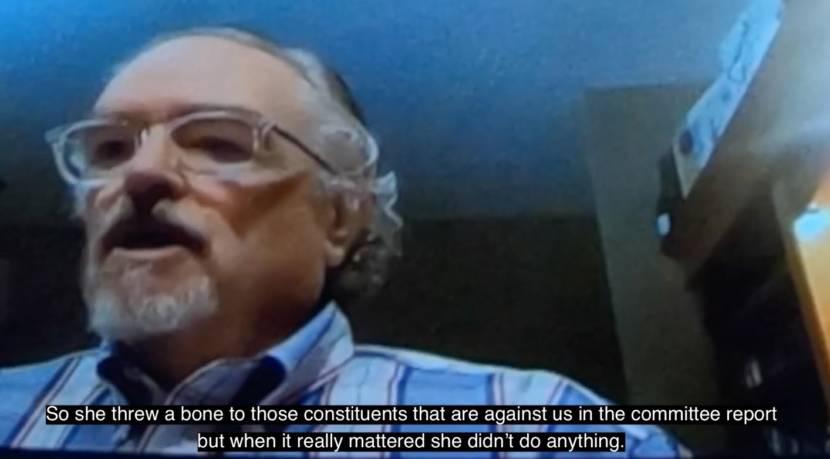
A group called Environmental Investigation Agency recorded Pebble CEO Tom Collier speaking on a video conference call with people he thought were potential investors. (Environmental Investigation Agency tape)
Tom Collier has resigned as CEO of Pebble Limited Partnership, according to a news release from Pebble’s parent company, Northern Dynasty Minerals.
Northern Dynasty says Collier resigned because of his comments about Alaska’s elected leaders and federal regulators. The calls were secretly recorded by an environmental group who had men working undercover, posing as potential investors.
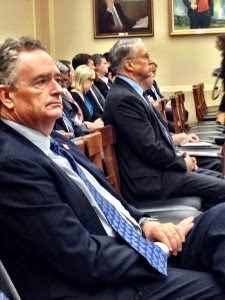
Pebble CEO Tom Collier at a U.S. House hearing in 2015. (Liz Ruskin/Alaska Public Media)
The group, called the Environmental Investigation Agency, released over an hour of tapes Monday. On them, Collier and Northern Dynasty CEO Ron Thiessen spoke of their plans to operate the mine for 180 years longer than the proposed 20-year plan. They also said Sens. Dan Sullivan and Lisa Murkowski would not do anything to prevent it from going forward, despite their recent statements that the mine should not receive a federal permit.
Both senators said they stand by their statements last month that the mine, as proposed, should not get a federal permit.
“The unethical manner in which these tapes were acquired does not excuse the comments that were made, or the crass way they were expressed,” said Thiessen. “On behalf of the company and our employees, I offer my unreserved apology to all those who were hurt or offended, and all Alaskans.”
Northern Dynasty has named former Pebble CEO John Shively as interim CEO.
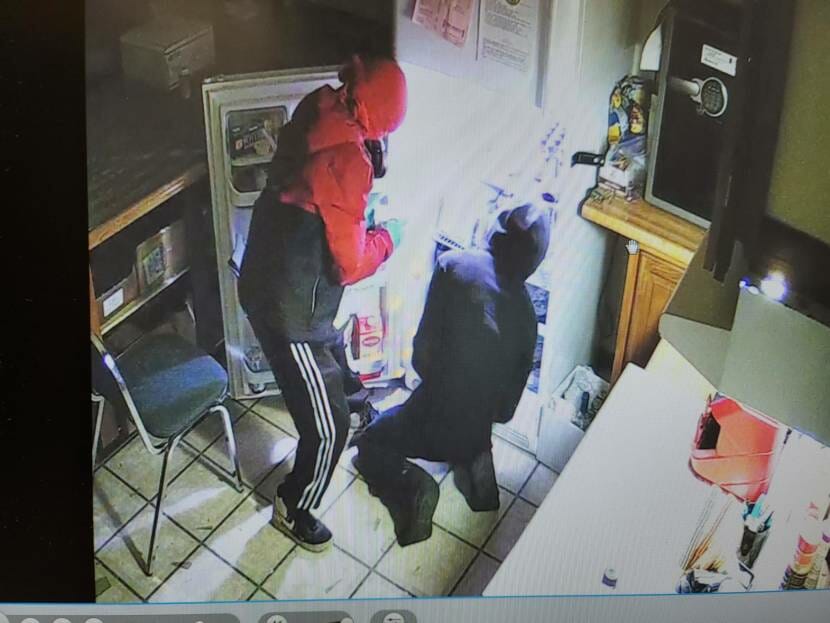
Image from Bristol Bay Bud Company security camera. September 14, 2020.
Updated post — 7:20 p.m.
On Wednesday, Dillingham Police charged an 18-year-old and a 13-year-old for breaking into the Bristol Bay Bud Company on Monday. The police contacted them at a Dillingham residence. Police say both admitted to committing the burglary. The 18-year-old is being charged with burglary and theft, and the police will send a report on the 13-year-old to the state Division of Juvenile Justice.
Items from the burglary were found in the woods near the marijuana store and near the residence. Police seized all items, as well as the clothing the two wore during the break in.
Original post — 2:00 p.m.
Two people broke into the Bristol Bay Bud Company just before 2 a.m. on Monday morning, according to the Dillingham Police Department and the company. The store’s security cameras show two people wearing hoodies and masks entering the building and ransacking the store’s shelves and refrigerator.
Dillingham police responded to the store’s alarm within minutes, but no one was there when they arrived.
This was the first break-in at the Dillingham marijuana store. Stolen items include marijuana gummies and soda as well as glass, rubber and gasmask bongs.
Heather Allen, one of company’s four owners, said the store has an extensive security system.
“I have no problem letting people know I have a security system that has facial recognition 20 feet away, tons of cameras, every inch of the store is covered on multiple angles, and I record in high-def,” she said.
Allen said they are also taking measures to increase security.
“I would be a fool not to shore up a few things that have been brought to light from my first break-in,” she said. “Absolutely you’ll notice there are some things up here already in place that happened overnight.”
Allen said she is now working with the Dillingham Police Department to identify the people in the camera footage.
“I have faith that this tight-knit community will rally together, and we’ll find who broke into the pot store and caused a big ‘ole hullabaloo,” she said.
Anyone with information about the incident can contact the Dillingham Police Department at (907) 842-5354.
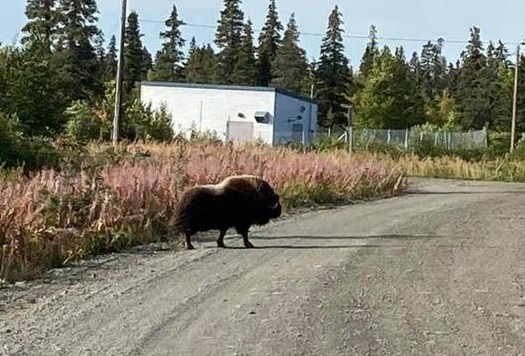
A muskox spotted on Airport Road in Manokotak in Sept. 2020. (Photo courtesy of Melvin and Sally Andrew)
Melvin and Sally Andrew were out in Manokotak in the early morning, looking for moose, when they spotted a large creature.
“She said, ‘A moose! A moose!’” Melvin said. “But I spy-glassed it and I saw the telltale signs of muskox horns. I said some explicit words — ‘What is he doing here?'”
The Andrews approached the muskox thinking it would leave, but it didn’t budge. It dipped out of sight, but they managed to catch a glimpse of the animal walking away and snapped a photo.
Muskox are native to the Yukon Delta National Wildlife Refuge. They can grow to be five feet tall and weigh somewhere between 600-800 pounds. They have long hair, a slight shoulder hump and very short tail. Both males and females have horns, but the bulls’ are larger and heavier.
Pat Jones is a wildlife biologist for the Alaska Department of Fish and Game in Bethel. Jones said this particular animal was an adult bull that moseyed down from the Nelson Island herd.
“The bulls seem to have a lot more wanderlust, they go on longer walkabouts,” he said. “They show up in areas first, and maybe five years to 10 years later we start seeing cows in the areas that we saw bulls. That’s kind of the historical pattern we’ve seen across the landscape. But there’s been some moving your direction for years.”
About a year ago, muskox were spotted by residents in villages around the Togiak Wildlife Refuge. Jon Dyazuk is the village refuge liaison.
“First sighting we had was last spring,” Dyazuk said. “It was a muskox that a village member sent us that was in Chagvan Bay.” He said that another muskox was sighted near Platinum soon after.
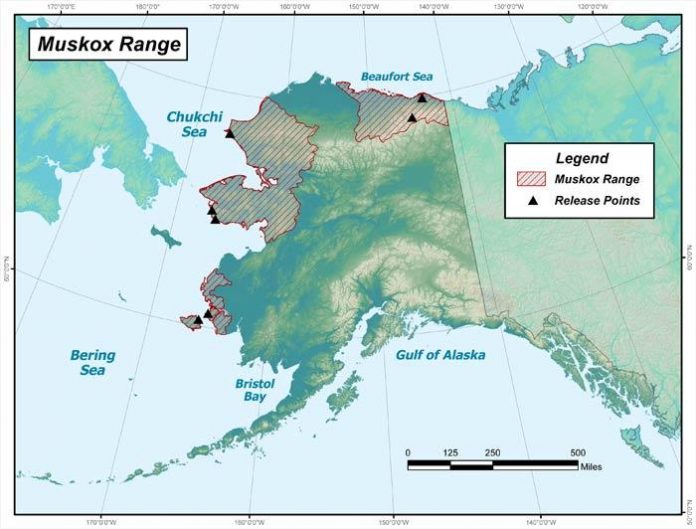
Muskox disappeared from Alaska in the 1920s. A federal initiative reintroduced the animals a decade later, bringing over 34 muskox from East Greenland to Nunivak Island, off the west coast of the state.
Muskox territory across the state. (Alaska Department of Fish and Game)
By the 1970s, the state transported some of the animals from Nunivak to establish new herds on the Seward Peninsula, Cape Thompson, the Nelson Island and the Arctic National Wildlife Refuge. ADF&G reported a total of about 5,300 muskox in Alaska in 2011.
There are no official population counts of muskox in Bristol Bay due to their low presence in the region.
But what happens if you encounter a muskox? Unlike moose or caribou, they usually will not acknowledge a person’s presence. Rather, a muskox will get defensive and back itself into a corner until it feels it’s safe to leave. But Jones says they will go on the offensive with canines.
“Probably a self-defense mechanism that goes back to the Ice Age,” he said. “They will kill dogs if they get the chance. If there’s a muskox around and you have a dog on a chain, you’ll want to bring it inside for a day or two till the muskox passes. Every year, muskox kill dogs that are chained up outside.”
Muskox hunting is not permitted in Bristol Bay, and there’s a closed moratorium in other regions of the mainland — Units 18 and 22 B,C, D and E, and in Unit 23. People can register for muskox hunting through June 30, 2021.
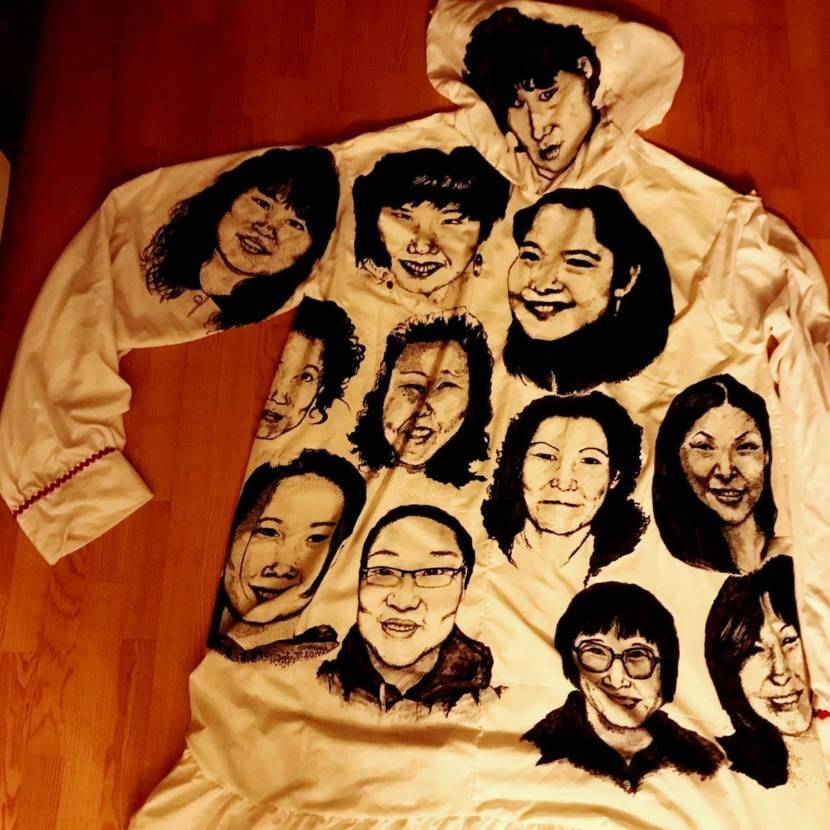
Amber Webb drew portraits of missing and murdered Alaska Native women on a handmade qaspeq to call attention to the high rate of death by homicide among Alaska Native and Native American women.
“I came to this job because I was concerned about what was happening in rural Alaska,” Cumberlidge says. “In my community, we’ve had people go missing from the community as well, later to be found after they passed away. Some real concerns about that. I’m concerned about what’s happening in Bristol Bay.”
There are no official statistics for missing people in Bristol Bay. The Urban Indian Health Institute, a tribal epidemiology center based in Seattle, reports that 52 Indigenous women and girls are listed as missing or murdered in Alaska — the fourth highest of all states. But a failure of state and federal agencies to collect that data means it’s impossible to know the scope of the epidemic.
In her new role, Cumberlidge will work to change that. She’s developing resources like a database for tracking missing and murdered Indigenous people for communities across the state.
Cumberlidge says she’s also putting together a small working group of victim service personnel, tribal representation and local law enforcement.
“The reason that we kept it small was to make sure that we could get some good communication going and work on some of the initiatives,” she says. “Improving communication when something happens, making sure that the data is getting recorded at the local, state and federal level. Also, that the response for any event is as thorough as can be.”
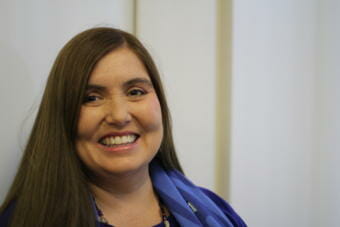
Ingrid Cumberlidge, a former tribal judge and educator, is Alaska’s Missing and Murdered Indigenous Persons Coordinator. (Photo by Wesley Early/Alaska Public Media)
Cumberlidge is working to establish protocols for local responders to follow when they have to wait for state troopers to arrive. Those troopers will be responsible for individual cases.
“They’re going to be joining the task force,” Cumberlidge says. “The objective is just to kind of review what we’re doing, how they’re doing things. But also how we’re doing things in tribal villages and villages that don’t have enforcement.”
Seven Missing and Murdered Indigenous Persons offices are opening around the country, demonstrating that there is growing federal attention to the epidemic.
In November, the U.S. Senate agreed to spend $6.5 million to address the epidemic. President Donald Trump formed the Operation Lady Justice Task Force, which is conducting tribal consultation meetings across the country. Alaska’s sessions are scheduled virtually for Sept. 10 and Sept. 14. But advocates have also voiced frustrations about the failure of the Senate to reauthorize the Violence Against Women Act, which created federal legislation classifying domestic violence and sexual assault as crimes, and has been up for renewal since 2018.
But communities have been grappling with missing and murdered Indigenous peoples epidemic on the ground for decades.
“The amount of trauma and loss in our community from missing and murdered Indigenous women is so apparent,” says Gregg Marxmiller, the education outreach coordinator at Safe and Fear-free Environment, a local domestic violence and sexual assault response agency in Dillingham. “The fact that everybody here has dealt with it one way or another means it’s all our issue to deal with.”
SAFE has organized public speaking events at the Dillingham schools, marches to raise awareness of sexual assault and domestic violence and talking circles in communities across Bristol Bay.
People are also using art to address structural barriers.
“I got into missing and murdered Indigenous women advocacy work three years ago when I started a qaspeq project,” says Amber Webb, an artist and activist who grew up in Dillingham and has worked to shed light on MMIW in Alaska and in Bristol Bay.
In 2018, Webb hand-stitched a giant qaspeq and drew on it the faces of missing and murdered women from around Alaska. She says she wanted to honor the women who were lost and bring awareness to the underlying causes of MMIW.
“Originally, that project started because I couldn’t even find data that reflected accurate numbers for Alaska,” Webb says. “And just kind of realizing how little was being done — it’s the kind of problem where you try to do anything you can when you realize how grave the situation is.”
Webb has since been collecting data from families, local news reports and police reports. She says a lot of this data collection has been happening on a grassroots level. The Sovereign Bodies Institute is one of the organizations that compiles such data.
“In 2018 Annita Lucchesi, who started the Sovereign Bodies Institute, unveiled the very first Indigenous-led database where she was collecting the names of murdered and missing Indigenous women,” Webb says. “Since then, there’s been a lot more research work around this issue, but we still can’t give a really accurate picture of those numbers, even within our own region.”
Webb says that along with state and federal efforts to address the MMIW epidemic, institutions and individuals need to examine sexism and racism in their own operations and in everyday life. Then, they need to take concrete steps to change.
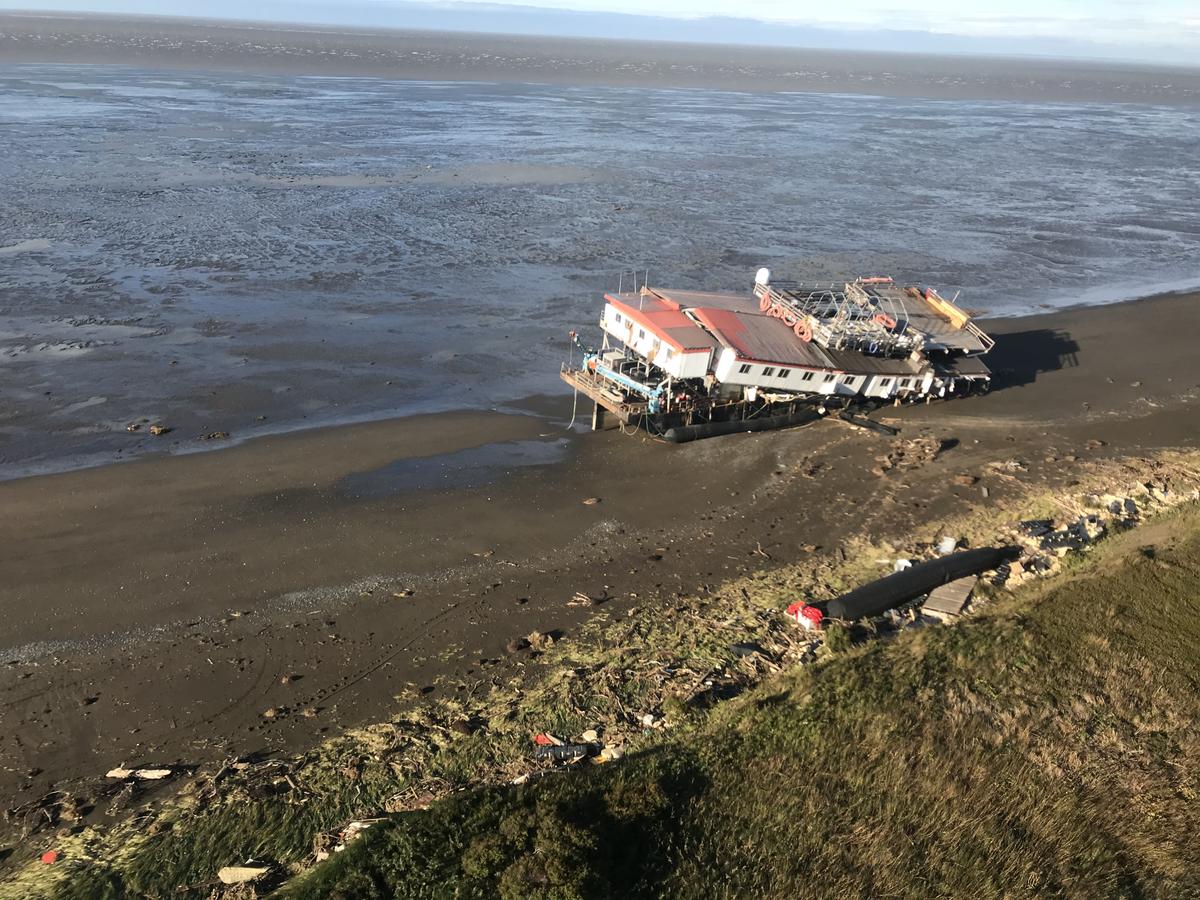
A Northline Seafoods barge was beached near Ekuk after a storm hit the area with 80 mph winds. (Photo courtesy of Russell Nelson)
A seafood processing barge in Bristol Bay sustained severe damage after it was beached during the first major storm of the season.
The 150-foot vessel belongs to Northline Seafoods and is worth $7 million. It was beached near Ekuk, a fishing community south of Dillingham.
Pat Glaab is Northline’s chief executive, and he says the storm hit the area with winds of up to 80 miles per hour.
“There were six people on board. And basically, the buoy parted about 10:30 at night,” Glaab said. “We deployed our backup anchors, and they didn’t hold, and then we ended up on the beach south of Ekuk about four miles, actually. And then just beached at high tide.”
The processing company uses the barge to buy fish, freeze them and send them out to sellers.
Pictures of the beached barge show a collapsed housing unit on top. Glaab says his insurance company is going to pull the barge off the beach within the next two weeks.
“No oil spills or any contaminants like that. All that’s safe. There was some flooding in the engine room, so there will be some repairing there,” he said. “But basically, it didn’t really suffer any real hull damage or anything like that. Just the house. You know there’s the house on stilts and it just sort of… one end of it collapsed over.”
The repairs will cover the wrecked housing unit, but Glaab says he doesn’t know how much that will cost. He expects the barge to be back to running by next summer’s fishing season.
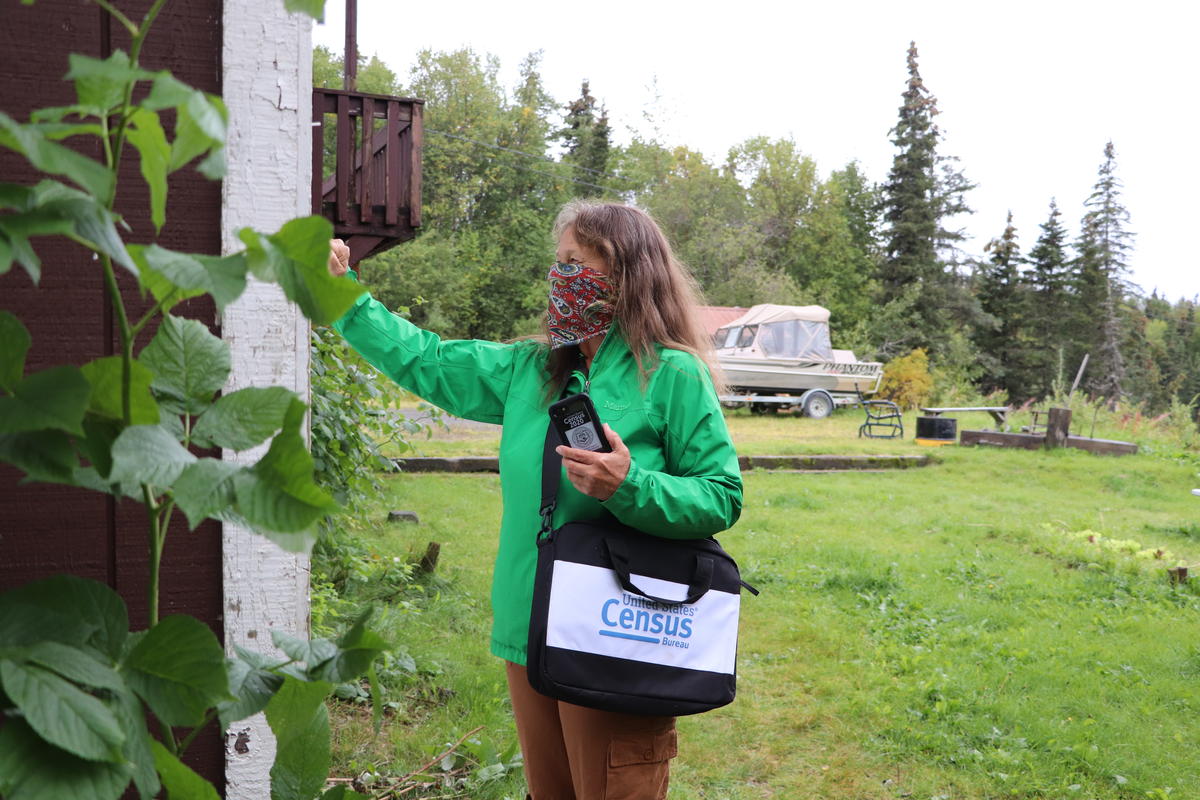
A census worker knocks on a door in Dillingham on Wednesday, Sept. 2, 2020. (Isabelle Ross/KDLG)
During a recent virtual panel discussion on Facebook Live, Alaska census advocates talked about getting people to participate in the count.
“People aren’t going to answer the census at this point because they saw a fancy add or because they got a cup that says ‘2020 Census,’” said James Christy, the assistant director for field operations at the U.S. Census Bureau. “They’re going to answer it because somebody that they trust said that it’s OK to do this, and that it’s important to do this.”
In early August, the Census Bureau announced that counting would end on September 30 — a month sooner than originally planned. Census officials say the bureau needs to complete data collection and statutory counts by their December 31 deadline.
Gloria O’Neill, the president and CEO of Cook Inlet Tribal Council, says the federal government should extend the deadline through the end of October.
“I think about how there are many Alaskans and Tribal people that, during this time, they are trying to fill their freezers,” she said. “And that’s their first focus right now…to ensure that their families have enough to eat through the winter, right? And to engage in subsistence activities.”
But many census committees in the state are not relying on Congress to push back that deadline.
Alaska has the lowest response rate of any state in the country. Only 30% of Dillingham residents have responded to the census so far. And the deadline change left local census takers scrambling to get everyone counted.
Dillingham’s Complete Count Committee is spearheading census outreach in the city. Co-chair Marilyn Rosene says the shortened timeline makes it difficult to get a full count from communities like Dillingham, where the summer can be the busiest time of year.
“When you add our summer activities, and hunting is going on now until the middle of September, we’ve got a lot to do before the end of September,” she said. “It is earlier than it originally was, which is a double hurdle for us I think.”
To help close that gap in Dillingham, trained census workers will call households and visit homes around the community.
“Basically, they each have a little computer that tells them every morning where they need to go, which addresses they need to knock on the door. Everything is safe and socially distant. Nobody goes inside. And it’s for verification of information,” Rosene explained.
The census happens every 10 years and helps the federal government determine funding for community services.
In Dillingham, those services include the hospital, the harbor, Tribal programs, HeadStart, the SAFE women’s shelter, the school district, the library and public safety.
According to the Alaska Federation of Natives, every Native person that goes uncounted means that $3,500 of funding could be lost annually. For a Native family of four that isn’t counted, the loss in AFN says that number is $14,000 dollars.
“The more complete count we get for Dillingham residents, the benefit for our whole community as a whole is going to be real impactful for the next 10 years,” said DeeDee Bennis, the Complete Count Committee’s other co-chair. “Can’t tell you enough how important it is, and we only have this small window of time before census is going to be completed and done, and that’s September 30.”
People can still complete the census online, over the phone, or by mail. You do not need your census code to fill out the actual form.
Close
Update notification options
Subscribe to notifications
Subscribe
Get notifications about news related to the topics you care about. You can unsubscribe anytime.