KDLG is our partner station in Dillingham. KTOO collaborates with partners across the state to cover important news and to share stories with our audiences.
A westward view of downtown Naknek in the summer. (Creative Commons photo by Todd Arlo)
An Eagle River man allegedly broke into the King Salmon Fire Department and stole a fire truck on Saturday.
According to a press release from the Bristol Bay Borough police department, 22-year-old fisherman Dawson Cody Porter used a piece of lumber to break a window and enter the fire station. He took the truck and drove it through the closed garage door. Police Chief John Rhyshek said that Porter cut the building’s power before breaking in.
Porter turned on the emergency lights and drove the firetruck 15 miles to Fishermen’s Bar in Naknek. He had parked the truck in front of the bar when police officers arrived and arrested him.
Porter was also arrested several weeks prior for a DUI, and was sent to Anchorage where he posted bail. Chief Rhyshek says there is no clear motive to the crime.
Porter is being held on a $10,000 bail at the Bristol Bay Borough detention facility on charges of burglary, vehicle theft, criminal mischief and violating his conditions of release from a previous arrest.
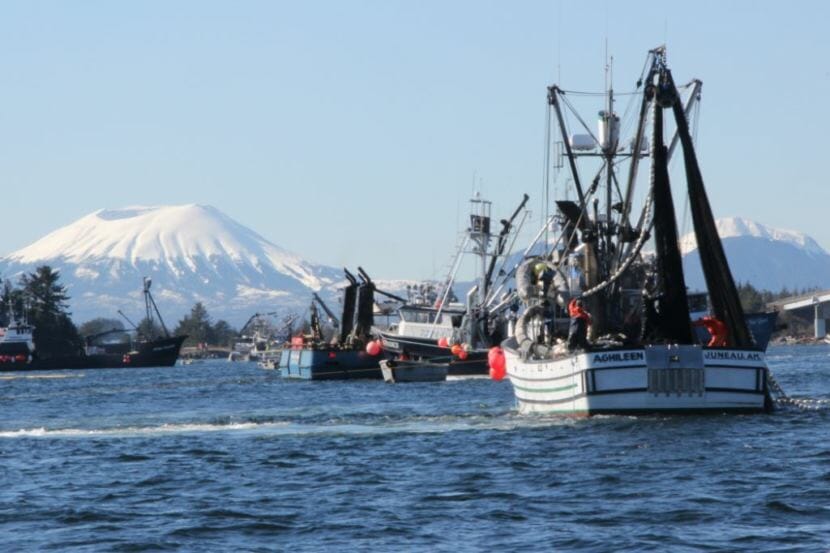
Purse seiners fish a commercial herring opening in Sitka Sound in 2014. (File photo/KCAW)
A new rule to the Paycheck Protection Program allows commercial fishing businesses to include their crew member payroll when they apply for the Paycheck Protection Program.
Previously, the PPP recognized crew members as “self-employed” by the Internal Revenue Service. Senator Lisa Murkowski, Dan Sullivan and Congressman Don Young urged the Department of Treasury and Small Business Administration to make the fix.
Murkowski said last month that the previous requirements left crew wages out of the equation when applying for the loans.
“The PPP really didn’t account for the fact that so many of our businesses in Alaska are seasonal,” she said. “When you think about the fisheries in Bristol Bay that’s certainly a seasonal business. It’s the very definition of it.”
In the announcement she said “enabling fishermen to secure the resources they need through PPP is not only fair, it means that these businesses so critical to Alaska have a fighting chance to say afloat.” Senator Sullivan called the new rule a “common-sense fix.”
Individual crew members will be able to calculate up to $100,000 in payroll made over a 12 week period.
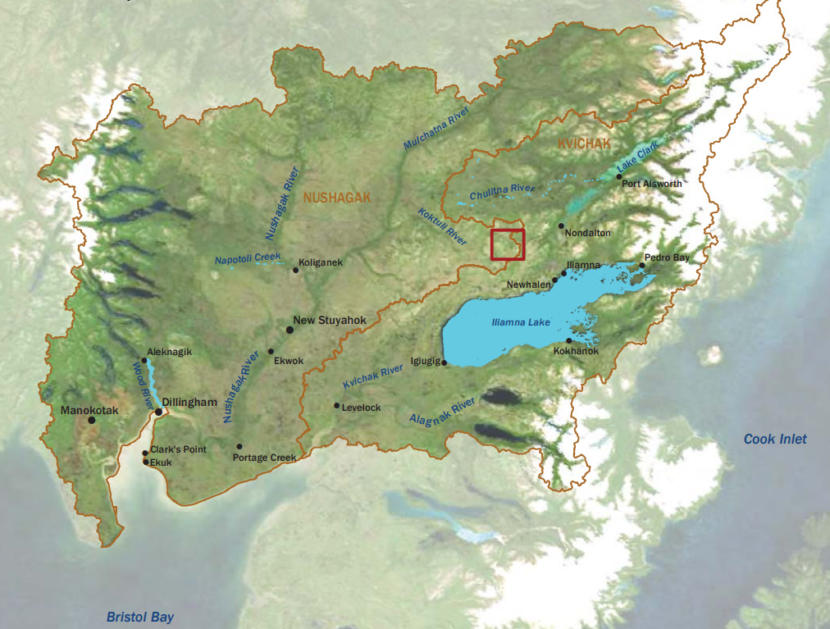
Map of the Bristol Bay region. The Pebble deposit location is indicated by the red box. (Photo courtesy U.S. EPA)
The Army Corps of Engineers plans to release its final environmental review for the proposed Pebble Mine later this summer. Last month, the Corps changed which transportation corridor it recommends. The route cuts through land owned by several Bristol Bay entities that refuse to grant Pebble access to their properties.
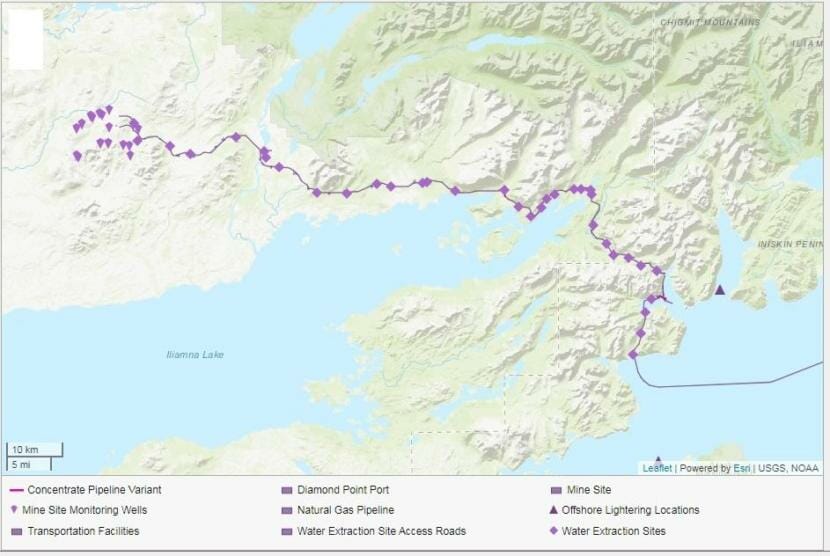
Known as the “northern route,” the transportation corridor is an 82-mile road along Lake Iliamna. A pipeline will carry copper and gold concentrates and trucks will transport other concentrates, materials and equipment through the area.
Trucks would use it to take copper and gold from the mine site in the north and drive along the lake to Diamond Point Port, where it would then be shipped off. A pipeline transporting minerals would run parallel with the road.
The Army Corps of Engineers announced last month that the northern route was its preferred alternative for the final environmental review. Pebble’s southern route was previously the preferred alternative. It would have used a ferry system to carry minerals across Lake Iliamna.
(Graphic courtesy Pebble Limited Partnership from the Pebble Project Environmental Impact Statement)
When Sen. Lisa Murkowski, R-Alaska, heard the news, she called the change “unsettling.”
“And that’s probably a mild word for many that we’ve heard from, because it was a new route in the sense that it was a change after completion of the EIS,” Murkowski said. “I know it may sound old, but I mean it: if this project can’t meet the high bar that it needs to meet, it should not be allowed to move forward”
The northern route was identified by the Environmental Protection Agency as the least environmentally damaging practicable alternative. But it would still permanently impact the area’s wetlands. According to the EPA, the route could destroy 2,292 acres of wetlands and 105 miles of streams. It will also indirectly impact to another 1,647 acres of wetlands and 80 miles of streams used for “dust deposition, dewatering and aquatic habitats.
Pebble spokesperson Mike Heatwole says the partnership will have to overhaul its plans for compensatory mitigation, or offsetting the mine’s impacts to wetlands. Pebble originally proposed to make up for environmental damage by providing water and sewer upgrades, around Kokhanok, Newhalen and Nondalton.
“One of the other process thesis that we work through here will end up being the compensatory mitigation plan for the wetlands impact,” Heatwole said. “Obviously that changes a little bit going from the southern route to the northern route and we’ll continue to work on it.”
If the mine is permitted, Pebble has to complete any compensatory mitigation before construction of the mine can begin. But there’s another barrier Pebble will need to consider.
“We are the subsurface landowner under all of the transportation alternatives we have surface acreage over a couple of allotments that we have purchased that are specifically along the northern route and yes we’ve objected all along, since day one, to the use of either our surface or subsurface resources for the construction of the transportation corridor of this project.’
That’s Dan Cheyette, vice president of lands and resources for the Bristol Bay Native Corporation. BBNC has condemned the alternative transportation route, Cheyette said they will not be granting Pebble any right of way access to the land.
“PLP apparently doesn’t believe they need our permission and those issues will have to be addressed or litigated down the line,” he said.
The route also cuts through land owned by Iliamna Native Limited, Pedro Bay Corporation and Igiugig Village Council. Igiugig’s council is a majority owner of Iliaska Enviromental LLC, a subsidiary that oversees Diamond Point Rock Quarry.
It also plans to deny use of the property. In a letter they say:
“PLP’s plan for Diamond Point presented in the EIS does not fit with our plans for Diamond Point, and should not be considered an acceptable alternative.”
Iliamna Natives Limited, or INL, is one of the entities that supports construction of the mine and the new route. Lisa Reimers is the CEO of Iliamna Development Corporation and is an INL board member.
“We want roads,” Reimers said. “That to us is really important to the growth of Iliamna is to build roads.”
Pebble’s vice president of permitting, James Fueg, acknowledged in a memo that “all access corridors are subject to PLP’s ability to negotiate a mutually acceptable access agreement with the associated landowners.” Heatwole, the Pebble spokesperson, says that’s the partnership’s main focus at this time.
“We intend to work with each of the landowners on the northern corridor and believe we can gain that access,” he said.
The Army Corps of Engineers is on schedule to submit the final EIS this summer with the northern route in mind. Another recent development from PLP is introducing a revenue sharing incentive for residents in Bristol Bay.
Pebble expects to pay at least $3 million a year in dividends that would be distributed to those who register for the program. If the mine is permitted, PLP will payout 3% of its net annual profits each year.
Editor’s note: This story has been updated to clarify how minerals will be transported via trucking and the pipeline for the proposed Pebble Mine.
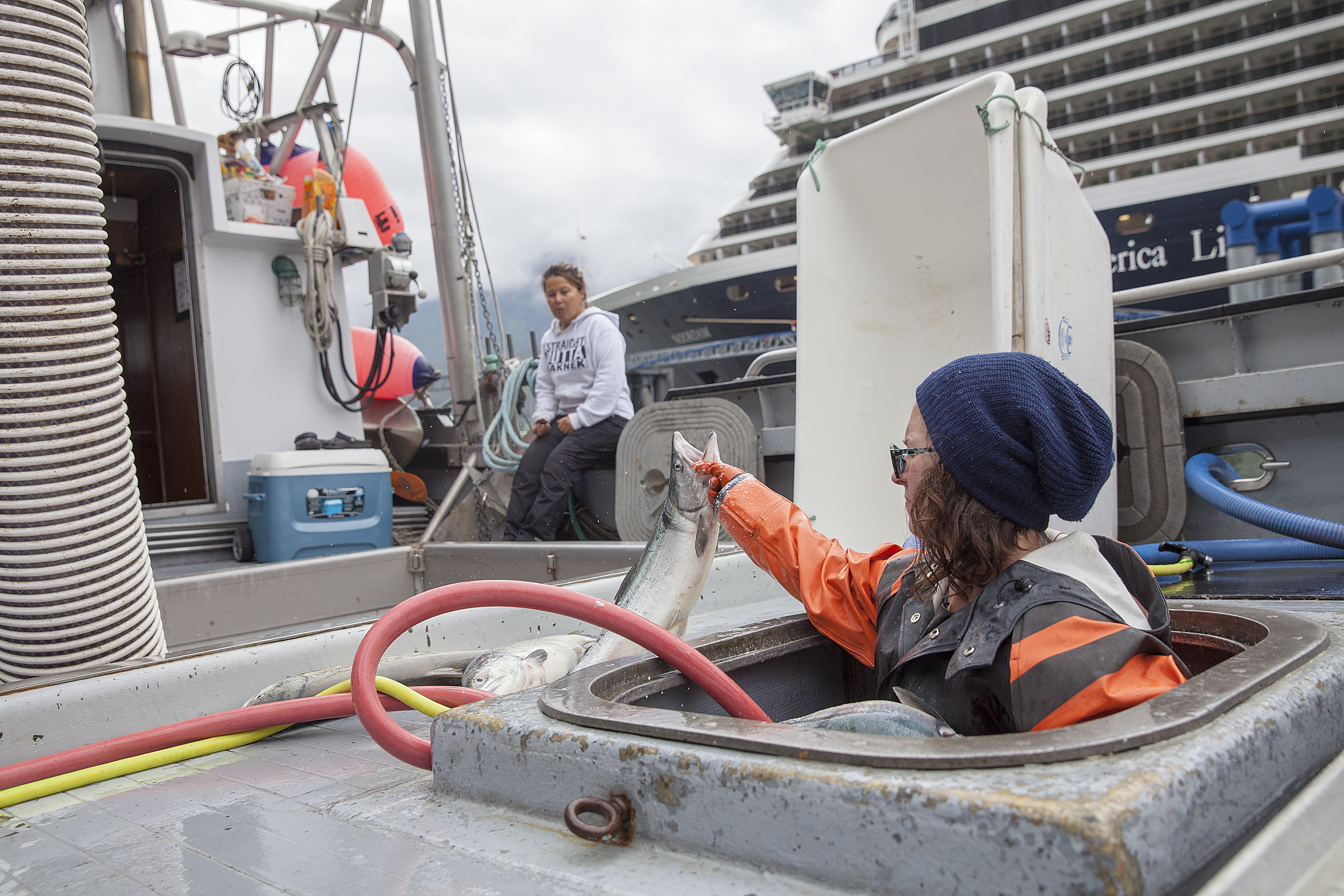
Sara Gering, of Juneau, clears fish from the tender San Juan on July 19, 2018, in Juneau, Alaska. (Photo by Rashah McChesney/Alaska’s Energy Desk)
“Let’s hope this is one hell of an anomaly,” says Gunnar Knapp, professor emeritus of economics at the University of Alaska Anchorage.
The market for salmon this year is in flux; Knapp says that’s due to functional hurdles.
“If you want to categorize the bad news, the biggest factors are the sheer operating logistics for this industry in dealing with this virus, and keeping the workers safe,” he explains. “That’s one huge complexity. The second is the drastic drop-off in restaurant consumption, and the third is the drastic decline in people’s incomes. Those are the three major hits.”
In a normal year, most of the uncertainty in the salmon market comes from the run itself; how the harvest compares to the previous year and how processors will keep up.
“Heck, every year brings surprises in salmon markets and salmon fisheries,” says Knapp.
But with the COVID-19 pandemic this year, the market faces uncertainty on both the supply and demand sides. That means a lot of market factors are up in the air, making outcomes even more difficult to predict.
Brett Watson, a post-doctoral fellow at UAA, says one indicator can be found in the Commercial Fisheries Entry Commission, which lists permit prices.
“CFEC is reporting about a $13,000 dollar slip in Bristol Bay permit price sales from April to May,” he explains. “So what that says to me is that fishers’ short-run and long-run expectations have decreased their value of what they’re expecting to get out of the fishery.”
That drop has brought permit prices back to what they were in early 2019 — a change from the steady rise in prices over the past three years. The range of prices is also twice as large as it’s been in years.
Several Bristol Bay processors have reported cases of COVID-19 since processing workers started arriving in the bay. As the run picks up and the fleet starts catching fish, there are also questions about how those outbreaks will affect processing capability.
“I saw there was a report […] that there were another 12 positive confirmed cases in Dillingham,” Watson says. “That’s going to pose real challenges to the processors as they try to figure out how to engage in their process safely, and that could impose real costs for them.”
To summarize: On the supply side, the run is starting a little weak. Processors are taking on massive preventative costs to try and stave off plant outbreaks. Those costs might take the form of a lower base price for fishermen, or a higher retail price for consumers. Total fishing effort and this year’s processing capacity are still unknowns, adding another level of uncertainty.
On the demand side, the industry is facing a global recession: Reduced restaurant demand, lower household incomes, lower farmed salmon prices, and a hiccup in the Chinese market for farmed salmon. That could be an indicator for the wild market.
Economist Garrett Evridge with the McDowell Group said in an email that statewide salmon harvests so far are the smallest they’ve been in the last 12 years, with Bristol Bay harvest 92% lower than it was last year. Evridge did note that those numbers can change quickly as the season progresses.
Does everything point to disaster? Gunnar Knapp, the UAA professor emeritus, isn’t predicting anything.
“There’s a lot of not so great indications going into the season but in the longer run, there’s sort of a ‘good news’ story,” he says.
The long-term trend, Knapp said, is an increasing demand in the U.S. for salmon in general, and wild salmon in particular.
“The basic thing is there’s still this tremendously wonderful fish resource, if it’s well-managed and well-marketed and well-handled. Mother Nature willing,” he says.
Despite all the uncertainties facing the market this season, Knapp says they are all tied to the pandemic. If Bristol Bay weathers the economic storm this year, he hopes the market will continue to improve.
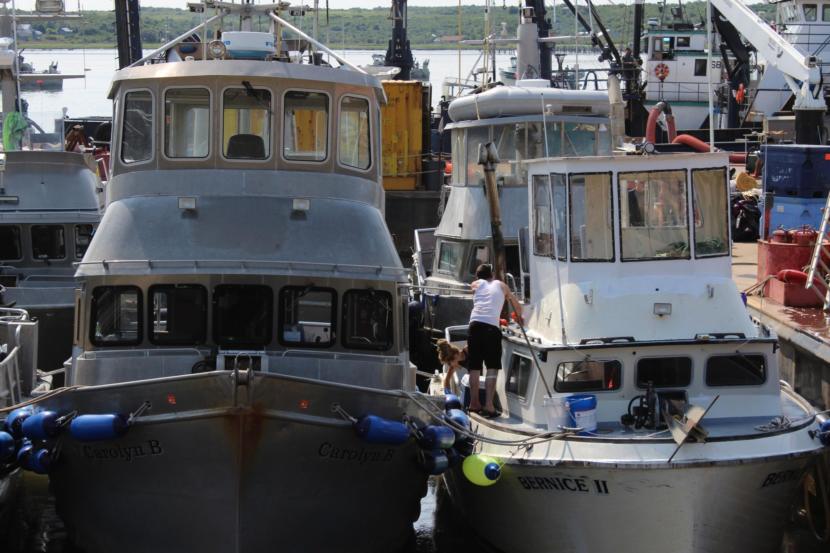
Boats in the Naknek harbor. July 10, 2019. (Photo by Sage Smiley/KDLG)
A Seattle-based seafood processor was sued for false imprisonment and failing to pay workers traveling to a Bristol Bay cannery after more than 100 of them were forced to quarantine in a Los Angeles hotel without pay — or lose their jobs. The complaint was first reported by the Los Angeles Times.
Around 150 workers, many from Mexico and southern California, were traveling to Bristol Bay to work at the Red Salmon Cannery in Naknek.
When they arrived in L.A, they were told to go to the Crown Plaza LAX hotel to be tested for COVID-19 and quarantine for four days. That’s when things got complicated.
“They told us they had gone there to be processed for employment and were being tested for COVID,” said Jonathan Davis, one of the attorneys who filed the suit.
Once the workers got to the hotel, he said, they were told to wait in a crowded hallway and fill out paperwork using shared pens, which allegedly put them into close contact with each other for several hours.
“They were in very cramped quarters,” Davis said. “They were very distressed because they were in these close quarters using the same pens. They didn’t feel like proper protocols were being followed.”
The workers then went to individual rooms, where nurses administered coronavirus tests.
According to the complaint, four days later, the day they were supposed to travel to Naknek, the results for three of the workers came back positive. All 150 of the workers were told they had to quarantine for an additional 11 days, until June 25.
“Without pay and without the right to leave your room at any time,” Davis said. “The key cards that they were given to access the rooms, our understanding is, they were deactivated. Because if you leave your room, you can’t get back in.”
Davis says that the workers were told if they left their rooms they would be fired immediately.
“We know that some workers were fired, cause they left the rooms, and we know some workers have left, because they have been very distressed and very upset by this whole situation,” he said.
Davis does not know how many left, or how many were fired. He says the company should have been following the Los Angeles and CDC guidelines, and that requiring people to stay put without pay violates California’s wage and hour laws.
During peak salmon season, Red Salmon Cannery employs about 500 workers, according to the complaint.
Leauri Moore, with the cannery operator North Pacific Seafoods, said in an email that the workers have since flown in a charter to Naknek, which was provided by the company.
She said North Pacific has been focused on the health and safety of its team and the communities where they work, and that it’s following the Alaska state requirement that seafood workers quarantine for 14 days and test negative for COVID-19.
“We took extensive steps to provide comfortable accommodations where those individuals could remain while they were quarantined,” she said.
Moore said they provided the workers with meals and lodging, allowing them to self-isolate throughout quarantine. She added that each person was tested and retested during quarantine, and that some who did not want to remain in quarantine left the hotel.
Davis, the attorney, says that since North Pacific decided to operate during a pandemic, it needs to follow through responsibly.
“You can’t say, ‘I’m gonna run this company, but I’m gonna do it on the backs of folks who are gonna have to sit in a room for two weeks, and they can’t leave or they’re gonna be fired, and we’re not going to pay them for that period of time’,” he said. “And certainly if you don’t let people know that’s what you’re intending to do.”
The lawsuit is asking for North Pacific to pay the workers for the time in quarantine. Among the charges are false imprisonment, three charges for failing to pay the workers or meet minimum and overtime pay requirements, negligence and unlawful business practices. Davis says the fact that the workers have been moved to Naknek doesn’t change anything about the lawsuit — only how much the company would have to pay in compensatory damages.
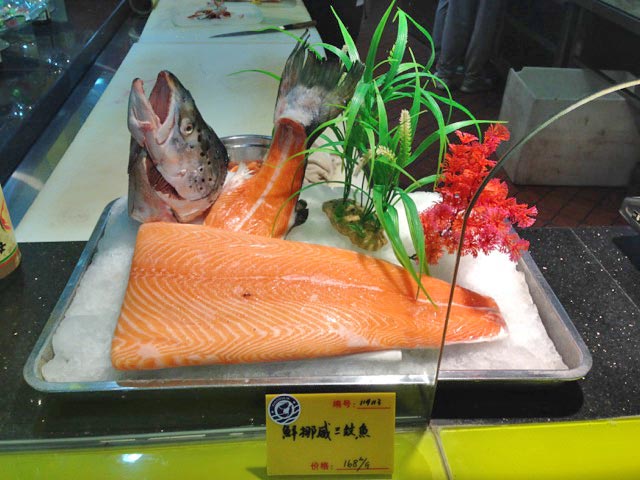
Salmon displayed in a seafood restaurant in China. (Photo courtesy of Alaska Sea Grant)
China has stopped imports from European salmon suppliers due to fears of a connection between salmon imports and coronavirus, according to a report by Reuters. State-run newspapers in China reported the coronavirus was discovered on chopping boards used for imported salmon at a market in Beijing. The initial cluster of infections came from the same market, and some fear the discovery of virus there indicates a second wave of the coronavirus in China.
Several fisheries organizations are pushing back against those reports. The National Fisheries Institute compiled statements on Tuesday from health professionals and agencies like the World Health Organization and the U.S. Food and Drug Administration saying there is no connection between seafood and COVID-19.
Fish marketing experts are assessing how the rumors could affect Alaska salmon’s image in the world. If people think eating salmon could put them at increased risk of contracting the virus — even if that information is incorrect — that could harm markets.
“Any time there’s information or misinformation, we have to wait and see how consumers respond to that,” said Andy Wink, executive director of the Bristol Bay Regional Seafood Development Association.
China made up roughly 6% of the market for Bristol Bay sockeye in 2019. It imported about 3,100 metric tons of the region’s reds. While that’s not a huge customer base, Wink says, it’s still important, especially in terms of the potential growth it represents. The market for salmon is expected to be weaker than it has been, because of coronavirus-related restaurant closures.
“You know, I think we’ll have to wait and see to what extent — if this impacts market demand outside of China, and, you know, if it impacts consumer demand in other markets in the U.S. and Europe and Japan where we have a much larger market share and many more consumers,” he said.
Wink says that if necessary, Bristol Bay Regional Seafood Development Association will work with other marketing groups to distribute accurate information to consumers.
In an email, Ashley Heimbigner with the Alaska Seafood Marketing Institute pointed out that multiple agencies have said there is no known link between seafood, food or food packaging and transmission of coronavirus. She also said Chinese officials issued a statement yesterday confirming that there was no evidence that salmon was the host or a carrier of COVID-19.
“While there was an immediate negative reaction in the imported salmon supply chain, a short term correction is expected following this official statement,” she said.
She said that Alaska’s largest challenge with the Chinese market continues to be the 32-40% final tariffs on most seafood, including salmon, when it’s imported into China for domestic consumption.
Close
Update notification options
Subscribe to notifications
Subscribe
Get notifications about news related to the topics you care about. You can unsubscribe anytime.