KDLG - Dillingham

KDLG is our partner station in Dillingham. KTOO collaborates with partners across the state to cover important news and to share stories with our audiences.
Meet one of the counters who tallied sockeye during Bristol Bay’s record run

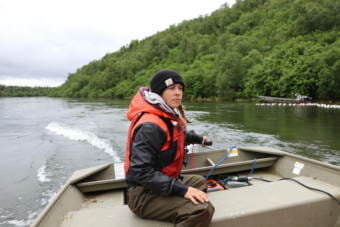
Fish counter Sooz Green on her commute. June 2021. (Stephanie Maltarich/KDLG)

This summer, Sooz Green packed her bags to travel north from New Mexico to Bristol Bay, where she became one of three tower counters on the Wood River.

That means she tallied sockeye as they swam upriver to return to their spawning grounds during Bristol Bay’s largest salmon run on record.

The counts help biologists balance conservation and commercial fishing.

Each morning, Green’s day started with a six-minute skiff ride downriver. Then she climbed a four-story tower built from scaffolding.

“I climb up, I start the timer at the top of the hour on the right bank and I count for 10 minutes. Depending on how many fish there are, I might have two clickers,” she said.

After 10 minutes, she would record the total in her notebook.

Then she crossed the river to do the same thing at the second tower. All in all, it’s a lot of climbing.

“So I calculated, if you are climbing up just one during your count, that’s 16,” she said. “At least 16 times a shift up and down.”

A tower counters on the Wood River (Stephanie Maltarich/KDLG)

The Wood River site is one of nine counting stations around Bristol Bay. It has operated since the mid-1950s.

Tower counters like Green send their tallies to the Alaska Department of Fish and Game.

Their numbers inform area managers’ decisions about when to open and close commercial fishing, said Phil Stacey, Fish and Game fishery biologist and west side tower coordinator.

“We know how many are getting into the lake systems to spawn and that will allow us to manage the fishery more accurately because we only need a certain number of escapement to actually be sustainable,” Stacey said.

The Wood River counting tower is especially important in years when there are conservation concerns, he said. The Nushagak’s chinook run started slow this summer, and biologists waited for more than 150,000 sockeye to pass the tower until they let fishermen cast their nets.

For Green, the counting job fits perfectly with her transient lifestyle. When not counting fish in Alaska, Green lives out of a school bus in New Mexico, where she spends a lot of time rock climbing.

Between counts here, she passes the time with workouts. She has also had some tranquil moments.

“I have a couple of bald eagle friends who have been keeping a close eye on me,” she said. “There is a big moose cow and two calves. During my first shift, she was coming out around midnight.”

In addition to nature watching and staying active, Green assists with genetic sampling. Green said her time on the Wood River also made her realize just how important the job is.

“I feel really good about contributing to the system that we have in place and making sure this species doesn’t get overfished,” she said.

Green counted sockeye every day for six weeks this summer before hanging up her clicker on July 24, when the Wood River tower closed up shop for the season. She plans to return next year, with her counter in hand.

LISTEN: A lifetime of subsistence fishing tells story of Yup’ik traditions

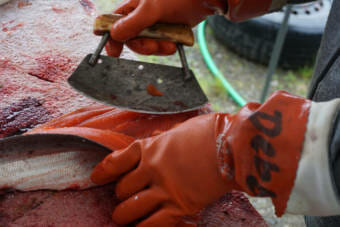
Debbie Coolidge processes sockeye at her home in Aleknagik. (Stephanie Maltarich/KDLG)

Each summer, Alaskans take to the rivers, bays and oceans to subsistence fish. Some head out to set nets, others may use dip nets, but the end goal is the same: to stock up on enough fresh fish to last the winter.

Debbie Coolidge spends at least one week each summer catching and processing salmon that will last her the entire year, continuing the traditions she learned from her grandmother.
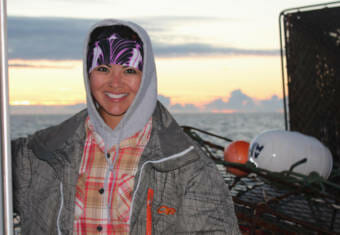
Coolidge grew up fishing with women in her family on the Wood River near her home on Lake Aleknagik, in Bristol Bay.

“I started fishing when I was 8 years old, it was just my grandma and my Aunt Virgin,” said Coolidge.

Today, in her mid-50s, she’s still at it, and she’s still independent. In early July, she heads downriver in her skiff to set nets.

Debbie Coolidge sets out for a day of fishing. (Stephanie Maltarich/KDLG)

Her favorite fish are kings.

“One year we went and sat down there and we didn’t expect to get a whole bunch of kings, our net was just smoking and we were trying to get the net in and trying to get the fish in, you know they are big fish,” Coolidge said.

By early July, she usually has about 10-12 kings in her freezer, but this time she only caught four.

Coolidge’s experience isn’t unique. The Nushagak River’s Chinook run started slow this summer. Additionally, the huge number of sockeye returning to the bay have filled subsistence nets, taking up room that kings may have occupied during a slower sockeye run.

Like many who fished this season, Coolidge caught hundreds of reds.

After a long day on the river, Coolidge sets up shop under a pop-up tent in her front yard. She processes fish while they are fresh.

First, she washes them. Then, she lines them up on a chest-high table.

Next, she cuts them with an ulu.

“It’s considered a women’s knife. We use it for everything — cutting fish, cutting meat, cutting seal and beluga,” she said.

Often, she hangs them to dry.  But the rainy summer made drying difficult this summer.

“There has been so much rain, trying to get them to dry; they are looking sad though,” said Coolidge.

And sometimes, they end up in the smokehouse she built with her brother many years ago.

Once the processing is done?

Coolidge smiled, laughed and said, “We eat it!”

Early this summer, Coolidge and her son enjoyed watching a show that explored Japanese food and culture. The series inspired them to share food stories as they relate to Yup’ik culture and way of life.

So one day, her son took out the camera and started filming.

“We thought about doing that with king salmon and how we do strips, how we catch, process and then eating them,” Coolidge said. “We thought about doing that with greens we pick, incorporating that into the video. Berries, eating and enjoying it just showing the world what our life is like.”

For Coolidge, the project is not just about the food she eats. It’s also about culture, community and taking care of one another.

She’s not sure what they’ll do with the videos, but she hopes they can help preserve and teach others about Yupik cultural traditions.

“There are disabled people and people don’t have resources to come and get fish, so everyone shares,” she said. “Even in the wintertime when people get moose or caribou, people share with the elders and widows and people who can’t do it themselves. ”

A day of fishing and processing isn’t complete until Coolidge throws some fresh filets on the grill with her favorite marinade.

“I get a nice char on it, then I flip it over and let it cook for a while, then I put the glaze on it,” Coolidge said.

With jars of canned salmon stacked in the corner, more in the freezer and plenty hanging outside, Coolidge is stocked for winter.

NOAA’s first tribal research coordinator aims to build partnerships with Alaska’s Indigenous communities

Mabel Baldwin-Schaeffer, the National Oceanic and Atmospheric Administration’s first tribal coordinator. (Photo courtesy of Mabel Baldwin-Schaeffer)

For the first time, the federal National Oceanic and Atmospheric Administration has a tribal research coordinator. NOAA is a key federal leader of environmental research. Those involved say the new position is a step toward better representation for Alaska’s Indigenous communities.

Mabel Baldwin-Schaeffer is the first tribal coordinator for the Alaska Fisheries Science Center’s communications program.
She was born and raised in Kiana, a small Iñupiaq village on the Kobuk River in northwest Alaska, and said she will bring that perspective with her.

“Near and dear to my heart has always been to improve local participation and to engage rural communities and research development,” she said. “I am most excited to work with elders and local people in the community.”

Mabel Baldwin-Schaeffer winter crabbing in Norton Sound. (Photo courtesy of Adem Boeckmann)

As a tribal coordinator, Baldwin-Schaeffer will facilitate existing communication and outreach efforts to communities. She will also act as a liaison between NOAA and communities that rely on subsistence when scientific research takes place in the future.

“My job is to help enhance and strengthen research networks in order to build effective and helpful collaborative partnerships with Alaskan Indigenous communities,” she said.

Baldwin-Schaeffer received her bachelor’s degree in sustainability studies and a master’s in environmental science from Alaska Pacific University.

She previously led a collaborative study on offshore gold mining and its effects on the environment — specifically, on young red king crabs in the Norton Sound. The study aimed to understand the effects of the Kuskokwim Bay’s water temperatures on crabs and strengthen communications between Alaska Native communities and the commercial fishing industry.

Bob Foy, NOAA’s science and research director, said that the partnership with Baldwin-Schaeffer will benefit the organization and Indigenous communities across the state.

“Our goal with that position is to bring information into our fisheries and marine mammal management process that includes Indigenous knowledge,” he said.

Baldwin-Schaeffer started in her new position as coordinator a couple of months ago. She says she is working to establish contacts and recruit participants from diverse backgrounds and viewpoints to engage with NOAA’s projects.

Bristol Bay sockeye run is largest on record

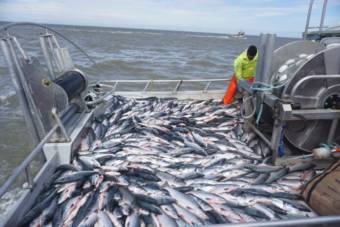
A fisherman on the F/V Cutting Edge on June 30, 2021. (Hope McKenney)

Bristol Bay’s 2021 sockeye run is the largest on record: 63.2 million fish have returned to the bay this year, breaking the 2018 record of 62.9 million.
This is the fourth time since 1952 that the bay’s run has exceeded the 60-million-fish mark.

The latest record shows Bristol Bay’s sockeye management is working, said Tim Sands, an area management biologist for the Alaska Department of Fish and Game.

“I think it’s a shining beacon of sustainable management,” he said. “We’ve been prosecuting the commercial salmon fishery management since 1884 and we are still able to set records on total runs, and I think that speaks to the escapement-based management that we use, and it’s great.”

The Nushagak District, on the west side of the fishery, also set several records this season.

Fishermen there broke the district’s record for daily catch two days in a row. They hauled in 1.7 million fish on June 30, and 1.8 million on July 1.

The Nushagak District’s escapement is also the largest on record, with 9.7 million fish swimming upriver, surpassing the 2018 count of 9.5 million. The district’s run of 27.2 million fish is second behind the 2018 record of 33 million.

River otter in Dillingham tests positive for rabies

(Bryan Reiley/ADF&G)

A river otter in Dillingham tested positive for rabies this week.

Construction workers were at the Dillingham harbor Monday morning when they called Fish and Game to report an otter “acting aggressively.”

Wildlife biologist Bryan Reiley responded to the call.

“I went down there to see it — it was completely covered in porcupine quills,” Reiley said. “Which is not normal. It’s now jumped from fox to at least otters. And given the amount of porcupine quills it had on it, maybe even porcupine.”

It’s uncommon for otters and porcupines to interact. Both species tend to stick closer to water and land respectively.

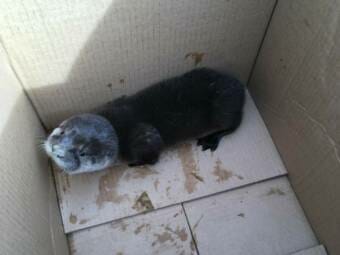
Fish and Game also found a baby otter near a pond by the Nushagak Power Plant. Reiley suspects it may belong to the rabid otter, which was a female, but he returned the baby to the water.

“I don’t know the prevalence, like how rabies transmits to the young,” he said. “If they were still feeding on the mother’s milk, maybe it was transmitted to them? More than likely, I think they’re not.”

Three cases of rabies have been reported in Dillingham foxes this spring. If an otter acts aggressively or is far away from the water, it could have rabies.
If you are bitten by any animal, get medical help immediately.

High water in Brooks River prompts partial closure in Katmai so bears can fish

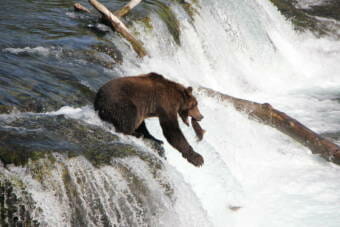
A bear at Brooks Falls. August 2019. (Izzy Ross/KDLG)

Katmai National Park and Preserve issued a temporary closure this week for a portion of Brooks River to allow the brown bears more access to the fishing grounds.

In a news release, Park Superintendent Mark Sturm said the water levels in the Brooks River have been unusually high this year, and the bears have a harder time fishing in deep waters. The closure will give bears unhindered access to shallower waters.

The area is typically open to anglers, photographers and tourists. Bears are most successful at fishing without the interference or presence of humans, so leaving the river open to people could dissuade bears from fishing there.

The closure went into effect Tuesday afternoon and ends at 3 p.m. Friday, though park officials may extend it. Park staff will also use the time as an opportunity to further study the bears’ eating habits and how the closure affects them.

Sport fishing remains open throughout other areas of the Brooks river, including above the falls.

Site notifications
Update notification options
Subscribe to notifications