KDLG - Dillingham

KDLG is our partner station in Dillingham. KTOO collaborates with partners across the state to cover important news and to share stories with our audiences.
3 men sentenced for wading in river with feeding bears at Katmai

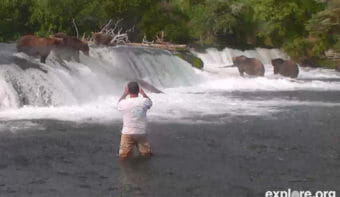
David Engelman wades into Brooks Falls to take photos the brown bears in August 2018. (Brooks bear cam via U.S. District Attorney’s office)

Three men were sentenced Monday for leaving a popular bear viewing platform in Katmai National Park and Preserve and wading into the river toward brown bears feeding on salmon, according to federal prosecutors.

The incident took place at the iconic Brooks Falls. The park’s rules are pretty simple: Humans have to stay on the viewing platform, which is elevated and looks out across the rushing water, where bears feed. There are also specific regulations against hazing wildlife or getting too close.

But in the summer of 2018, prosecutors say, three men ignored those rules — David Engelman, now 56, of New Mexico, and King Salmon residents Ronald Engelman II, 54, and Steven Thomas, 30.

Prosecutors say the group waded into Brooks River. David Engelman was caught on a livestream camera taking a selfie in front of the bears.

The men pleaded guilty and were sentenced to a total of $9,000 in fines, as well as jail time and a year of probation. Magistrate Judge Matthew Scoble characterized the defendants’ actions as “drunken capering, and a slap in the face to those who were there.”

Park Superintendent Mark Sturm said the incident was concerning. Brown bears gather in that area of the park to catch salmon when the fish migrate upriver. Those bears can be territorial.

“They’re very aggressive among each other,” he said. “Certainly, had a bear shown up in a different location that the individuals in the water wouldn’t have seen, or had they approached a bear that was particularly territorial, or even just gotten near a club and a sow nearby, you know, there’s different types of scenarios that could have resulted in a very tragic incident. So we consider ourselves lucky that nothing like that happened.”

David and Ronald Engelman were each sentenced to a week in prison. Thomas was sentenced to 10 days. Each of the men will pay $3,000 in fines. That money will go to the non-profit Katmai Conservancy, which will distribute it to park services. All three are prohibited from entering any national park for a year.

Supporters back Yup’ik name for Dillingham creek

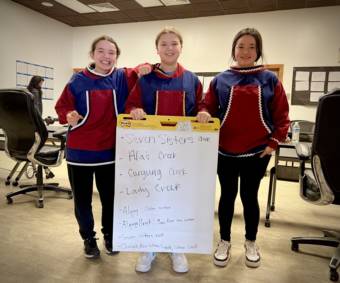
Alora Wassily, Harmony Larson, and Trista Wassily with names community members suggested for the creek in Dillingham. They began advocating to change the creek’s name, which currently includes a slur against Native women, last year. (Photo by Avery Lill/KDLG)

Everyone who spoke at the Curyung Tribe’s talking circle on Saturday supported changing the name of a stream that runs through Dillingham.

The current name includes a slur against Indigenous women. The proposed replacement that gained broad approval was “Al’a Creek.” Al’a means older sister in Yup’ik.
“The creek, in a way she is our al’a,” Katirina Mowrer said. “The land ultimately takes care of us.”

Those gathered in person and via Zoom discussed variations on the form and spelling of “al’a,” but they agreed the new name should honor Native women.

“I think this is the beginning of some healing and boldness that we, as a tribe and members, can begin to see,” said Carol Luckhurst, a member chief of the Curyung Tribal Council.

Tribal administrator Courtenay Carty said in the meeting that the Choggiung Limited board of directors and the Bristol Bay Native Corporation also support changing the creek’s name to one the Curyung Tribal Council recommends.

Dillingham elementary students, Alora Wassily, Trista Wassily and Harmony Larson, began advocating to change the creek’s name last year. Separately, Secretary of the Interior Deb Haaland established a federal process last fall to review and replace derogatory names for geographic features, including streams.

In February, the Department of the Interior proposed replacement names for 660 places across the country. For the creek in Dillingham, DOI suggests naming it after nearby features–Grassy Island, Snag Point, Sheep Island, Picnic Point or Bradford Point. Those names didn’t gain any traction at Saturday’s talking circle.

The Curyung Tribal Council will finalize the name it supports for the creek next week, taking into account input from the talking circle. Then it will consult with the U.S. Board on Geographic Names about renaming the creek on April 19.

“That’s something our tribe takes very seriously is our government-to-government relationship with the feds,” Carty said. “Our tribe also takes very seriously our relationship here with our own people. And so we wanted to make sure we have this opportunity to hear from our people, to make sure that the message we’re sending up is really our community’s message.”

DOI is accepting public comment on the replacement names for the creek through April 25 online and by mail.

Changing the name of the creek would not change the name of other features around Dillingham that share the name, notably the private road.

The Curyung Tribe is gathering input for changing a Dillingham creek’s derogatory name

""
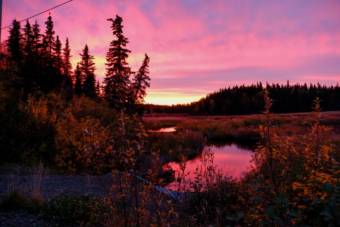
Sunset over a creek in Dillingham on Sept. 29, 2020. The creek will be renamed in the federal registry as part of a push to remove a word that disparages Indigenous women from the names of geographic features across the country. (Photo by Brian Venua/KDLG)

More than two dozen places in Alaska are named using a racist and sexist word that disparages Indigenous women.

Last spring, months before the federal government began steps to change those names, three elementary students wanted to rename a Dillingham creek that uses that slur, as well as a road that bears the creek’s name.

Now, members of the Curyung Tribal Council in Dillingham are working to gather ideas for new names from the community.

The students — Alora Wassily, Trista Wassily and Harmony Larson — wanted to change the name to Seven Sisters Creek to reflect the community’s connection to sisters who traveled about six miles from Nushagak Point to live along the creek generations ago.

In November, Interior Secretary Deb Haaland moved to ban the slur from the names of places on federal lands. And last month the Interior Department opened a public comment period on name changes for over 660 geographic features across the country.

The federal Derogatory Geographic Names Task Force, unlike the girls, based its suggestions on other geographic locations in the area.

In Alaska, the task force will give priority to tribes’ suggestions for name changes, but those suggestions have to adhere to existing policies — like restrictions on naming things after people.

First Chief JJ Larson said the Curyung Tribal Council took part in a March 22 consultation with the U.S. Board on Geographic Names, but the Tribe also requested an independent session with the board, which is scheduled for April 19.

“The three girls that have worked on this for over a year now have done a lot of the groundwork, and really pushed for this to happen,” he said. “We felt that as a tribe, if the federal government was going to come in here and change the name on our tribal lands, that we should be consulted individually.”

In February, the task force released more than 3,300 alternatives for locations across the country. In Dillingham, the names it suggested were Bradford Point, Snag Point, Grassy Island, Sheep Island and Picnic Point.

A creek in the Lake and Peninsula Borough will also receive a new name. Suggested changes for that include Sea Gull Flat, Telephone Point, Svoger Slough, Graveyard Point and Cape Horn.

On April 2, the Curyung Tribe plans to hold a community meeting open to everyone in Dillingham to discuss ideas and gather feedback. The Tribe also invited the U.S. Geological Survey to attend.
Larson said a few names have been brought forward since the students first presented Seven Sisters Creek.

“The girls actually came to our Tribal Council meeting and gave us another name as another option: Al’a’s Creek,” Larson said. “Al’a is big sister, and so it’s a really good name, I think, that that really ties well with our community and our culture.”

Elder Dora Andrew-Ihrke worked with the students on the name change project. She taught for decades at the Dillingham school before she retired. She is from Aleknagik — Alaqnaqiq — which she said means “wrong way” in Yup’ik.

Her aunt told her that the first people who resided in Aleknagik set up a camp at what became the mission school.

“They settled there, and it became a permanent place. And once it becomes a place to live, then you give it a name,” she said. “When people come around, they ask, ‘Who are you guys?’ And they’d say, ‘Igyararmiunguukut.’ We’re people from the throat. Throat of the area, meaning the lake was like the head of a person. And the throat is right between the river, and the river would be like going down into your stomach area, and so forth. So land was sometimes named after the human body. And so Aleknagik, which was Alarneq — somebody went up the wrong river with the kayak, instead of going up the Nushagak River, and settled there. And then the rest of the group, the Natives that first settled there called themselves the Igyararmiut.”

As for renaming the creek in Dillingham, Andrew-Ihrke thinks it should reflect the women who lived there.

“For my Yup’ik culture, I would show respect by just calling it Alqaqellriit Kuigat, the Sisters Creek. Alqaqellritt, Alqaq Al’a is the oldest sister, so Alqaqellriit implies there are more than one sister,” she said. “So it doesn’t say how many, but the Sisters Creek in English would be proper, and to me that’s showing respect on how you name places.”

Efforts to restore Native place names aren’t new. In 2015, then-President Barack Obama used his executive power to rename Mount McKinley as Denali after a more than quarter-century push to do so.

In Bristol Bay, the Bristol Bay Native Corporation has led a place names project for years. Francisca Demoski worked on the project since the early 2000s. She’s from Togiak, where many people call her by her Yup’ik name, Mall’u.

Demoski said the program began with the goal to preserve place names. Early on, they gathered information on names in a database. She then worked with Tim Troll, of the Nature Conservancy, to conduct local interviews.

Demoski said it’s imperative to consult with the Native people of an area when renaming a place.

“For thousands of years, our people have lived on this land, they’ve known this land and they’ve named this land. So the efforts that the Dillingham school kids are doing I think is so important, and so respectful,” she said. “Because you’re learning more today as people are realizing, you know, and they’re reclaiming back to their original name, and realizing how important it is to be using their local names versus somebody who came from outside to give, you know, the place the name.”

Mayor Alice Ruby said the city council has not yet taken a position on renaming the Dillingham road which shares the creek’s name. Part of what makes it complicated, she said, is that it’s always been a private road.

“The council has been very sensitive about first of all, acknowledging private property and private owners and stuff,” Ruby said. “But they’re also pretty sensitive about things that might be offensive to the public. The property owners on the road are going to be pretty key to whether there’s interest in changing the name.”

Curyung First Chief JJ Larson said that through this effort, he’s started to think about the potential for changing the names of other places in the area.

“I think that as the new first chief — I’m pretty new to it — one of the things that I would like to work on is working with the city and seeing if there would be any interest in changing the name of the city to Curyung,” he said.

Larson hasn’t taken any action on that yet. But he pointed to other cities throughout the state that have changed their names, like Utqiaġvik.

“It was Barrow before, but now it’s Utqiaġvik. And just saying that out loud, you have to think about like, ‘Oh, this is Native land.’ Right? And so that’s something to think about,” he said. “And that’s something that I would like to work with the city on.”

The Derogatory Names Task Force’s current effort will change geographic names in the federal registry, but not local or state building, park or road names or those of federal land units, like national parks.

Mike Tischler, with the Derogatory Names Task Force, said that this renaming effort will end with recommendations to the Board on Geographic Names in late summer or early fall. People can submit comments on the process or name suggestions of their own to the Federal Register. The deadline to do so is April 25th.

With a ski plane and a plywood gurney, friends rescue Dillingham man badly injured in snowmachine crash

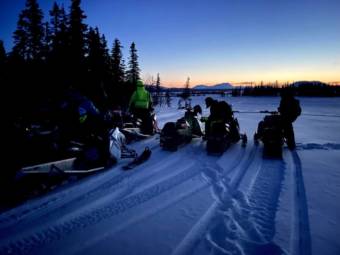
snowmachiners parked next to a wrecked snowmachine under dark skies
Snowmachiners who responded to an accident near the Iowithla River. March 20, 2022. (Photo courtesy of Ian Fo)

It wasn’t the first time Kortnie Horazdovsky had gotten a call from the International Emergency Response Coordination Center. Her brother, Kaleb Westfall, had used his inReach satellite messenger to call for help when he got caught in a sudden storm while fishing last June. On Sunday, he pressed the SOS button again. Horazdovsky said he had also sent her a one-word message: “Crash.”

“I was like, ‘Oh, boy, here we go,’” she said. “He’s not on a boat this time. But, you know, I didn’t know what he was up to out there. I figured he was snowmachining.”

Westfall was at the top of the Iowithla River in the Muklung Hills, about 50 miles north of Dillingham. He had crashed after hitting a creek bed and seemed to be in rough shape.

“He was texting another friend from his inReach the whole time, just kind of one-word answers. Things like ‘serious injury,’” she said. “So it was a little concerning, because he was just one word answers. And it sounded pretty bad. He thought he had broken his femur.”

Horazdovsky got in contact with some of Westfall’s friends, and the rescue center contacted the state troopers at 4:45 p.m. on Sunday.

Troopers requested help from local rescue teams and sent for a helicopter from Joint Base Elmendorf Richardson in Anchorage, more than 300 miles away.

But volunteers got there first.

Ian Fo was one of the first to arrive on the scene. He often snowmachines with Westfall. He got a call from Horazdovsky and the troopers Sunday afternoon.

“I automatically just started getting dressed and was in contact with the trooper and he was gonna contact some people and let me know what the plan was,” he said.

Fo rallied three friends, and they set out for the crash site on snowmachines. The group found Westfall conscious but badly bleeding from his leg and face when they reached him shortly before 8 p.m.

“We just kept him warm, we brought some blankets and we started a small fire and waited for the helicopter, it was going to be on its way,” he said.

They also contacted pilot Gabe Davis, a friend who was out flying in his Cessna 185, a small plane equipped with skis to land on snow. Davis said one of the snowmachiners, Mark Schwantes, told him Westfall had activated an SOS signal.

“He told me about where he was,” he said. “I know the trail. So I went over and tried to find his trail and I found it, and I saw him. He had damaged his snow machine. I mean, I could see blood on the snow and he was in pretty rough shape.”

Davis had to fly to Dillingham and unload his plane so it was light enough to get back to the scene.

“By stroke of luck, the guy I was with who’s a friend of mine who came up for vacation to see Alaska is a fireman and first responder,” he said. “When we got back to Dillingham we had some lumber, and so we grabbed some sheets of plywood and some two-by-fours to make a backboard and stuff. So we took off, went back and landed. By the time we got there the second time the snowmachiners were there.”

The group of snowmachiners told Davis a trooper helicopter was on its way from Anchorage. But three hours after the accident was first reported, it hadn’t arrived yet. Davis didn’t think they should wait.

“I said, ‘F*** that, we’re putting him in the airplane and getting him out of here,’” Davis said. “It was after eight o’clock at night.”

The volunteer rescuers made a makeshift plywood gurney and loaded Westfall into Davis’ plane. He was flown to Dillingham, then medevaced to Seattle.

Horazdavsky said her brother has multiple broken bones in his face, bruised lungs and a gash on his leg, but he’s in stable condition.

“He’s awake. He’s texting. He’s in good spirits. He told me he looks worse than he feels,” she laughed. “So that’s good. And, yeah, we’re just really thankful that it ended up this way.”

After Westfall was flown out, volunteers with Dillingham Search and Rescue arrived and brought his snowmachine back to Dillingham.

Fo said that over the several hours they were out there, it felt like everything was a matter of life and death — a few strokes of good fortune made all the difference.

“I think it was extremely important that the airplane was there,” Fo said. “[Davis] happened to be in the area, and he happened to be working on a project himself. So he had adequate supplies on the plane, including a first aid kit as well as a friend who is a firefighter EMT, so that was a huge help. The fact that he had supplies on his plane for us to make something to transport Kaleb about 300 yards to the plane.”

But luck only goes so far. Fo said the rescue wouldn’t have been possible without quick thinking from everyone involved and the competence of the region’s outdoor community.

“It makes me feel just really grateful and confident in the people in this community that have the skills and the wherewithal and just the decision-making at the time in the moment,” Fo said. “It gives me so much confidence in the people in the community.”

He said they came together with their skills and experience to save Westfall’s life.

Alaska Board of Game to consider subsistence use protections for Nushagak Peninsula caribou herd

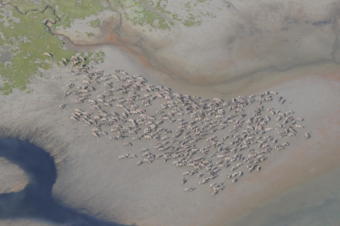
A group of 551 caribou on tidal flats of the Nushagak Peninsula seeking relief from biting insects, July 9, 2019. (Photo by Andy Aderman/USFWS)

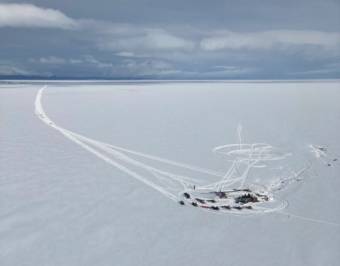
The Nushagak Peninsula caribou herd ranges across more than 400 square miles of tundra, streams and ponds on a piece of land that juts into Bristol Bay. For thousands of years, people in the area have subsisted on caribou in the region.

Now, the Alaska Department of Fish and Game Division of Subsistence is asking the statewide Board of Game to place additional protections on the herd.

This week, the board will consider a proposal to designate the Nushagak Peninsula caribou herd as a resource culturally and traditionally used for subsistence. If it does, the herd will be protected by law, which ensures that subsistence is prioritized above commercial and sport uses.
In order to make that decision, the board will consider eight criteria, said Bronwyn Jones, the southwest subsistence resource specialist for the state’s Division of Subsistence.

Reliance on the herd

As part of the proposal, Jones and her team provided information about how the Nushagak herd meets those criteria, which include sharing of intergenerational knowledge, efficient harvesting and cost, and how the population fits into subsistence in the area.

The team also had to determine a pattern of use and reliance on the population over a long period of time.

“How people in the Nushagak Peninsula have used this caribou population since it was established, and also prior to its establishment, before it was kind of wiped out in the early 1900s,” Jones said.

The Division of Subsistence cited documentation of people using caribou in that area for more than 2,000 years. Historically, a large number of caribou lived along the coast of the Bering Sea, from Bristol Bay to Norton Sound.

The state says that in the western portion of the Mulchatna Caribou herd’s range, archaeological evidence points to caribou hunting since prehistoric times in the mountains southeast of the Kuskokwim River. That includes parts of land that now fall in Unit 17.

Along salmon streams northwest of Togiak Bay, remains of caribou are common in Norton tradition sites dating back 2,500 years. Local traditional knowledge and oral history suggest caribou were always significant to people residing in the area.

“We had done some traditional ecological knowledge interviews about historical caribou uses,” Jones said. “People talked about stories that they had heard of people using caribou bones for nets, just all the different uses of caribou that had been in the community that they lived in before and no longer were.”

For example, the state Division of Subsistence worksheet for the proposal points to a 2008 study in which the division interviewed elders in Togiak, who described traditional uses of caribou.

“Before there were rifles, they used the caribou rib bone for part of the ‘spear’ because caribou rib bone doesn’t break,” said one elder. “At one location, when the walrus were hauling out, they would go up to the one farthest from the water when he was asleep and drive the caribou spear into the walrus near where the collar bone is sticking out, to try to reach the heart to make it bleed.”

Fluctuating caribou populations

Caribou populations can fluctuate dramatically. In 2019, around 700 animals made up the Nushagak Peninsula herd. But after managers liberalized harvest, in part to protect lichen cover, the numbers dropped to around 250, and the hunt was severely restricted. Last summer the herd was estimated at just under 300 animals.

In the late 1800s, the region’s caribou population declined.

In 1979, a researcher with the Division of Subsistence recorded an elder in Togiak who said caribou disappeared from the area in the early 1900s. He reported hearing stories from his elders in the men’s community house about wolves driving out caribou, and talked about how elders would talk and sing about past hunts.

Jones said that when Nushagak Peninsula’s herd declined, residents of the region didn’t stop hunting caribou — they just traveled farther to do so.

“Just because caribou were no longer available doesn’t mean that the traditional use was gone,” she said. “It once existed, and people kind of adjusted their ways. But now the opportunity is back because the herd has been transplanted, and — well, available to harvest until recent years anyways.”

The Board of Game did make a customary and traditional determination for caribou in the area for subsistence in 1988 in units 9A and B, 17 and 18. That was primarily for the Mulchatna herd.

But that year, the state and the federal government teamed up with Tribes, municipalities and village corporations in the area to reintroduce caribou to the peninsula, and transplanted around 140 caribou from the Northern Alaska Peninsula Herd to the Nushagak Peninsula. That provided a new resource for people in Togiak, Twin Hills, Manokotak, Aleknagik and Dillingham.

In the mid-1990s, the Federal Subsistence Board found that those communities had customary and traditional uses for the Nushagak caribou. But the state never made a designation for that herd.

The Mulchatna herd has declined drastically in the past several years, which Jones said sparked this proposal.

“I think to document the importance of each herd separately, and un-lump the Nushagak from the Mulchatna is important,” Jones said. “When the Nushagak are back up to optimal harvest, people can just go ahead and use them again for subsistence while the Mulchatna caribou herd is unavailable while they’re trying to figure out what’s happening there and waiting for that herd to recover again.”

Board decision could set protections for subsistence uses of the herd

If the board does make a positive finding for the Nushagak caribou, nothing concrete would change — for now.

“Basically, we are documenting that there is a positive use finding it is a subsistence resource that’s depended on, and so the next step will be for the board to establish an ANS, or an amount reasonably necessary for subsistence,” Jones said.

That’s a range of harvest numbers the board will consider to determine whether subsistence needs are being met. Once that harvest range is established, people can reference it when discussing their subsistence needs and spur changes to the hunt for that herd, like moving it to a different tier or limiting registration hunts.

“That’s basically what this [customary and traditional determination] is — the first step towards just being able to protect subsistence uses of the resource,” she said.

Jones and her colleagues also submitted a proposal for the board to apply the same designation to the Unimak caribou herd in Unit 10, which comprises the Aleutian, Unimak and Pribilof islands.

5 survive plane crash near Iliamna

An aerial view of a crowd of people with snowmachines gathered in a remote spot on flat, snowy tundra
Responders at the site of the March 5 plane crash on Lake Iliamna. (Alaska State Troopers photo)

A plane carrying five adults crashed about eight miles southwest of Iliamna around 1 p.m. on Saturday, according to a dispatch from Alaska State Troopers. All five survived the initial impact and are receiving medical care at Anchorage-area hospitals.

One person is in serious condition, one is in fair condition and three are in stable condition, troopers said in an update Sunday afternoon.

Around 1 p.m. on Saturday, troopers received notice of a signal from an emergency locator transmitter — a device that sends out an audio alert and GPS signal when activated. The signal was coming from the offshore ice on the lake.

Alaska Wildlife Troopers launched an R44 helicopter from the King Salmon area, and local crews and private aircraft from Iliamna tried to reach the site. Responders included Lake and Peninsula Airlines, Iliamna Air Taxi, search-and-rescue volunteers and others from the Iliamna area.

Trooper spokesperson Austin McDaniel said the helicopter arrived at the scene around 3:45 p.m.

Rescue teams and troopers found a Cessna 206, which had been destroyed in the crash. According to the Federal Aviation Administration registry, the plane — which has a tail number of N1853Q — is owned by Send North, the Anchorage-based branch of evangelical missions organization Send International. Send North “supports and administers remote ministry activity” in Alaska and parts of Canada.

Bad weather conditions initially stopped rescue teams from the Alaska Air National Guard at Joint Base Elmendorf Richardson and the U.S. Coast Guard in Kodiak from reaching the area.

At about 6 p.m. — at least five hours after the plane went down — those teams arrived at the crash site and lifted all five people from the scene. They were flown to Iliamna and then medevaced to hospitals in the Anchorage area.

The National Transportation Safety Board was notified of the incident and will investigate the cause of the crash.

Site notifications
Update notification options
Subscribe to notifications