KDLG - Dillingham

KDLG is our partner station in Dillingham. KTOO collaborates with partners across the state to cover important news and to share stories with our audiences.
Voyage from Homer to Bristol Bay commemorates fishery’s sailing tradition

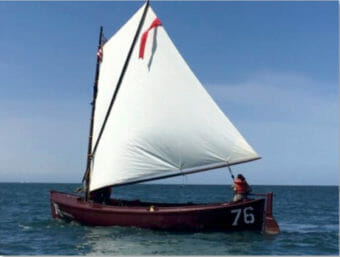
A small sailing boat with one man in the stern
The Libby, McNeil & Libby No. 76. (Bristol Bay Heritage Land Trust photo)

For more than 60 years, sailboats dominated Bristol Bay’s commercial fishery. Motorized vessels were illegal. Then, in 1951, the federal government finally allowed motorized fishing vessels in Bristol Bay.

LaRece Egli, the director of the Bristol Bay Historical Society Museum in Naknek, says that made sailing obsolete almost immediately for the fishery.

“I think it’s literally down to 50 or 46 boats or something like that in 1954, and then they just disappear,” she said.

By 1952, powerboats outnumbered sailboats 4 to 1. In less than five years, every commercial vessel had a motor.

This year, local historians are bringing the sailing tradition back to the bay with a vessel named the Libby, McNeil & Libby No. 76.  Tim Troll is the executive director of the Bristol Bay Heritage Land Trust and one of the sailing crew. They launched from Homer on July 5.

“We launched this morning at about 9 (a.m.),” Troll said. “It’s a beautiful, nice, sunny day with very calm weather.”

The sailboat has crossed the Cook Inlet, sailing toward Naknek.

“The boat is on its way,” he said. “It’s sailing nicely right now. We’ve got four guys aboard, and it just looks beautiful out there.”

Troll said in an email that they made it to their first stop, Williamsport, on Wednesday night. They carried the boat across the portage to Lake Iliamna and planned to reach Pedro Bay that evening.

The crew expected to visit Iliamna and Newhalen over the weekend and then head on to Kokhanok and Igiugig. It will visit Levlock on July 17 and the vessel is scheduled to arrive in Naknek on July 19.

Egli says the journey commemorates an iconic period in the fishery’s history.

“Those sails, sailing out on the horizon of our bay, are really visual icons, and they’re one of those grounding visual markers for both our canning industry, for the labor issues, independence of our fishermen, and also for our Indigenous story in our community,” she said.

Troll plans to update KDLG on their voyage over the next few weeks. More information about their journey is available on the Bristol Bay Heritage Land Trust website.

The Bristol Bay Heritage Land Trust and the Bristol Bay Historical Society Museum have also partnered to purchase the boat.

Supplies a ‘near total loss’ after wildfire burns Pebble Mine camp

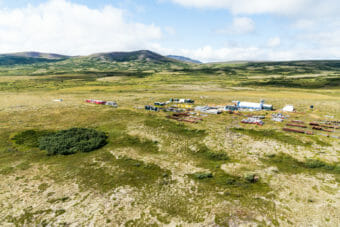
A field camp in mostly treeless wilderness
The Pebble Mine project area. (Pebble Limited Partnership)

The Upper Talarik Fire in Southwest Alaska has caused significant damage at the site of the controversial Pebble Mine project northwest of Iliamna.

The fire is part of a group of fires that officials are calling the Lime Complex. The flames burned through Pebble’s supply camp over the Fourth of July holiday weekend, according to Mike Heatwole, a spokesperson for the Pebble Limited Partnership. He said the mine had stored equipment for exploration at the camp.

Heatwole said no one was injured.

The Alaska Division of Forestry said that, as of Wednesday, the fire covered nearly 8,000 acres.

Heatwole described the damage of supplies as a “near total loss.”

“What used to be a very colorful tundra landscape is now quite charred. Most of what we had there has burned up — in some cases, tents, canvas tents, supported by metal. The metal, you know, got quite hot and collapsed,” he said. “So it’s not really salvageable.”

The fire also burned wooden pallets and railroad ties used to minimize the impact of drilling, along with tools to maintain the site’s equipment, Heatwole said.

Pebble sent some workers to the site on Thursday, and the company is still working with fire managers to take stock of the fire’s impact, Heatwole said, adding that they don’t know yet how much this will affect Pebble’s operations long term.

Kale Casey, public information officer with the incident management Team, says this year’s fire season is unprecedented.

“We reached 1 million acres of wildfire-impacted landscape 10 days before we ever have in the recorded history of Alaska,” he said.

Heatwole emphasized how much the Pebble Partnership appreciates the team’s response to the fires.

“It’s a fire, it’s devastating, but it’s just things, right? There was no one harmed. And that’s a much better story,” he said.

Casey said more information will be made public once a thorough assessment has been done.

EPA extends comment period on watershed protections that would block Pebble Mine

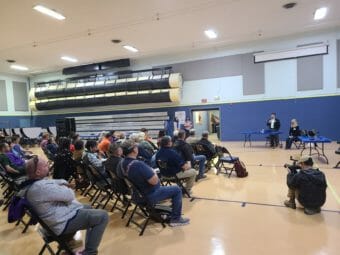
A public meeting in a gymnasium
Residents flew in from around the Bristol Bay region to give public comment on the EPA’s proposed determination. (Photo by Corinne Smith/KDLG)

The Environmental Protection Agency announced last week that it is extending its comment period for proposed restrictions on mining of the Pebble deposit. The comment period was originally set to end in July. Now it will continue for two more months, to Sept. 6.
Representatives with the EPA visited Dillingham and Newhalen earlier this month to hear public testimony on the agency’s proposal to protect waters around the Pebble deposit. It was the first in-person public hearings since the start of the COVID-19 pandemic.

Dozens of residents from around the Bristol Bay region traveled to Dillingham to weigh in.

Robin Samuelsen is a board member of the Bristol Bay Native Corporation. He has fished in the bay for 57 years and now fishes with four grandsons on his boat.

Samuelsen urged the EPA to take action to protect salmon runs that support Alaska Native ways of life.

“My family has subsisted in Bristol Bay for thousands of years. Subsistence is the most important fish you can put in front of an individual in Bristol Bay,” he said. “We live and die by our fish.”

If finalized, the EPA’s determination would implement federal watershed protections for South Fork Koktuli River, North Fork Koktuli River, and Upper Talarik Creek watersheds. It would also pose restrictions on mining waste discharges around the proposed mine site.

Bertha Pavian-Lockuk flew in to testify from Togiak, a community about 67 miles southwest of Dillingham.

“This two minutes, you will not fully get all the detailed information that each person that flew in from each village has. It’s not enough time for me, or any of us,” she said.

She thanked the EPA representatives for visiting in-person and stressed the importance of healthy salmon runs in her community.

“Our subsistence lifestyle, each and every one in here is carrying on. My children and my grandchildren are still subsisting today. And we are teaching our children of what we have learned from our parents and grandparents,” she said. “And we’ve gone through this COVID, we just we are still going over (it), and subsistence was our only way, only source of food that we were able to survive by.”

In 2014, when the Obama administration released a proposed determination for protections, more than a million people — including tens of thousands of Alaskans — commented in support of the federal protections for Bristol Bay. In 2019, the Trump administration revoked the proposal.

In May, the EPA used its authority under the Clean Water Act to issue a revised proposal that included analysis from multi-year environmental reviews and Pebble’s mining proposal.

EPA spokesperson Suzanne Skadowski says the agency found that the mine would negatively affect salmon habitat in the area.

“Basically, within the mine footprint, the fisheries are too sensitive and too important to be doing any any discharges in related to the mine, in that footprint,” she said.

But Skadowski says the EPA’s plan would only limit mining of the deposit as proposed by the Pebble Limited Partnership.

“It’s very specific to the Pebble deposit and the Pebble Mine to that area, and not to any other development or mining that might be happening in Alaska, it’s very specific to their plan,” she said.

Many Bristol Bay tribes, fishermen and environmental advocates want to see comprehensive protections and bans on any mining activity near the bay.

Skadowski says the EPA can only restrict digging and dumping that would impact waterways around the Pebble Mine site, but federal authorities could further restrict mining. For example, Congress could create a protected area in Bristol Bay.

During a virtual hearing, interim CEO of Pebble Limited Partnership John Shively opposed EPA restrictions on the mine, citing demand for copper resources.

“Copper is essential to the green economy,” Shively said. “This federal administration is attacking not only Pebble but, for other mines, how it thinks you’re gonna get all the minerals you need in order to do the green economy?”

Shively has served as interim CEO since 2020, when former CEO Tom Collier resigned after secretly recorded comments about close relationships with elected officials and federal regulators were released, known as the Pebble Tapes.

Dillingham Mayor Alice Ruby says that since the EPA started to deliberate about protections for Bristol Bay, the economic value of the commercial fishing industry has only increased. She says the city opposes any mining activity that puts it at risk.

“We’re even more committed now to protecting that industry from the huge risk presented by large scale mining in the very waters that assure our industry, our economy and our future,” Ruby said.

Bristol Bay is forecasted to see a record-breaking harvest of 75 million sockeye salmon this summer. The commercial fishing industry is estimated at roughly $2 billion in 2019 and 15,000 jobs.

The EPA announced last week that it would extend the comment period on its proposal by another two months. At another public hearing, the state Department of Environmental Conservation spoke in favor of an extension. But mining opponents have said they want this process to wrap up as quickly as possible.

The EPA will accept written comments on the proposed restrictions on mining of the Pebble deposit until Sept. 6. A final determination is expected to be issued before the end of the year.

Wildfire in Katmai National Park grows to 3,500 acres

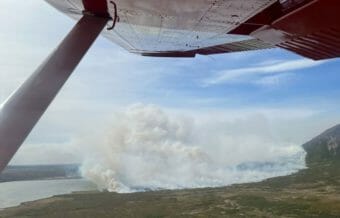
An aerial view of a large wildfire from the cockpit of a red airplane
An aerial view of the Contact Creek Fire burning 40 miles southeast of King Salmon in a limited management area in Katmai National Park & Preserve. May 30, 2022. (National Park Service photo)

A private pilot reported a wildfire on Sunday night in Katmai National Park and Preserve, according to the National Park Service. The fire is currently smoldering and growing to the southeast, but it hasn’t damaged any infrastructure.

Officials say lightning likely caused the Contact Creek fire, which is burning in an uninhabited area about 40 miles southeast of King Salmon, on Lake Brooks.
Park Service Public Information Officer Caron McKee said residents of King Salmon may see smoke from the fire, which has spread across an estimated 3,439.

The fire is a mile and a half from a remote weather station.

“Crews have actually gone in and finished wrapping that weather station and protective structure wraps to protect it just in case the fire should reach it. That is at this point, the fire has not reached it.”

Crews with the park service and the Division of Forestry are monitoring the fire by air. But they’re not actively controlling it. Each national park has its own fire management plan. In Katmai, fires in areas without a lot of infrastructure are usually left to burn. And the Contact Creek fire is about 20 miles from the nearest Native allotment.

“The unique thing about Alaska is there’s so many areas where a fire might start that it’s just not near any infrastructure, and sometimes the fire can even be beneficial to the ecosystem,” she said. “So in those limited management areas, what they’ll do is monitor the fire and just make sure it’s not encroaching on any infrastructure but not actively suppress it. And then they can always change tactics if needed if the fire conditions were to change.

McKee said that this fire is burning tundra and grass, but that so far, it hasn’t burned that deep into the ground.

“The fire management officers that were observing it in the last couple of days described it as, it’s really only burning about the top three inches or so — the vegetation —so it’s really kind of staying at the surface.”

Hot and dry weather around Alaska has triggered Red Flag warnings and burn bans. In the Bristol Bay area, that weather is expected to continue into this weekend.

A map of Katmai National Park showing the location of the fire
The location of the fire is marked in the southwest portion of the national park. (National Park Service map)

As EPA moves to block mining at the Pebble deposit, mine supporters and opponents look to details

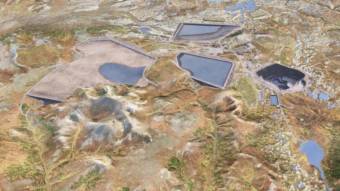
A digital simulation of what the proposed Pebble Mine’s foundation will look like if it receives a federal permit. (U.S. Army Corps of Engineers)

In late May, the U.S. Environmental Protection Agency announced it wants to veto development of the Pebble Mine — a vast deposit of copper and gold at the headwaters of Bristol Bay.

The proposal is a step toward permanently blocking development of the proposed open-pit mine in the Bristol Bay watershed. Mine opponents have pursued a veto for more than a decade.

The EPA said mining the Pebble deposit would result in unacceptable loss of salmon habitat, both at the site and further downstream. Using its authority under the Clean Water Act, the agency proposes to prohibit the discharge of mining materials in waters and wetlands at the Pebble site. That could make it impossible to extract minerals from the deposit.
The executive director of the United Tribes of Bristol Bay, Alannah Hurley, opposes the mine and said the EPA’s move is a step in the right direction.

“Today is a really big day for Bristol Bay — for us to get back on track in this process, and for the Biden administration to be committed to finishing the job to stop Pebble Mine once and for all is very exciting,” she said. “But we’re not there yet. We definitely need to get through the rest of this process.”

She said her organization will closely read EPA’s proposal, which it has released for public review.

The mine would result in the loss of almost 100 miles of stream habitat, 8.5 miles of salmon habitat, and 2,113 acres of wetlands and waters at the mine site, the EPA notes, drawing from the mine plan.

If finalized, the EPA’s decision would ban digging and dumping material in the area delineated in Pebble’s 2020 mine proposal. That could kill the project. The EPA also wants to restrict the use of waters as disposal sites for any future mine proposals that are as big or bigger.

The EPA has used its “veto” power under section 404(c) of the Clean Water Act just 13 times in the law’s 50-year history. It allows the agency to nix projects that would significantly damage habitat or recreational areas.

Hurley said she hopes the EPA’s proposal will ban the mine forever, but she’s been here before. The Obama administration proposed vetoing the mine, too. That was in 2014 — three years before Pebble submitted its proposal.

“As many remember, those got held up in court,” Hurley said. “And when the federal administration changed [with the election of Donald Trump], they eventually were withdrawn.”

Meanwhile, the U.S. Army Corps of Engineers denied Pebble a federal permit in 2020. The company that wants to build the mine, Pebble Limited Partnership, has appealed that decision.

Pebble, for its part, called the EPA’s proposal a step backward not just for the mine, but for President Biden’s climate goals. Minerals like copper are used to make batteries and in other renewable energy technologies. Pebble said the administration shouldn’t hinder domestic production.

Pebble Spokesperson Mike Heatwole said the company will give the EPA proposal a close look to see which areas it’s placing restrictions on.

“Reading between the lines on the EPA action here — that’s upwards of 400 square miles of state of Alaska land that the federal government is proposing taking off the table,” Heatwole said. “There’s just a lot of details within what the EPA is proposing that really needs to be scrutinized to know how it’s all going to work.”

Heatwole said the company will examine how the EPA incorporates the U.S. Army Corps of Engineers’ environmental findings.

“Which are very clear in terms of both the fishery not being impacted and on the water resources as well,” he said.

The company has consistently maintained that the mine would bring jobs and wealth to the region without significant harm to Bristol Bay’s fishery.

The scope of the EPA’s proposal only extends to the discharge of materials associated with the Pebble deposit. While Pebble is the largest mining claim in the region, it’s not the only one.

Hurley, with the United Tribes of Bristol Bay, said Tribes and mining opponents in the region and around the country want broader protections of the area.

“How do we make sure that our future generations aren’t fighting these types of proposals 20 years from now?” she said. “That includes finalizing this EPA process to protect what we hope will be the entirety of the headwaters of our region up near the Pebble mining site.”

Public hearings on the EPA’s proposal will take place in June. The EPA will also accept written comments until July 5.

Firefighters contain wildfire in Bristol Bay walrus sanctuary

A firefighter looking out of the side of an airplane at smoke on an island
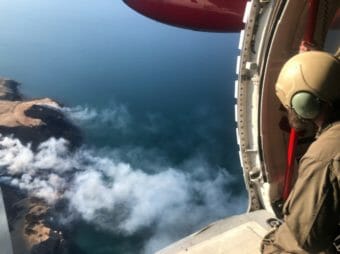
Jared Weber, a smokejumper spotter, watches the Walrus Islands fire on Tuesday evening, May 17, 2022. (Kevin Pabinquit/BLM Alaska Fire Service)

Firefighters on Wednesday contained a fire on Round Island that was caused by a staff burn barrel near Fish and Game’s campsite, officials said. The ground was damp, but sparks escaped and spread through dry grass to cover about 40 acres of the roughly 720-care island.

“It ignited dead grass that had been recently exposed after snowmelt, and the fire quickly took off from there and spread through the grass,” said Fish and Game’s lands and refuges manager Adam Dubour.

No one lives on the island year-round. But it’s an important site for subsistence hunts, which take place in the spring and fall. A limited number of people can also get permits to visit. Plus, the Alaska Department of Fish and Game staffs a camp on the island during the summer to conduct research and monitor walruses and other wildlife. The fire started near that camp.

Dubour said staff thought it was safe to use the burn barrel because the ground was damp, but they didn’t take into account how dry the grass was.

“We’re still doing a debriefing and assessment of the situation to try to learn from it,” he said.

Staff first reported the fire to the Alaska Division of Forestry late Tuesday afternoon. It got close to four buildings, but did not cause major damage, and no one was injured.

Sam Harrel, an information officer with the Alaska Division of Forestry, said the division sent an air tanker and six smoke jumpers from Fairbanks to the island.

“The tanker dropped water and the smokejumpers deployed,” he said. “I think we got six smokejumpers on that fire. They worked last night to stop the forward progression of that fire.”

In videos taken from an airplane responding to the fire, smoke streamed steadily from the eastern edge of the island.

Harrel said the vegetation and steep terrain were a challenge for firefighters. The crew worked Tuesday evening to contain most of the fire and mopped up hotspots on Wednesday. Harrel said they will continue to monitor the fire, but that it’s no longer a threat.

The island is one of four major haul out sites for Pacific walruses in Alaska. Each summer, thousands of males haul out on its beaches. Walruses are particularly sensitive to air traffic, and Dubour said Wednesday evening that they were likely disturbed by the smoke and aircraft that responded to the fire, but that wildlife hadn’t been harmed directly.

Site notifications
Update notification options
Subscribe to notifications