
KDLG - Dillingham

KDLG is our partner station in Dillingham. KTOO collaborates with partners across the state to cover important news and to share stories with our audiences.

New assistant district attorney taking the reins at Dillingham office

New Dillingham Assistant District Attorney Dan Doty is taking over the caseload from Pamela Dale, and he and his wife plan to make the move to town next month. (Photo by KDLG)

Dillingham’s new assistant district attorney is in town this week as part of a transition to take over the caseload.

His arrival comes after a two-year fight to keep the local DA’s office open and staffed with a prosecutor in town.

Dan Doty sat behind his desk at the Dillingham district attorney’s office Monday afternoon. In between a few court hearings and familiarizing himself with the caseload he’s taking over, Doty has been making rounds to introduce himself to town.

“You’ve got a very dedicated police force at DPD, you’ve got a lot of very competent troopers at the AST post here. I met with Mayor (Alice) Ruby, and she was very welcoming and enthusiastic about having me here,” he said. “I’m looking forward to serving this community and living in it at the same time.”

A 2013 William & Mary Law School grad, Doty started his career in the Bethel district attorney’s office, which has a considerably larger staff and larger caseload than Dillingham. He was there for two years before moving to Anchorage to work for a private law firm.

“I did that for a year, then worked at the municipal prosecutor’s office in Anchorage for a little while before the state reached out to me,” he said. “They told me they’d like someone with rural experience running the office out here in Dillingham,” a job he was eager to sign on for.

Doty is taking over the caseload from Pamela Dale, who has been assigned to the Dillingham court since the beginning of 2016. At that time it wasn’t clear the Dillingham DA’s office would stay open, and after one of the two ADA’s was laid off and the other quit, Dale was hired to take the cases but work from Anchorage. In an interview with KDLG in February 2016, she pointed out that would not necessarily be a bad setup.

“I understand that the community would like their DA in the community, but I can also tell you that I do not believe that Dillingham is being sold short having the Anchorage district attorney’s office handling this jurisdiction,” she said.

Dale highlighted the ability to take felony charges before an Anchorage grand jury for indictment sooner, avoiding a complicated delay scheme that often results in temporarily reduced charges and lower bail.

Another plus was having senior attorneys available for help and advice.

Dale proved to be a feisty and dedicated prosecutor who kept her eye on the ball even as she lived in and worked primarily from Anchorage.

“I live downtown, every single morning, first thing, I go into the office and see if there are any in-custody arraignments … you’re covered seven days a week,” she said. “My entire job is the Dillingham calendar.”

Still, law enforcement and the community had grown accustomed to having their prosecutor in town. After the position was cut from the budget, many spoke up vigorously to get it back.

“The overriding message was there’s just simply no substitute for having local presence in the community,” said Rep. Bryce Edgmon in January, referring to the input he and Sen. Lyman Hoffman had received.

The Walker administration announced late in 2015 that the Dillingham office would be closed, cutting the remaining one attorney and one paralegal positions to save an estimated $340,000 annually. Hoffman and Edgmon fought to keep it open.

“I certainly had my doubts as to whether we would get it in the budget, number one, and number two whether we could actually get it staffed in Dillingham,” Edgmon said.

The Department of Law announced in January that it found its attorney to send to Dillingham, and would keep the office open with Doty and one paralegal. The office itself will move from the Bristol Inn downtown to a converted rental home closer to the new courthouse on Emperor Way.

Dillingham is a busy court with about 400 criminal cases filed annually.

Doty expects to soon take over almost all of the open cases, minus one sexual assault Dale will take to trial again later this year and a homicide being handled by a senior prosecutor from Anchorage.

Naknek cases, which used to be fielded by the Dillingham office when there were two attorneys, will continue to be assigned to various prosecutors in the Anchorage office.

Doty and his wife will make the move to the area next month. He said they are looking to close on a home soon and are planning to start a family here.

Dillingham Spanish and French language students travel to Europe

Café Olé, the Dillingham High School Spanish and French club, explored France and Spain at the end of March, practicing language skills along the way. (Photo courtesy Andria Budbill)

At the end of March, Café Olé, the Dillingham High School Spanish and French club, took a whirlwind trip through France and Spain.

In 10 days, 13 students and five chaperones traveled through Paris, Versailles, Avignon, Provence, Nimes, Carcasonne, Barcelona and Madrid.
This was the first trip outside of Alaska for high school senior Dorothy Bavilla. Before she left, she was most looking forward to seeing Notre Dame.

When they toured the cathedral, organ music and a voice singing vespers cut through the hum of tourists and camera clicks.

“It was mind blowing,” Bavilla said. “I was getting lost in there literally and mentally.”

For Liam Wright, another Dillingham senior, an excursion to the top of the Eiffel tower was the highlight.

“It was late at night, totally dark. It was raining really hard,” Wright said. “You think you feel it start to lean every time you take a step. It’s really nerve-wracking, but it’s really still a beautiful view even through the mist and the rain.”

French teacher Mariah Smith and Spanish teacher Andria Budbill have been planning this trip for more than a year.

“A huge thing I was so impressed with is the language they got to experience,” Smith said. “What are they going to do in the future? Well hopefully travel, and then they learned all the language behind that.”

For 12 of the 13 students this trip was their first trip outside of the United States. Learning to navigate cities as large as Paris and Barcelona was one of the biggest hurdles, Smith said.

“It’s just city life is different, so getting on metros and trying to push through crowds versus trying to be polite,” she said. “You kind of have to be a little forceful, and I think that was the hardest part.”

Bavilla grins as she tells about one particular metro ride.

“In Paris, I chose the wrong day to wear slippers,” she said. “I didn’t know we were going on the metro. It’s pretty rushed. Either you go or you don’t. I got shoved. It was pretty crazy, and then I lost the right side of my slipper.”

Experiences like that one helped Bavilla overcome her pre-trip anxieties about travel.

“The sights and the excitement of going to a specific place like Paris and then passing through France to go to Spain, soothes down the worries and it really helped me in a bunch of ways,” she said.

Wright has lived in Dillingham his entire life.

He’s grown up fishing the world’s largest sockeye fishery and exploring Bristol Bay’s rivers, mountains, and tundra.

For him this trip shifted his perception, not just of countries across the ocean, but also of his hometown.

“I’m still realizing how much it’s opened up my mind. I’m realizing more and more how small Dillingham is,” Wright said. “There are a lot more people than I usually visualize when I think of the world population. It does make me kind of glad to be from here that I have that perspective that I can compare going someplace crazy like Paris or Barcelona to.”

The group returned April 2, and the students say that they are still getting caught up on schoolwork and sleep.

But there’s no question the time spent raising the money for the trip and working on their French and Spanish was worth it for the sights, the sounds and the chocolate and churros.

New stipulations, shorter time period, for Pebble’s state land use permit

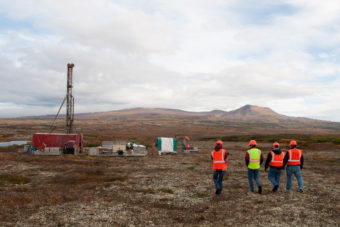
Members of the media walking to an exploratory drill rig. Photo by Jason Sear, KDLG – Dillingham
Members of the media walking to an exploratory drill rig at the Pebble Mine Exploratory site. (File photo by Jason Sear/ KDLG)

After months of delay, the Pebble Limited Partnership was granted Tuesday its land use permit by the state’s Department of Natural Resources.

But taking into account the concerns raised through a public comment period, DNR is adding more oversight to Pebble’s activities and adding some new stipulations to the permit.

Alaska’s Department of Natural Resources grants the miscellaneous land use permit needed by companies like Pebble to operate on state lands. This one was different than the rest of the thousands processed annually.

“It’s a very unique process,” commissioner Andy Mack said Tuesday. “A lot of what of we have done is new, including the requirement that a permit application like the one that we saw from Pebble would be subject to a public comment period.”

That followed a lawsuit challenge brought by Nunamta Aulukestai, which made its way to the Alaska Supreme Court. The result was an opportunity for the public to weigh in on Pebble’s state land use permit requests.

Last fall DNR took in more than 2,000 comments on this application, and Mack said staff took them very seriously.

“Many of them were substantive, many of them were Alaskan, and many of them were from the Bristol Bay region,” Mack said.

Many also alleged Pebble left a mess at some past exploratory drill sites and that state regulators have not been stringent enough.

DNR does not necessarily agree with that assessment.

“One of the central points that was raised as a matter of concern was the status of approximately 80 sites that were reviewed by (Center of Science in Public Participation),” DNR wrote in it’s report. “Upon review of the CSP2 report, in consultation with the Alaska Department of Environmental Conservation, the department was unable to conclude there is clear evidence of permit violation, but agreed these concerns should be reviewed on site.”

The state agreed to public requests for more site inspections, and added a $2 million bonding requirement for cleanup in the event Pebble folds. The length of the requested permit also was shortened to one year.

“Miscellaneous Land Use Permits, or MLUPs, can be issued for as little as one year or for as long as five years,” Mack said. “Based on the amount of interest, and based on the need in our minds to be more proactive and get into the field and be looking at some of the concerns being raised, we issued this permit for one year.”

Groups opposed to Pebble say they did not get everything they were hoping for, including a request that the company be required to close any old boreholes no longer in use. But they did cheer the administration for the other changes the state put in place.

“This is really the state holding Pebble to a tighter standard, which they should,” said Kim Williams, the executive director of Nunamta Aulukestai.

Williams, the United Tribes of Bristol Bay and others have voiced concern about a perceived prior lack of state oversight and “rubber stamping” of permits for the controversial project.

“Our state hasn’t, I believe, held them to a standard of watching them, inspecting them, and making sure that they go back in and close things up,” said Williams. “So it’s good for us.”

For three summers, Pebble has done little but “care and maintenance” of their mining claims. Of the more than 1,300 old boreholes, 80 were identified as problematic by the independent inspection paid for by the United Tribes of Bristol Bay.

Pebble also disagrees with the findings of that report, which were a primary theme of the public comments.

“Many of the issues that were raised in the public comment window we take great exception to primarily because the technical foundation for it was not very strong,” Pebble spokesman Mike Heatwole said Tuesday. “We firmly believe that we’re in compliance with the terms and conditions for the permit to operate out there. Our work is sound, we take our responsibility very seriously and will continue to do so.”

Heatwole said the company has already put up the $2 million performance guaranty now required by DNR and would welcome the added state inspections.

“We’re looking forward to getting our summer work program on track, and we’re committed to continuing to run a compliant operation,” he said. “More than anything it’s good to have a permit in hand and ready to move forward.”

The permit issued Tuesday by the state does not authorize any new exploration at the Pebble claims, nor has the company yet requested that.

However, in a news release issued Tuesday, CEO Tom Collier confirmed “Pebble will be advancing a program of work in Alaska in 2017 to prepare the project to initiate permitting under the Clean Water Act and National Environmental Policy Act.”

Bristol Bay bears coming out of hibernation

It’s that time of year. The bears around Bristol Bay are waking up, according to Neil Barten, the area wildlife management biologist for Fish and Game in Dillingham.

“We’ve been flying around a lot the last two or three weeks,” he said. “We’ve seen a handful of bears, so they’re starting to come out.”

In the last week, Barten has seen a few far up the Mulchatna and Nushagak rivers. With bear activity increasing, he says that it’s time to clear the yard of anything that could be an invitation for a hungry animal.

“This is the time of the year that I always encourage people to get rid of their bird feeders,” Barten said. “Anything like that with fat in it they really go after, whether it’s old fish or that kind of thing.”

For bear hunters, Barten said it’s the early edge of the hunting season.

In a week or so, however, hunters’ opportunities will increase as more bears come out of hibernation.

Levelock man serves 9 months for sexual abuse of teenage relative

A Levelock man will likely be released from jail soon after being sentenced in the sexual abuse of a 14-year-old girl after a March 1 hearing.

Judge Gregory Miller sentenced Eric Tallekpalek, 22, to 48 months in jail with 39 suspended, plus five years of probation, in the alleged abuse in the village last summer.

Tallekpalek also will be required to register as a sex offender for the next 15 years.

The sentence was handed down with the intent that Tallekpalek would be released from custody soon after. He has been in jail since his arrest late last August, accounting for the nine month sentence.

Tallekpalek pleaded guilty to a reduced charge of third-degree sexual abuse of a minor in December.

“I’d just like to say that I’m here to take full accountability,” Tallekpalek said during sentencing. He was reportedly drunk at the time of the crime, and his past criminal behavior has been largely attributed to alcoholism. “I’ve been in alcohol treatment numerous times, I’ve completed it, and not completed it once before, and I believe I can complete it again and better myself for the community and for my family.”

James Klugman prosecuted the case, and said Tallekpalek’s chance to rehabilitate himself was good, but it would take his devoted effort to steer clear of alcohol.

Miller, in handing down a five year period of probation agreed.

“The ball is going to be completely in your court,” Miller said. “You’ve got an awful alcohol history. You’re just 22. All of this has landed you in numerous problems. You can count on it happening more and more and the price of poker going up if you don’t get a handle on it.”

Miller encouraged him to get into alcohol treatment programs.

“If you don’t use them, then, you’ll be back,” Miller said. The question is, ‘are you going to get a handle on this now at age 22, or are you going to wait till 42, or 52, or 72?'”

“might not make it to 72 at that rate,” he said.

While the charge had been pleaded down to the class C felony, the parties agreed to a “most serious aggravator” that allowed for the longer sentence.

The victim chose not to participate in the hearing.

The same victim was allegedly abused by another man earlier in 2016, also in Levelock, a case which has not yet been resolved.

Long winter is making for cranky moose, Fish and Game warns

(Photo by KDLG)
(Photo by KDLG)

As this winter continues, longer and snowier than those in the recent past, moose are getting cantankerous warns the Alaska Department of Fish and Game in a Monday news release.

Neil Barten, Fish and Game wildlife biologist in Dillingham, said that no aggressive moose have been reported in the area, but that potential is there, so it’s important not to pester them.

“This winter’s been getting kind of long, and in places where the snow has piled up, the moose are kind of having to work harder to get food,” Barten said. “They’re burning up their energy reserves that they have to hopefully make it through the winter with, so as some people have kind of noted, they can get kind of ornery around this time of year because they are already stressed out.”

Come late spring, Barten said people should be especially mindful of giving moose appropriate space.

“When we get into late May, when the moose start dropping calves, moose are very good mothers,” he said. “They’re very defensive, and that’s the time of year that they can be very aggressive toward a dog, a person or whatever that happens to get close to them or their calves.”

Fish and Game says that Alaskans have reported encounters with aggressive moose from Homer to Anchorage, Palmer and beyond in recent weeks.

Site notifications
Update notification options
Subscribe to notifications