KDLG - Dillingham

KDLG is our partner station in Dillingham. KTOO collaborates with partners across the state to cover important news and to share stories with our audiences.
UAF graduate student maps native place names around Iliamna Lake

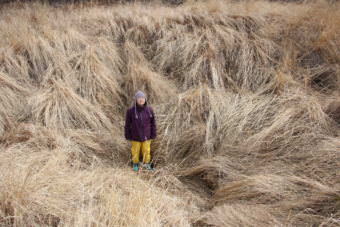
Yuko Kugo stands in a pit house in an abandoned settlement along the Kvichak River. (Photo by Avery Lill/KDLG)

A creek runs into the river at the base of a bluff along the Kvichak. At the top of the hill, grass covered pits mark the foundations of old buildings, evidence of an abandoned settlement. It likely has a Yup’ik name.

Yoko Kugo, a doctoral candidate in anthropology at the University of Alaska Fairbanks, is hoping to find out from elders in the nearby village of Igiugig what it is.

Kugo is in the midst of research for her dissertation, a three-year project to document the Yup’ik names of places around Iliamna Lake.

As she conducts field work at the old settlement, she photographs the creek, house pits, an old cross that would have marked a grave and a metal bell that lies in the dirt.

She will take these photos back to the village. From there, she will interview elders about the area’s history and about what the creek, site, and artifacts are called in their native language.

“I ask them about the place names, also how they used to get there, what time of the year they went there,” she said. “It’s not just the place name. But it’s the story behind the places.”

A cross that marked a grave at an abandoned Kvichak settlement. (Photo by Avery Lill/KDLG)

In Igiugig, Kugo’s work dovetails with the work of Village Council President AlexAnna Salmon. Salmon has dedicated years to recording the history and Yup’ik names of places around the village where she grew up.

“It’s just learning about how the Yup’ik chose to orient themselves and what they chose to name and why,” Salmon said. “There’s a lot of cultural, ecological knowledge that are in those place names as well as, for some people, family history that would be lost without having recorded that.”

To underline the importance of native place names, Salmon points out that they can be key to understanding how the area has changed over time.

“A lot of times the place names were places where they harvested certain resources, like Naruyatuli, an island that was known for all of its seagull eggs. If you went back there today and saw that there were no seagulls that would tell you another story,” Salmon said. “Thousands of years ago there must have been a lot of seagulls here, but today there aren’t any. So what’s happened?”

Kugo’s research will broaden the context for the work already done in Igiugig.

Salmon is excited that Kugo is bringing that energy to other villages around Iliamna Lake.

“Yoko is just expanding what we’ve done to the whole region, which is extremely wonderful because Kokhanok, and Levelock, and Iliamna and Newhalen, they’re our cousin villages,” Salmon said.We’ll have the whole picture rather than just our piece from our elders.”

Since Kugo began the project last summer, she has visited Newhalen, Iliamna, Kokhanok and Igiugig.

In those villages, she has interviewed more than a dozen people.

Kugo has funding from the National Science Foundation to continue for two more years.

When she is finished she plans to create a physical map and an online database of place names and their histories for the communities that she studies.

Wildfire northeast of Dillingham grew to 1,000 acres Sunday, Forestry Division says

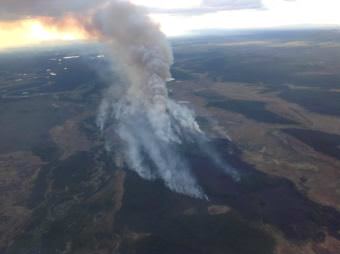
A photo of the 1,000-acre Kenakuchuk Fire taken late Saturday evening. The fire is burning in a limited protection area about 40 miles northeast of Dillingham and is being monitored by the Alaska Division of Forestry. (Photo by Jason Jordet/Alaska Department of Natural Resources/Division of Forestry)
A photo of the 1,000-acre Kenakuchuk Fire taken late Saturday evening. The fire is burning in a limited protection area about 40 miles northeast of Dillingham and is being monitored by the Alaska Division of Forestry. (Photo by Jason Jordet/Alaska Department of Natural Resources/Division of Forestry)

A wildfire near Okstukuk Lake, 40 miles northeast of Dillingham, had grown to 1,000 acres by Sunday night.

After a slow start to the state’s wildlfire season, thunderstorms sparked a dozen or more new blazes over the weekend around Western Alaska.

The Kenakuchuk Creek was first reported to authorities by several pilots Saturday, though the smoke was visible from Dillingham, too.

McGrath-based fire crews responded Saturday afternoon, according to Division of Forestry spokesman Tim Mowry.

“They sent a plane with smoke jumpers to check it out,” he said Sunday. “When they first saw it, it was about 25 acres, and they went to fuel up in Dillingham and came back it had grown to 100 acres.”

The fire is in a limited protection zone, and the nearest cabin is several miles away.

The decision was made to just monitor the fire for now, Mowry said. The total cost of the response to this fire alone was more than $16,000 by Sunday, according to the Alaska Interagency Coordination Center website.

By Saturday night, the fire had grown to 800 acres, and by Sunday a flight over it estimated the size was past 1,000 acres.

“It’s mostly burning in tundra, black spruce and mixed hardwoods, but it’s not too active,” Mowry said.

In comparison to 2015 especially, which saw more than 5 million acres burned in Alaska, this year’s wildfire “season” is starting slow and mild.

“One of the slowest that a lot of people that have been here many years can remember,” Mowry said. “It was a cold April, and kind of a cold, wet May, but in this last week things have warmed up, we haven’t had any precip really around the Interior, and we’re just starting to pick up fire activity now.”

“When we get lightning, typically out in the Southwest area, we see a lot of fires,” Mowry said.

Monday brought cooler, cloudy weather and some drizzle.

Mowry said the McGrath-based crews would likely fly the Kenakuchuk Creek within a few days to see if it had burned itself out, or gotten any worse.

Southwest Alaska village staves off opening new landfill by recycling

Igiugig's recycling center (Photo courtesy of Stacy Hill)
Igiugig’s recycling center (Photo courtesy of Stacy Hill/Indian General Assistance Program)

Rural Alaskan villages are not typically known for their recycling prowess.

For communities off the road system, it can be a hassle not only to ship products in, but also to deal with junk when it has served its purpose.

However, recycling is a priority for the village of Igiugig.
“Currently we recycle aluminum cans and plastics,” said Stacy Hill, Indian General Assistance Program coordinator and environmental director for the village. “We crush our glass, and we put it in our roads as a foundation. Any household waste as far as moist stuff, food, we compost it for the greenhouse. We have chickens that eat scraps.”

The funding that animates Igiugig’s recycling program comes from a variety of sources.

The village has been flying out cans with funding from Alaskans for Litter Prevention and Recycling since the non-profit started in the 1982.

It helped the organization pilot a program for flying out plastics in 2010.

Now Igiugig is the non-profit’s most recent recipient of the Outstanding Recycling Community award.

Last year the Lake and Peninsula Borough provided the village $45,000 in matched funds to back haul 55,000 pounds of scrap metal.

Hill estimates that the village still has 15,000 pounds of scrap metal remaining.

When area lodges bring guests in this summer, the village hopes to send out more of that metal on empty backhaul flights.

IGAP is another major source of funding for the village’s recycling program.

“That funds our landfill. That funds our interns. We have about five or six high school kids that work for IGAP during the year,” Hill said. “After school they help with the recycling and separating all this material,”

For this village of roughly 70 people, recycling is about more than being environmentally conscious. It’s also integral to keeping city costs down.

“It would really fill up our landfill if we were to bury all that material,” Hill said. “It’s about $3 million to $5 million to produce another landfill of our size, and nobody has $3 million to $5 million to replace what we’ve got now. So we might as well cherish what we have.”

Next on the agenda, Igiugig is turning its attention to the oil-based paints that they have stored in their hangar. This year they are applying for a hazardous waste grant that will allow them to dispose of the paint safely.

Dillingham beekeepers set up hives, aiming to maintain them year-round

Pamela Murphy dons her bee suit. In February, Fairbanks beekeeper Dawn Cogan taught a weekend crash course in Dillingham. Afterward, four students, including Murphy made a god of it and ordered their own bees. (Photo by Avery Lill/KDLG)

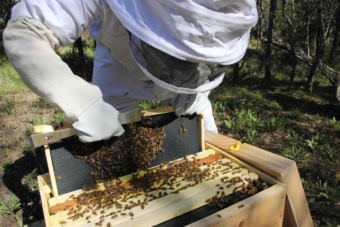
Pamela Murphy dons a classic, white bee suit, making sure all the zippers are zipped, the Velcro is fastened and the elastic cuffs are pulled down well over her Xtratuf rain boots.

Then she slides on her calf skin gloves.

She has had her bees for about two weeks, and she has not yet been stung.

Her bee box sits in a sunny clearing.

Several bees meander toward a small opening in the wooden crate that is about the size of a microwave.

The pollen baskets on their hind legs are swollen and bright yellow.

Murphy opens the lid to reveal the nine trays that fill the box.

She lifts one up. It is teaming with bees that are beginning to build a honeycomb.

Pamela Murphy slides up one of nine trays that fills a wooden crate to show bees in the early stages of building a honeycomb. (Photo by Avery Lill/KDLG)

“The bees are mostly working on creating the wax comb to have all the space to store honey,” Murphy said. “Ultimately, come late August, early September, we’ll take the frames out of the honey supers and try to extract what honey we have. Then the ultimate goal is to then take these bees, insulate the hive and try to winter them over.”

That’s an unusual goal for beekeepers in Alaska, a state without native honey bees.

The bees need temperatures above 50 degrees to fly, and they need to fly to defecate.

If they don’t, then they will become septic and die.

When temperatures plunge, most Alaskan beekeepers kill their bees and start over with a new colony in the spring.

Bristol Bay temperatures are mild enough relative to the rest of Alaska, however, that Dillingham’s beekeepers might be able to keep theirs alive with the right strategy.

“Bees do go into kind of a hibernation state,” said Murphy, who will insulate the brood box where the bees will spend the winter.

Then she anticipates setting up a greenhouse over the brood box to allow the bees to fly a time or two during the cold months.

This project began with a February class at the University of Alaska Fairbanks Bristol Bay campus.

Dawn Cogan, a beekeeper from Fairbanks, taught a weekend crash course in Dillingham.

Afterward, four students, including Murphy, made a go of it and ordered their own bees.

They found that even getting bees to rural Alaska can be a chore.

Some bees got loose in the cargo hold when the first vendor tried to ship Murphy’s bees. The airline declined to carry the vendor’s goods after that.

The second supplier was more successful at keeping the critters contained. Murphy’s roughly 20,000 Carniolan bees arrived from California a couple weeks ago.

Her hive serves a dual purpose: It is both a hobby and a research experiment that she is conducting in partnership with UAF.

“(I’m) working with the Bristol Bay Campus and working with Dawn Cogan to basically do the research and find out, can we winter bees over?” Murphy said. “What does it take to winter bees over?”

Murphy has about $600 invested in her hive between the bees and the equipment.

It will cost a little more than $200 to order more bees next year, if these don’t survive the winter.

But if the experiment is a success, this will be the first time bees have been successfully wintered over in Dillingham.

The coming months will tell whether the town’s small club of beekeepers can make a hospitable home out of a harsh climate for Dillingham’s new, buzzy residents.

Researchers scout Dillingham area for Aleutian tern nesting sites

Fish and Game wildlife biologist Kelly Nesvacil sets a bow net, aiming to trap an Aleutian tern in Dillingham to try a new strategy for a more accurate count of terns. (Photo by Avery Lill/KDLG)

With the help of some modern trapping and tracking technology and some shoe-leather sleuthing, researchers are aiming to find out how many Aleutian terns there really are in Alaska and where they are making their summer homes.

The hope is that with better data better decisions can be made about how to manage the Aleutian tern and its environment.

Misty rain sprinkles the tundra on a mid-May morning as Kelly Nesvacil pounds stakes into the spongy ground by the Lily Pond near downtown Dillingham.

It’s a reliable haunt for Aleutian terns, which are notoriously hard to track down. She is here because she, like many biologists who study seabirds, wants to know, where have the Aleutian terns gone?
In recent years, the population count at their known nesting grounds in Alaska has declined dramatically.

Biologists are unsure whether the number of these birds is declining or whether they have lost track of the colony sites.

Nesvacil, a wildlife biologist with the Alaska Department of Fish and Game, and her team are in Dillingham to attempt a new strategy for a more accurate tern count.

Even as Nesvacil anchors a bow net, a handful of terns wheel overhead, cackling to each other and swooping low over the pond.

The bow net is a spring trap, an oval ring with a net stretched across. She folds the ring in half so that it forms a crescent. With the press of a button on her remote control, the trap springs back to its oval shape. If one of the seabirds were standing within the net’s circumference, it would be trapped but not harmed.

There are decoys around the traps to make them more visible to the researchers and a Bluetooth speaker singing out tern calls to attract the birds.

Once they catch a tern, they will put a radio tag on its leg and release it. That is standard procedure for nesting terns, but the team is trying something new for this species.

They are tagging the terns before they nest.

“The hope is if we catch them before they nest then we might be able to find new colony sites or places we didn’t know about, and that can help us kind of put into perspective other colony counts as well,” Nesvacil said.

Aleutian terns only nest in Alaska and Russia, and a steep decline in the number of nesting birds counted in the state has made it a high priority species for Fish and Game when it comes to research and stewardship.

Nesvacil estimates that there are about 30,000 Aleutian terns globally.

Also on the ground with Nesvacil is Oregon State University assistant professor Don Lyons, who has been studying terns for about 20 years.

Lyons estimates that the Aleutian tern count in Alaska is down about 90 percent from the 1970s and 1980s.

If it is true that terns are declining, a number of factors could be contributing. Lyons says that because the bird count is down across the state the cause is likely to be widespread, not localized.

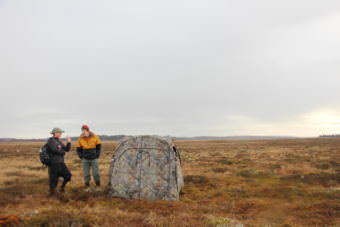
Fish and Game wildlife biologist Nelly Nesvacil and Oregon State University assistant professor Don Lyons stand beside the camouflage tent from which they will spend the morning watching the traps they have set. (Photo by Avery Lill/KDLG)


“That might suggest factors like climate and just the way climate cycles or with the warming climate,” he said. “When they migrate in the fall and winter. They migrate through the Russian Far East, Japan, China and into Indonesia for the winter. And that could be being exposed to a lot of contaminants. There’s a lot of industrial development.”

But if the Aleutian terns are running into trouble in places where they spend the winter, researchers would expect to see declines at nesting sites in Russia as well.

But that isn’t the case, Lyons said. Experts in Russia report their tern populations are stable.

“We’re trying to do some detective work to find out if their declines at known colonies is real or whether they’re just moving around,” Lyons said. “We’re hoping that if we get some birds tagged that they’ll wander around and kind of show us the neighborhood and hopefully show us some new colonies that we don’t know about.”

To maximize their week in Dillingham, the team scouted the area by plane, flew up the Wood River to Sheep Island, looked for birds at Snake Lake, and visited a former nesting ground on Grassy Island.

The team spent the majority of their time at the Lily Pond.

Team members set up a camouflage tent near the water, where they watched their bow nets through a spotting scope. They have seven radio tags that they hope to attach to birds in western Alaska this summer.

This trip to Dillingham was early days in what promises to be a long project for researchers. Nesvacil anticipates that it will be a couple of years before they begin drawing conclusions from the research.

As with most questions of ecology, the answer to what is happening with Aleutian terns could have ramifications up and down the food chain.

“They’re definitely kind of a canary in a coal mine species for the coastal environment and what changes may be going on there that might impact us,” Lyons said.


Cape Greig walrus are back; Fish and Game plans change fishery boundary again

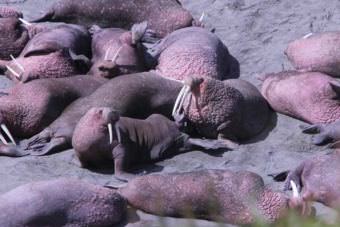
A few of the couple thousand walrus hauled out at Cape Grieg north of Ugashik Bay in June 2016. Alaska Department of Fish and Game and U.S. Fish and Wildlife Service say the walrus are back this year, but have not said yet how many. (Photo by KDLG)
A few of the couple thousand walrus hauled out at Cape Grieg north of Ugashik Bay in June 2016. Alaska Department of Fish and Game and U.S. Fish and Wildlife Service say the walrus are back this year, but have not said yet how many. (File photo by KDLG)

Thousands of Pacific walrus unexpectedly showed up last year at Cape Greig north of Ugashik Bay, delighting sightseers but complicating fishing and shipping in the busy fishing district.

When they left in the fall, biologists were not sure if they would be back the following summer or not.

“I’ve gotten word from three different sources that there are some animals there now,” said Alaska Department of Fish and Game’s Paul Salomone, who manages the Egegik and Ugashik commercial fishing districts.

The department will pull the north line of the Ugashik District back away from the haulout site again, Salomone said, the same as last year. The exact coordinates will be published with the first announcement from Fish and Game about June 1.

Pulling the line south and requiring a 1-mile buffer seemed to allow the walrus and the fishing fleet to peacefully co-exist in 2016, which state and federal managers were not sure would be the case.

“I haven’t heard anything official from anybody that there was a problem,” Salomone said of last season. “There might’ve been some issues of people getting too close to them or a few other things, I have rumors of that, but nothing official.”

The Marine Mammal Protection Act prohibits the harassing, hunting, capturing or killing of all marine mammals in U.S. waters, according to the U.S. Fish and Wildlife Service.

At their haulout sites, walrus are sensitive to “noises, sites and smells” that can trigger a deadly stampede.

There are rules for those flying into a haulout site, or hiking near the animals, to prevent that.

Fish and Wildlife Service requires vessels to keep a half-mile offshore when transiting near a haulout beach, and Fish and Game increased that to one nautical mile for the commercial fishing industry.

The walrus at Cape Greig attracted some “flightseers” and beachcombers in 2016, as it quickly became one of the most accessible haulout sites in Bristol Bay.

It may become the sixth main regularly used summer spot, alongside Round and Hagemeister Islands and Capes Peirce, Newenham and Seniavin.

Site notifications
Update notification options
Subscribe to notifications